105th Amendment of Indian Constitution: OBC List Powers Restored
After the Supreme Court read the 102nd Amendment as stripping states of the power to identify backward classes, Parliament passed the 105th Amendment in a fortnight to give that power back. Here is what it does, why it was needed, and what it means for federalism.
The 105th Amendment of the Indian Constitution — the Constitution (One Hundred and Fifth Amendment) Act, 2021 — restored the power of states and Union Territories to prepare and maintain their own lists of socially and educationally backward classes (SEBCs). It inserted Article 342A(3), received the President’s assent on 18 August 2021, and is deemed to have come into force from 15 August 2021. The amendment reversed the Supreme Court’s May 2021 Maratha-reservation reading of the 102nd Amendment, which had been interpreted to hand the power of identifying backward classes exclusively to the Centre.
In the summer of 2021 a single Supreme Court judgment threw the reservation lists of nearly every Indian state into doubt. The court had read a 2018 constitutional amendment to mean that only the Union government could decide which communities counted as backward — that states, which had built their own backward-class lists for decades, no longer had that power. Within three months Parliament reversed it, and it did so with a rare show of unanimity.
That law is the 105th Amendment of Indian Constitution, formally the Constitution (One Hundred and Fifth Amendment) Act, 2021. It is short, technical and easy to skim past in a polity textbook. But it sits on top of three of the biggest fault lines in Indian public life — who is backward, who gets to decide, and how federal that decision should be. For a UPSC aspirant it’s a clean case study in how the executive, the judiciary and Parliament push against each other over social justice. And it’s exactly the kind of recent amendment examiners like to test.
The 102nd Amendment and the Backward Classes Commission
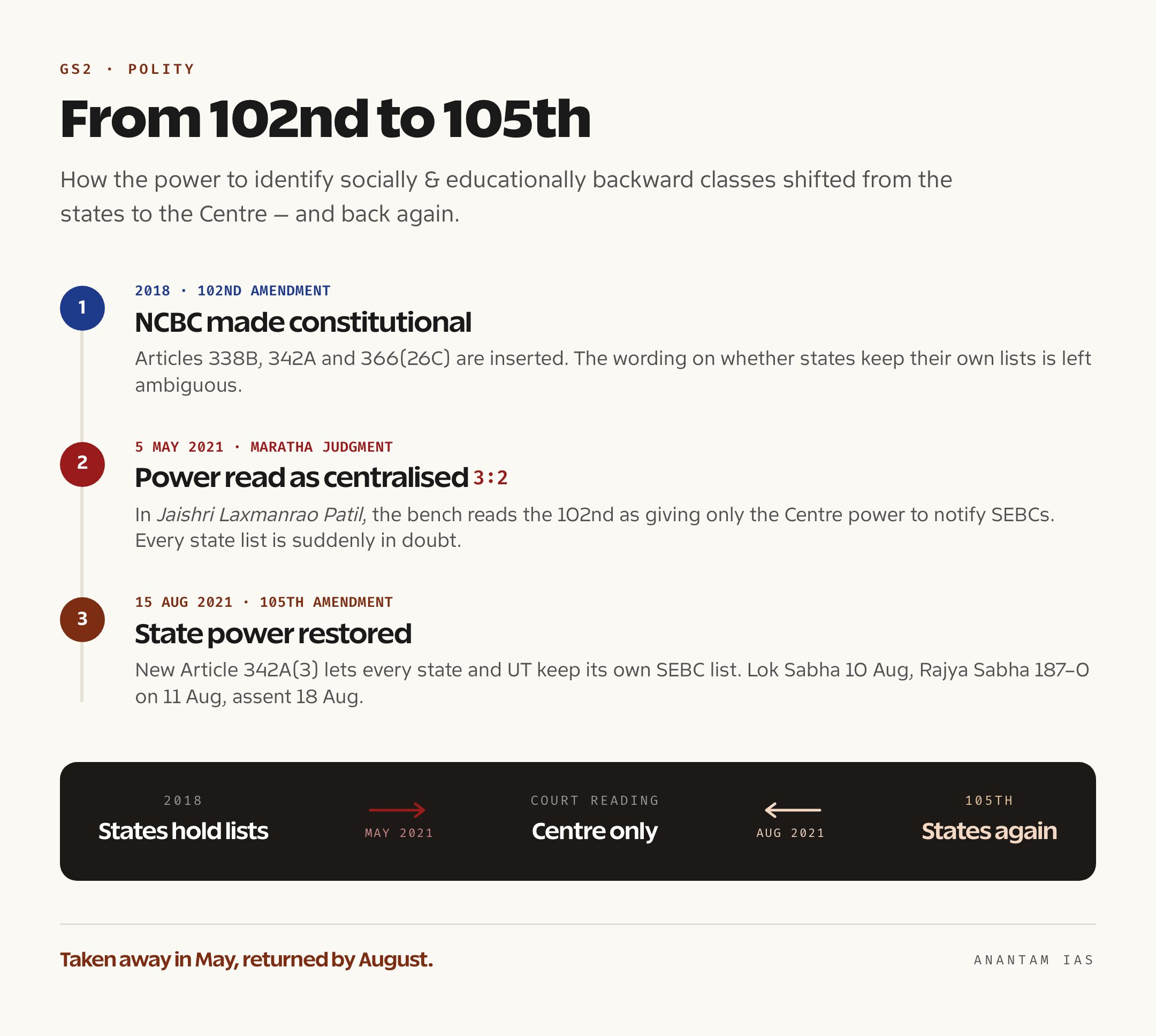
To understand the 105th, you have to start with the 102nd. The Constitution (One Hundred and Second Amendment) Act, 2018 did something the backward-class movement had wanted for years: it gave the National Commission for Backward Classes, the NCBC, full constitutional status. Until then the NCBC was only a statutory body set up under a 1993 law, weaker than the National Commissions for Scheduled Castes and Scheduled Tribes, which already had their own constitutional articles.
The 102nd Amendment fixed that by inserting three new pieces into the Constitution. Article 338B created the NCBC as a constitutional commission, on the same footing as the SC and ST commissions, with the power to investigate complaints and advise government on the welfare of backward classes. Article 342A gave the President the power, in consultation with the Governor, to notify the list of “socially and educationally backward classes” — SEBCs — for each state, and said that once that list was published, only Parliament could add to it or take a community out of it. And Article 366 got a new clause, 26C, which defined SEBCs as the classes deemed backward under Article 342A.
The intention was straightforward — give backward classes a strong constitutional guardian and a clear identification process. But the wording of Article 342A was ambiguous on one crucial point. It spoke of “the” list of SEBCs notified by the President. It did not clearly say whether states could still keep their own separate lists for their own reservations, the way they always had. That silence is where the trouble started.
The Maratha Judgment That Forced Parliament’s Hand
The ambiguity came to a head in the Maratha reservation case. Maharashtra had passed a 2018 law giving the Maratha community a separate reservation in jobs and education, over and above the existing quotas. When that law was challenged, the Supreme Court heard it as Dr Jaishri Laxmanrao Patil v. Chief Minister, and a five-judge Constitution Bench led by Justice Ashok Bhushan delivered its verdict on 5 May 2021.
The bench struck the Maratha quota down unanimously on one ground: it pushed Maharashtra’s total reservation well past the 50% ceiling that the court had fixed back in the Indra Sawhney case of 1992, and the Marathas were not an exceptional case that justified crossing it. But the judgment carried a second, far more disruptive holding. By a 3:2 majority, the court read the 102nd Amendment as having taken the power to identify SEBCs away from the states altogether. After 2018, the majority said, only the President — that is, the Union government — could notify who counted as backward in a state; states could merely recommend names to the Centre.
Think about what that meant in practice. Every state had its own backward-class list, built over decades to fit local caste realities — the Vokkaligas and Lingayats in Karnataka, the Jats and Gujjars elsewhere, hundreds of communities in each state. If only the Centre could now notify those lists, every one of them was suddenly on shaky legal ground, and states had effectively lost a power they had exercised since the Constitution began. The Union government, across party lines, decided this could not stand. It promised a constitutional amendment to put the matter beyond doubt.
What the 105th Amendment Actually Does
The amendment was introduced as the 127th Constitutional Amendment Bill and moved fast. It was brought into the Lok Sabha on 9 August 2021, passed the lower house on 10 August with the full strength of the floor and not a single vote against it, and cleared the Rajya Sabha the next day, 11 August, by 187 votes to none. The President gave assent on 18 August 2021, and the Act is deemed to have come into force from 15 August 2021 — Independence Day. Because it touches the federal balance of power, it also needed ratification by the legislatures of at least half the states under the special procedure in Article 368, which it received.
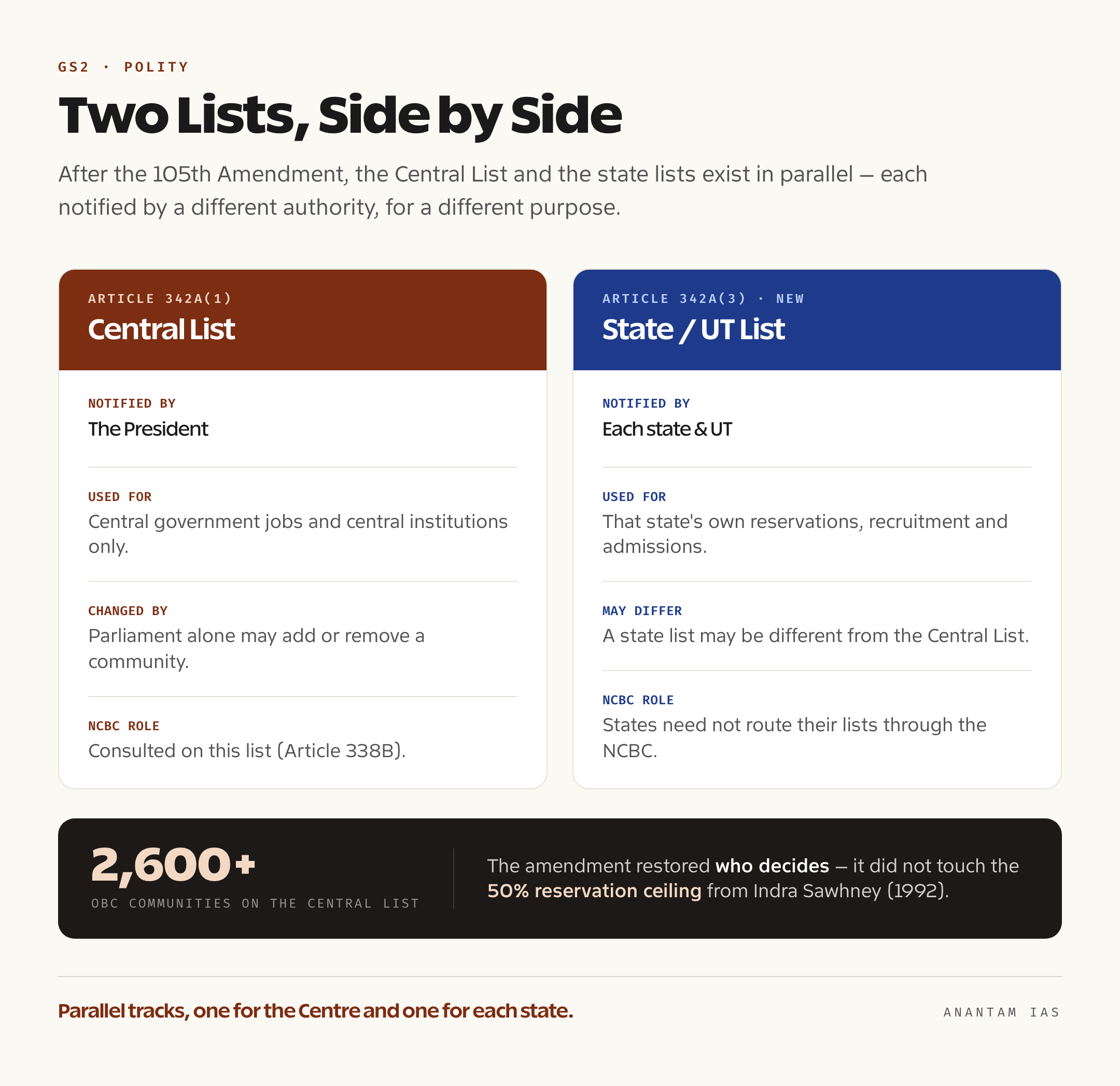
On the substance, the amendment does one thing and does it cleanly: it puts back, in black and white, the states’ power to maintain their own backward-class lists. It rewrites clauses (1) and (2) of Article 342A so that the list the President notifies is explicitly the Central List — meant for the purposes of the Union government alone. Then it adds a brand-new clause, Article 342A(3), which says that every state and Union Territory may “prepare and maintain, for its own purposes, a list of socially and educationally backward classes,” and that this state list may be different from the Central List.
It backs that up with two consequential tweaks. Article 366(26C), the definition clause, is amended so the term SEBC now clearly covers both the centrally notified classes and those on a state list, depending on whose purpose is in question. And Article 338B is adjusted so that the NCBC need only be consulted on the Central List — states do not have to route their own lists through the commission. Put together, the changes restore the pre-2021 position: two parallel tracks, a Central List notified by the President and used for central jobs and central institutions, and separate state lists notified by each state for its own reservations, recruitment and admissions.
Why It Matters for Federalism and OBC Politics
The deepest significance of the 105th Amendment is federal. Identifying who is backward had always been a shared exercise — the Centre kept a list for its own posts, but states, which run the bulk of public employment and education, kept theirs. The 2021 reading of the 102nd Amendment threatened to centralise all of that in one stroke. By restoring the state lists, the 105th Amendment reaffirmed a basic logic of Indian federalism: a state legislature in Bengaluru or Patna usually understands its own caste landscape better than a notification issued from Delhi, and social justice works best when that local knowledge is respected.
So the amendment protected a vast number of existing reservations at one go. The Central List alone covers more than 2,600 OBC communities, and states carry their own lists on top of that — a system serving hundreds of millions of people. Had the May 2021 reading been left standing, much of that scaffolding would have needed re-notification through the Centre, with all the litigation and uncertainty that implies. The 105th Amendment closed that gap and steadied the ground for state-level OBC quotas across the country.
Politically, it landed in territory that no party wanted to be on the wrong side of, which is why the votes were near-unanimous in both houses. Backward-class assertion is one of the strongest currents in Indian electoral life, and the idea that states had “lost” the power to recognise their own OBCs was politically untenable. The amendment let every party claim credit for restoring it. It also quietly kept alive the space for states to experiment with sub-categorising their OBC lists — sorting backward communities into bands so that benefits reach the genuinely under-served — a debate the Justice G. Rohini Commission took up at the central level, submitting its report on OBC sub-categorisation to the President in July 2023.
The Reservation Debates It Did Not Settle
It’s just as important to be clear about what the 105th Amendment did not do, because exam questions often hinge on the limits. It restored a power; it did not expand a quota. The amendment deliberately left untouched the 50% ceiling on total reservations laid down in Indra Sawhney v. Union of India (1992), the nine-judge Mandal verdict that also gave us the creamy-layer rule — the principle that the better-off section within a backward class should be kept out of reservation. Restoring the states’ power to identify SEBCs did nothing to let them breach that 50% cap, which is exactly why the Maratha quota itself was never revived by this amendment.
That ceiling remains the live wire in Indian reservation politics. States from Tamil Nadu to Bihar have pushed total reservations past 50%, and the question of whether and when the cap can be crossed keeps returning to the courts; the Supreme Court has so far declined to disturb it. The other big recent shift came on a different track entirely. In State of Punjab v. Davinder Singh (August 2024), a seven-judge bench held by a 6:1 majority that states may sub-classify Scheduled Castes and Scheduled Tribes to direct benefits toward the most disadvantaged — and signalled that a creamy-layer logic could reach even SC/ST quotas. The 105th Amendment sits inside this larger, unfinished argument: it answered the narrow question of who identifies backward classes, while the harder questions of how much reservation, for whom, and how finely sliced are still being fought out. For an aspirant, that is the honest frame — a precise federal correction, not a settlement of the reservation debate.
For Your Mains Answer
This topic belongs squarely to GS Paper 2, under the Constitution, federal structure, and “mechanisms, laws, institutions and bodies constituted for the protection and betterment of vulnerable sections.” It connects naturally to questions on centre-state relations, the powers of the judiciary to interpret amendments, and the architecture of reservation. Treat the 105th Amendment as a worked example of the executive-judiciary-legislature triangle, not as an isolated fact to memorise.
How to Build the Answer
Open with the trigger, not the definition. Lead with the May 2021 Maratha judgment reading the 102nd Amendment to centralise SEBC identification, then show the 105th Amendment as Parliament’s swift corrective. Move in sequence: the 102nd Amendment and the NCBC, the judicial interpretation, the precise fix in Article 342A(3), and then the wider significance for federalism. Close on the limits — the untouched 50% ceiling — so the answer reads as balanced rather than celebratory.
Common Mistakes to Avoid
Don’t confuse the 102nd and 105th Amendments — one created the NCBC and the ambiguity, the other resolved it. Don’t say the amendment “increased reservation” or “revived the Maratha quota”; it did neither. Don’t drown the answer in dates — the year 2021 and the articles 342A, 366 and 338B are the anchors that matter. And don’t ignore the 50% ceiling, because leaving it out is the single most common way candidates show they’ve half-understood the topic.
A Compact Answer Spine
102nd Amendment (2018) gives NCBC constitutional status via Articles 338B, 342A, 366(26C) → ambiguity over state lists → Maratha judgment (Jaishri Laxmanrao Patil, May 2021, 3:2) reads it as centralising SEBC identification → 105th Amendment (2021) inserts Article 342A(3) restoring state/UT lists → significance: cooperative federalism, protects 2,600-plus OBC communities and state lists → limit: 50% Indra Sawhney ceiling untouched.
Diagram or Flowchart Idea
Draw two parallel boxes after the amendment: “Central List — President, Article 342A(1), for Union purposes” and “State / UT List — Article 342A(3), for state purposes,” with the NCBC linked only to the central box. A second small timeline arrow — 2018 → May 2021 → August 2021 — captures the whole sequence in one glance and is quick to draw.
A Balanced-Conclusion Line
End on the idea that the 105th Amendment was a precise federal correction — restoring who decides — while the larger questions of how much reservation and for whom remain open before the courts and Parliament. That distinction signals maturity.
How to Use Data Without Cramming
Carry three numbers and no more: the 50% ceiling from Indra Sawhney (1992), the 2,600-plus communities on the Central List of OBCs, and the 3:2 split in the Maratha judgment. Drop them where they earn their place — the ceiling in the limits paragraph, the community count in the federalism paragraph — rather than front-loading a statistics dump.
FAQ
What is the 105th Amendment of the Indian Constitution? It is the Constitution (One Hundred and Fifth Amendment) Act, 2021, which restored the power of states and Union Territories to prepare and maintain their own lists of socially and educationally backward classes (SEBCs). It amended Articles 342A, 366 and 338B, received presidential assent on 18 August 2021, and is deemed to have come into force from 15 August 2021.
Why was the 105th Amendment needed? Because of the Supreme Court’s Maratha reservation judgment of May 2021 (Dr Jaishri Laxmanrao Patil v. Chief Minister). The court read the earlier 102nd Amendment as having handed the power to identify SEBCs exclusively to the Centre, which put every state’s backward-class list in legal doubt. Parliament passed the 105th Amendment within weeks to put that state power beyond question.
What is the difference between the 102nd and 105th Amendments? The 102nd Amendment (2018) gave constitutional status to the National Commission for Backward Classes and inserted Articles 338B, 342A and 366(26C), but its wording was read as centralising SEBC identification. The 105th Amendment (2021) added Article 342A(3) to make clear that states and UTs can keep their own SEBC lists, separate from the Central List, for their own purposes.
Did the 105th Amendment change the 50% reservation ceiling? No. The amendment only restored the states’ power to identify backward classes. It left untouched the 50% ceiling on total reservations laid down in Indra Sawhney v. Union of India (1992), which is why it did not by itself revive the Maratha quota that had breached that cap.
Practice Questions
Prelims MCQs
- The Constitution (One Hundred and Fifth Amendment) Act, 2021 primarily restored which power?
(a) The power of states to breach the 50% reservation ceiling
(b) The power of states and UTs to prepare and maintain their own lists of socially and educationally backward classes
(c) The power of the NCBC to notify the Central List unilaterally
(d) The power of the President to dissolve state backward-class commissions
Answer: (b) — The amendment inserted Article 342A(3) to let states and UTs maintain their own SEBC lists for their own purposes. - Which set of constitutional provisions was inserted by the 102nd Amendment, 2018?
(a) Articles 338, 340 and 341
(b) Articles 15(4), 16(4) and 16(4A)
(c) Articles 338B, 342A and 366(26C)
(d) Articles 243 and 244 and 244A
Answer: (c) — The 102nd Amendment created the constitutional NCBC under Article 338B, the SEBC notification power under 342A, and the definition in 366(26C). - The Maratha reservation case, Dr Jaishri Laxmanrao Patil v. Chief Minister (May 2021), held by what margin that the 102nd Amendment had centralised SEBC identification?
(a) Unanimously, 5:0
(b) By a 4:1 majority
(c) By a 3:2 majority
(d) By a 2:1 majority
Answer: (c) — The five-judge bench struck the Maratha quota down unanimously, but split 3:2 on reading the 102nd Amendment as taking the identification power from states. - After the 105th Amendment, the Central List of socially and educationally backward classes is notified by the President under which provision?
(a) Article 342A(3)
(b) Article 342A(1)
(c) Article 338B
(d) Article 366(26C)
Answer: (b) — Clauses (1) and (2) of Article 342A were rewritten so the President-notified list is explicitly the Central List for Union purposes, while state lists fall under 342A(3). - Which ceiling on total reservations, left untouched by the 105th Amendment, was laid down in Indra Sawhney v. Union of India (1992)?
(a) 27%
(b) 33%
(c) 50%
(d) 60%
Answer: (c) — The Mandal verdict fixed the 50% cap on total reservations and introduced the creamy-layer rule, neither of which the 105th Amendment altered.
Mains Practice Questions
- Discuss how the Supreme Court’s reading of the 102nd Constitutional Amendment in the Maratha reservation case necessitated the 105th Amendment, and examine its significance for cooperative federalism. (15 marks, 250 words)
- “The 105th Amendment was a precise federal correction, not a settlement of the reservation debate.” Critically analyse. (15 marks, 250 words)
- Trace the evolution of the National Commission for Backward Classes from a statutory body to a constitutional commission, and assess its present role in identifying socially and educationally backward classes. (10 marks, 150 words)
- Examine the constitutional and political reasons why the 105th Amendment secured near-unanimous support in both Houses of Parliament. (10 marks, 150 words)
- “Identifying who is backward has always been a shared exercise between the Centre and the states.” In light of Articles 342A(1) and 342A(3), discuss the rationale for maintaining parallel Central and State lists of backward classes. (15 marks, 250 words)