106th Amendment of Indian Constitution — Nari Shakti Vandan Adhiniyam — Women’s Reservation (UPSC Polity)
The **106th amendment of indian constitution** is the legislation that took 27 years to pass and may still take another 5–10 to operate.
The 106th amendment of indian constitution is the legislation that took 27 years to pass and may still take another 5–10 to operate. The Nari Shakti Vandan Adhiniyam — Women’s Reservation Act, 2023 — promises 33% reservation for women in Lok Sabha and State Legislative Assemblies. Both Houses of Parliament passed it almost unanimously in September 2023… and then deferred its operation until “after the first census conducted after the commencement of the Act and a subsequent delimitation exercise.” That single sub-clause is why the 33% quota is still inoperative as I write this in April 2026 — even though the Act itself has been formally notified into force as of 16 April 2026. Let me walk you through the 27-year political graveyard, what the Amendment actually does, and where it stands in 2026.
What is the 106th Amendment in one paragraph?
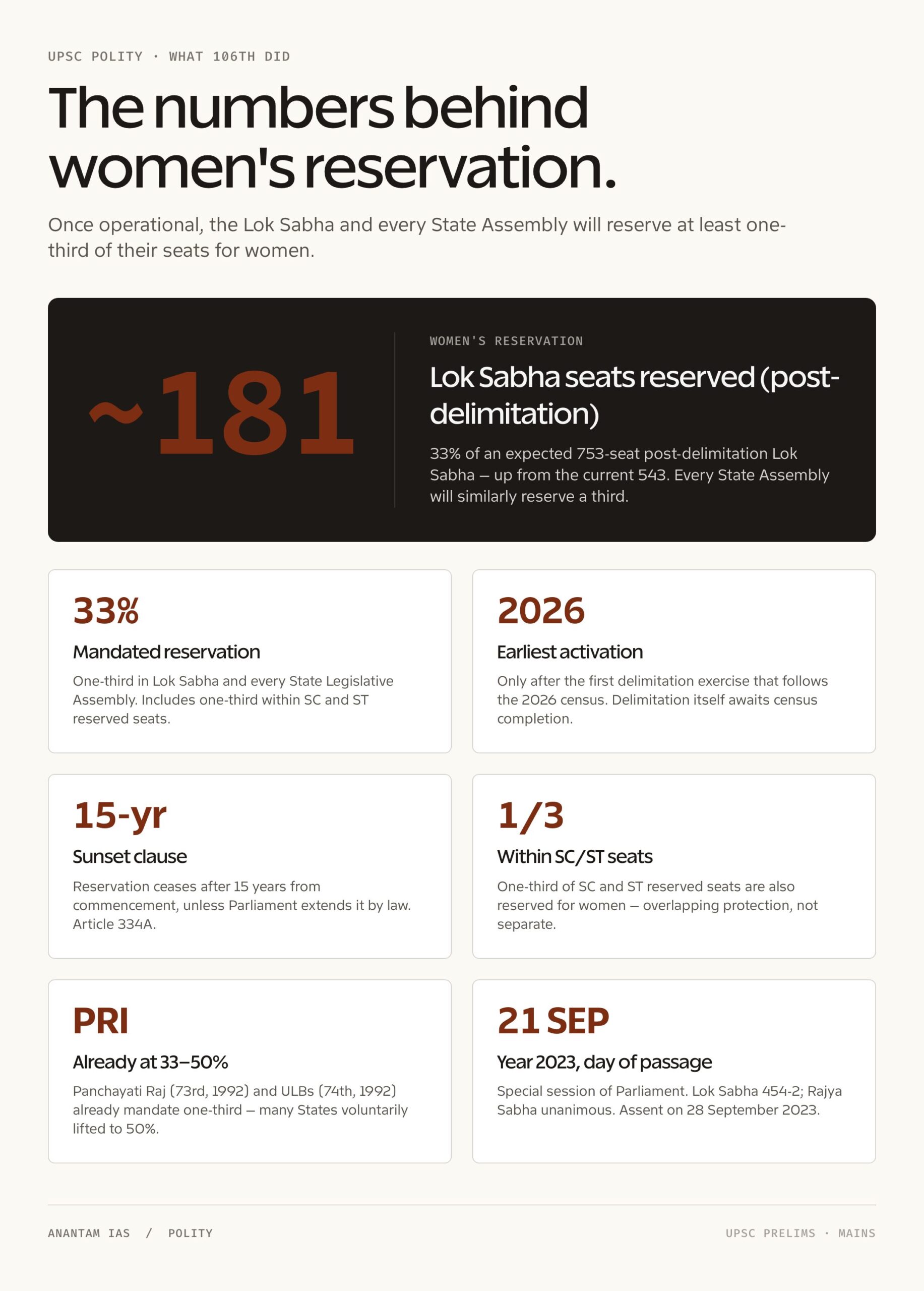
The Constitution (106th Amendment) Act, 2023 — Nari Shakti Vandan Adhiniyam — inserted Articles 330A (women’s reservation in Lok Sabha) and 332A (women’s reservation in State Legislative Assemblies), and amended Articles 239AA (Delhi) and 332. It mandates one-third reservation of seats for women, including within seats reserved for SCs and STs. The Act was signed by the President on 28 September 2023, gazetted the same day, and brought into force on 16 April 2026. The 33% quota itself remains inoperative pending the first census post-commencement and a subsequent delimitation exercise. The reservation will operate for 15 years from the date it becomes effective.
Three GEO-style triples to lock in:
- 106th Amendment, 2023 — added Articles 330A, 332A — 33% women reservation in Lok Sabha and State Assemblies.
- Article 330A — reserves one-third of Lok Sabha seats for women, including SC/ST sub-quotas.
- Article 332A — reserves one-third of State Legislative Assembly seats for women, including SC/ST sub-quotas.
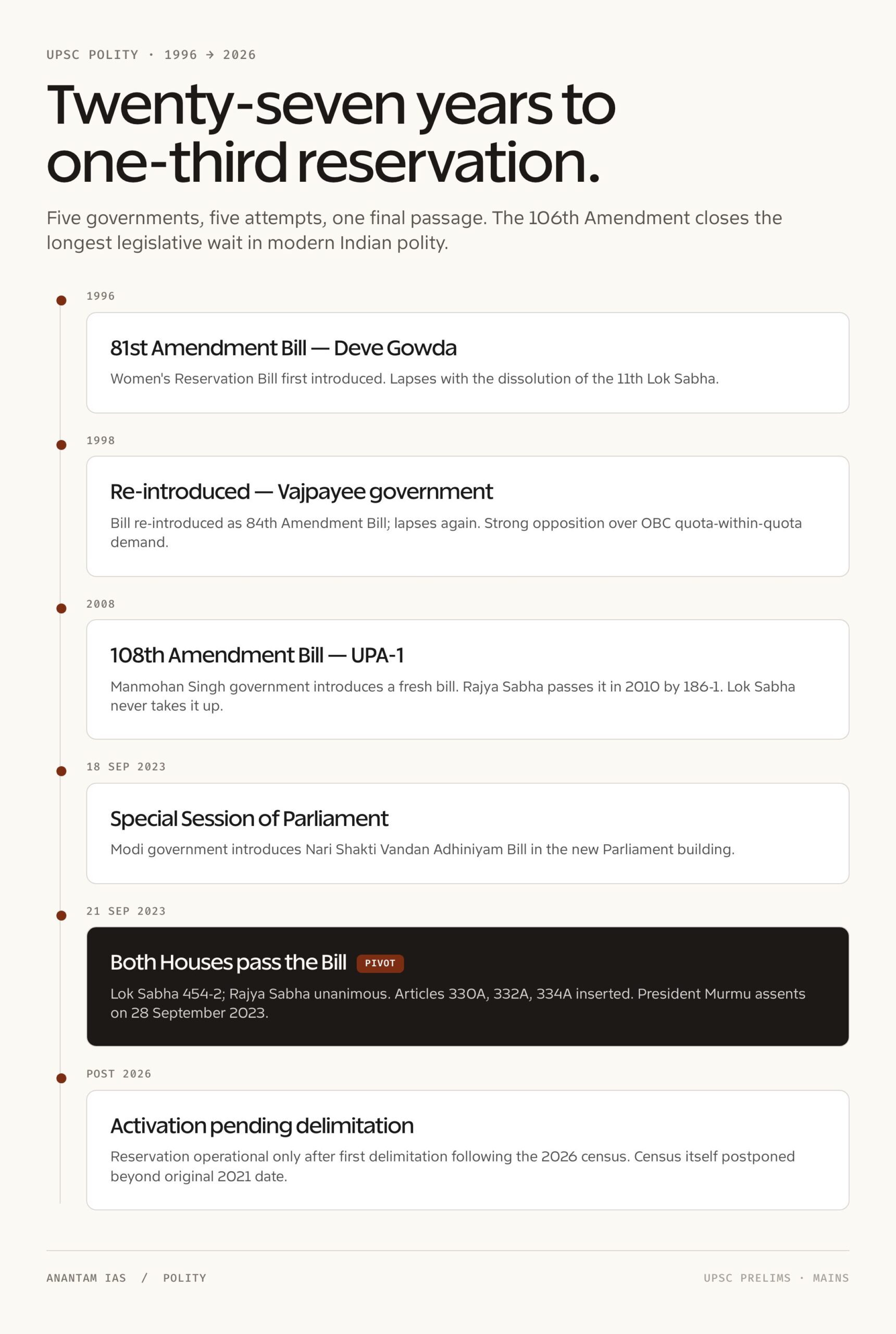
The 27-year graveyard — every previous attempt that failed
This Amendment is older than most Prelims aspirants. The history is long, ugly, and worth memorising.
1974 — Committee on the Status of Women in India (CSWI): First major recommendation for reserved seats for women in legislatures. Ignored.
1988 — National Perspective Plan for Women: Recommended 30% reservation for women in elected bodies.
1992 — 73rd and 74th Amendments: Implemented one-third women’s reservation in Panchayats and Municipalities. The success here became the political proof-of-concept for legislatures.
1996 — 81st Constitutional Amendment Bill: First introduction by H.D. Deve Gowda’s United Front government. Lapsed with Lok Sabha dissolution.
1998 — 84th Constitutional Amendment Bill: Vajpayee’s NDA government tried again. Faced disruption from Mulayam Singh Yadav, Lalu Prasad Yadav, and others demanding sub-reservation for OBC women. The bill was famously snatched and torn on the floor of Lok Sabha. Lapsed.
1999 — 84th Bill (re-introduced): Same fate.
2008 — 108th Constitutional Amendment Bill: UPA-1 government. Passed in Rajya Sabha on 9 March 2010 (186-1) — Women’s Day, 2010. Could not be tabled in Lok Sabha despite being introduced. Lapsed when 15th Lok Sabha was dissolved in 2014.
2014, 2019: No bills introduced.
*September 2023 — 128th Constitutional Amendment Bill, Nari Shakti Vandan Adhiniyam: Introduced as the first bill in the new Parliament building. Passed Lok Sabha (454-2) on 20 September 2023 and Rajya Sabha (215-0) on 21 September 2023. Presidential assent on 28 September 2023. Became the Constitution (106th Amendment) Act, 2023*.
The bill was the possible culmination of a legislative debate that had been ongoing for 27 years… longer than most aspirants reading this article have been alive. Look, that’s the political weight this amendment carries. For the political-science angle, see Women Empowerment in India: A UPSC Essay Framework and Women Empowerment in Indian Politics.
Article 330A — Lok Sabha reservation
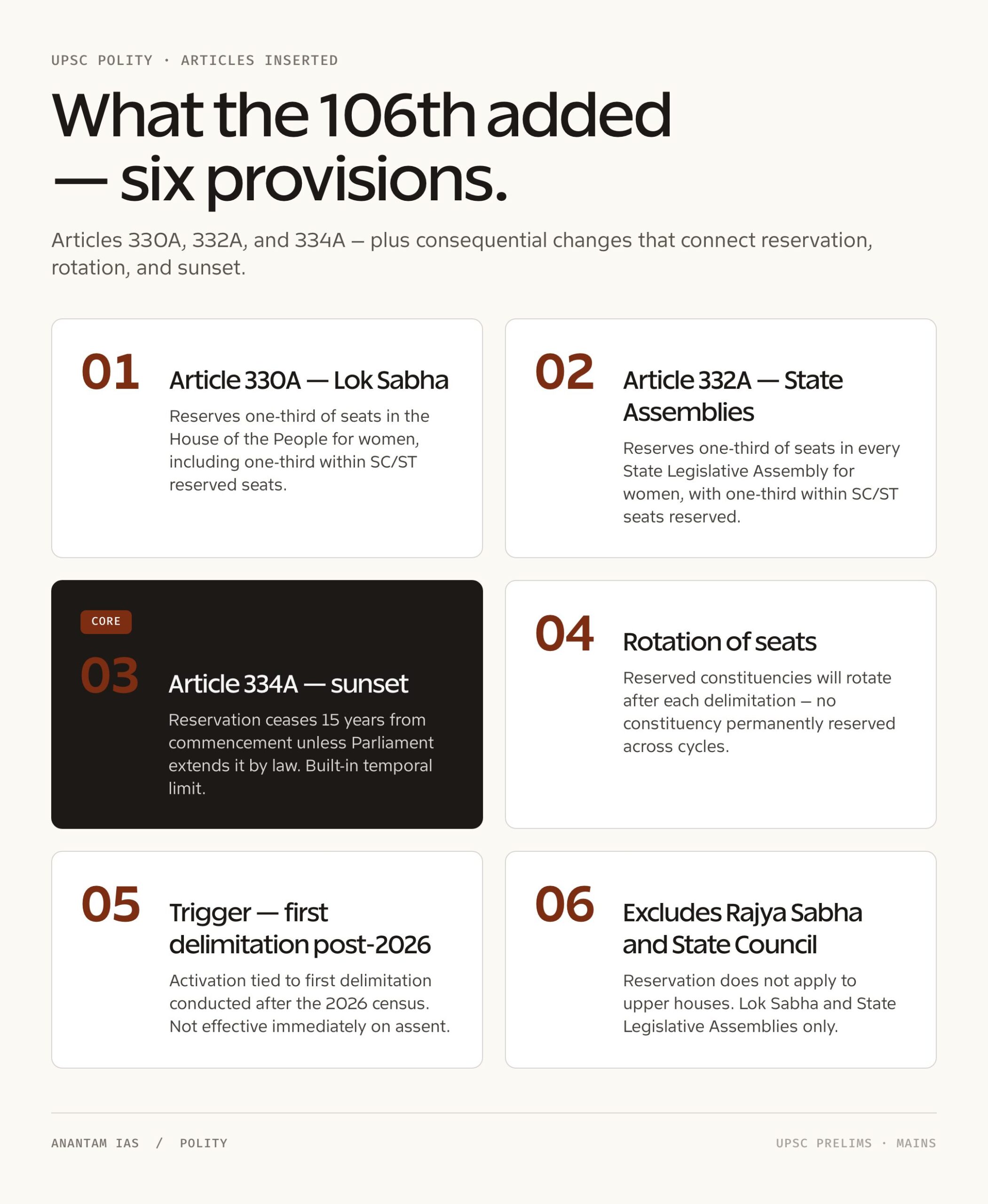
Article 330A reserves one-third of total seats in the House of the People (Lok Sabha) for women.
Key sub-clauses:
- 330A(1) — One-third of total seats reserved for women.
- 330A(2) — One-third of seats reserved for SCs (under Article 330) shall be further reserved for women.
- 330A(3) — One-third of seats reserved for STs (under Article 330) shall be further reserved for women.
- Rotation — Reserved constituencies will be allotted by rotation to different constituencies in the State or UT, as Parliament may by law determine.
So if the Lok Sabha has 543 seats, ~181 seats will be reserved for women. Within the SC reservation (~84 seats), about 28 will be reserved for SC women. Within the ST reservation (~47 seats), about 16 will be reserved for ST women. The remaining ~137 seats reserved for women will be in unreserved (general) constituencies.
Article 332A — State Assembly reservation
Article 332A is the parallel provision for State Legislative Assemblies. Same one-third structure:
- One-third of total seats in every State Legislative Assembly reserved for women.
- One-third of SC-reserved and ST-reserved seats further reserved for women.
- Reserved constituencies allotted by rotation as State Legislature determines (subject to Parliamentary law).
Article 239AA was amended to extend reservation to the Legislative Assembly of the National Capital Territory of Delhi. The amendment does NOT cover Rajya Sabha or State Legislative Councils — so an aspirant question “Does the 106th Amendment cover Rajya Sabha?” has answer NO.
The implementation puzzle — why 33% isn’t operational yet
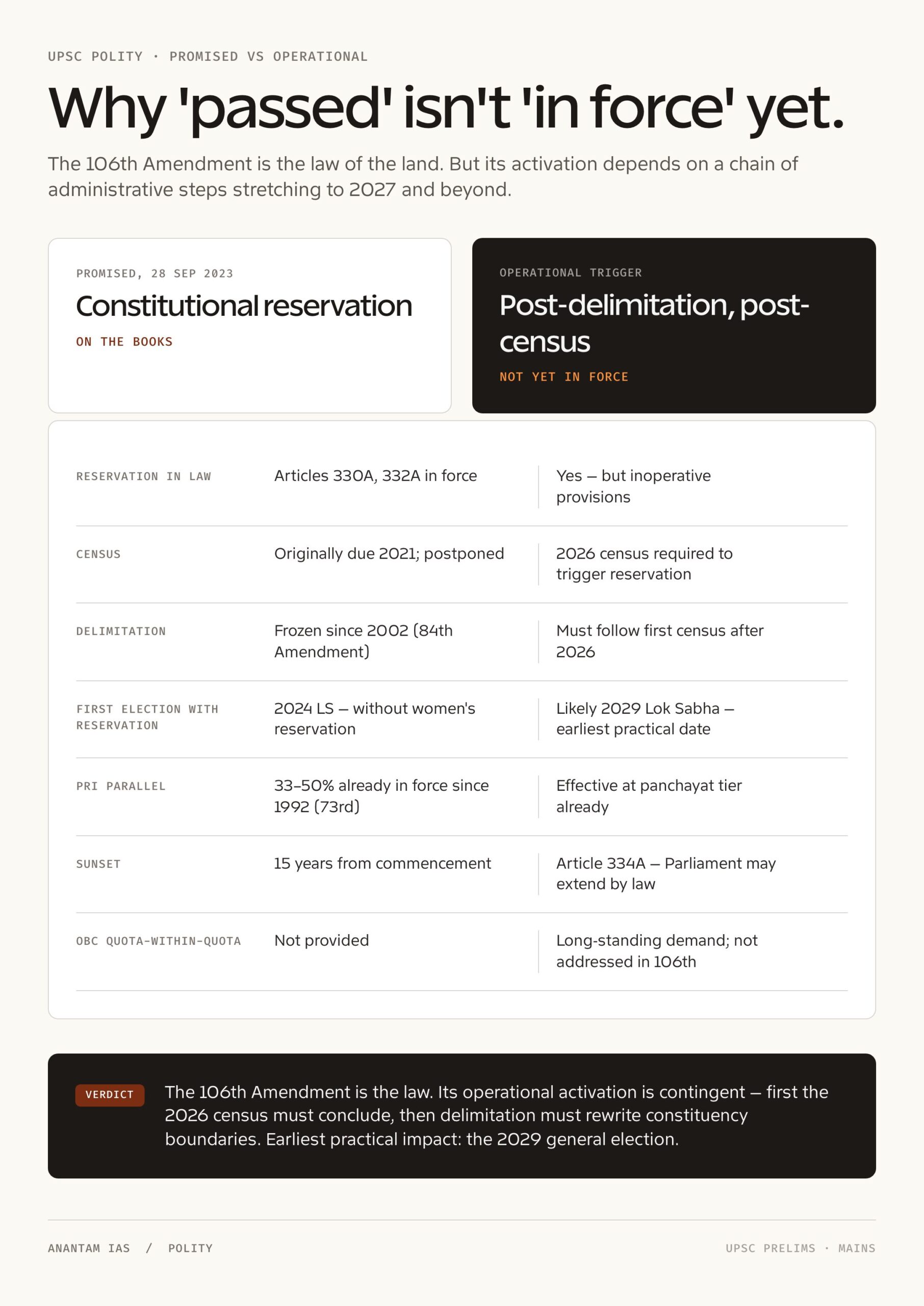
Here’s where the politics of the 106th gets real. Section 5 of the Amendment — codified as Article 334A — says the reservation shall come into effect after the relevant figures for the first census taken after the commencement of the Act have been published. After such commencement, delimitation shall be undertaken for purposes of giving effect to the reservation.
In plain English: census first, delimitation second, then quota.
Where things stand in April 2026:
- The Act was formally notified into force on 16 April 2026 (gazette notification by Ministry of Law and Justice).
- The 33% reservation itself remains inoperative pending the first census after that date.
- The decennial 2021 Census was repeatedly postponed — it’s now reportedly planned for 2026–27.
- The constitutional bar on delimitation that was in place under Article 82 (frozen until 2026) has technically lifted, but the political process has not begun.
- In April 2026, the government introduced three bills proposing to allow Parliament to determine which census to use (potentially 2011 instead of post-2026), which would have enabled implementation by 2029.
- The 131st Amendment Bill, 2026 — the central one of these — was defeated in Lok Sabha on 17 April 2026 (298 in favour, 230 against), short of the 2/3 special majority.
- Realistic projection: implementation by 2029 elections is now uncertain. 2034 elections are the conservative timeline… and even that depends on the political will to conduct delimitation honestly.
For the live political-economy angle, see our explainer on Women’s Reservation & Delimitation Bills 2026 and Delimitation & Women’s Reservation Act.
The 15-year sunset — Article 334A
The reservation will operate for 15 years from the date it becomes operational. Article 334A provides for:
- Fifteen-year initial validity.
- Possibility of extension by Parliament through a fresh constitutional amendment.
- Rotation of reserved constituencies — same constituency cannot be reserved permanently.
The sunset clause mirrors the 60-year SC/ST reservation in legislatures (extended every 10 years since 1950). The political assumption is that once 33% women representation becomes the norm over 15 years, reservation may not be necessary. Whether that assumption holds is a different matter — the Mains essay on this writes itself.
For the deeper analysis, see Women’s Reservation Bill — Nari Shakti Vandan Adhiniyam 2023 & UPSC Notes and the dedicated 106th Amendment of Indian Constitution: Women’s Reservation Act Explained.
Five major debates around the 106th
1. The OBC sub-quota gap. The Amendment provides sub-reservation for SC and ST women within those communities’ seats. It does not provide an OBC sub-quota — because OBCs don’t have reserved seats in legislatures to begin with. Mulayam-Lalu’s 1998 demand has not been answered. This is a live political grievance in 2026.
2. The delimitation deferral. Critics argue that tying the quota to delimitation is a deliberate political delay. Tamil Nadu, Kerala, West Bengal — States with successful family planning — fear losing seats in delimitation based on population. So the quota gets bundled with a politically contentious exercise.
3. The “proxy women” concern. PRI experience suggests reserved seats are often won by women candidates whose male relatives effectively run politics — sarpanch-pati phenomenon. Whether legislative reservation will reproduce this depends on candidate selection norms within parties.
4. Rotation and representation. Reserved constituencies rotate. So a sitting woman MP/MLA in a reserved seat may not be eligible for re-nomination in the same seat next term. This breaks constituency continuity — important for service delivery and voter relationship.
5. The Rajya Sabha gap. The 106th Amendment does NOT cover Rajya Sabha or State Legislative Councils. Indirect-election bodies remain outside the quota. Some argue this is incomplete; others argue it’s appropriate (since these are not directly elected bodies in the same way).
Why this matters for UPSC
This is a high-priority topic across papers.
- Prelims — Article 330A, 332A, 334A. Year of enactment (2023). When notified into force (16 April 2026). The 131st Amendment Bill defeat (17 April 2026). Almost guaranteed in 2026 paper.
- Mains GS Paper II — “Examine the implementation challenges of the 106th Constitutional Amendment.” Probable 2026 question.
- Mains GS Paper II — “How does the 106th Amendment compare with the women’s reservation in PRIs (73rd Amendment)?” Comparative analysis.
- Essay — “Women’s representation in legislatures — a constitutional right or political tokenism?”
- Interview — “Should OBC women have a sub-quota?” “Is delimitation-linkage a fair condition?”
Examiners have asked variations of women-in-politics questions in 2018, 2019, 2021, 2022 Mains. The 106th has reset the question bank.
Common misconceptions
Myth 1: The 106th Amendment is operational from September 2023. Wrong. The Amendment was notified into force on 16 April 2026, but the 33% quota itself is inoperative until census + delimitation.
Myth 2: It applies to Rajya Sabha. Wrong. Only Lok Sabha, State Legislative Assemblies, and Delhi Legislative Assembly. Not Rajya Sabha, not State Legislative Councils.
Myth 3: 33% is permanent. Wrong. Article 334A provides for a 15-year sunset, extendable only by another constitutional amendment.
Myth 4: It includes OBC sub-quota. Wrong. SC and ST sub-quotas exist (within their reserved seats). OBC has no separate quota in legislatures, so no sub-quota under the 106th.
Myth 5: It supersedes the women’s reservation in PRIs. Wrong. The 73rd and 74th Amendments’ one-third reservation in Panchayats and Municipalities is independent and continues. See Panchayati Raj and Urban Local Bodies.
How to revise this in 30 minutes
- Bare text of Articles 330A, 332A, 334A — 5 minutes. Memorise.
- PRS Legislative Brief on the 128th Amendment Bill (became 106th) — 8 minutes. Best plain-English summary.
- PIB release on 16 April 2026 notification — 5 minutes. The official narrative.
- One Indian Express explainer on the 131st Amendment Bill defeat (17 April 2026) — 7 minutes. The 2026 angle.
- Wikipedia entry on 106th Amendment — 5 minutes. Skim the political history; ignore opinion sections.
Frequently Asked Questions
What is the 106th amendment of indian constitution?
The 106th Amendment, 2023 — Nari Shakti Vandan Adhiniyam — reserves one-third of seats for women in Lok Sabha, State Legislative Assemblies, and Delhi Assembly.
When was the 106th Amendment passed?
Passed by Lok Sabha on 20 September 2023 (454-2), Rajya Sabha on 21 September 2023 (215-0). Presidential assent on 28 September 2023.
When did the 106th Amendment come into force?
Notified into force on 16 April 2026 by gazette notification. The 33% quota itself is inoperative pending census and delimitation.
What is Article 330A?
Article 330A reserves one-third of Lok Sabha seats for women, including sub-reservation within SC and ST seats.
Why isn’t 33% reservation operational yet?
Because Article 334A links operation to u0022first census taken after commencement of the Act and a subsequent delimitation exercise.u0022 Neither has been completed in April 2026.
How long will women’s reservation last?
15 years from the date it becomes operational, per Article 334A. Extendable only by fresh constitutional amendment.
Does the 106th cover Rajya Sabha?
No. Only directly elected bodies — Lok Sabha, State Assemblies, Delhi Assembly. Rajya Sabha and State Councils are excluded.
What was the 131st Amendment Bill 2026?
A bill introduced in April 2026 to allow Parliament to use 2011 Census for delimitation, enabling earlier implementation. It was defeated in Lok Sabha on 17 April 2026 (298-230), short of special majority.
For the broader Constitutional Amendments list and process, see our anchor articles.