6th Schedule of Indian Constitution: Tribal Areas & Autonomous Councils
6th Schedule of Indian Constitution provides autonomous district and regional councils for tribal areas in Assam, Meghalaya, Tripura, Mizoram. Full UPSC notes.
The 6th Schedule of the Indian Constitution provides for the administration of tribal areas in the four northeastern states of Assam, Meghalaya, Tripura, and Mizoram through Autonomous District Councils (ADCs) and Regional Councils, under Articles 244(2) and 275(1). Drafted on the recommendations of the Bordoloi Sub-Committee of the Constituent Assembly, the Sixth Schedule grants tribal communities extensive self-governance in areas like land, forests, customary law, village administration, and local taxation. For UPSC, this is one of the most high-yield topics in Polity, intersecting with federalism, tribal rights, and the recent Ladakh Sixth Schedule demand — a live contemporary issue.
What Is the Sixth Schedule
The Sixth Schedule is a special constitutional framework for areas where Scheduled Tribes form the dominant population and practise distinct customs. Instead of ordinary state administration, these areas are governed through Autonomous District Councils (ADCs) and, where more than one tribe lives in the district, Autonomous Regional Councils.
Constitutional anchors:
- Article 244(2): Applies the Sixth Schedule to tribal areas of Assam, Meghalaya, Tripura, and Mizoram.
- Article 275(1): Provides grants-in-aid to states for tribal welfare and administration.
- Articles 371A and 371G: Separate special provisions for Nagaland and Mizoram, working alongside the Sixth Schedule.
Tribal Areas Covered Under the Sixth Schedule
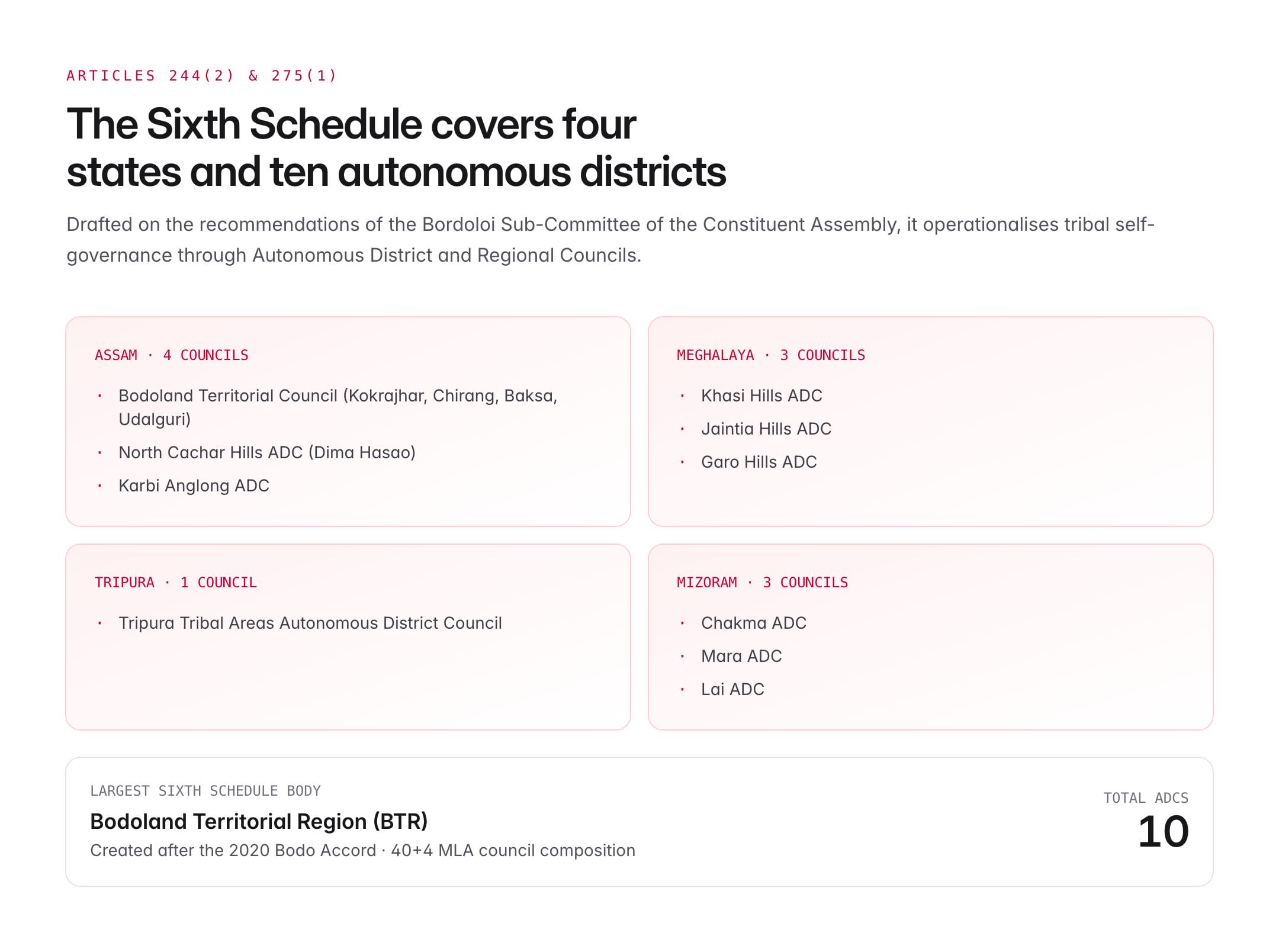
The Schedule currently covers 10 autonomous districts across four states:
| State | Autonomous District Councils |
|---|---|
| Assam | Bodoland Territorial Council (Kokrajhar, Chirang, Baksa, Udalguri), North Cachar Hills ADC (Dima Hasao), Karbi Anglong ADC |
| Meghalaya | Khasi Hills ADC, Jaintia Hills ADC, Garo Hills ADC |
| Tripura | Tripura Tribal Areas Autonomous District Council |
| Mizoram | Chakma ADC, Mara ADC, Lai ADC |
The Bodoland Territorial Region (BTR), created by the 125th Amendment-linked 2020 Bodo Accord, is the largest Sixth Schedule body, with expanded powers.
Structure of Autonomous District Councils
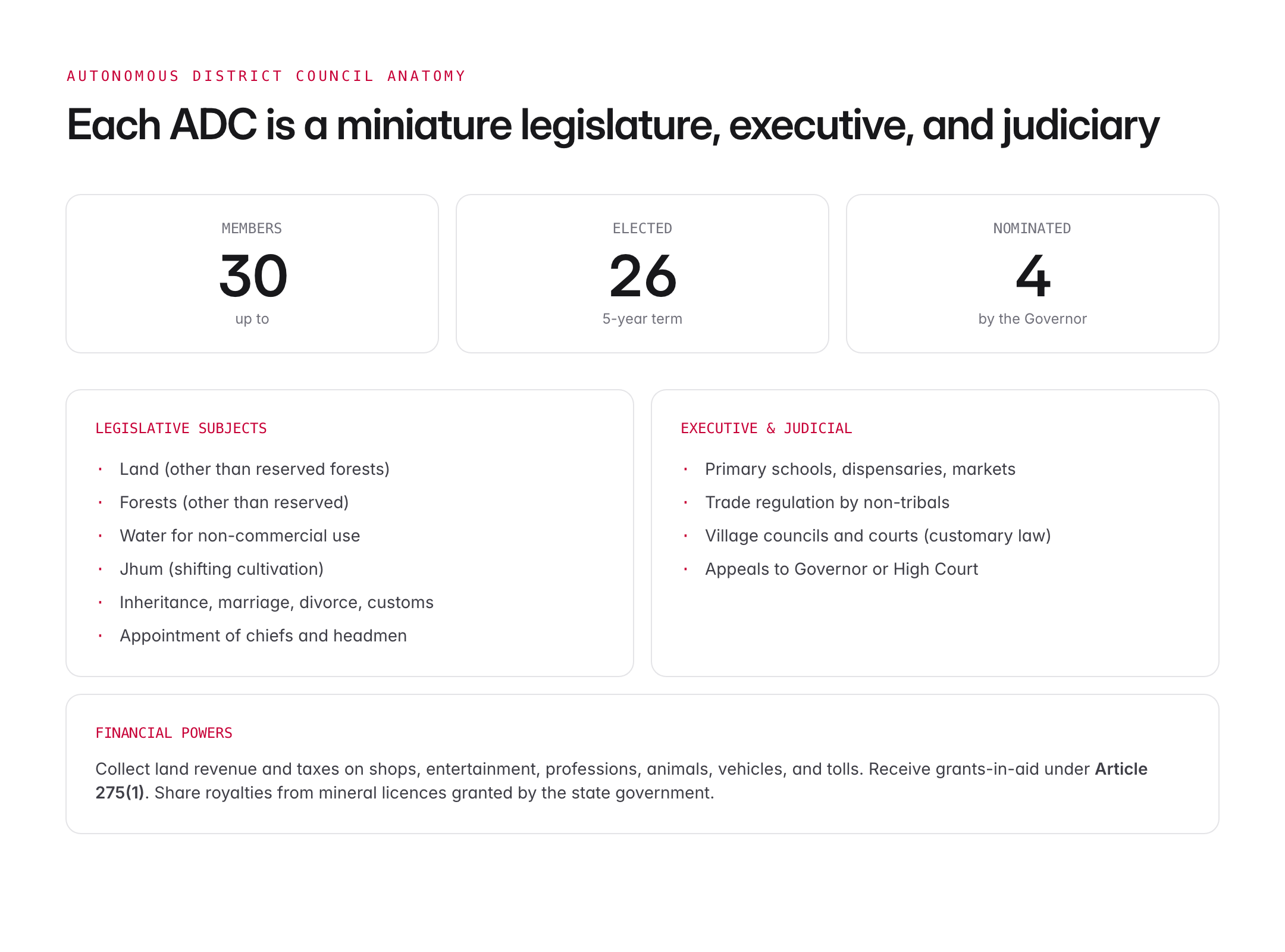
Each ADC is a miniature legislature + executive + judiciary for its area.
Composition:
- Up to 30 members.
- 26 elected for a five-year term.
- Up to 4 nominated by the Governor.
- An Executive Committee headed by a Chief Executive Member.
Legislative powers (over the tribal area of the district):
- Land (other than reserved forests), forests (other than reserved), water for non-commercial use.
- Village administration, jhum or shifting cultivation.
- Inheritance of property, marriage, divorce, social customs.
- Appointment of chiefs and headmen.
Laws made by an ADC require the Governor's assent to take effect.
Executive powers:
- Management of primary schools, dispensaries, cattle pounds, roads, ferries, markets.
- Trade regulation by non-tribals within the district.
- Administration of tribal villages.
Judicial powers:
- ADCs may constitute village councils and courts for suits between tribal parties.
- These courts apply customary law, subject to appeals to the Governor or High Court.
Financial powers:
- Collect land revenue and taxes on shops, entertainment, professions, animals, vehicles, and tolls.
- Receive grants-in-aid under Article 275(1).
- Royalties from mineral licences granted by the state government are shared.
Governor's Role and Central Oversight
The Governor of the state is a critical actor under the Sixth Schedule:
- Determines the composition of ADCs.
- Gives assent to laws passed by ADCs.
- Can dissolve an ADC or suspend its resolutions in case of failure.
- Appoints commissions to enquire into the administration of autonomous districts.
- Allocates revenue between the state and the ADCs.
The Union government can also notify new tribal areas and modify Sixth Schedule boundaries through parliamentary law under Paragraph 21 of the Schedule.
How the Sixth Schedule Differs from the Fifth Schedule
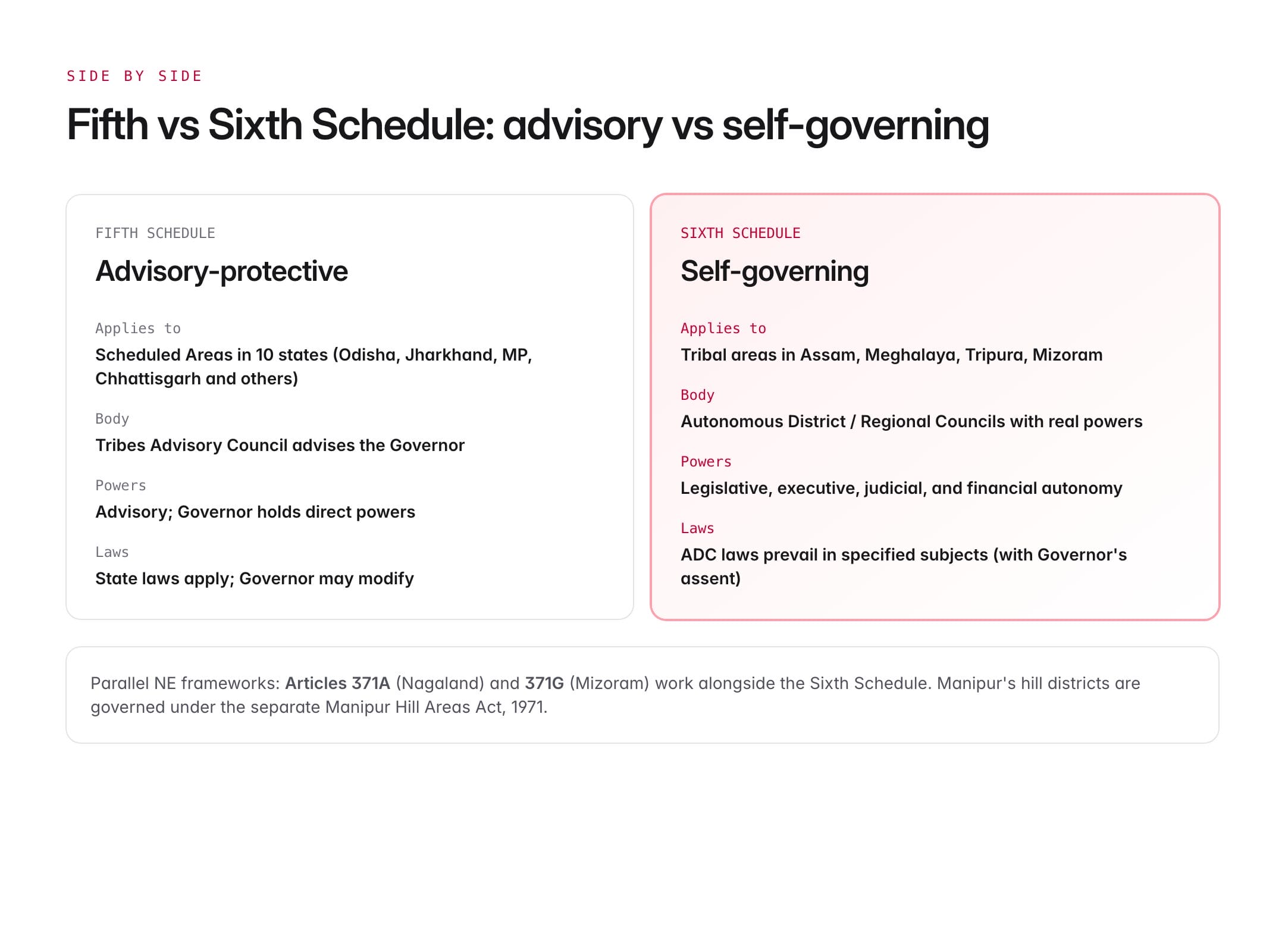
| Feature | Fifth Schedule | Sixth Schedule |
|---|---|---|
| Applies to | Scheduled Areas in states other than the NE four | Tribal areas in Assam, Meghalaya, Tripura, Mizoram |
| Scope | 10 states (e.g., Odisha, Jharkhand, MP, Chhattisgarh) | 4 NE states only |
| Body | Tribes Advisory Council (TAC) advises the Governor | Autonomous District/Regional Councils with real powers |
| Powers | Advisory; Governor has direct powers | Legislative, executive, judicial, financial autonomy |
| Laws | State laws apply, Governor may modify | ADC laws prevail in specified subjects |
In short, the Sixth Schedule is a stronger, self-governing model; the Fifth Schedule is an advisory-protective model.
Recent Developments
Bodo Accord 2020. Created the Bodoland Territorial Region (BTR) with 40+4 MLA composition in the council, more legislative powers, and expanded territorial jurisdiction, including four new districts in Assam.
Ladakh Sixth Schedule demand. After Jammu and Kashmir's reorganisation in 2019 and Ladakh becoming a Union Territory without a legislature, local civil society — including the Apex Body Leh and Kargil Democratic Alliance, led by climate activist Sonam Wangchuk — has demanded inclusion of Ladakh under the Sixth Schedule to protect tribal rights, land, jobs, and fragile ecology. Over 80% of Ladakh's population is tribal. The National Commission for Scheduled Tribes (NCST) has supported the demand. The central government has set up a High-Powered Committee under the Ministry of Home Affairs to examine Ladakh's concerns, though it has so far stopped short of Sixth Schedule inclusion.
Manipur tribal council discussions. Manipur's hill districts are currently governed under separate state laws (Manipur Hill Areas Act, 1971), but demands to bring them under the Sixth Schedule resurface periodically.
Significance and Criticism
Significance:
- Constitutional recognition of tribal self-governance and customary law.
- Safeguards land alienation to non-tribals.
- Empowers local decision-making on forests, shifting cultivation, and social customs.
- Has been a peace and integration instrument — Bodoland and Mizoram are clear examples.
Criticisms:
- Funds mismatch — powers often exceed financial capacity.
- Overlap with state legislatures and MLAs leads to turf battles.
- Weak audit and transparency in some councils.
- Not extended to other tribal-majority areas like Ladakh, Manipur hills, Arunachal Pradesh, creating a patchy tribal governance map.
- Several ADCs have seen allegations of ethnic exclusion of sub-tribes and non-tribals.
UPSC Relevance
Prelims focus:
- Sixth Schedule applies only to Assam, Meghalaya, Tripura, Mizoram — often tested as a "which states" match.
- Constitutional articles: 244(2) and 275(1).
- Number of autonomous districts (currently 10, subject to updates).
- Difference between Fifth and Sixth Schedule.
- Bordoloi Sub-Committee of the Constituent Assembly.
- Recent: Bodoland Territorial Region under 2020 Accord; Ladakh Sixth Schedule demand.
Mains GS-II angle:
- Effectiveness of the Sixth Schedule as a model of asymmetric federalism.
- Comparison of Fifth vs Sixth Schedule in protecting tribal rights.
- Why Ladakh's Sixth Schedule demand has constitutional, cultural, and ecological dimensions.
- Role of autonomous councils in bringing peace in Bodoland, Karbi Anglong, and Mizoram.
Sample PYQ angle: "The Sixth Schedule of the Indian Constitution is a unique instrument for protection and empowerment of tribal communities. Discuss." — candidates should explain the four-state coverage, powers of ADCs, Bordoloi Committee origins, the Bodoland model, and then evaluate its relevance to current demands in Ladakh and Manipur hills, ending with reforms needed in funding, accountability, and inclusion.