Kurmi Caste: History, Distribution, and Political Significance
Kurmi caste explained: origin, agrarian role, Kurmi Kshatriya movement, geographic spread, OBC politics in UP-Bihar, and Kurmali tribal status demand.
The Kurmi caste is a large agrarian community spread across the Indo-Gangetic plains and central-eastern India, classified in most states as an Other Backward Class (OBC). Historically identified with peasant cultivation, the Kurmis have played a significant role in India's agrarian economy, anti-caste social reform, and post-independence backward-class politics. In recent years, a section of Kurmis in Jharkhand, West Bengal, and Odisha has demanded Scheduled Tribe (ST) status as "Kudmi", making the community relevant for UPSC Indian Society, Polity, and Current Affairs.
Origin and Social Background
The Kurmi caste is traditionally associated with cultivation and animal husbandry. The etymology of "Kurmi" is debated — some link it to the Sanskrit root krishi (agriculture), others to tribal or regional roots.
- Historical and colonial ethnographies described Kurmis as "the backbone of Indian agriculture" (a phrase used by colonial administrator William Crooke).
- They are broadly classified as a Shudra peasant caste in traditional varna ranking but have long contested this, asserting Kshatriya status.
- They are distinct from — though sometimes conflated with — other peasant castes such as Kunbis (Maharashtra), Patidars/Patels (Gujarat), and Koeri/Kushwaha (Bihar/UP).
Geographic Distribution
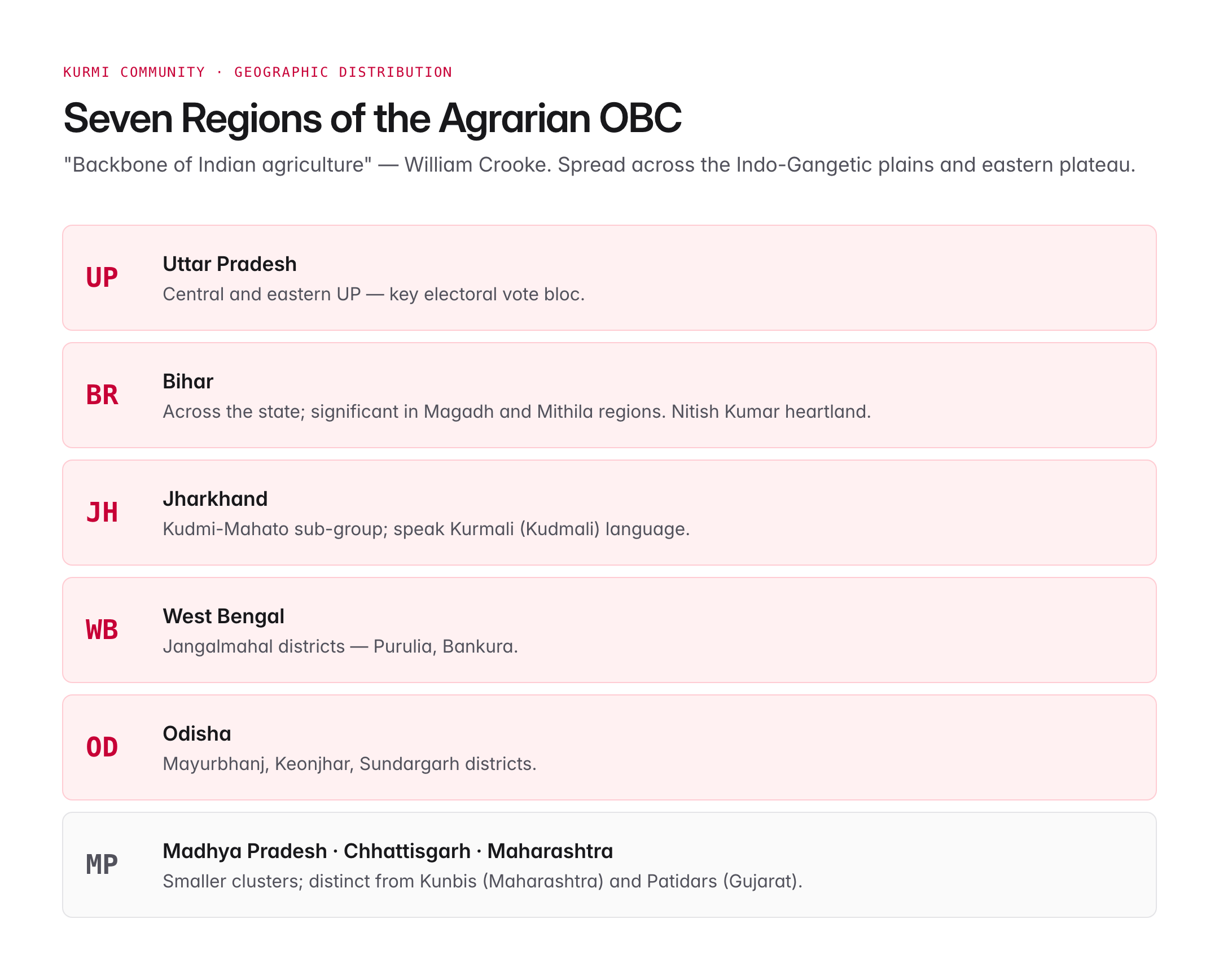
The Kurmi community is concentrated in:
| Region | Presence |
|---|---|
| Uttar Pradesh | Central and eastern UP |
| Bihar | Across the state; significant in Magadh and Mithila |
| Jharkhand | Kudmi-Mahato sub-group |
| West Bengal | Jangalmahal districts (Purulia, Bankura) |
| Odisha | Mayurbhanj, Keonjhar, Sundargarh |
| Madhya Pradesh, Chhattisgarh, Maharashtra | Smaller clusters |
The Kudmi-Mahato of the Chotanagpur plateau speak Kurmali (also called Kudmali), a language listed in the 8th Schedule demands but not yet included.
The Kurmi Kshatriya Movement
From the late 19th century, Kurmis organised a social reform and identity assertion movement.
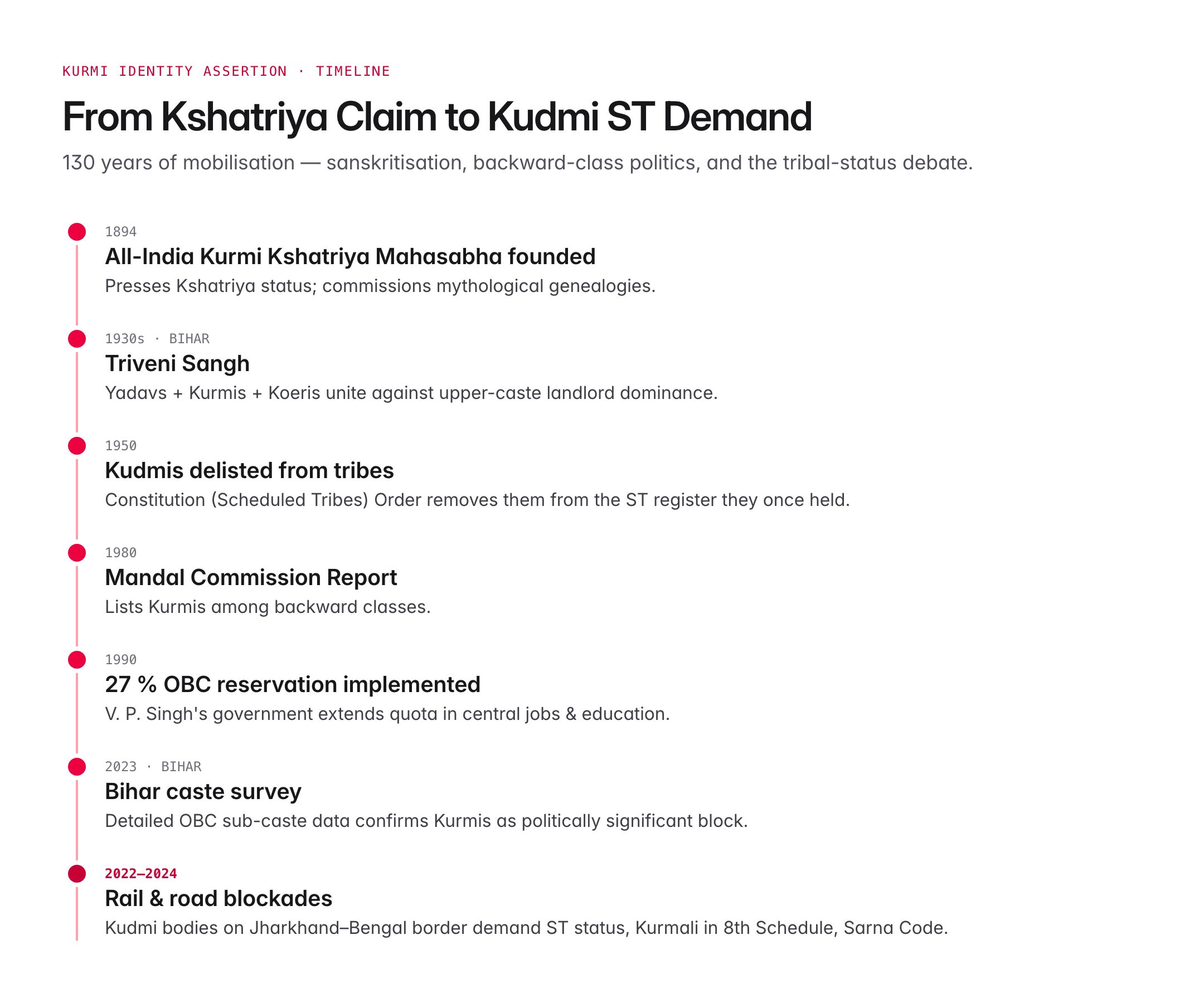
- In 1894, the All India Kurmi Kshatriya Mahasabha was founded to press claims to Kshatriya status.
- The movement drew on the broader sanskritisation trend identified by sociologist M. N. Srinivas, where lower castes adopted upper-caste rituals and genealogies.
- Community leaders commissioned genealogies tracing Kurmis to mythological Kshatriya lineages.
- Chhedi Lal Sathi, Ramdin Singh, and later Triveni Sangh activists championed Kurmi rights, often in alliance with Yadavs and Koeris.
The Triveni Sangh (1930s Bihar) brought together Yadavs, Kurmis, and Koeris against upper-caste landlord dominance and is considered an important precursor of the backward-class mobilisation that shaped post-independence Indian politics.
Place in Reservation and OBC Politics
Post-independence, Kurmis have been listed as an OBC in most states and benefit from reservations in education, employment, and political representation.
- The Mandal Commission Report (1980) listed Kurmis among the backward classes.
- Implementation of the Mandal report in 1990 under V. P. Singh's government extended 27% OBC reservation in central jobs and education — a turning point for Kurmi political visibility.
- Prominent Kurmi-origin political leaders include Nitish Kumar (former Chief Minister of Bihar) and Anupriya Patel (Apna Dal).
- The community is a key vote bloc in Bihar and eastern Uttar Pradesh, often decisive in electoral coalitions.
The Kudmi ST Status Demand
A long-standing issue is the demand by the Kudmi/Kurmi-Mahato community of Jharkhand, Bengal, and Odisha for inclusion in the Scheduled Tribes (ST) list.
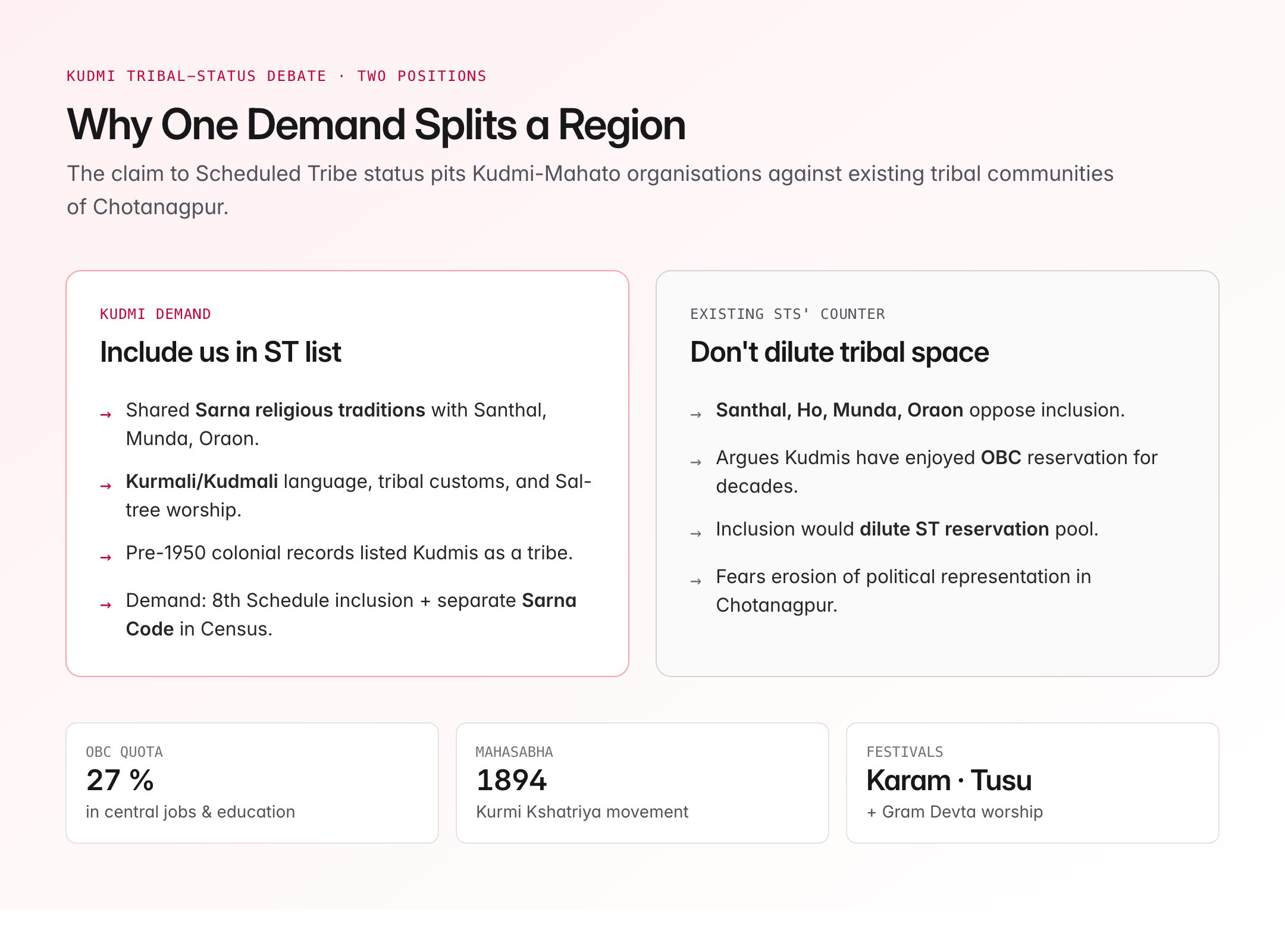
- The community argues it shares Sarna religious traditions, tribal customs, and the Kurmali/Kudmali language with tribal groups of Chotanagpur.
- Before 1950, Kudmis were listed as a tribe in some colonial records but were delisted when the Constitution (Scheduled Tribes) Order, 1950 was finalised.
- In 2022–2024, rail and road blockades in Jharkhand-West Bengal borders by Kudmi organisations demanded ST status and recognition of Kurmali in the 8th Schedule and Sarna Code as a separate religion in the Census.
- Existing STs such as the Santhal, Ho, Munda, and Oraon have opposed the Kudmi ST demand, arguing it would dilute tribal reservation and political space.
Sarna Religion and Cultural Practices
Many Kurmis in Jharkhand and adjacent regions practise a syncretic faith combining Sarna (nature worship) with Hindu practices.
- Worship of Gram Devta (village deity), Karam festival, and the sacred Sal tree are common.
- The community has supported the demand for a separate Sarna religious code in the Census to recognise indigenous religions distinct from Hinduism.
- Tusu Parab and Karam Puja are major Kurmi festivals.
Socio-Economic Indicators
As an agrarian OBC community, Kurmis historically worked as cultivator-landholders, distinguishing them from landless agricultural labourers.
- They benefited modestly from Green Revolution gains in UP and Bihar.
- Education and urban migration have produced a visible middle-class professional segment, though rural poverty remains significant.
- Caste-based political assertion has contributed to their upward mobility through reservations, cooperative politics, and kisan movements.
Contemporary Issues
- Sub-categorisation of OBCs: The Rohini Commission report on OBC sub-categorisation affects how reservation benefits are distributed among sub-groups including Kurmis.
- Caste census demand: Kurmi organisations support a national caste census to establish precise OBC population numbers for proportional reservation.
- Bihar caste survey (2023) counted detailed OBC sub-caste data, in which Kurmis emerged as a politically significant block.
- Farmer protests and MSP: As a predominantly agrarian caste, Kurmis have been part of kisan andolan mobilisations on MSP, agrarian distress, and land rights.
UPSC Relevance
Prelims focus:
- Kurmis classified as OBC in most states; distinct demand for ST status as Kudmi.
- All India Kurmi Kshatriya Mahasabha (1894) and Triveni Sangh (1930s).
- Mandal Commission (1980), implemented in 1990 — 27% OBC reservation.
- Kurmali language – demand for 8th Schedule inclusion.
Mains GS angle (GS Paper I – Society; GS Paper II – Polity):
- Caste-based social mobilisation and identity politics in post-colonial India.
- Sanskritisation and claims to Kshatriya status (M. N. Srinivas).
- Debate on expanding Scheduled Tribe list and its impact on existing STs.
- Sarna religion, tribal identity, and indigenous rights.
Sample PYQ angle: UPSC has asked about caste mobility, sanskritisation, reservation policy, and sub-categorisation of OBCs. Expect current-affairs-linked questions on the Kudmi ST demand, the Sarna Code, and sub-classification within OBC quotas.