Mission Amrit Sarovar: Focus, Objectives & Implementation (UPSC Notes)
Mission Amrit Sarovar set out to build 75 village water bodies in every district to mark 75 years of independence. It overshot a 50,000 target, crossed 68,000, and has now turned to keeping those ponds alive.
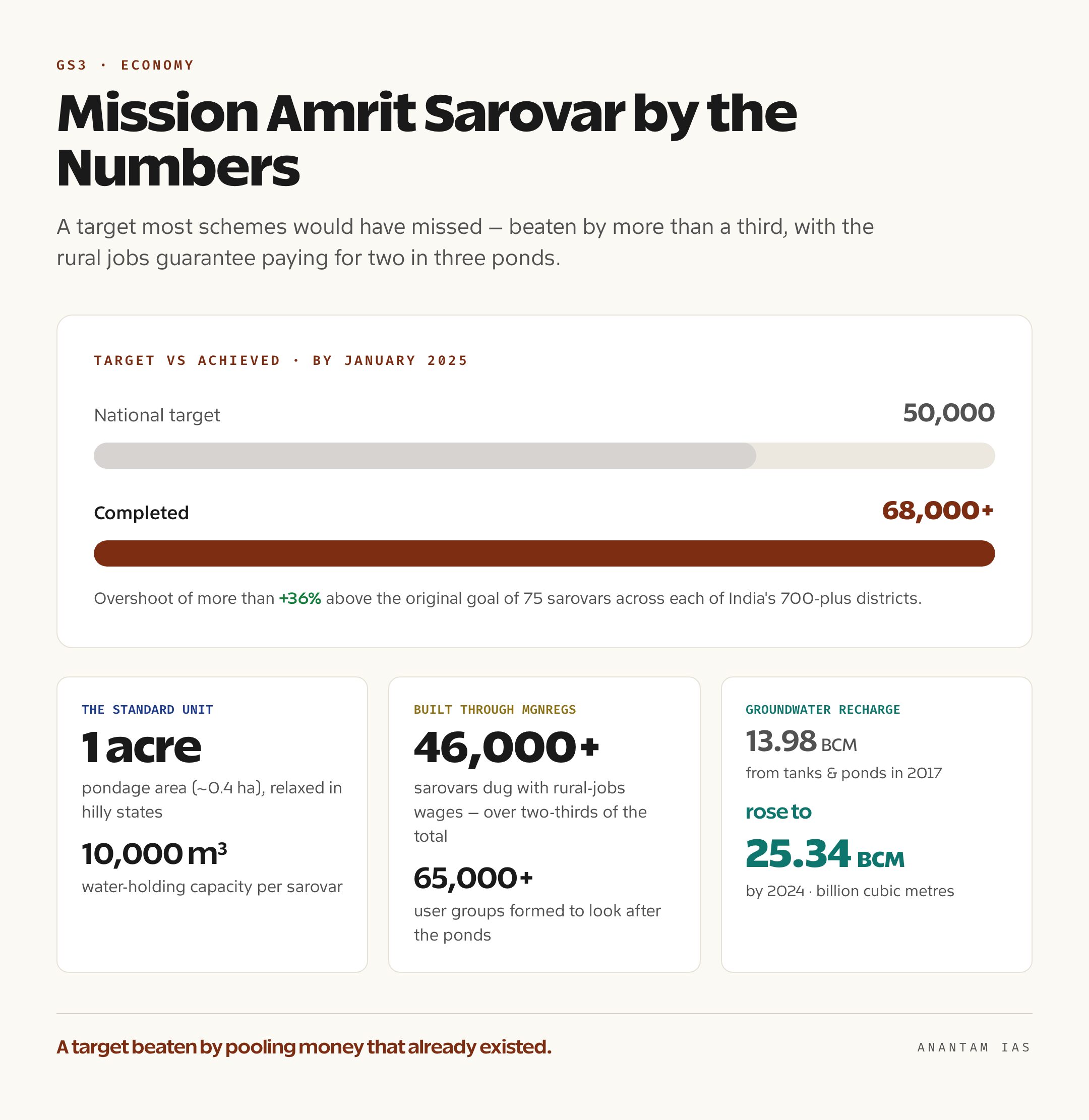
Mission Amrit Sarovar set itself a deceptively simple sum: build or revive 75 small water bodies in every district of India, one set of 75 for each of the country’s 75 years of independence. Do the arithmetic across more than 700 districts and you get a national target of 50,000 ponds. Launched on 24 April 2022 — National Panchayati Raj Day — under the Azadi ka Amrit Mahotsav, the mission was meant to wrap up by 15 August 2023. It didn’t stop there. By January 2025 the Ministry of Rural Development told Parliament that work on more than 68,000 Amrit Sarovars had been completed, well past the original goal.
And that overshoot is the real story. Most government targets are missed; this one was beaten by more than a third, largely because the mission didn’t ask for a new budget line at all. It stitched together money and labour that already existed — MGNREGS wages, Finance Commission grants, irrigation funds — and pointed them at the same village pond. For a UPSC aspirant, that makes Mission Amrit Sarovar a rare cross-cutting case study sitting at the join of governance, water security, rural livelihoods and climate adaptation.
What Mission Amrit Sarovar Actually Is
Mission Amrit Sarovar is a water-conservation drive run by the Ministry of Rural Development, built on a single physical unit: the amrit sarovar, or “pond of nectar.” It is not a brand-new pond from scratch in most cases. The mission deliberately leaned on reviving traditional water bodies — the tanks, johads, baolis and village ponds that India spent centuries digging and then a few decades silting up and forgetting.
Each Amrit Sarovar has a technical definition, which is exactly the kind of detail Prelims rewards. The standard sarovar has a pondage area of at least one acre — roughly 0.4 hectare — relaxed for hilly states, with a water-holding capacity of about 10,000 cubic metres. Around it sit plantations of native trees like neem, peepal, banyan and amla, and a spot is set aside for hoisting the national flag on Independence Day and Republic Day, tying the structure back to the freedom-anniversary theme that gave the mission its name.
The framing matters. By fixing a clear, measurable object — one acre, 10,000 cubic metres, native trees, a flag post — the mission gave hundreds of district collectors the same blueprint to copy. That standardisation is why a scheme with no dedicated fund of its own could still be counted, geotagged and audited at national scale.
The Focus Areas and the Numbers
So what does Mission Amrit Sarovar focus on, in practice? Six things, and they reinforce each other. First, water conservation and rainwater harvesting — capturing monsoon runoff that would otherwise drain away. Second, groundwater recharge, letting that stored water seep down to refill aquifers. Third, community participation, or Jan Bhagidari, with Gram Panchayats and local user groups meant to own each pond. Fourth, convergence of existing schemes rather than fresh spending. Fifth, rural livelihoods — fisheries, duck rearing, makhana and singhara (water chestnut) cultivation, and protective irrigation. And sixth, ecology — afforestation, biodiversity and a cooler local micro-climate around the water.
The numbers behind that focus are worth memorising. Against a target of 50,000, more than 68,000 sarovars had been completed by early 2025 — and of those, over 46,000 were built or rejuvenated using MGNREGS, the rural jobs guarantee, which paid for the digging while creating wage employment. The mission also reports more than 65,000 user groups formed to look after individual ponds, the institutional spine of the Jan Bhagidari idea. The wider payoff shows up in the aquifers: the Ministry notes that recharge from tanks, ponds and water-conservation structures rose from 13.98 billion cubic metres in 2017 to 25.34 billion cubic metres by 2024, a jump that water-storage drives like this one helped deliver.
Implementation runs through a whole-of-government cast. Six ministries and departments act as nodal partners — Rural Development as the lead, plus Jal Shakti (water resources and drinking water), Panchayati Raj, Culture, Environment, and the Department of Land Resources — while the Bhaskaracharya National Institute for Space Applications and Geo-informatics, or BISAG-N, geotags and monitors every sarovar by satellite. On the ground, district collectors and Gram Panchayats do the actual work.
How the Convergence Model Works
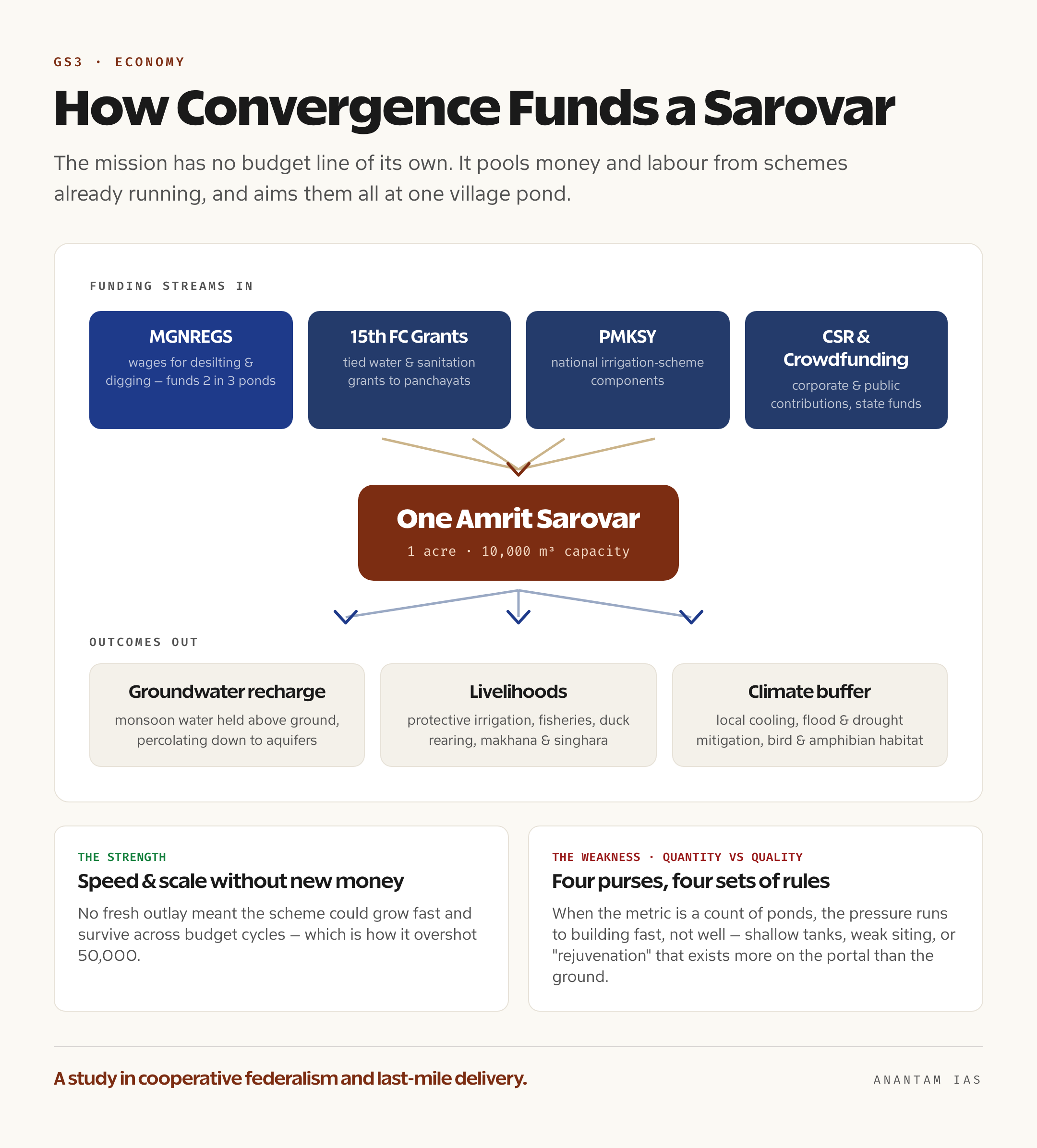
The cleverest part of Mission Amrit Sarovar isn’t the pond — it’s the funding trick behind it. The mission has no dedicated budget line. Instead it works by convergence: pooling money and labour from schemes that were already running. The largest tap is MGNREGS, whose wage budget pays villagers to desilt and dig, which is why over two-thirds of the sarovars were built through it. Alongside sit the 15th Finance Commission tied grants meant for water and sanitation at the panchayat level, and components of the Pradhan Mantri Krishi Sinchayi Yojana, the national irrigation scheme. States add their own sector funds, and the mission also opened doors for corporate social responsibility money and even public crowdfunding.
Because no fresh outlay was needed, the scheme could scale fast and survive across budget cycles. But convergence is double-edged. Money braided from four or five sources answers to four or five sets of rules and reporting lines, which makes a single pond harder to plan and audit than one funded from a single purse. The model rewards a district collector who can knit schemes together and quietly penalises one who can’t — so outcomes vary as much with local administrative skill as with rainfall.
This is the lens UPSC examiners care about. Mission Amrit Sarovar is, at heart, a study in cooperative federalism and last-mile delivery: a centrally designed template, financed through existing central and state flows, executed by panchayats, and monitored by a central tech agency. It shows both the strength of convergence — speed and scale without new money — and its weakness, the coordination burden it dumps on the district.
Why It Matters for Water Security and Livelihoods
The significance runs deeper than the pond count. India holds about 18 per cent of the world’s people but only around 4 per cent of its fresh water, and the Central Ground Water Board has flagged thousands of blocks as over-exploited, where extraction outpaces recharge. Surface ponds are one of the cheapest ways to slow that drain: they hold monsoon water above ground, then let it percolate down to refill the aquifer that village hand-pumps and bore-wells draw from. A network of 68,000 such sarovars is, in effect, a distributed recharge grid.
For farmers, that buffer is the difference between one crop and two. Stored water means protective irrigation during dry spells and the chance to raise cropping intensity, while the ponds themselves throw off allied incomes — pisciculture, duck rearing, lotus and makhana farming, water-chestnut cultivation. Self-help groups, often women-led, frequently run these activities and the routine upkeep, which knits the livelihood and ownership goals together. And there’s a climate dividend: a pond cools its surroundings, buffers small floods, mitigates drought and becomes habitat for migratory birds and amphibians.
It helps to place the mission in the wider water architecture rather than treat it as a stand-alone. Jal Jeevan Mission delivers tap water to individual rural households; Atal Bhujal Yojana manages groundwater at the aquifer level in stressed states; the Jal Shakti Abhiyan’s “Catch the Rain” pushes rainwater harvesting as a campaign. Mission Amrit Sarovar sits between them at the community scale — the village pond. Together they form a layered system, and the smart exam answer shows how the layers complement rather than duplicate each other.
The Challenges and the Way Forward
A scheme this large hits real limits, and naming them is what separates a top answer from a brochure. The biggest is maintenance. Digging a pond is a one-off; keeping it alive needs annual desilting, repair and de-weeding, and once the MGNREGS construction wage dries up, the incentive to maintain often dries up with it. Close behind sits encroachment — village water bodies are routinely nibbled away for farming or building, a problem courts have repeatedly flagged. Then there’s water quality: ponds silt up, choke with weeds and suffer eutrophication when nutrients run off into stagnant water.
The deepest critique is quality versus quantity. When the headline metric is a count of completed sarovars, the pressure runs toward building fast, not building well — shallow tanks, poor siting, or “rejuvenation” that exists more on the portal than on the ground. State performance is uneven too, with some states racing past their targets while others lag. None of this erases the achievement, but all of it shapes whether the ponds still hold water a decade on.
The way forward is essentially what the mission’s Phase II is reaching for. Begun after the first phase wound up around 2023-24, Phase II shifts the emphasis from construction to sustainability, climate resilience and community ownership — fewer new ponds, more attention to the carrying capacity, water quality and long-term upkeep of what already exists. By 17 April 2025 the Ministry reported 3,182 sites identified under Phase II, and in September 2025 it convened a national workshop at the IARI Pusa campus in Delhi to set the roadmap around outcome-based monitoring, Jan Bhagidari and technical innovation. The honest verdict: Phase I proved India can build water bodies at scale; Phase II will decide whether it can keep them.
For Your Mains Answer
Mission Amrit Sarovar is a high-value, cross-cutting example. It maps to GS Paper II on government schemes, cooperative federalism, Panchayati Raj implementation and last-mile delivery, and to GS Paper III on water resources, groundwater, conservation, and climate adaptation. It is also a ready data point for GS Paper I geography questions on water scarcity. Treat it as a model of convergence-based governance, not just a water scheme — that framing is what fetches marks.
How to Build the Answer
Open with the design idea, not a definition dump: a no-new-budget mission that beat a 50,000 target by pooling MGNREGS, Finance Commission and irrigation funds at the village pond. Then move in a clean arc — what it is and its technical unit, the focus areas with one or two hard numbers, the convergence mechanism, the significance for water security and livelihoods, the challenges, and the Phase II way forward. Anchor it in the wider water architecture (JJM, Atal Bhujal, Catch the Rain) to show you see the system, not one scheme in isolation.
Common Mistakes to Avoid
Don’t recite the launch date and forget the analysis — examiners want the why, not a fact sheet. Don’t quote a vague “lakhs of ponds”; use the verifiable anchors (50,000 target, 68,000-plus completed, ~10,000 cubic metres each). Don’t ignore the maintenance and quality-versus-quantity critique, because leaving out the limits reads as a press release. And don’t confuse this community-scale scheme with household-level Jal Jeevan Mission or aquifer-level Atal Bhujal.
A Compact Answer Spine
Water-stressed India (18% of people, 4% of fresh water) → 75 sarovars per district to mark 75 years, launched 24 April 2022 → no new budget, built through convergence (MGNREGS, 15th FC, PMKSY) → 50,000 target beaten, 68,000-plus done, BISAG-N geotagging → recharge, protective irrigation, livelihoods (fisheries, makhana), local cooling → challenges (maintenance, encroachment, water quality, quantity over quality) → Phase II turns to sustainability and ownership → continuity needs community stewardship, not just construction.
Diagram or Flowchart Idea
Draw a funnel: at the top, four funding streams (MGNREGS, 15th Finance Commission, PMKSY, CSR/crowdfunding) flowing down into one circle labelled “Amrit Sarovar — 1 acre, 10,000 m³.” From that circle, draw three outward arrows to “Groundwater recharge,” “Livelihoods,” and “Climate buffer.” It captures the whole convergence-to-outcomes logic in one frame.
A Balanced-Conclusion Line
Mission Amrit Sarovar has shown that India can build water bodies at remarkable scale by pooling what it already spends; whether those ponds endure now depends less on construction targets and more on the panchayats and communities who must keep them alive.
How to Use Data Without Cramming
Carry just three or four numbers and deploy them with intent: the 50,000 target versus 68,000-plus completed (proves the overshoot), the ~10,000 cubic-metre capacity per pond (proves you know the unit), the 46,000-plus built via MGNREGS (proves the convergence claim), and the recharge rise from 13.98 to 25.34 billion cubic metres between 2017 and 2024 (proves the impact). Four figures, well placed, beat a paragraph of unsourced statistics.
FAQ
What does Mission Amrit Sarovar focus on? It focuses on developing and rejuvenating 75 water bodies, called Amrit Sarovars, in every district of India to conserve water, recharge groundwater, support irrigation and rural livelihoods, and build community ownership of village ponds. Launched on 24 April 2022 under the Azadi ka Amrit Mahotsav, it ties each pond to the country’s 75 years of independence.
How many Amrit Sarovars have been built so far? The original target was 50,000 — that is 75 per district across India’s districts. The Ministry of Rural Development reported that work on more than 68,000 Amrit Sarovars had been completed by January 2025, comfortably exceeding the goal, with over 46,000 of them built through the MGNREGS rural employment scheme.
Which ministry runs Mission Amrit Sarovar, and how is it funded? The Ministry of Rural Development leads it, with five other ministries and departments — Jal Shakti, Panchayati Raj, Culture, Environment, and Land Resources — as nodal partners, and BISAG-N as the technical agency for satellite geotagging. It has no dedicated budget; it works by convergence, pooling MGNREGS wages, 15th Finance Commission grants, PMKSY irrigation funds, state schemes, and CSR or crowdfunding.
What is Phase II of Mission Amrit Sarovar? Phase II, taken up after the first phase concluded around 2023-24, shifts the emphasis from building new ponds to keeping them sustainable — focusing on water quality, carrying capacity, climate resilience and community stewardship. The Ministry reported 3,182 sites identified under Phase II by April 2025 and held a national roadmap workshop at IARI Pusa in September 2025.
Practice Questions
Prelims MCQs
- With reference to Mission Amrit Sarovar, consider the following: it was launched in April 2022 under the Azadi ka Amrit Mahotsav. The mission aims to develop or rejuvenate how many water bodies in each district?
(a) 50
(b) 75
(c) 100
(d) 150 —
Answer: (b) The mission targets 75 Amrit Sarovars per district, symbolising 75 years of independence, giving a national target of 50,000. - Which of the following is the lead/nodal ministry for Mission Amrit Sarovar?
(a) Ministry of Jal Shakti
(b) Ministry of Panchayati Raj
(c) Ministry of Rural Development
(d) Ministry of Environment, Forest and Climate Change —
Answer: (c) The Ministry of Rural Development leads the mission; Jal Shakti, Panchayati Raj, Culture, Environment and Land Resources are partner ministries. - As per the mission’s technical norms, a standard Amrit Sarovar should have approximately which water-holding capacity?
(a) 1,000 cubic metres
(b) 5,000 cubic metres
(c) 10,000 cubic metres
(d) 50,000 cubic metres —
Answer: (c) Each sarovar should have a pondage area of about one acre (relaxed in hilly terrain) and a water-holding capacity of around 10,000 cubic metres. - The agency engaged as the technical partner for geotagging and satellite monitoring of Amrit Sarovars is:
(a) ISRO
(b) BISAG-N
(c) NRSC
(d) Survey of India —
Answer: (b) The Bhaskaracharya National Institute for Space Applications and Geo-informatics (BISAG-N) provides geotagging and monitoring support. - Which scheme has funded the largest share of Amrit Sarovars through wage employment?
(a) Pradhan Mantri Krishi Sinchayi Yojana
(b) Atal Bhujal Yojana
(c) Jal Jeevan Mission
(d) Mahatma Gandhi NREGS —
Answer: (d) MGNREGS funded the construction or rejuvenation of over 46,000 of the 68,000-plus sarovars, paying wages for desilting and digging.
Mains Practice Questions
- “Mission Amrit Sarovar is less a new scheme than a new way of using old ones.” Critically examine the convergence-based design of the mission and its implications for cooperative federalism and last-mile delivery. (15 marks, 250 words)
- Discuss how community-scale water bodies under Mission Amrit Sarovar complement household-level and aquifer-level interventions in India’s water-security architecture. (15 marks, 250 words)
- Despite surpassing its construction target, Mission Amrit Sarovar faces serious questions of sustainability. Examine the key challenges and suggest measures to ensure the long-term viability of the water bodies created. (15 marks, 250 words)
- Evaluate the role of Mission Amrit Sarovar in groundwater recharge, drought mitigation and rural livelihoods, with reference to India’s water stress. (10 marks, 150 words)
- “Quantity of construction is not the same as quality of conservation.” In the light of this statement, assess the shift in focus from Phase I to Phase II of Mission Amrit Sarovar. (15 marks, 250 words)