NDMA Full Form: National Disaster Management Authority (UPSC Notes)
NDMA full form is National Disaster Management Authority. Complete UPSC guide on NDMA structure, functions, DM Act 2005, guidelines, and disaster management framework.
The NDMA full form is National Disaster Management Authority. It is the apex statutory body of India for managing disasters, established under the Disaster Management Act, 2005 and headed by the Prime Minister of India. NDMA lays down policies, plans, and guidelines for disaster management to ensure a timely, effective, and coordinated response to natural and human-induced disasters. For UPSC aspirants, NDMA is a high-yield topic under GS Paper III (Disaster Management), GS Paper II (Statutory Bodies & Governance), and recurring in Prelims through current-affairs triggers like cyclones, earthquakes, floods, and pandemics. Understanding its structure, functions, and relationship with SDMAs and NDRF is essential.
What Is NDMA?
The National Disaster Management Authority (NDMA) is the nodal agency at the national level for disaster management in India. It was constituted on 27 September 2006 under Section 3(1) of the Disaster Management Act, 2005.
- Chairperson: The Prime Minister of India (ex-officio).
- Vice-Chairperson: In the rank of Union Cabinet Minister.
- Members: Up to 9 members, including the Vice-Chairperson.
- Headquarters: New Delhi.
- Administrative Ministry: Ministry of Home Affairs (MHA).
Background and Evolution
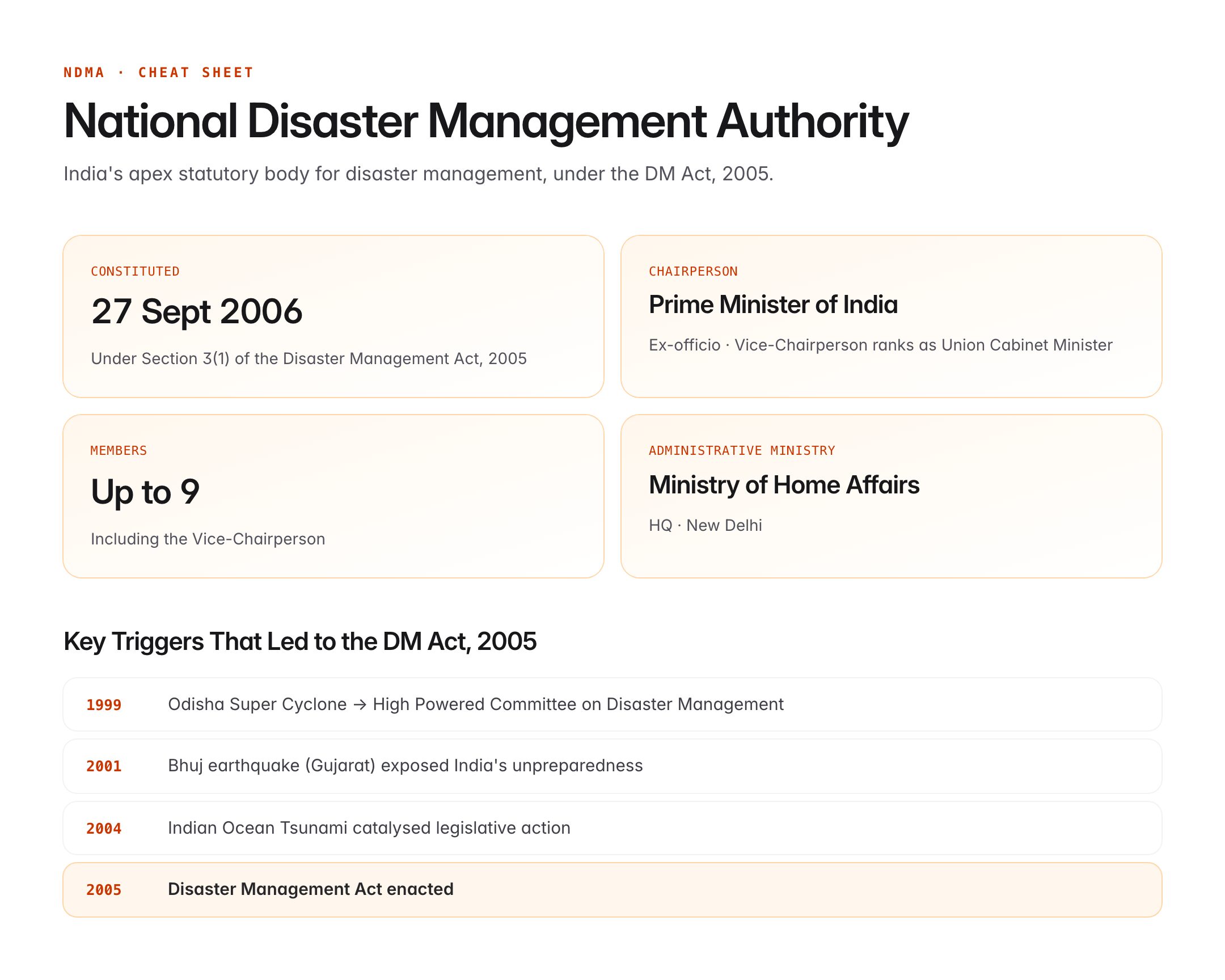
- 1999: High Powered Committee on Disaster Management set up after the Odisha Super Cyclone.
- 2001: Bhuj earthquake (Gujarat) exposed India's unpreparedness.
- 2004: Indian Ocean Tsunami catalysed legislative action.
- 2005: Disaster Management Act, 2005 enacted.
- 2006: NDMA formally constituted.
- 2009: National Policy on Disaster Management (NPDM) adopted.
- 2016: National Disaster Management Plan (NDMP) released (first nationwide plan aligned with Sendai Framework).
- 2019: NDMP updated, adding SDG and climate change linkages.
Structure of Disaster Management in India
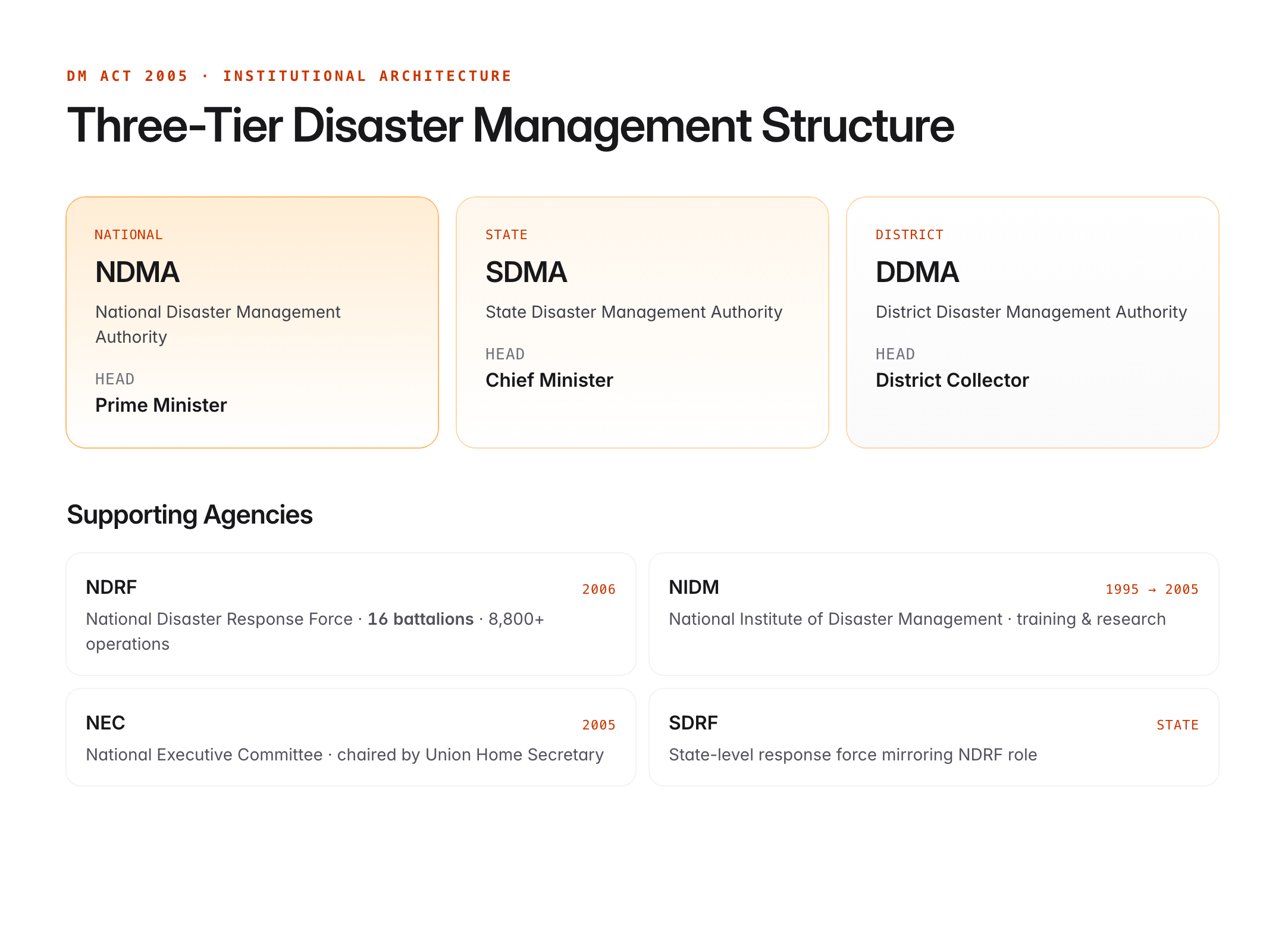
The DM Act, 2005 created a three-tier institutional architecture:
| Level | Body | Head |
|---|---|---|
| National | NDMA | Prime Minister |
| State | SDMA (State Disaster Management Authority) | Chief Minister |
| District | DDMA (District Disaster Management Authority) | District Collector/Magistrate |
Supporting agencies:
- National Executive Committee (NEC) — chaired by Union Home Secretary; implements NDMA policies.
- National Institute of Disaster Management (NIDM) — training and research.
- National Disaster Response Force (NDRF) — specialized response force with 16 battalions.
- State Disaster Response Force (SDRF) — state-level response.
Functions of NDMA
Under Section 6 of the DM Act, NDMA's responsibilities include:
- Laying down policies on disaster management.
- Approving the National Plan prepared by the NEC.
- Approving plans by Ministries and Departments of the GoI.
- Laying down guidelines to be followed by State authorities for preparing State Plans.
- Coordinating the enforcement of disaster management.
- Recommending financial provisions in the National Disaster Response Fund (NDRF) and NDMF.
- Providing support to other countries affected by major disasters.
- Takes measures for prevention, mitigation, preparedness, and capacity building.
Phases of Disaster Management
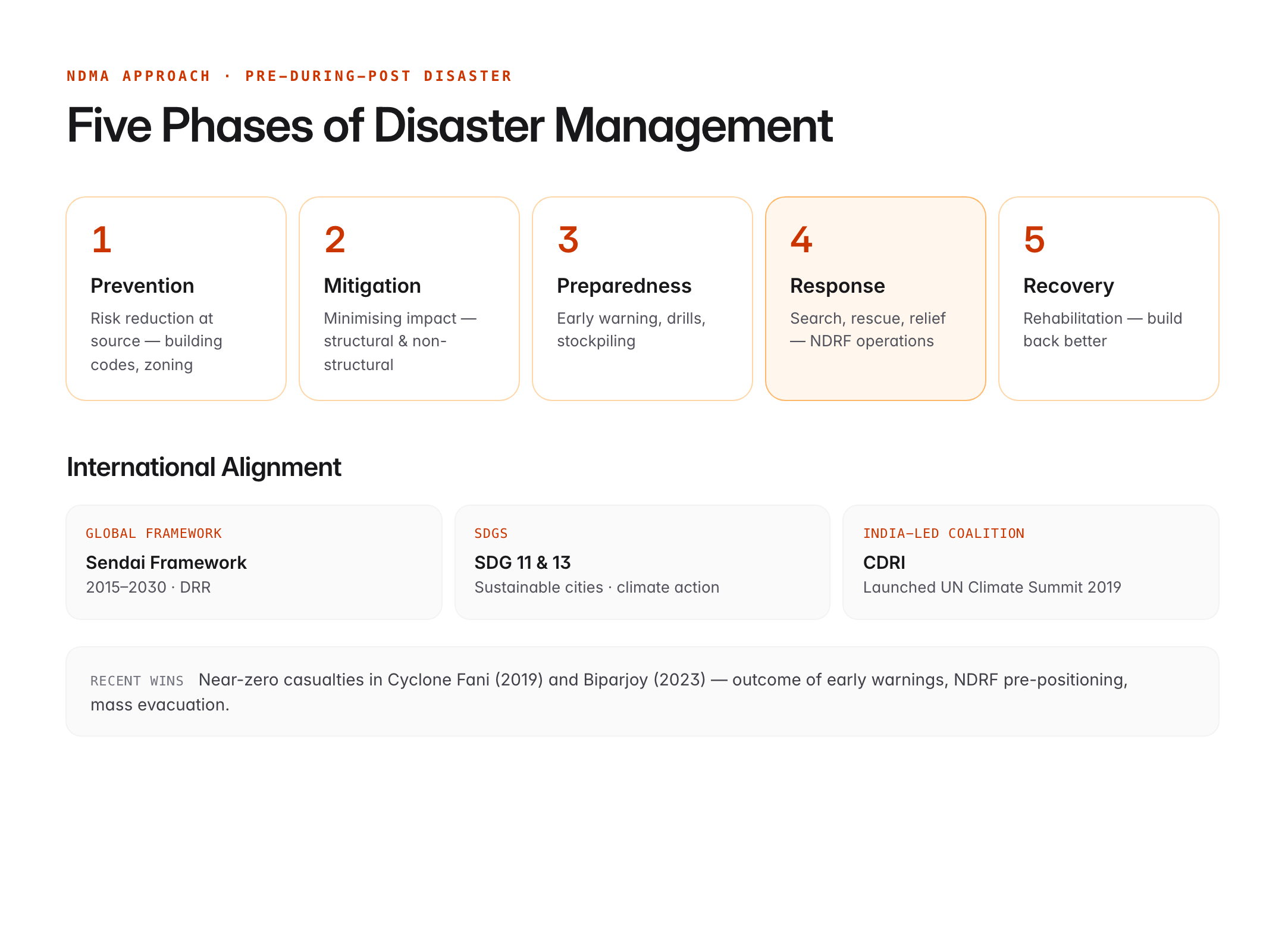
NDMA follows a holistic, pre-during-post disaster approach:
- Prevention — reducing risk at source (e.g., building codes).
- Mitigation — minimising impact (structural & non-structural).
- Preparedness — early warning, drills, stockpiling.
- Response — search, rescue, relief via NDRF.
- Recovery & Rehabilitation — building back better.
NDMA Guidelines (Key Ones)
NDMA has issued 30+ sector-specific guidelines, including:
- Earthquake Management
- Floods, Cyclones, Tsunamis
- Landslides and Snow Avalanches
- Biological and Chemical Disasters
- Nuclear and Radiological Emergencies
- Urban Flooding
- School Safety Policy
- Heat Wave Management
- COVID-19 Pandemic response
NDMA vs NDRF vs NIDM
| Agency | Full Form | Role | Established |
|---|---|---|---|
| NDMA | National Disaster Management Authority | Policy & guidelines | 2006 |
| NDRF | National Disaster Response Force | Specialised response | 2006 |
| NIDM | National Institute of Disaster Management | Training & research | 1995 (as NCDM), statutory in 2005 |
| NEC | National Executive Committee | Implementation of NDMA policy | 2005 |
Funding Mechanism
- National Disaster Response Fund (NDRF) — for immediate relief.
- National Disaster Mitigation Fund (NDMF) — for mitigation projects.
- State Disaster Response Fund (SDRF) and State Disaster Mitigation Fund (SDMF).
- Funded primarily by Union and State Governments; supplemented by grants based on Finance Commission recommendations.
NDMA and International Frameworks
India aligns its disaster management with global frameworks:
- Sendai Framework for Disaster Risk Reduction (2015–2030).
- Sustainable Development Goals (SDGs) — particularly SDG 11 and 13.
- Paris Agreement — climate change adaptation.
- India chairs/participates in the Coalition for Disaster Resilient Infrastructure (CDRI) — launched at UN Climate Summit 2019.
Significance and Achievements
- Cyclone preparedness: Near-zero casualties in Cyclone Fani (2019), Cyclone Biparjoy (2023) through early warnings and evacuation.
- COVID-19: NDMA invoked DM Act 2005 to issue lockdown guidelines.
- NDRF deployment: Over 8,800 operations; considered among the best-trained disaster forces.
- Aapda Mitra: Community volunteer training programme.
- Common Alerting Protocol (CAP) and SACHET for early warning dissemination.
Challenges
- Overlapping jurisdiction between Centre and States.
- Inadequate funds at district level.
- Urban disaster risk (earthquakes, urban floods).
- Climate-induced disasters increasing in frequency.
- Need for a specialized cadre for disaster management.
UPSC Relevance
- Prelims focus: NDMA full form, year of DM Act (2005), NDMA establishment (2006), Chairperson (PM), ex-officio structure, NDRF battalions (16), NIDM, Sendai Framework (2015–2030), CDRI launch year.
- Mains GS-III angle: Disaster management framework of India; role of NDMA-SDMA-DDMA; NDRF operations; Sendai Framework; climate-induced disasters. GS-II: Statutory bodies, centre-state relations in disaster response.
- Sample PYQ angle: "Vulnerability is an essential element for defining disaster impacts and its threat to people. Examine the role of NDMA and NDRF in building disaster resilience in India." — structure around DM Act 2005, three-tier architecture, sectoral guidelines, and case studies like Cyclone Fani or Joshimath subsidence.