Nehru Report 1928: Key Recommendations, Significance, UPSC Notes
The Nehru Report 1928 was India's first attempt to draft its own constitution. Learn its recommendations, critics, and UPSC relevance.
The Nehru Report, submitted on 10 August 1928, was the first serious attempt by Indians to draft their own constitution. Prepared by a committee chaired by Motilal Nehru under the umbrella of the All Parties Conference, the report was India's response to the British challenge — voiced by Secretary of State Lord Birkenhead — that Indians could not agree on a common constitutional framework. Its detailed recommendations on dominion status, fundamental rights, and federal structure made it a landmark document in the freedom struggle, even though it was ultimately rejected by both the British government and several Indian groups. For UPSC aspirants, the Nehru Report is essential for understanding the constitutional journey between the Simon Commission and the Poona Pact.
| Nehru Report — Quick Facts | Detail |
|---|---|
| Submitted | 10 August 1928 |
| Chaired by | Motilal Nehru (All Parties Conference committee) |
| Secretary | Jawaharlal Nehru |
| Trigger | Lord Birkenhead’s challenge; boycott of the all-white Simon Commission |
| Key demands | Dominion status, a bill of 19 fundamental rights, joint electorates (no separate electorates), linguistic provinces |
| Outcome | Rejected by the British and by the Muslim League (Jinnah’s Fourteen Points, 1929); pushed the Congress towards Purna Swaraj (1929) |
Background and Context
By the mid-1920s, Indian politics was shaped by two pressures:
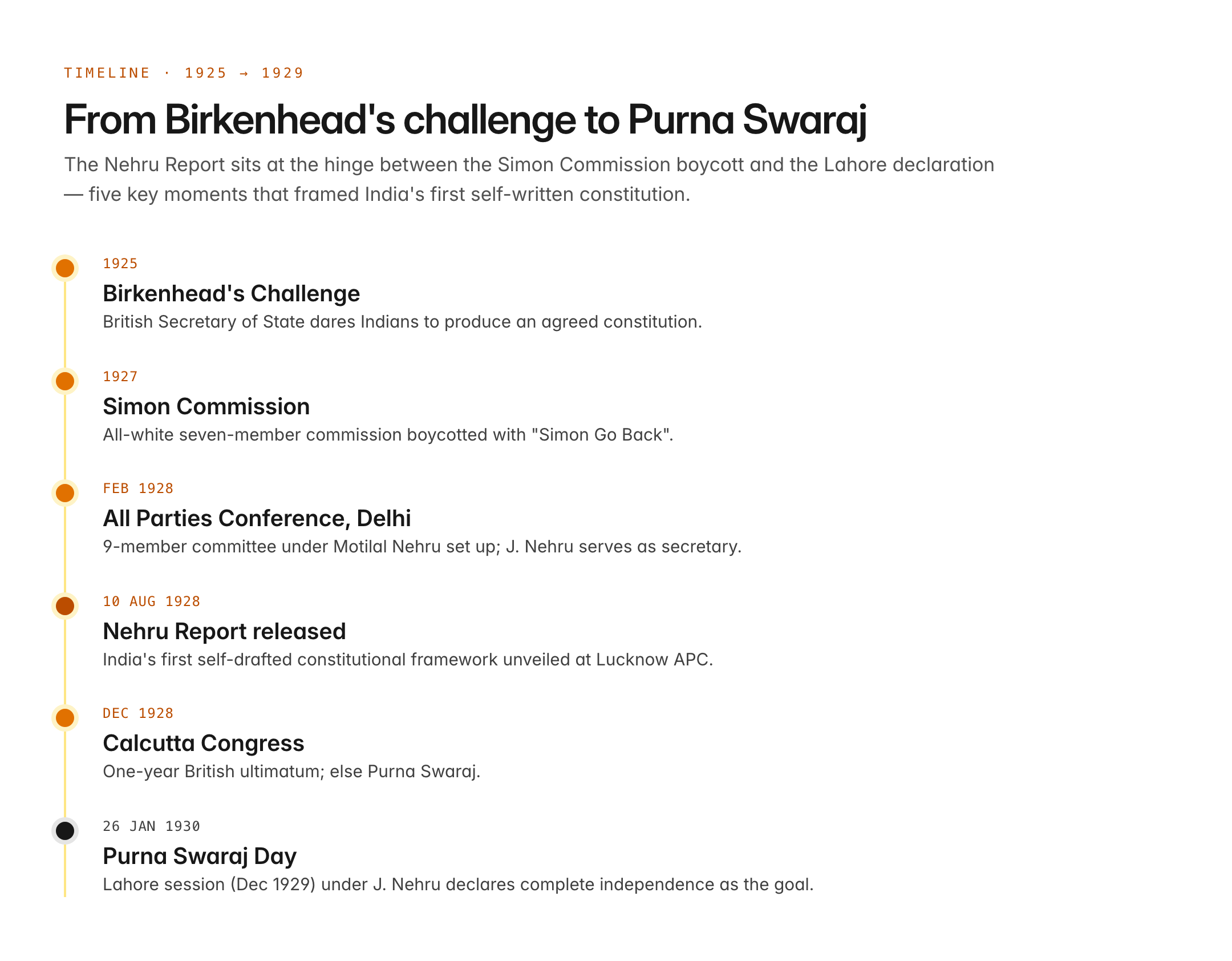
- Lord Birkenhead's challenge (1925): The British Secretary of State publicly dared Indians to produce an agreed constitution.
- Simon Commission, 1927: The all-white seven-member commission to review the Government of India Act 1919 was boycotted nationwide with the slogan "Simon Go Back" because it had no Indian members.
In response, Indian leaders convened an All Parties Conference in February 1928 at Delhi. The conference set up a committee of nine members, chaired by Motilal Nehru, to draft a constitution. Jawaharlal Nehru served as secretary. Other members included Tej Bahadur Sapru, Subhas Chandra Bose, Ali Imam, M.S. Aney, Shuaib Qureshi, G.R. Pradhan, Mangal Singh, and N.M. Joshi.
The committee's report was released at the Lucknow All Parties Conference in August 1928.
Key Recommendations
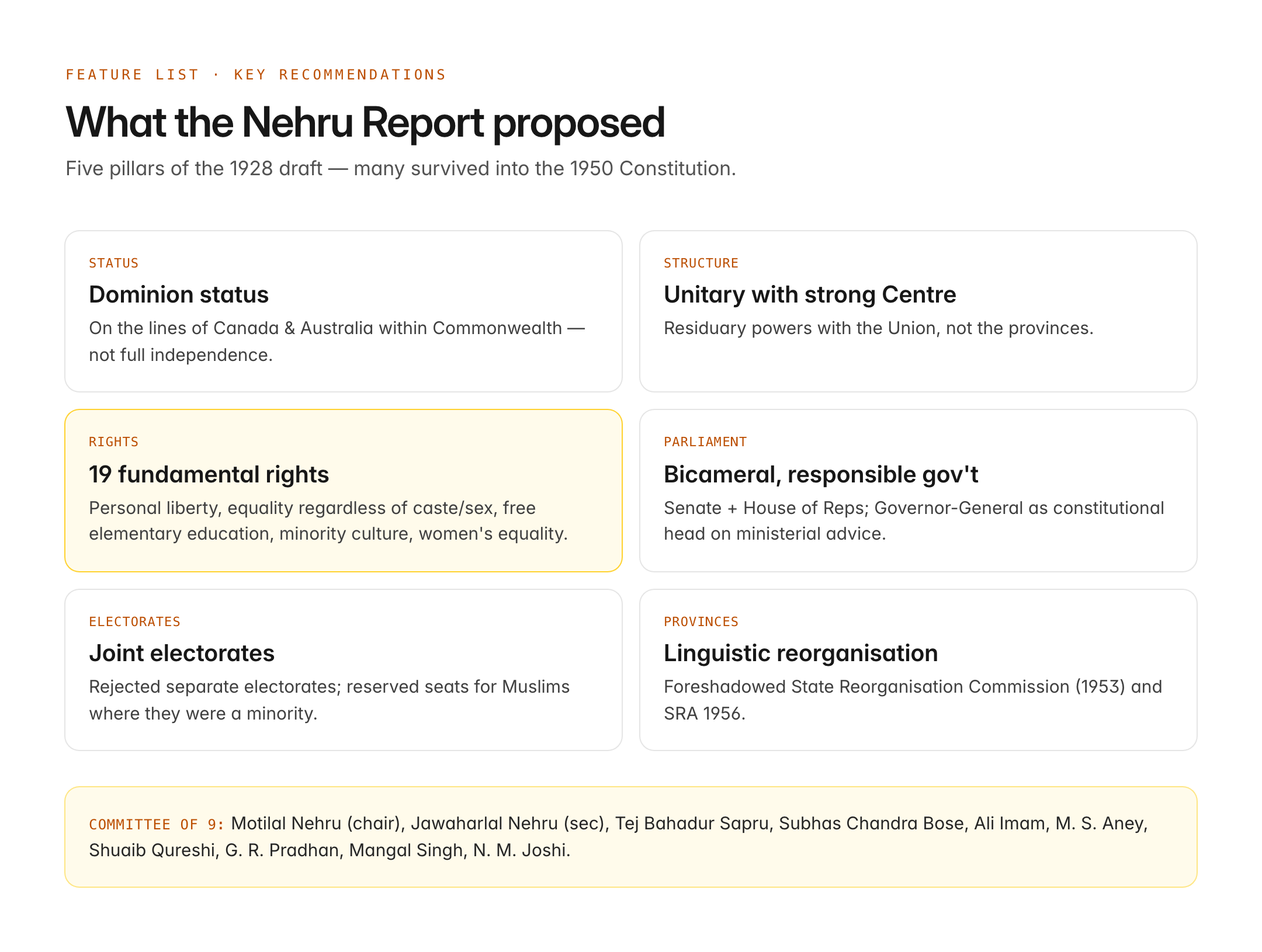
The Nehru Report proposed a comprehensive constitutional framework covering status, rights, and government structure.
Political Status
- Dominion status for India on the lines of Canada and Australia within the British Commonwealth — not complete independence. This was a major point of contention.
- A unitary constitution with a strong Centre and residuary powers with the Union.
Fundamental Rights
The report was pioneering in proposing a bill of 19 fundamental rights, including:
- Personal liberty, freedom of conscience, free expression.
- Equality before the law irrespective of religion, race, caste, or sex.
- Right to free elementary education.
- Protection of language, script, and culture of minorities.
- Equal rights for women.
Several of these later shaped Part III (Fundamental Rights) of the 1950 Constitution.
Government Structure
- A bicameral parliament: a Senate (upper house, indirectly elected) and a House of Representatives (directly elected).
- A responsible government at the Centre and in provinces, modelled on the British parliamentary system.
- A Governor-General acting as a constitutional head on the advice of the Council of Ministers.
Minority Safeguards
- Rejection of separate electorates — a sharp departure from the Lucknow Pact (1916) and the existing communal award framework.
- Joint electorates with reservation of seats for Muslims in provinces where they were in a minority, and no reservation where they were in a majority (Punjab, Bengal).
- Reservation of seats for non-Muslim minorities at the Centre.
Linguistic Provinces
- Redrawing of provincial boundaries on a linguistic basis, a suggestion that influenced the State Reorganisation Commission (1953) and the States Reorganisation Act, 1956.
Reactions and Criticisms
The report evoked sharp reactions from multiple quarters.
| Group | Position |
|---|---|
| Younger Congress leaders (J. Nehru, S.C. Bose) | Rejected dominion status, demanded complete independence (Purna Swaraj) |
| Muslim League (Jinnah) | Rejected due to loss of separate electorates; proposed Fourteen Points, 1929 |
| Hindu Mahasabha | Opposed reservations for minorities |
| Sikh League | Opposed inadequate safeguards for Sikhs in Punjab |
| British government | Ignored; proceeded with its own proposals via the Round Table Conferences |
At the Calcutta Congress (December 1928), the younger Congress faction forced a compromise: the British would have one year to accept the Nehru Report; otherwise, the Congress would adopt Purna Swaraj as its goal. When no acceptance came, the Lahore session (December 1929) under Jawaharlal Nehru formally declared Purna Swaraj as the goal and fixed 26 January 1930 as the first Independence Day.
Jinnah's Fourteen Points
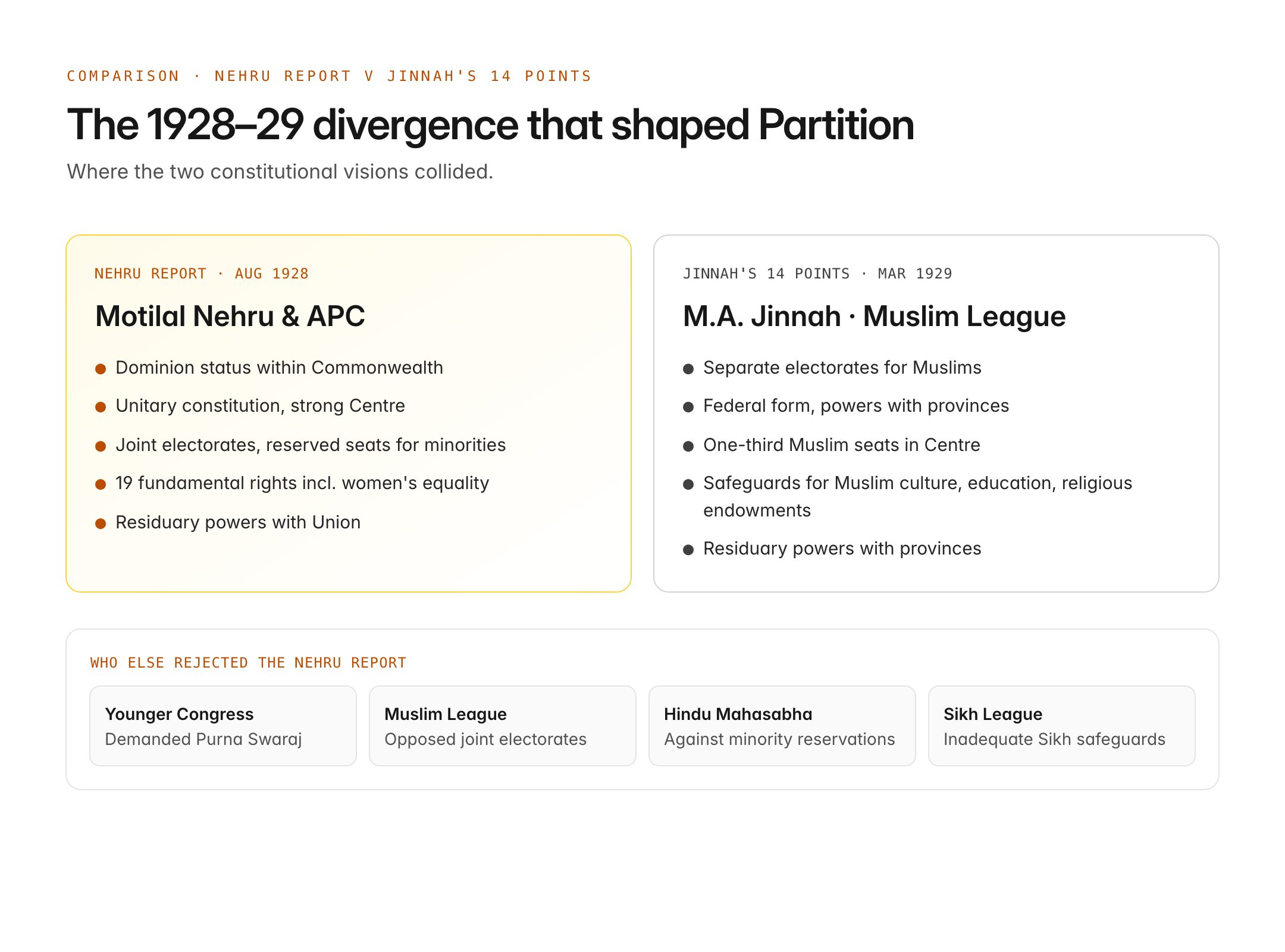
M.A. Jinnah's response, known as the Fourteen Points (March 1929), demanded:
- Separate electorates for Muslims.
- One-third Muslim representation in central legislature.
- A federal form of government with residuary powers with provinces.
- Safeguards for Muslim culture, education, and religious endowments.
The divergence between the Nehru Report and Jinnah's Fourteen Points is a key UPSC theme, marking the widening gulf between Congress and the Muslim League that would culminate in the demand for Pakistan.
Significance in the Freedom Struggle
The Nehru Report was significant for several reasons:
- First Indian-drafted constitution. It demonstrated that Indians could produce a coherent constitutional framework, answering Birkenhead's challenge.
- Template for fundamental rights. Its 19-point list prefigured Part III of the 1950 Constitution.
- Catalyst for Purna Swaraj. Its rejection pushed the Congress towards complete independence.
- Linguistic reorganisation idea. The principle it endorsed eventually shaped independent India's internal map.
- Communal fault lines. It exposed the deepening Hindu–Muslim political divide, signalling challenges that would shape the 1940s.
Many provisions also influenced the Government of India Act, 1935, and the Constituent Assembly debates (1946–49) that drafted the final Constitution.
UPSC Relevance
Prelims focus: date (10 August 1928), chairperson (Motilal Nehru), triggering event (Simon Commission and Birkenhead challenge), demand (dominion status, not full independence), rejection of separate electorates, 19 fundamental rights, and follow-up at Calcutta (1928) and Lahore (1929) Congress sessions.
Mains GS angle:
- GS I — Indian freedom struggle, its various stages and important contributors; significant personalities and events between 1919 and 1947.
- Analytical questions on the transition from dominion status to Purna Swaraj, communal fault lines, and the constitutional legacy of pre-Independence documents.
Sample PYQ angle: UPSC has asked about the significance of the Nehru Report in the evolution of the Indian Constitution. A structured answer highlights the bill of rights, linguistic provinces idea, rejection of separate electorates, and contrasts the report with Jinnah's Fourteen Points to show how the failure of consensus in 1928–29 accelerated both the demand for complete independence and the communal polarisation that followed.