Panchayat Development Index (PAI): Measuring Rural Local Governance
Panchayat Development Index evaluates Gram Panchayats across 9 LSDG themes. Learn objectives, indicators, thematic scoring and UPSC relevance.
The Panchayat Development Index (PAI), officially branded by the Ministry of Panchayati Raj as the Panchayat Advancement Index, is a composite performance measurement tool designed to evaluate the progress of Gram Panchayats across nine thematic areas linked to the Localization of Sustainable Development Goals (LSDGs). Released by the Ministry of Panchayati Raj (MoPR), the PAI ranks panchayats on the basis of outcome-oriented indicators and classifies them into tiers ranging from "beginners" to "front runners". It operationalises the constitutional vision of the 73rd Amendment by converting devolved functions into measurable, comparable development outcomes at the grassroots level.
Origin and Constitutional Context
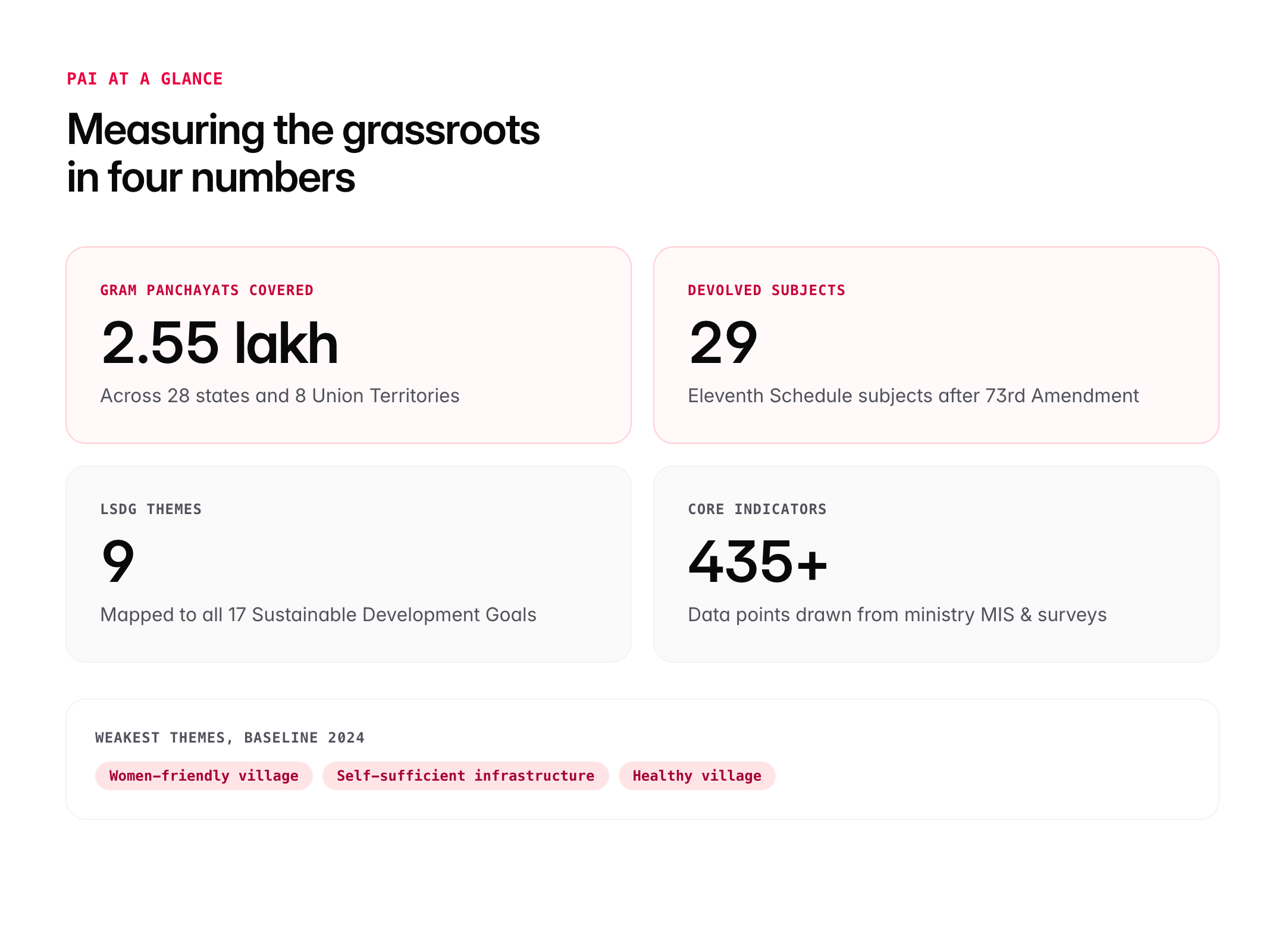
India has nearly 2.55 lakh Gram Panchayats across 28 states and 8 Union Territories. Following the 73rd Constitutional Amendment (1992), panchayats have been entrusted with 29 subjects under the Eleventh Schedule, ranging from agriculture and education to drinking water and sanitation. Until recently, however, there was no uniform national yardstick to benchmark their performance.
The Panchayat Advancement Index fills this gap. It is conceptually inspired by two earlier NITI Aayog indices, the SDG India Index and the Aspirational Districts Programme, but is customised for the local government level. The index operationalises the nine themes of LSDG adopted by the Ministry of Panchayati Raj in 2022–23.
The Nine LSDG Themes
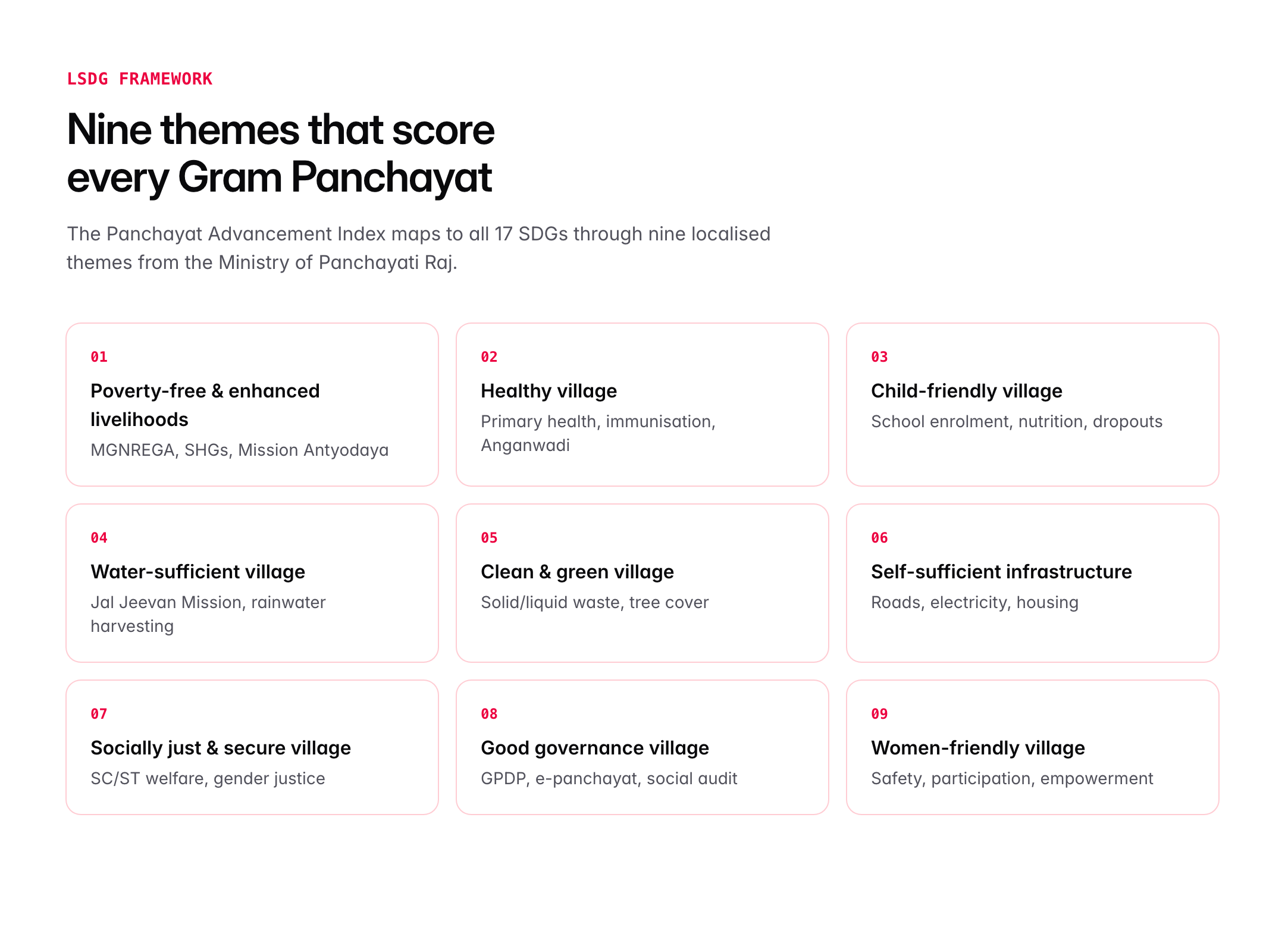
The PAI scores each panchayat across nine thematic areas that collectively map to all 17 SDGs.
| # | Theme | Illustrative Focus |
|---|---|---|
| 1 | Poverty-free and Enhanced Livelihoods Village | MGNREGA, SHGs, Mission Antyodaya |
| 2 | Healthy Village | Primary health, immunisation, Anganwadi |
| 3 | Child-friendly Village | School enrolment, dropout, nutrition |
| 4 | Water-sufficient Village | Jal Jeevan Mission, rainwater harvesting |
| 5 | Clean and Green Village | Solid/liquid waste, tree cover |
| 6 | Self-sufficient Infrastructure | Roads, electricity, housing |
| 7 | Socially Just and Secure Village | SC/ST welfare, gender justice, grievance redress |
| 8 | Good Governance Village | GPDP, e-panchayat, social audit |
| 9 | Women-friendly Village | Safety, participation, economic empowerment |
Indicators and Methodology
The index uses a large set of local-level indicators (the initial framework identifies over 500 data points with nearly 435 key indicators at the core) drawn from multiple ministries, the Mission Antyodaya survey, SECC, and administrative MIS systems. Each theme has a set of weighted indicators that generate a sub-score, which is then aggregated into an overall PAI score on a scale of 0 to 100.
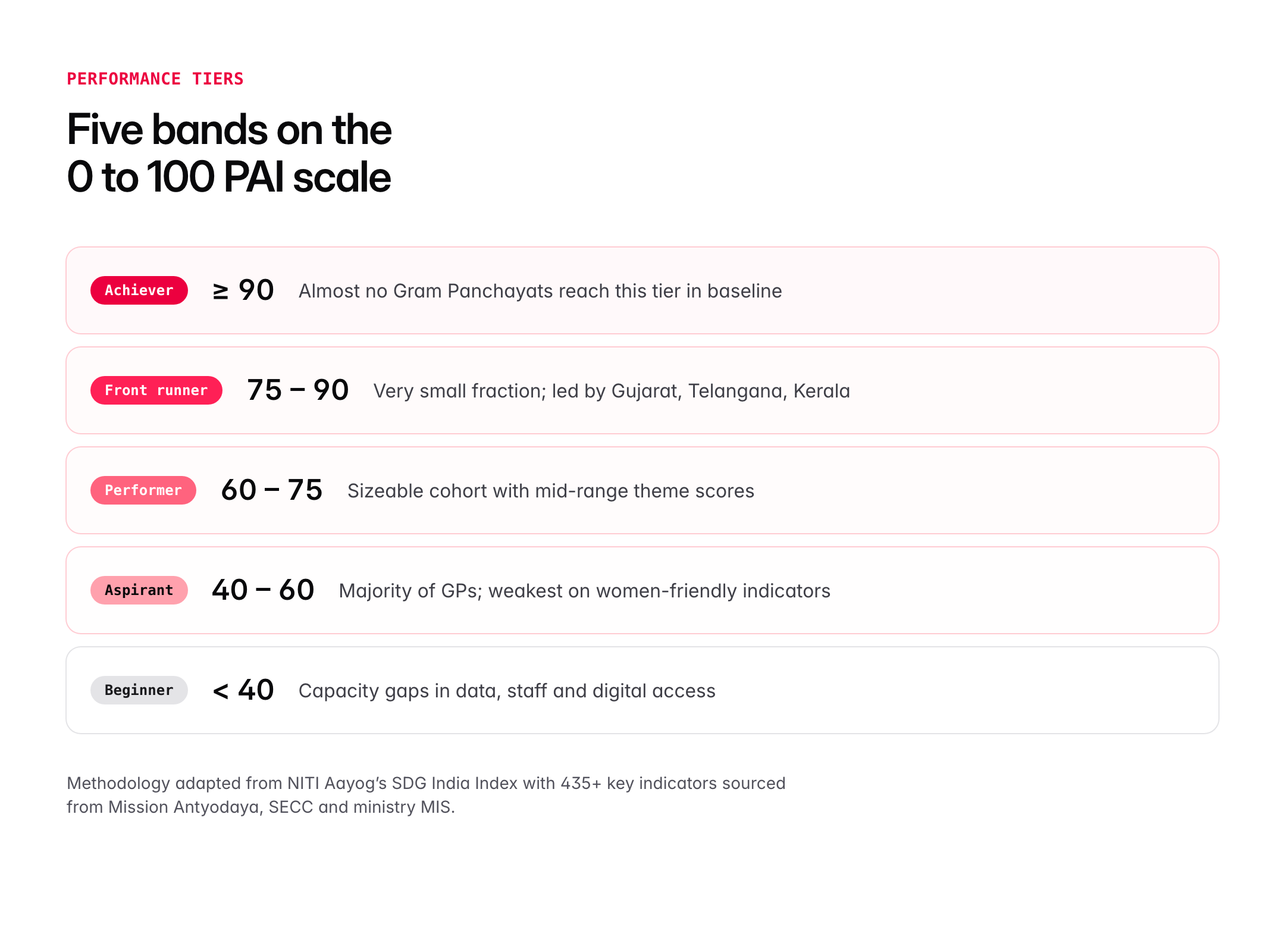
Panchayats are then classified into five performance tiers:
- Achiever (score 90 and above)
- Front Runner (75 to below 90)
- Performer (60 to below 75)
- Aspirant (40 to below 60)
- Beginner (below 40)
The methodology borrows heavily from NITI Aayog's SDG scoring framework to ensure comparability across states and years.
Key Findings of the First Baseline Report
The first PAI Baseline Report, released in 2024, analysed a large share of Gram Panchayats that reported validated data. Highlights include:
- A majority of panchayats fall into the "Aspirant" and "Performer" categories.
- Only a very small fraction qualify as "Front Runners", and almost none reach the "Achiever" tier.
- States like Gujarat, Telangana, Kerala, Tamil Nadu and Karnataka consistently perform better across themes.
- Weakest scoring themes, nationally, tend to be Women-friendly Village, Self-sufficient Infrastructure, and Healthy Village.
These baseline findings provide states a diagnostic map of where devolution of functions, funds and functionaries (3Fs) remains inadequate.
Significance of the PAI
For grassroots governance
- Creates a performance culture among Gram Panchayats.
- Strengthens the Gram Panchayat Development Plan (GPDP) by aligning it with measurable outcomes.
- Supports evidence-based planning by linking panchayat data with MGNREGA, Jal Jeevan Mission, PMAY-G, POSHAN Abhiyaan, and the Swachh Bharat Mission.
For cooperative federalism
- Enables inter-state and intra-state comparisons.
- Informs allocation decisions under the Finance Commission grants to local bodies.
- Complements the 15th Finance Commission's tied grants for water, sanitation and health infrastructure.
For SDG 2030
- Localises global commitments, since India cannot meet the SDGs without panchayats functioning effectively.
- Provides a roadmap for the "Theme-based approach" in panchayat planning.
Challenges in Implementation
Despite its conceptual strength, the PAI faces several practical challenges.
- Data quality: Self-reported data from panchayats may be incomplete or inconsistent.
- Capacity gaps: Many Gram Panchayats lack trained staff to capture outcome indicators.
- Digital divide: The index relies on platforms like eGramSwaraj, which requires reliable internet and digital literacy.
- Weak third-party verification: Unlike the Aspirational Districts Programme, real-time third-party audits are limited.
- Fiscal and functional asymmetry: Unequal devolution across states distorts comparability.
Way Forward
To make the PAI more meaningful, experts recommend:
- Integration with PRIA-Soft and eGramSwaraj for real-time, verified data flow.
- Annual updation of the index with published dashboards.
- Linking part of Finance Commission grants and state transfers to PAI improvement.
- Capacity-building of elected representatives, especially women sarpanches, to drive data-based planning.
- Incorporating citizen-feedback indicators to capture perception of service quality.
UPSC Relevance
Prelims focus
- Nodal Ministry: Ministry of Panchayati Raj
- Nine LSDG themes and their alignment with SDGs
- Five performance tiers of PAI
- 73rd Constitutional Amendment and the Eleventh Schedule
Mains GS-II angle
- Devolution of powers and finances to local levels
- Role of civil society, SHGs and NGOs in local development
- Indices and indicators as tools of governance
Mains GS-III angle
- Inclusive development and issues arising from it
- Role of Finance Commission in strengthening local government finances
Sample PYQ-style question
"The Panchayat Advancement Index seeks to operationalise the Localization of Sustainable Development Goals at the grassroots level. Critically examine its design and suggest measures to enhance its effectiveness." (GS-II, 15 marks)