Partition of Bengal (1905): Causes, Swadeshi, and Annulment
Partition of Bengal 1905: Lord Curzon's plan, Swadeshi and Boycott movement, role of Congress, 1911 annulment, and its place in Indian freedom struggle.
The Partition of Bengal was announced by Viceroy Lord Curzon on 19 July 1905 and took effect on 16 October 1905, splitting the vast Bengal Presidency into two provinces — Bengal proper, and a new province called Eastern Bengal and Assam with its capital at Dhaka. Justified by the British as an administrative measure, it was widely seen as a political move to weaken the growing nationalist movement by dividing Hindus and Muslims. It triggered the Swadeshi and Boycott Movement and remains a pivotal milestone in India's freedom struggle. This guide explains the background, administrative details, nationalist response, and the partition's eventual annulment in 1911.
Background and Administrative Context
The Bengal Presidency under the British covered a massive area including present-day West Bengal, Bihar, Jharkhand, Odisha, Bangladesh, and Assam, with a population of around 78 million. By the late 19th century the presidency was considered unwieldy to govern.
- The idea of reorganisation was discussed from the 1860s onward.
- Lord Curzon toured East Bengal in 1904 and made speeches emphasising the "administrative" need for partition.
- The real motive, nationalists argued, was to break the unity of Bengali-speaking people and curb the growing intelligentsia-led nationalism.
- Curzon's Home Secretary Herbert Risley put the divide-and-rule logic on paper, writing that "Bengal united is a power. Bengal divided will pull in different ways."
Details of the Partition
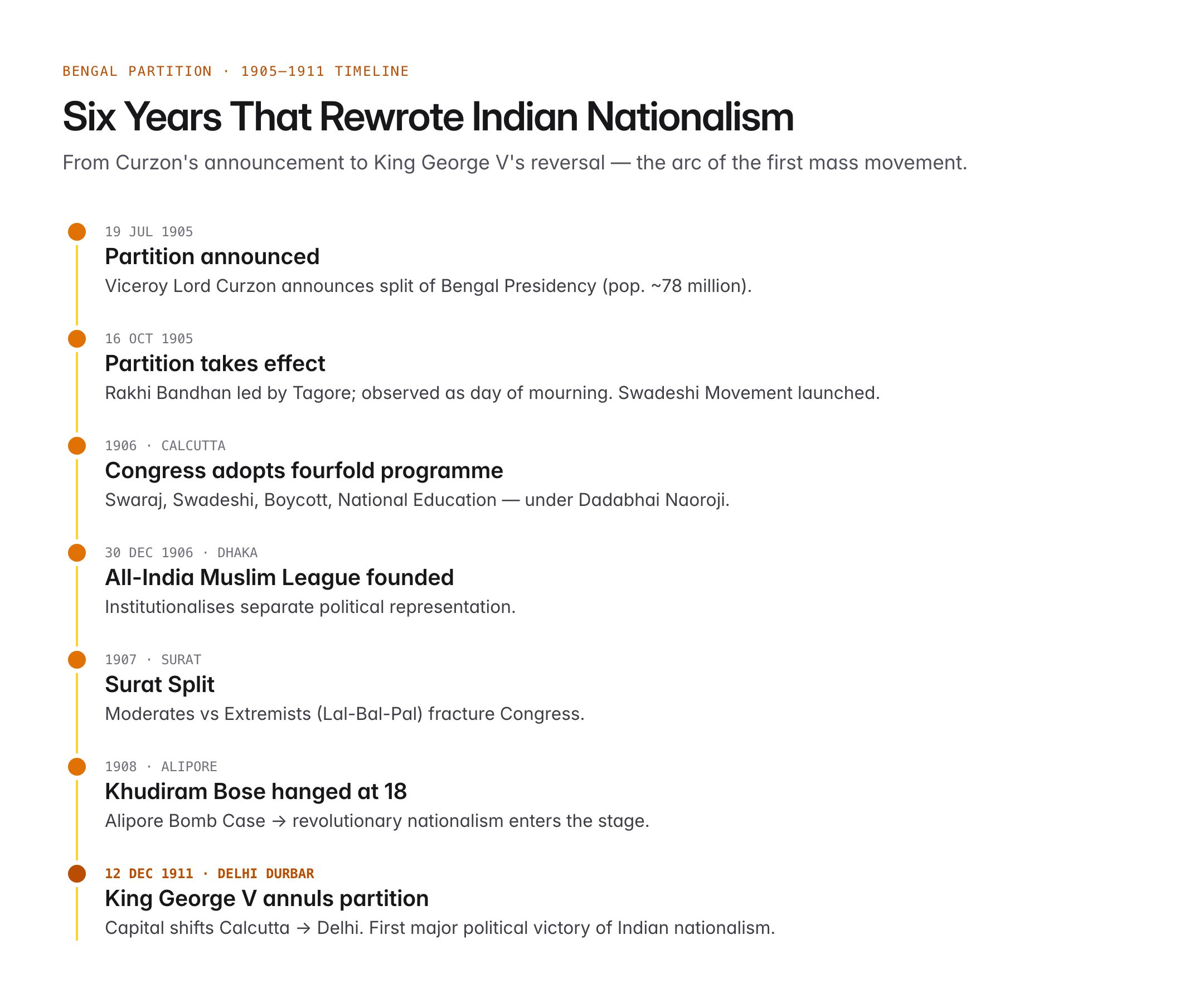
The partition created two administrative units:
| Province | Area | Majority | Capital |
|---|---|---|---|
| Bengal (west) | West Bengal, Bihar, Odisha | Hindu | Calcutta |
| Eastern Bengal and Assam | East Bengal, Assam | Muslim | Dhaka |
Key features:
- The new province of Eastern Bengal and Assam had a Muslim-majority population of about 31 million.
- Bengal proper remained under a Lieutenant Governor.
- The partition was announced on 19 July 1905 and implemented on 16 October 1905, observed by nationalists as a day of mourning.
The Swadeshi and Boycott Movement
The partition triggered the first mass nationalist movement in modern India, known as the Swadeshi Movement (1905–1911).
Key features of the movement:
- Boycott of British goods, especially cloth, salt, and sugar
- Promotion of Indian-made goods (swadeshi), weaving, and indigenous industries
- National education through new institutions like the National Council of Education (1906) and Bengal National College with Aurobindo Ghosh as principal
- Cultural assertion: Rabindranath Tagore composed "Amar Sonar Bangla" (later the national anthem of Bangladesh) and led the Rakhi Bandhan tying between Hindus and Muslims on 16 October 1905 as a symbol of unity
- Samitis and volunteer corps like the Anushilan Samiti spread across Bengal
Leaders associated with the movement include Bipin Chandra Pal, Aurobindo Ghosh, Surendranath Banerjee, Ashwini Kumar Dutt, Lala Lajpat Rai, and Bal Gangadhar Tilak. The slogan "Vande Mataram" became the movement's battle cry.
Congress Response and the Surat Split
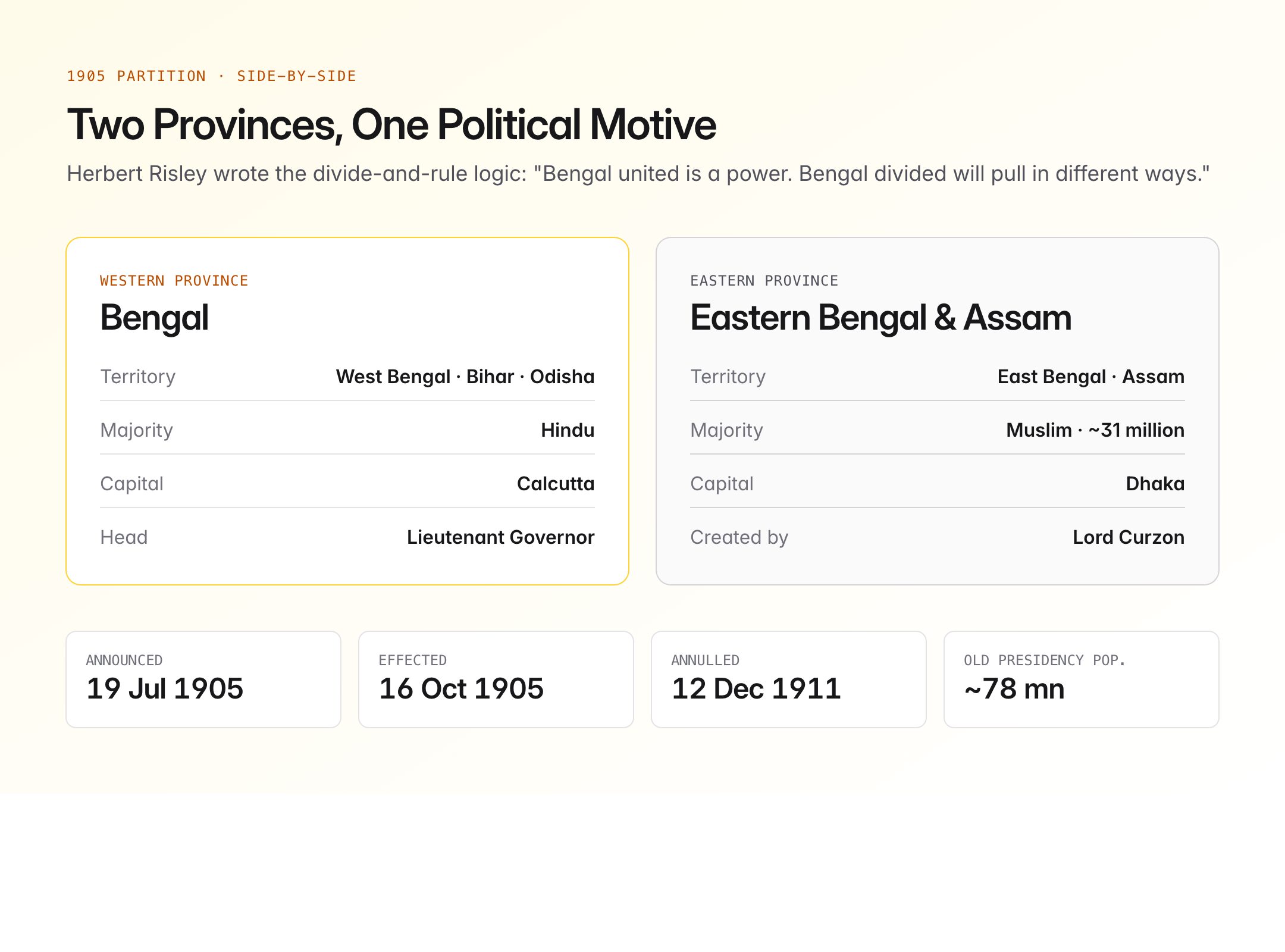
The Indian National Congress endorsed Swadeshi at its Banaras Session (1905) under Gopal Krishna Gokhale and more forcefully at the Calcutta Session (1906) under Dadabhai Naoroji, where the fourfold goals were declared: Swaraj, Swadeshi, Boycott, and National Education.
The methods of struggle polarised the Congress:
- Moderates (Gokhale, Pherozeshah Mehta) wanted peaceful petitioning.
- Extremists (Tilak, Bipin Chandra Pal, Lala Lajpat Rai — the "Lal-Bal-Pal" trio) wanted mass agitation and direct action.
The divergence culminated in the Surat Split of 1907, which weakened the movement temporarily.
Rise of Revolutionary Nationalism
The perceived failure of constitutional methods pushed a section of youth toward revolutionary activity.
- Anushilan Samiti (Calcutta, 1902) and Jugantar (1906) emerged as revolutionary groups.
- The Alipore Bomb Case (1908) followed the attempt by Khudiram Bose and Prafulla Chaki to kill Magistrate Kingsford at Muzaffarpur.
- Khudiram Bose was hanged in 1908 at age 18, becoming an icon of revolutionary nationalism.
Communal Impact and the Muslim League
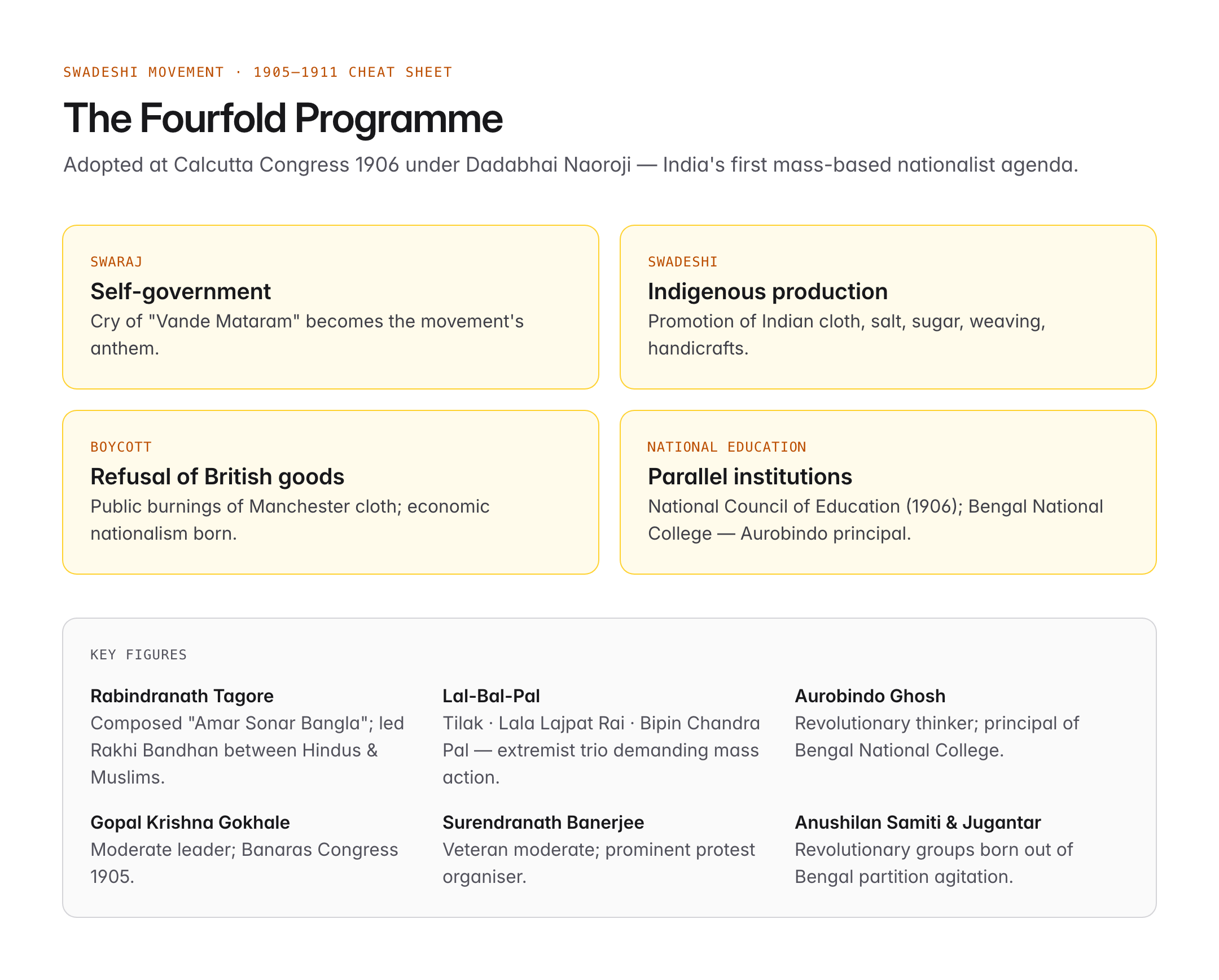
The partition had lasting communal consequences.
- Curzon's administration actively courted Muslim elites in Eastern Bengal, promising them advancement in jobs and education.
- The All India Muslim League was founded in Dhaka on 30 December 1906, partly in response to Hindu-dominated Swadeshi agitation and to protect Muslim interests.
- This institutionalised separate political representation, a trend that would intensify with the Morley-Minto Reforms of 1909 and separate electorates.
Annulment of the Partition
The sustained agitation and global condemnation made the partition untenable.
- On 12 December 1911, at the Delhi Durbar, King George V announced the annulment of the partition of Bengal.
- Bengal, Bihar, and Odisha were reorganised: Bihar and Odisha became a separate province (1912); Assam reverted to a Chief Commissioner's province.
- The capital of British India was shifted from Calcutta to Delhi (new capital commissioned in 1911, inaugurated as New Delhi in 1931).
The annulment is widely regarded as the first major political victory of Indian nationalism, demonstrating that organised mass agitation could reverse imperial decisions.
Significance in Indian History
- Marked the beginning of mass-based nationalism moving beyond moderate petitioning.
- Introduced economic nationalism through the Swadeshi idea.
- Fostered indigenous industry, literature, and education.
- Sowed the seeds of communal politics and separate electorates.
- Shifted the capital of British India to Delhi.
- Laid the ideological groundwork later drawn upon by Gandhian non-cooperation (1920) and civil disobedience (1930).
UPSC Relevance
Prelims focus:
- Date of partition (16 October 1905), announcement (19 July 1905), annulment (12 December 1911)
- Viceroy – Lord Curzon; annulled under Lord Hardinge
- Capitals: Calcutta (Bengal), Dhaka (Eastern Bengal and Assam)
- Founding of Muslim League at Dhaka, 1906; Surat Split 1907
- Leaders and figures: Tagore, Aurobindo, Tilak, Bipin Chandra Pal, Surendranath Banerjee
Mains GS angle (GS Paper I – Modern History):
- Partition of Bengal as a turning point in India's national movement
- Role of Swadeshi in economic and cultural nationalism
- Divide-and-rule policy and the roots of communalism
- Shift from moderate to extremist methods in the Congress
Sample PYQ angle: UPSC has previously asked about the aims of the Swadeshi Movement, the Surat Split, and the significance of the Bengal partition. Expect analytical questions linking Swadeshi economic ideas to later Gandhian thought.