Jagannath Rath Yatra: History, Rituals, Significance and Cultural Importance
Jagannath Rath Yatra is Puri's grand chariot festival. Explore its history, rituals, temple traditions, cultural significance and UPSC relevance.
Introduction
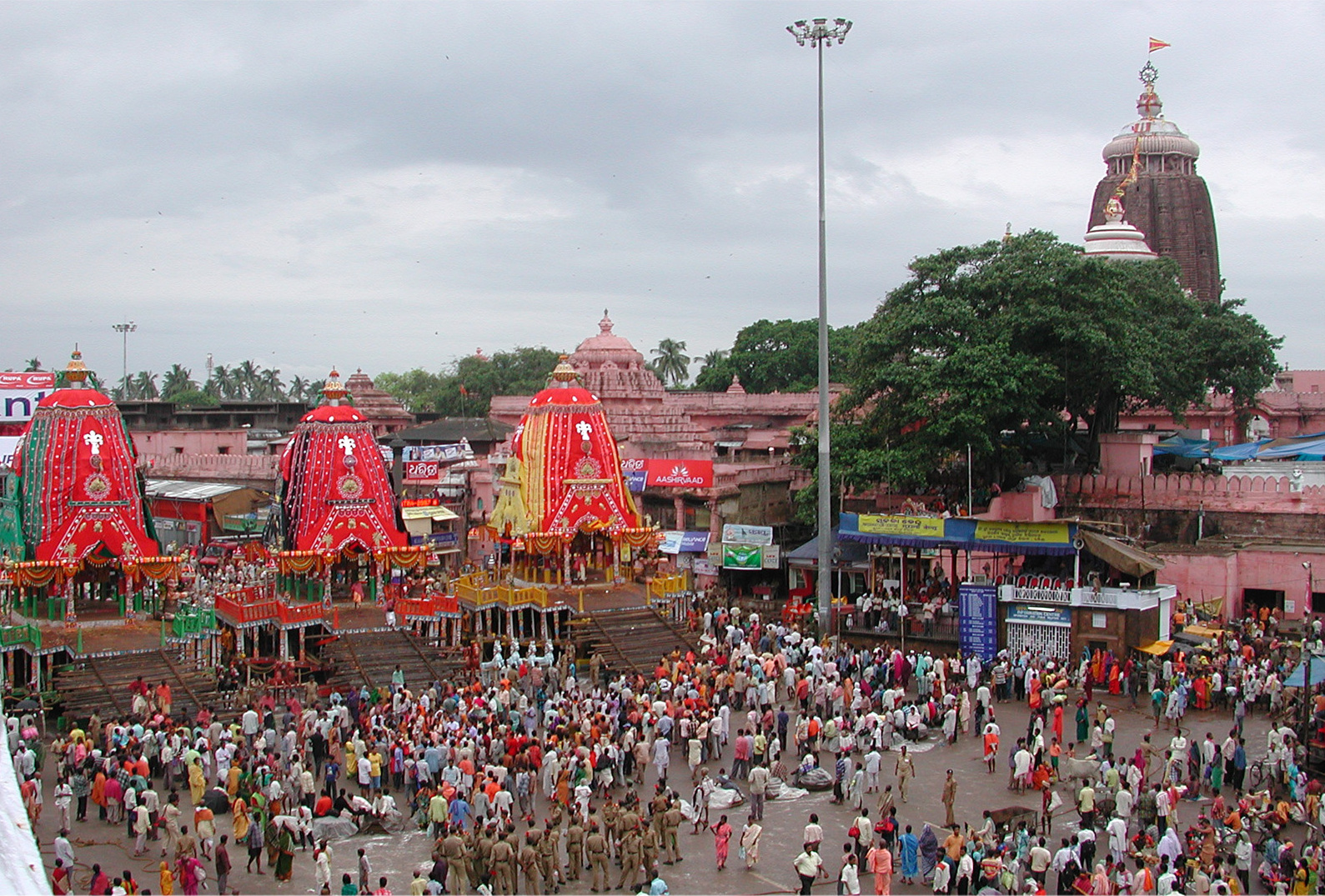
Every summer, a coastal town in Odisha pauses its routine for a festival that is part pilgrimage, part civic spectacle and part living museum of medieval India. The Rath Yatra, literally the chariot journey, sees Lord Jagannath, his elder brother Balabhadra and sister Subhadra leave the sanctum of the Shree Jagannath Temple in Puri and travel by enormous wooden chariots to the Gundicha Temple, roughly three kilometres away. The sight of the three towering chariots, each hand-built afresh every year and pulled by thousands of devotees, has become one of India’s most recognisable cultural images.
For a UPSC aspirant, the Rath Yatra is more than colour and crowd. It connects art and architecture of the Kalinga school, the ritual economy of a major pilgrimage town, the evolution of Bhakti traditions, the reach of the Indian diaspora and contemporary debates on temple management, heritage conservation and tourism. The festival sits at the intersection of GS Paper 1 topics of Indian culture and heritage and GS Paper 2 themes of governance and tourism policy.
Quick Facts at a Glance
| Attribute | Detail |
|---|---|
| Main festival | Rath Yatra of Lord Jagannath |
| Primary location | Puri, Odisha |
| Calendar date | Ashadha Shukla Dwitiya (June or July) |
| Duration | Nine days, from the journey to Gundicha Temple to the return journey |
| Presiding deities | Jagannath, Balabhadra, Subhadra and Sudarshana |
| Chariots | Nandighosha (Jagannath), Taladhwaja (Balabhadra), Darpadalana (Subhadra) |
| Temple | Shree Jagannath Temple, 12th century, part of the Char Dham |
| Built by | Eastern Ganga dynasty king Ananta Varman Chodaganga Deva |
| UNESCO status | Konark Sun Temple nearby is a UNESCO World Heritage Site |
| Legal framework | Sri Jagannath Temple Act, 1955 (Odisha) |
Background and Historical Context
The Jagannath tradition is widely regarded as a synthesis of tribal, Vedic, Puranic and Buddhist elements. Scholars trace the roots of the deity to an older tribal cult of Nila Madhava worshipped by the Sabaras, an indigenous community of eastern India. Over centuries this cult was absorbed into the Vaishnava mainstream, with Jagannath identified as a form of Krishna or Vishnu.
The present Shree Jagannath Temple in Puri was built in the 12th century by Ananta Varman Chodaganga Deva of the Eastern Ganga dynasty and completed during the reign of his successor Anangabhima Deva III. The temple complex is an exemplar of the Kalinga style of temple architecture, with its four structural units of Vimana, Jagamohana, Natamandira and Bhogamandapa aligned on a single axis. Puri became one of the four Char Dhams recognised by Adi Shankaracharya in the eighth century, and the Rath Yatra became a popular public ritual where caste and gender distinctions were softened, because devotees could see and touch the deities outside the sanctum.
The festival also acquired a political dimension. The Gajapati kings of Odisha, as first servants of Jagannath, performed the Chhera Pahara, the ritual sweeping of the chariots, an act of royal humility that symbolically placed the divine above the crown. Bhakti saints such as Sri Chaitanya Mahaprabhu popularised Jagannath devotion in the 16th century. During the colonial era, the East India Company for a time collected a pilgrim tax, a practice that later drew strong criticism and was withdrawn. The International Society for Krishna Consciousness, founded by A C Bhaktivedanta Swami Prabhupada in 1966, carried Rath Yatra processions to London, New York and dozens of other cities from 1967 onwards, giving the festival a global footprint.
Key Rituals and Features
Construction of the Chariots
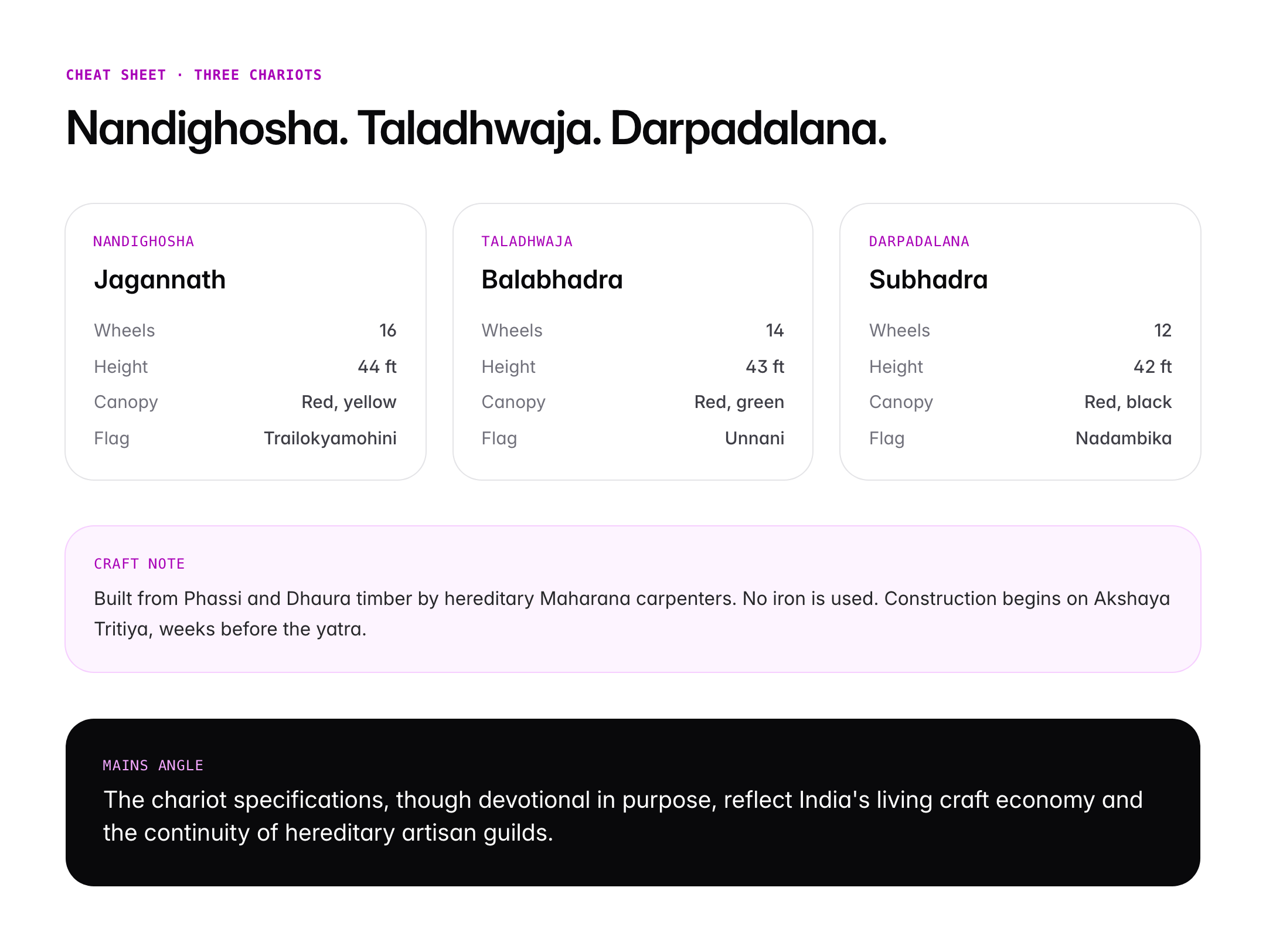
The three chariots are rebuilt each year from a fresh batch of timber, primarily Phassi and Dhaura trees felled in designated forests of Odisha. Work begins on Akshaya Tritiya and involves hereditary carpenter and artisan lineages known as Maharanas, Bhois and Ojha Maharanas. No iron is used in the construction. Each chariot has a fixed number of wheels: Nandighosha has sixteen, Taladhwaja fourteen and Darpadalana twelve, each with a specified colour code for the canopy.
The Snana Purnima
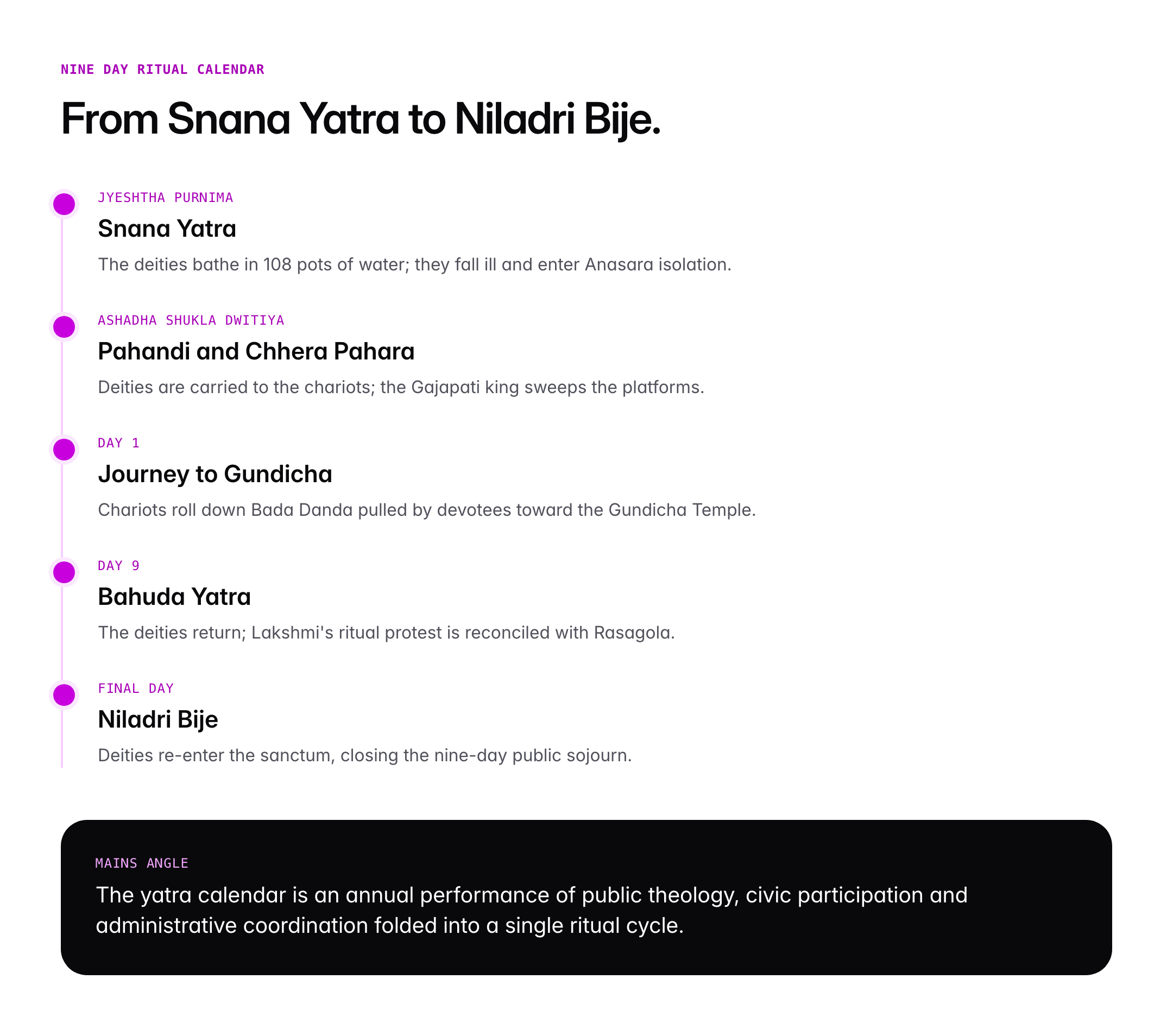
Fifteen days before the yatra, on the full moon of Jyeshtha, the deities are bathed with 108 pots of water in the Snana Yatra. They are then believed to fall ill and are kept in isolation during a period called Anasara, during which only the Daitapati servitors attend to them. The deities return for public darshan on the day of the yatra.
The Journey to Gundicha Temple
On Ashadha Shukla Dwitiya, the deities are brought out in the Pahandi ritual, a slow swaying procession to the chariots. The Gajapati king performs the Chhera Pahara, sweeping the chariot platforms with a gold-handled broom. Thousands of devotees then pull the chariots along the Bada Danda or Grand Road to the Gundicha Temple, where the deities stay for seven days. This sojourn is described in tradition as their visit to their aunt’s home.
The Bahuda Yatra and Niladri Bije
The return journey, known as the Bahuda Yatra, takes the deities back to the main temple. A ritualised argument between Jagannath and goddess Lakshmi at the temple gate, followed by the offering of Rasagola, ends in her forgiveness. The final entry of the deities into the sanctum is called Niladri Bije.
Significance for UPSC and General Knowledge
- Prelims questions on Indian festivals, temple architecture and Bhakti traditions often feature Jagannath, Puri and the Char Dham.
- GS Paper 1 Mains questions on Indian culture can use Jagannath tradition as a case of syncretism between tribal, Vedic and Buddhist strands.
- Debates on temple administration, the Sri Jagannath Temple Act and entry rights for non-Hindus raise governance and constitutional questions for GS Paper 2.
- Tourism circuits such as the Swadesh Darshan and PRASHAD schemes cover Puri and the Jagannath temple, making the festival a policy case study.
- Essay and interview candidates can draw on the yatra to discuss social cohesion, festival economies and heritage preservation.
Detailed Analysis: Culture, Economy and Governance
The Jagannath cult is an unusually open framework within Hindu tradition. The wooden images, the inclusion of a goddess as the third principal deity, the absence of iron in chariot construction and the annual renewal of the deities through the Nabakalebara ceremony all reflect a tradition that has internalised tribal and pre-Brahmanical elements. Historians such as Hermann Kulke and G C Tripathi argue that the Puri tradition is a deliberate construction of royal, Brahmin and tribal stakeholders, each essential to the functioning of the temple.
The festival is also an economic engine. Puri’s economy during Ashadha is driven by lodging, food, transport, craft markets and flower trade. The district administration coordinates with the Shree Jagannath Temple Administration, the Odisha Police, the Indian Railways, the Archaeological Survey of India and central agencies such as the National Disaster Response Force to manage crowds that routinely exceed one million on the main day. Over the past decade the state has invested in the Shree Jagannath Heritage Corridor project to widen the Bada Danda, improve pedestrian flow and restore the temple precinct.
Governance questions remain alive. The Sri Jagannath Temple Act, 1955 vests management in a governing body with the Gajapati king as chairperson. Several episodes, including debates over the entry of non-Hindus into the temple, the rights of servitors and the Ratna Bhandara inventory, have reached the Odisha High Court and Supreme Court. The Nabakalebara, where the wooden bodies of the deities are replaced in years when Ashadha has an additional lunar month, involves the selection of sacred Daru Brahma trees and is itself a coordinated exercise of state, forest department and temple officials.
The diaspora dimension is equally noteworthy. ISKCON’s Rath Yatra chapters in London, New York, Toronto and dozens of other cities have turned the festival into a marker of cultural diplomacy for India, often attended by local mayors and multicultural communities. This global projection has encouraged academic interest in the iconography and ritual grammar of the Puri tradition.
Comparative Perspective
| Festival | Location | Core Deity | Key Feature |
|---|---|---|---|
| Puri Rath Yatra | Puri, Odisha | Jagannath, Balabhadra, Subhadra | Three wooden chariots rebuilt annually |
| Mahesh Rath Yatra | Serampore, West Bengal | Jagannath | Second oldest yatra, since 1396 CE |
| Ahmedabad Rath Yatra | Ahmedabad, Gujarat | Jagannath | Largest urban yatra outside Puri |
| Kumbh Mela | Prayagraj, Haridwar, Ujjain, Nashik | Ganga, Shipra, Godavari | Bathing ritual at river confluences |
| Thrissur Pooram | Thrissur, Kerala | Vadakkunnathan | Caparisoned elephants and percussion |
What sets the Puri Rath Yatra apart is the combination of an open-air procession, annually rebuilt chariots, and an iconography with clear tribal and syncretic roots. The festival therefore serves as a cultural ambassador for Odisha in a way few others do.
Controversies and Debates
The Rath Yatra is not free of contestation. Crowd safety remains a permanent concern after periodic stampedes, and the state and central agencies invest heavily in barricading, real-time monitoring and emergency medical response. Disputes over the rights of sevayats, the hereditary temple servitors, surface regularly and touch on questions of labour, caste and livelihoods.
A longstanding debate concerns the entry of non-Hindus into the Shree Jagannath Temple, restricted by tradition. Advocates see this as a matter of religious custom protected under Article 26; critics argue that the restriction sits uneasily with constitutional values of equality. The status of the Ratna Bhandara, the temple treasury, has also drawn judicial attention, with recent inventories conducted after decades of delay. Finally, conservationists have warned about pressures on the temple’s structural health from footfall and the impact of the corridor project on heritage precincts, leading to regulatory oversight by the Archaeological Survey of India.
Prelims Pointers
- Rath Yatra is celebrated on Ashadha Shukla Dwitiya, in June or July.
- The three chariots are Nandighosha, Taladhwaja and Darpadalana.
- Nandighosha, Jagannath’s chariot, has sixteen wheels.
- Puri is one of the Char Dhams identified by Adi Shankaracharya.
- The Jagannath temple was built by Ananta Varman Chodaganga Deva in the 12th century.
- The Gajapati king performs the Chhera Pahara ritual on the chariots.
- The deities’ renewal ritual is called Nabakalebara.
- The temple is governed by the Sri Jagannath Temple Act of 1955.
- Mahesh Rath Yatra in West Bengal is the second oldest after Puri.
- ISKCON has organised Rath Yatra processions globally since 1967.
- The first bath festival before the yatra is the Snana Yatra on Jyeshtha Purnima.
- The return journey is called the Bahuda Yatra, concluding with Niladri Bije.
Mains Practice Questions
- The Jagannath tradition of Puri represents a remarkable syncretism of tribal, Vedic and Buddhist strands. Discuss with reference to the iconography, rituals and history of the Rath Yatra.
- Trace tribal Sabara origins and absorption into Vaishnavism.
- Explain iconographic and ritual features: wooden deities, Nabakalebara, open procession.
- Link to Bhakti movement and saintly figures such as Sri Chaitanya.
- “Major religious festivals in India are both cultural expressions and complex governance challenges.” Evaluate this statement using the Puri Rath Yatra as a case study.
- Map the crowd management, heritage conservation and safety apparatus.
- Discuss the Sri Jagannath Temple Act and the role of the Gajapati king.
- Cover the tourism and diaspora dimension and contemporary debates on access.
Conclusion
The Rath Yatra of Puri is one of the oldest continuously celebrated public festivals in the world. It is simultaneously a theological statement about a god who steps out to meet his devotees, an administrative exercise in heritage and crowd management, and a cultural flagship that Odisha projects to the world. Its wooden chariots, rebuilt each year without a single iron nail, embody a society that renews its traditions without losing their continuity.
For the aspirant, the festival is a ready-made case study in cultural pluralism, Bhakti devotion, temple architecture, governance of religious institutions and soft power through diaspora. Understanding its layered history helps build the kind of contextual depth that marks out strong answers in GS Paper 1 and the essay.
Frequently Asked Questions
What is the Rath Yatra?
The Rath Yatra is the annual chariot festival of Lord Jagannath at Puri in Odisha, during which Jagannath, his brother Balabhadra and sister Subhadra travel on three wooden chariots from the Shree Jagannath Temple to the Gundicha Temple and back after nine days. The chariots are rebuilt each year and pulled by thousands of devotees.
Why is the Rath Yatra important for UPSC?
The festival is an important case study for GS Paper 1 on Indian culture, temple architecture of the Kalinga school, the Bhakti movement and syncretism between tribal and Vedic traditions. For GS Paper 2 and governance, it illustrates temple administration, heritage conservation, tourism policy and crowd management, making it useful across Prelims, Mains and essay topics.
How is the Rath Yatra related to the Bhakti movement?
The Jagannath cult became a major centre of Krishna Bhakti, especially after Sri Chaitanya Mahaprabhu made Puri his base in the 16th century. The open-air procession allowed devotees across caste lines to see and touch the deities, which was in line with the Bhakti emphasis on direct, personal devotion over exclusive temple rituals controlled by priests.
Who built the Jagannath Temple at Puri?
The Shree Jagannath Temple at Puri was built in the 12th century by Ananta Varman Chodaganga Deva of the Eastern Ganga dynasty and completed during the reign of his successor Anangabhima Deva III. It is one of the finest examples of Kalinga style temple architecture and one of the four Char Dhams recognised by Adi Shankaracharya.
What are the names of the three Rath Yatra chariots?
The three chariots are Nandighosha for Lord Jagannath with sixteen wheels, Taladhwaja for Balabhadra with fourteen wheels, and Darpadalana for Subhadra with twelve wheels. Each has a specific colour code for its canopy and is rebuilt every year from freshly cut timber without using any iron nails or fittings.
What is the Nabakalebara ceremony?
Nabakalebara, meaning new body, is the periodic renewal ritual in which the wooden images of Jagannath, Balabhadra, Subhadra and Sudarshana are replaced with fresh bodies carved from sacred Daru Brahma trees. It takes place in years when the Ashadha month has an additional lunar month and involves coordinated participation of temple servitors, forest officials and state authorities.
What is the Chhera Pahara ritual?
Chhera Pahara is the ceremonial sweeping of the three chariots performed by the Gajapati king of Puri before the yatra begins. The king, despite his royal status, sweeps the chariot platforms with a gold-handled broom and sprinkles sandalwood water. The act symbolises humility, placing the deity above the crown and reaffirming the king’s role as first servant of Jagannath.
Where else is the Rath Yatra celebrated?
Beyond Puri, the Mahesh Rath Yatra at Serampore in West Bengal is the second oldest, dating to 1396 CE, and Ahmedabad hosts the largest urban yatra outside Odisha. Globally, the International Society for Krishna Consciousness has organised Rath Yatra processions in cities including London, New York, Toronto and Sydney since 1967, carrying the tradition to the Indian diaspora.