Republic Day 2026: History, Significance, Chief Guest and Parade
Republic Day 2026 explained: the history of 26 January, its constitutional significance, the 2026 chief guest and the Kartavya Path parade, with UPSC-ready note
Introduction
Every 26 January the Republic of India renews its own origin story. On this day in 1950 the Constitution of India came into force, replacing the Government of India Act of 1935 as the fundamental law of the land and turning a newly independent country into a sovereign democratic republic. Republic Day is therefore not merely a ceremonial date but the anniversary of the moment at which the Indian people formally gave themselves a Constitution drafted by the Constituent Assembly under the chairmanship of Dr B R Ambedkar.
This note walks through what Republic Day commemorates, how the parade is organised, who serves as chief guest and why, and what a civil services aspirant should know for both Prelims and Mains. The most-searched queries cluster around the date, the history, the chief guest of the year and the parade route along Kartavya Path. We address each in turn, keeping the focus on the 2026 edition while placing it in the longer arc of seventy-six Republic Days.
Quick Facts at a Glance
| Attribute | Detail |
|---|---|
| First Republic Day | 26 January 1950 |
| 2026 Edition | 77th Republic Day of India |
| Parade Venue | Kartavya Path (formerly Rajpath), New Delhi |
| Duration of Parade | Approximately 90 minutes |
| Salute Taken By | President of India, as Supreme Commander of the Armed Forces |
| Chief Guest 2026 | Announced annually by the Ministry of External Affairs |
| Final Beating Retreat | 29 January at Vijay Chowk |
| Constitution in Force From | 26 January 1950 |
| Constitution Drafting Committee Chair | Dr B R Ambedkar |
Background and Historical Context
The date 26 January has a pre-1950 history that explains why it was chosen to inaugurate the Republic rather than 15 August, the date of Independence. At the Lahore session of the Indian National Congress in December 1929, under the presidency of Jawaharlal Nehru, the Congress passed the Purna Swaraj resolution demanding complete independence from British rule. On 26 January 1930 Indians across the country took a pledge of Purna Swaraj at public gatherings. Every 26 January from 1930 to 1947 was observed as Independence Day by the national movement.
When India actually became independent on 15 August 1947, the date that had symbolised the aspiration for decades needed a new home. The Constituent Assembly, which had begun work on 9 December 1946, completed the drafting of the Constitution by 26 November 1949, a date now marked as Constitution Day or Samvidhan Divas. The Assembly deliberately postponed the commencement of the Constitution by two months so that it could come into force on 26 January 1950, honouring the Purna Swaraj pledge of two decades earlier.
On that first Republic Day, Dr Rajendra Prasad was sworn in as the first President of India at the Durbar Hall of Rashtrapati Bhavan and then drove in a procession to the Irwin Stadium, now the Major Dhyan Chand National Stadium, to receive the first Republic Day parade. From 1955 onwards the parade has been held at Rajpath, renamed Kartavya Path in 2022 as part of the Central Vista redevelopment.
Key Features of Republic Day 2026
Date, Venue and 77th Edition
Republic Day 2026 falls on Monday, 26 January 2026, and marks the 77th anniversary of the commencement of the Constitution. The main parade is held at Kartavya Path, from Vijay Chowk to India Gate, and continues to the Red Fort for the cultural tableau procession.
The Parade
The parade is commanded by the General Officer Commanding Delhi Area and paraded by the Parade Commander. It begins with the President, as Supreme Commander, unfurling the national flag and taking the salute. The parade is structured into four blocks:
- The awards segment, in which gallantry awards such as the Ashoka Chakra, Kirti Chakra and Shaurya Chakra are presented, along with children’s bravery awards.
- The tri-services contingent, showcasing the Indian Army, Navy and Air Force with their bands, tanks, missiles, anti-aircraft systems and drone formations.
- The state tableaux and ministry tableaux, reflecting the theme of the year. Recent themes have included Nari Shakti, Viksit Bharat and India as Mother of Democracy.
- The cultural performances by schoolchildren from across the country, followed by the flypast by the Indian Air Force.
Chief Guest
The chief guest at Republic Day is the highest protocol honour India extends to a visiting dignitary. The practice began in 1950 with Indonesian President Sukarno as the first chief guest. Chief guests are decided by the Ministry of External Affairs in consultation with the Prime Minister’s Office, factoring in strategic partnerships, regional priorities and ongoing bilateral commitments. The 2025 edition hosted President Prabowo Subianto of Indonesia, returning to the relationship inaugurated with Sukarno 75 years earlier. The chief guest for 2026 is announced by the Ministry of External Affairs in the weeks leading up to the event.
Beating Retreat
The celebrations culminate on 29 January with the Beating Retreat ceremony at Vijay Chowk, performed by the bands of the three services and the paramilitary forces. The ceremony traces its roots to 17th-century European military practice and formally signals the end of Republic Day festivities.

Significance for UPSC and General Knowledge
- The choice of 26 January 1950 links the Republic directly to the Purna Swaraj resolution of 1929, an important GS Paper 1 connection between the nationalist movement and the constitutional founding.
- Republic Day is an anchor topic for GS Paper 2 discussions on the Constitution of India, the transition from Dominion status to Republic, and the role of the Constituent Assembly.
- Chief-guest patterns reflect India’s foreign policy priorities each year and feed into GS Paper 2 international relations questions on strategic partnerships.
- The parade’s display of indigenous defence platforms under the Atmanirbhar Bharat push is a useful case point in GS Paper 3 internal security and defence modernisation.
- Gallantry awards presented on the day are Prelims-relevant factual material for civil-military relations and national honours.
Detailed Analysis: Constitutional Significance
Republic Day commemorates more than a ceremonial transition. At midnight on 25-26 January 1950 India ceased to be a Dominion under the British Crown and became a sovereign, democratic republic, severing the last formal link with the British monarchy. The Governor-General of India, C Rajagopalachari, stepped down and Dr Rajendra Prasad took oath as the first President under the new Constitution.
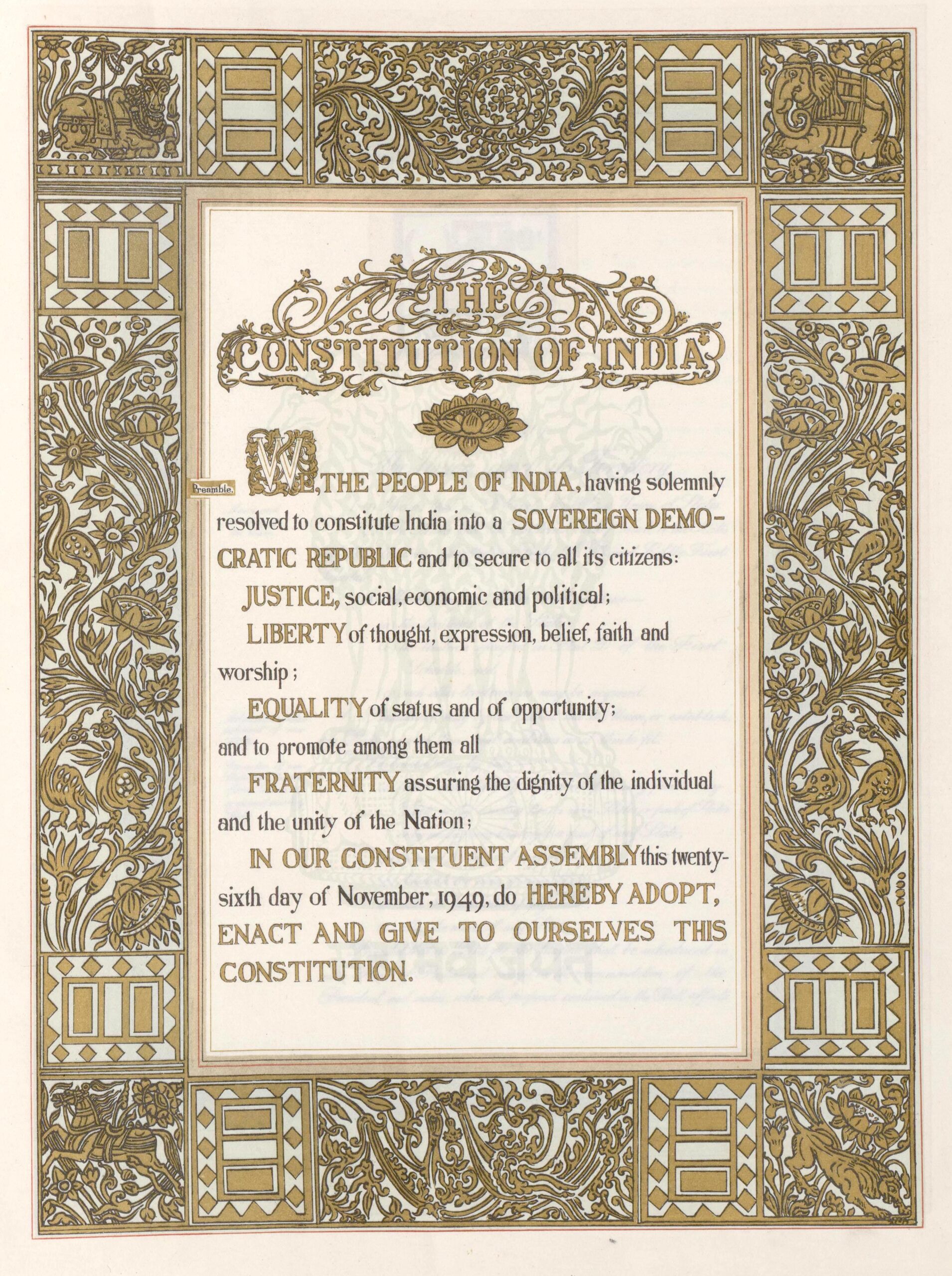
The Constitution that came into force was the longest written Constitution in the world, with 395 Articles, 22 Parts and 8 Schedules at the time of commencement; it now has over 470 Articles and 12 Schedules following successive amendments. The Preamble declares India a Sovereign Socialist Secular Democratic Republic, with the words socialist and secular inserted by the 42nd Amendment in 1976. Republic Day is the anniversary of the promulgation of this Preamble and of the machinery that flows from it, including the Parliament, the President, the Supreme Court and the federal structure under Part XI.
The day also marks the operational start of Part III on Fundamental Rights and Part IV on Directive Principles of State Policy, the dual engines of Indian constitutional morality. Every Republic Day address by the President, read in the Durbar Hall on the eve of the day, refers back to these commitments. The 2026 address will be delivered by the incumbent President and is a primary-source document worth reading in full for Mains preparation.
From a foreign policy perspective, the chief guest list reads like a chronological map of Indian diplomatic priorities. Early chief guests included Sukarno of Indonesia in 1950, Nehru-era partners from Yugoslavia and Egypt, and the leaders of the Non-Aligned Movement. In recent years the list has included Presidents of the United States, France, South Africa, Brazil and Egypt, as well as leaders of ASEAN countries and Central Asian republics, reflecting the Indo-Pacific focus, the Act East and Link West policies, and the Neighbourhood First doctrine.
Comparative Perspective
| Day | Date | Commemorates | Venue | Flag Hoisted By |
|---|---|---|---|---|
| Republic Day | 26 January | Constitution coming into force, 1950 | Kartavya Path, New Delhi | President of India |
| Independence Day | 15 August | Independence from British rule, 1947 | Red Fort, New Delhi | Prime Minister of India |
| Constitution Day | 26 November | Adoption of the Constitution by the Assembly, 1949 | Parliament and institutions across India | Various |
| Gandhi Jayanti | 2 October | Birth of Mahatma Gandhi, 1869 | Raj Ghat, New Delhi | Homage, no flag unfurling |
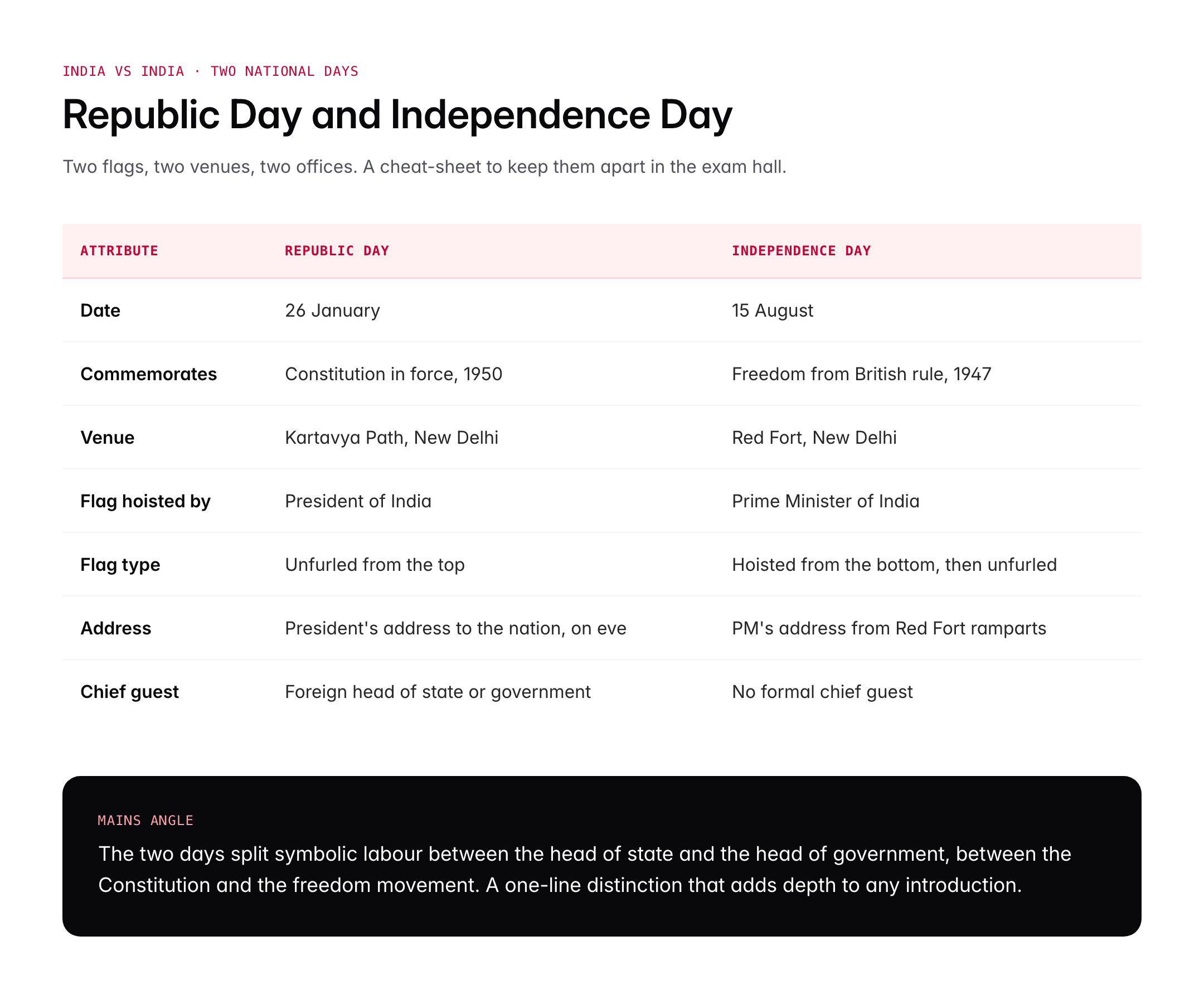
The table shows the deliberate division of symbolic labour between Republic Day and Independence Day. The President unfurls the flag on Republic Day as head of state to honour the Constitution; the Prime Minister hoists the flag on Independence Day as head of government to honour the political movement that delivered freedom.
Challenges and Criticisms
The scale of the Republic Day parade has attracted debate. Critics argue that the extensive deployment of military hardware reflects a military-parade tradition that sits uneasily with India’s constitutional commitment to peace. Defenders counter that a display of defence capability on the day that commemorates the Republic’s founding is appropriate in a region facing active security challenges on two borders.
The renaming of Rajpath to Kartavya Path in 2022, along with the broader Central Vista redevelopment, raised concerns about heritage conservation, public consultation and the cost of ceremonial architecture during a pandemic recovery. Climate scientists have also flagged Delhi air quality in late January, noting that winter inversions and stubble burning residue make the parade one of the most polluted set-piece events in the government calendar. Adjustments to parade timings and pedestrian flows have been discussed in recent years.
Prelims Pointers
- The Constitution of India came into force on 26 January 1950.
- Republic Day 2026 is the 77th Republic Day of India.
- The first Republic Day parade was held at Irwin Stadium, now Major Dhyan Chand Stadium.
- President Sukarno of Indonesia was the first chief guest at Republic Day in 1950.
- The drafting of the Constitution was completed on 26 November 1949, now Constitution Day.
- Dr B R Ambedkar chaired the Drafting Committee of the Constituent Assembly.
- Rajpath was renamed Kartavya Path on 8 September 2022.
- The President of India takes the salute at the Republic Day parade as Supreme Commander.
- Beating Retreat is held on 29 January at Vijay Chowk.
- The Purna Swaraj resolution was passed by the Congress on 19 December 1929 at Lahore.
- The Preamble was amended by the 42nd Amendment in 1976 to add socialist and secular.
- Ashoka Chakra, Kirti Chakra and Shaurya Chakra are conferred on Republic Day.
Mains Practice Questions
Q1. Discuss the constitutional and historical significance of 26 January as Republic Day, distinguishing it from Independence Day. How does the choice of this date link the Constitutional founding to the nationalist movement? (10 marks, 150 words)
- Trace the Purna Swaraj pledge of 26 January 1930 and its observance through 1947.
- Contrast constitutional commencement on 26 January 1950 with political independence on 15 August 1947.
- Conclude with the symbolic unity of the nationalist and constitutional projects.
Q2. “The Republic Day chief guest is an instrument of Indian foreign policy as much as a ceremonial honour.” Examine with reference to recent invitations. (15 marks, 250 words)
- Outline the MEA’s criteria, including strategic partnerships and regional priorities.
- Analyse recent chief guests from Indonesia, Egypt, France and ASEAN.
- Conclude on how the invitation signals India’s evolving diplomatic posture.
Conclusion
Republic Day is the founding anniversary of the idea that Indians are citizens before they are subjects, governed by a Constitution they have given themselves. The Kartavya Path parade, the Beating Retreat at Vijay Chowk and the President’s address to the nation are choreographed reminders of that first morning of 1950. Behind the ceremony stands the Constituent Assembly’s three-year labour, the Purna Swaraj pledge of 1930 and a republic that has endured wars, an Emergency, and many decades of democratic contest.
For a civil services aspirant, the day is an entry point into almost every major constitutional topic. A working understanding of its origins, its institutions and its place in Indian diplomacy will serve both the facts-heavy questions of Prelims and the argument-heavy questions of Mains. Republic Day 2026 marks the 77th year of this unbroken constitutional chain, and each parade is a public audit of the Republic’s self-image.
Frequently Asked Questions
What is Republic Day and why is it celebrated on 26 January?
Republic Day commemorates the coming into force of the Constitution of India on 26 January 1950, which transformed India from a British Dominion into a sovereign democratic republic. The date was chosen to honour the Purna Swaraj resolution passed by the Indian National Congress at the Lahore session on 19 December 1929, on which 26 January 1930 had been observed as the first Independence Day by the national movement.
Why is Republic Day important for UPSC preparation?
Republic Day connects several core syllabus themes: GS Paper 1 on the Indian freedom struggle through the Purna Swaraj pledge, GS Paper 2 on the Constitution, the Constituent Assembly and the role of the President, and GS Paper 3 on indigenous defence capabilities displayed at the parade. Chief guest choices also reflect foreign policy priorities and surface in international relations questions.
How is Republic Day different from Independence Day and Constitution Day?
Independence Day on 15 August marks the end of British rule in 1947 and is observed with the Prime Minister hoisting the flag at the Red Fort. Constitution Day on 26 November marks the adoption of the Constitution by the Constituent Assembly in 1949. Republic Day on 26 January marks the Constitution coming into force in 1950, with the President unfurling the flag at Kartavya Path as Supreme Commander of the Armed Forces.
Who was the first chief guest on Republic Day?
The first Republic Day chief guest in 1950 was President Sukarno of Indonesia, reflecting the close bonds between the two young post-colonial democracies. The tradition has continued since, with invitations extended by the Ministry of External Affairs to leaders whose countries are of strategic or symbolic importance to India. In 2025 India again hosted an Indonesian leader, President Prabowo Subianto, 75 years after Sukarno’s visit.
What happens during the Republic Day parade at Kartavya Path?
The parade begins with the President unfurling the flag and taking the salute. It features the awards segment, tri-services marching contingents, tanks and missile systems, state and ministry tableaux representing the year’s theme, cultural performances by schoolchildren, motorcycle stunts by military riders and a flypast by the Indian Air Force. The parade moves from Vijay Chowk along Kartavya Path to the Red Fort area.
Why was Rajpath renamed Kartavya Path?
Rajpath, meaning king’s way, was renamed Kartavya Path, meaning duty path, on 8 September 2022 as part of the Central Vista redevelopment. The government cited the shift from the colonial idiom of royal power to the republican idiom of citizens’ duty. The boulevard runs from Rashtrapati Bhavan through India Gate and remains the venue of the Republic Day parade.
What is the Beating Retreat ceremony?
Beating Retreat is held at Vijay Chowk on 29 January each year and formally concludes Republic Day celebrations. Massed bands of the Army, Navy, Air Force and paramilitary forces perform Indian and military compositions against a lit-up Raisina Hill. The tradition traces to 17th-century European practice in which bugles and drums signalled soldiers to withdraw at dusk.
What gallantry awards are presented on Republic Day?
The President presents peacetime gallantry awards on Republic Day including the Ashoka Chakra, the highest peacetime gallantry award, followed by the Kirti Chakra and the Shaurya Chakra. Children’s bravery awards are also announced. Wartime gallantry awards such as the Param Vir Chakra, Maha Vir Chakra and Vir Chakra are announced on the day but typically conferred on other occasions.


