NCERT PDF Downloads for UPSC: Class 7 to 9 Science and Social Science
The complete UPSC-focused guide to NCERT Class 7 to 9 Science and Social Science PDFs, including Matter in Our Surroundings, Democratic Rights and more.
Introduction
Every serious UPSC aspirant begins with the NCERT textbooks for Classes 6 to 12. The older middle-school titles, especially Class 7 to Class 9 Science and Social Science, remain the fastest way to build fundamentals in polity, economics, geography, history and general science. Topics like what is matter class 9, democratic rights, public facilities and on equality appear directly in Prelims general studies, and they are frequently referenced in Mains answer stems.
This guide maps the most searched NCERT chapters and textbooks for Classes 7, 8 and 9, explains where to download the official PDFs, and shows how each title translates into the UPSC syllabus. It is not a dump of links. It is a study plan anchored in a genuinely short list of books.
Quick Facts at a Glance
| Class | Subject | Title | Key Chapters for UPSC |
|---|---|---|---|
| 7 | Social Science (Civics) | Social and Political Life II | On Equality, Role of the Government in Health |
| 7 | Social Science (History) | Our Pasts II | Delhi Sultanate, Mughal Empire, Muhammad Ghori |
| 8 | Social Science (Civics) | Social and Political Life III | Public Facilities, Judiciary, Parliament |
| 9 | Science | Science (NCERT 2024) | Matter in Our Surroundings, Atoms and Molecules |
| 9 | Social Science (Civics) | Democratic Politics I | Democratic Rights, What is Democracy |
| 9 | Social Science (Geography) | Contemporary India I | Drainage, Physical Features, Climate, Tectonic Plates |
| 9 | Social Science (Economics) | Economics | The Story of Village Palampur, Food Security |
Background and Historical Context
The National Council of Educational Research and Training, or NCERT, was established on 1 September 1961 as an autonomous body under the Ministry of Education. Its textbooks are based on a National Curriculum Framework, the most recent of which is the NCF for School Education 2023, rolled out in phases from 2024. New textbooks for Classes 3 and 6 released in 2024 and 2025, but the existing Class 7 to 9 titles remain in use for UPSC preparation until new editions arrive.
UPSC aspirants have used NCERTs as foundation material since at least the mid 1990s, when the Union Public Service Commission started asking increasingly conceptual questions that went beyond the older Manorama style of factual cramming. Coaching institutions standardised the Class 6 to 12 reading list, and it has remained largely unchanged because NCERT revisions have been incremental rather than radical. Even after the 2023 curriculum rewrite, the core Class 7 to 9 titles retain their usefulness.
The NCERT makes every textbook available as a free PDF on its official portal at ncert.nic.in, along with e-pathshala mobile apps and DIKSHA platform downloads. There is no legitimate reason to pay for an NCERT PDF. Third party sites sometimes host modified copies. An aspirant should rely on the official NCERT pages or the NCERT e-textbook app for a clean, complete file.
Key NCERT Titles for UPSC — Class 7 to 9
Class 9 Science — Matter in Our Surroundings
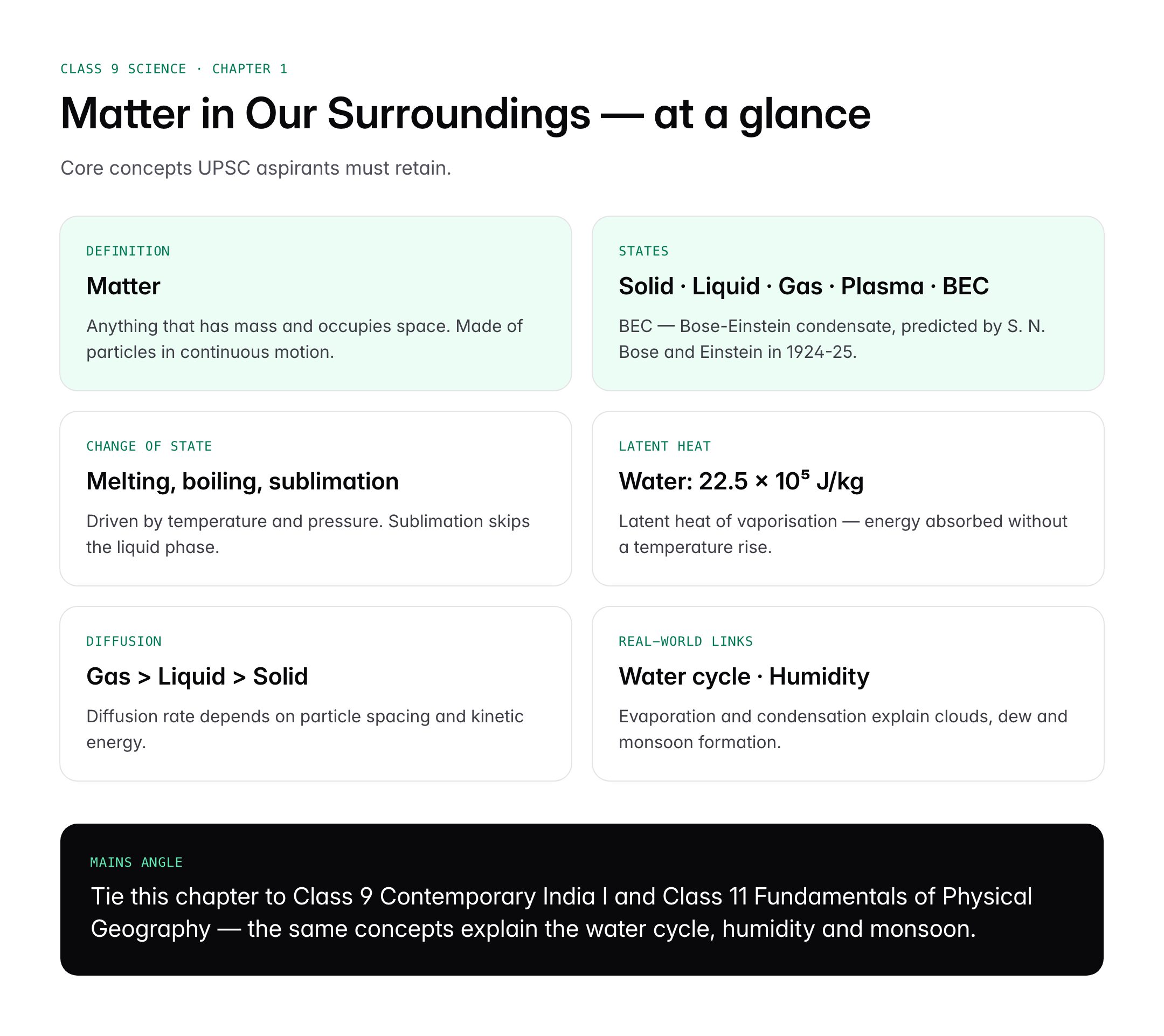
Matter in Our Surroundings is the opening chapter of the Class 9 Science textbook. It defines matter as anything that has mass and occupies space, describes the five states of matter including Bose-Einstein condensate, and explains changes of state through melting, boiling, evaporation, sublimation and deposition. The chapter introduces latent heat, diffusion and the kinetic theory in accessible language. For UPSC, these concepts reappear in prelims questions on humidity, condensation and cloud formation, and in GS3 science and technology answers on materials.
Class 9 Civics — Democratic Rights
Democratic Rights is chapter 5 of Democratic Politics I. It covers the Universal Declaration of Human Rights, fundamental rights in the Indian Constitution, reasonable restrictions and the role of the judiciary. For UPSC GS2, this is the gentlest introduction to Articles 12 to 35, and it pairs well with Laxmikanth for deeper coverage.
Class 9 Geography — Theory of Tectonic Plates
Chapter 2 of Contemporary India I introduces the theory of tectonic plates and the physical features of India. The Himalayan orogeny, the Peninsular Plateau and the Indo-Gangetic plain all trace back to the plate movements explained here. This is essential reading for GS1 physical geography.
Class 9 Economics — The Story of Village Palampur
The fictional village of Palampur is the lens through which the Class 9 Economics textbook introduces production, labour, capital and the types of farming. The chapter on food security and the chapter on poverty set up the vocabulary for GS3 agriculture and economic development answers.
Class 8 Civics — Public Facilities
Public Facilities in the Class 8 Social and Political Life III book discusses water, electricity, sanitation and transport as public goods, the role of the government and the debate on privatisation. It is a short, high-return read for GS2 governance questions.
Class 7 Civics — On Equality
On Equality is the first chapter of Social and Political Life II. It covers universal adult franchise, dignity and the struggle against inequality, framed around real Indian examples. It is foundational for GS2 social justice and Mains essay writing on equality.
Class 7 History — Muhammad Ghori and the Delhi Sultanate
The Class 7 Our Pasts II textbook introduces the Delhi Sultanate, starting with Muhammad Ghori‘s invasions from 1175 CE onwards. His defeat of Prithviraj Chauhan at the Second Battle of Tarain in 1192 CE set up the Mamluk dynasty under Qutb al-Din Aibak. The book also covers the Khalji, Tughlaq, Sayyid and Lodi dynasties — the basic frame for medieval India in Prelims.
Significance for UPSC and General Knowledge
- NCERT Class 7 to 9 books cover at least 20 per cent of Prelims questions in a typical year
- They are the only study source explicitly recommended by UPSC toppers across the last three decades
- Class 9 Science chapters like Matter in Our Surroundings anchor GS3 general science answers
- Class 9 Social Science bridges easily into Laxmikanth, Bipan Chandra and Ramesh Singh for advanced study
- NCERT PDFs are free, official and revision-stable, making them ideal for multiple readings
Detailed Analysis — How to Study These NCERTs
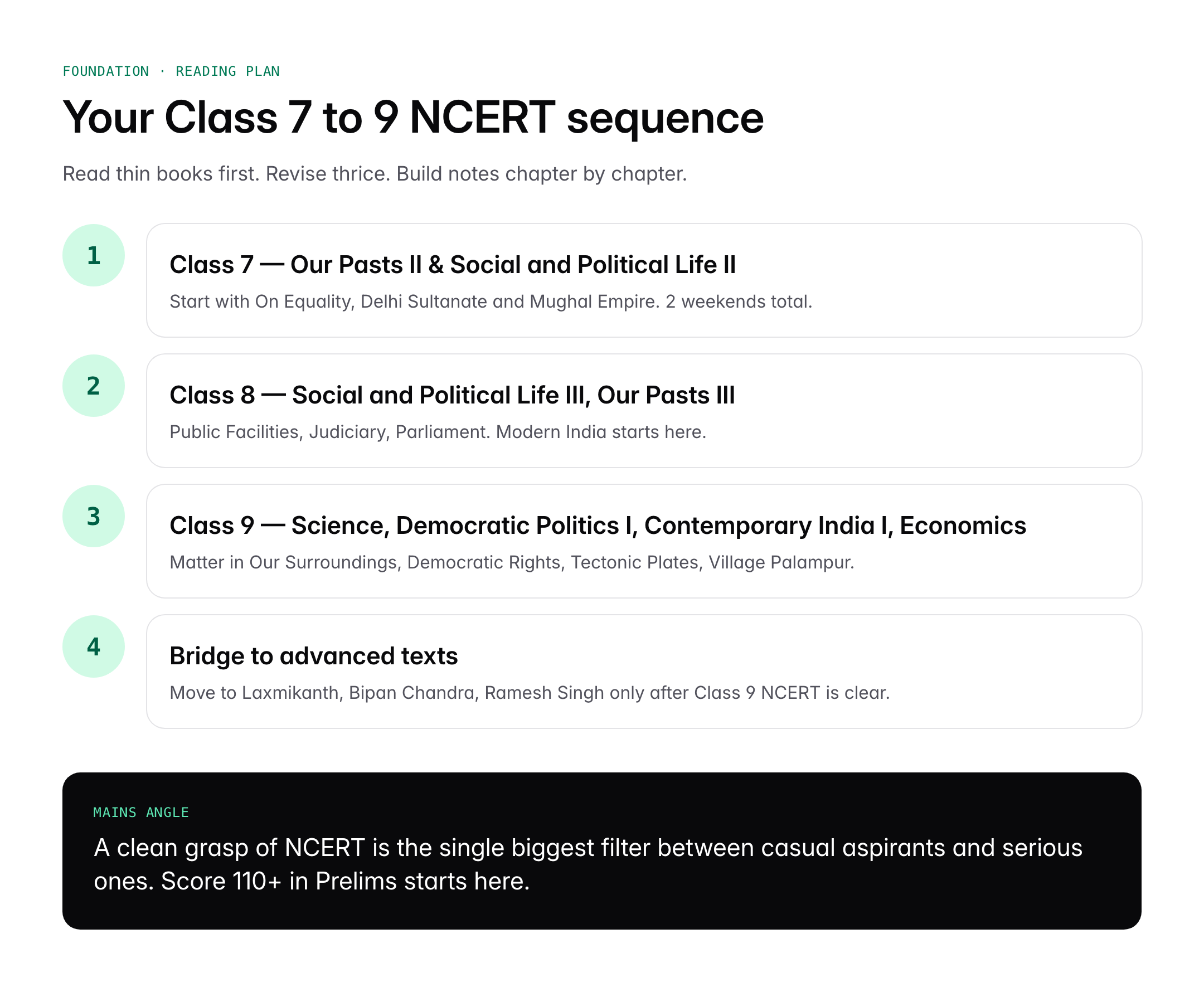
The most efficient sequence for a first-time UPSC aspirant is to read Class 6 to 10 NCERTs in the order Geography, History, Polity, Economics, Science. Start with the thinnest books. Class 7 Our Pasts II can be finished in a weekend. Class 9 Contemporary India I takes about two weekends if notes are made chapter by chapter.
For Science, Class 9 is the hinge point. Chapter 1 on Matter in Our Surroundings, Chapter 3 on Atoms and Molecules, Chapter 5 on The Fundamental Unit of Life and Chapter 10 on Gravitation appear most often in Prelims general science. Aspirants should not attempt to memorise equations. Focus on definitions, real-world examples and simple diagrams. A one-page summary per chapter is enough for revision.
For Social Science, treat Class 9 Democratic Politics I and Class 8 Social and Political Life III as prep books for M. Laxmikanth’s Indian Polity. Similarly, Class 9 Economics is a bridge to Ramesh Singh. The Class 7 and Class 8 History textbooks prepare the ground for Bipan Chandra’s modern India coverage.
A disciplined revision cycle is critical. Aspirants should revisit Class 7 to 9 NCERTs at least three times — once before reading advanced material, once after, and once in the final month before Prelims. The free PDFs make this easy because they can be loaded on any device.

Comparative Perspective
| Source | Typical length | UPSC relevance | Best use |
|---|---|---|---|
| NCERT Class 7 to 9 | 80-150 pages each | Foundational for Prelims GS | First read, multiple revisions |
| NCERT Class 11 to 12 | 200-350 pages each | Advanced for Prelims and Mains | Second phase of study |
| Laxmikanth (Polity) | 800+ pages | Mains-level Polity depth | After NCERT Civics |
| Bipan Chandra (Modern India) | 600+ pages | Mains-level History depth | After NCERT History |
Older editions of NCERT textbooks (pre-2007 versions by R. S. Sharma and others) are sometimes recommended for depth, but the current editions are sufficient for Prelims and Mains. A student who has read the current Class 7 to 12 Social Science and Science NCERTs has already crossed the single biggest threshold in UPSC preparation.
Challenges and Criticisms
NCERT textbooks have been periodically criticised for content cuts. Chapters on the Mughal empire, the periodic table and evolution were rationalised in 2023, triggering public debate. UPSC aspirants should be aware that certain deleted topics may still appear in older question papers. A good practice is to refer to both the current and the pre-2023 editions for topics like the Mughal administration, Faraday’s law and the theory of evolution.
A second criticism is that the Social Science books, especially at Class 9, do not go deep enough for Mains. They are designed for 14-year-olds, not for graduate level policy analysis. The fix is to treat them strictly as foundation, and then move to Laxmikanth, Bipan Chandra and a newspaper habit. Finally, the Hindi medium translations are sometimes rough. Students should cross-check with the English PDF where possible.
Prelims Pointers
- Matter is anything that has mass and occupies space — Class 9 Science, chapter 1
- The five states of matter are solid, liquid, gas, plasma and Bose-Einstein condensate
- Latent heat of vaporisation of water is 22.5 × 10^5 J/kg
- Universal adult franchise is discussed in Class 9 Civics chapter on Democratic Rights
- NCERT was established on 1 September 1961 under the Ministry of Education
- The Story of Village Palampur is the first chapter of Class 9 Economics
- Public Facilities is chapter 9 of Class 8 Social and Political Life III
- On Equality is the first chapter of Class 7 Social and Political Life II
- Tectonic plate theory is introduced in Class 9 Contemporary India I chapter 2
- The Second Battle of Tarain took place in 1192 CE between Muhammad Ghori and Prithviraj Chauhan
- NCF for School Education 2023 guides the current textbook revision cycle
- NCERT PDFs are available for free at ncert.nic.in and through the DIKSHA platform
Mains Practice Questions
- NCERTs remain central to UPSC preparation despite curriculum revisions. Discuss with reference to the Class 7 to 9 Social Science and Science texts.
- Explain NCERT’s role as a foundation reading
- Identify the 2023 curriculum revision and its implications for aspirants
- Suggest a study sequence that integrates NCERTs with advanced texts
- Public facilities and democratic rights are two foundational concepts for Indian citizenship. Evaluate their treatment in NCERT Class 8 and 9 Civics textbooks.
- Summarise the coverage of public facilities in Class 8
- Summarise the coverage of democratic rights in Class 9
- Critically assess their adequacy for GS2 preparation
Conclusion
The NCERT Class 7 to 9 textbooks are the quiet workhorses of UPSC preparation. They teach the vocabulary of Indian polity, the architecture of Indian geography and the first principles of Indian science in a way that no advanced textbook can replace. Every chapter from what is matter class 9 to Democratic Rights, Public Facilities and On Equality pays back the time invested many times over.
Download the official PDFs, take handwritten notes, and revise at least three times. This is the single highest-leverage activity in the first six months of Prelims preparation. Everything else in the UPSC reading list rests on this foundation.
Frequently Asked Questions
What is matter in Class 9 Science?
In Class 9 NCERT Science, matter is defined as anything that has mass and occupies space. The first chapter, Matter in Our Surroundings, classifies matter into five states — solid, liquid, gas, plasma and Bose-Einstein condensate — and explains changes of state through melting, boiling, evaporation, sublimation and deposition, backed by the kinetic theory.
Why is NCERT Class 9 Science important for UPSC?
Class 9 NCERT Science anchors Prelims general science questions on states of matter, atoms, cells and gravitation. It is the last stage before specialised Class 11 and 12 science books and provides definitions and examples that reappear in GS3 science and technology answers. Aspirants are expected to know it well for both Prelims and Mains.
How is Matter in Our Surroundings related to the water cycle and weather?
The chapter’s treatment of evaporation, condensation, latent heat and diffusion directly explains how the water cycle works, why clouds form and how humidity affects weather. These are concepts aspirants encounter again in Class 9 Geography and Class 11 Fundamentals of Physical Geography, so the chapter acts as a bridge between pure science and geography.
Where can I download NCERT Class 7 to 9 PDFs legally?
All NCERT Class 7 to 9 textbooks are available as free PDFs from the official NCERT website at ncert.nic.in, the e-pathshala portal and the DIKSHA platform. The NCERT e-textbook Android app also offers chapter-wise downloads. There is no need to pay on third party sites, and official PDFs guarantee a clean, complete copy.
What is covered in the Democratic Rights Class 9 chapter?
The Democratic Rights chapter in Class 9 NCERT Democratic Politics I explains the Universal Declaration of Human Rights, the six fundamental rights in the Indian Constitution under Articles 12 to 35, reasonable restrictions and the role of the judiciary as the guardian of these rights. It is the standard introduction to fundamental rights for UPSC aspirants.
Which chapter covers tectonic plates in Class 9 Geography?
The theory of tectonic plates is introduced in chapter 2 of Class 9 Contemporary India I, titled Physical Features of India. It uses plate movements to explain the formation of the Himalayas, the Peninsular Plateau and the Indo-Gangetic plain. This is foundational content for GS1 physical geography and is revisited in Class 11 geography.
What is On Equality in Class 7 Social Science?
On Equality is the first chapter of Class 7 Social and Political Life II, the civics textbook. It covers universal adult franchise, dignity and the struggle against caste, gender and economic inequality, using real Indian examples. It is a foundational text for UPSC GS2 social justice preparation and Mains essays on equality.
What is Public Facilities in Class 8 NCERT?
Public Facilities is chapter 9 of Class 8 Social and Political Life III. It discusses water, electricity, sanitation, transport and public health as public goods, the role of government, the debate on privatisation of basic services, and case studies like water supply in Chennai. It is a quick, high-return read for GS2 governance questions.