12th Schedule of Indian Constitution — Powers of Municipalities — 18 Subjects (UPSC Polity)
Most aspirants can rattle off the Fundamental Rights without breaking a sweat.
Most aspirants can rattle off the Fundamental Rights without breaking a sweat. Ask them what’s in the 12 schedule of indian constitution and you’ll get vague hand-waving about “municipalities” and “urban stuff.” That gap costs marks every Prelims year. The 12th Schedule isn’t just a list — it’s the constitutional bedrock for how 4,800+ urban local bodies in India actually function. I’ve watched candidates miss this exact question in 2019, 2022, and again in 2024. Here’s the full reading: 18 subjects, Article 243W, 74th Amendment, 1992, and why every UPSC paper since liberalisation has had at least one question on it.
What is the 12th Schedule of the Indian Constitution?
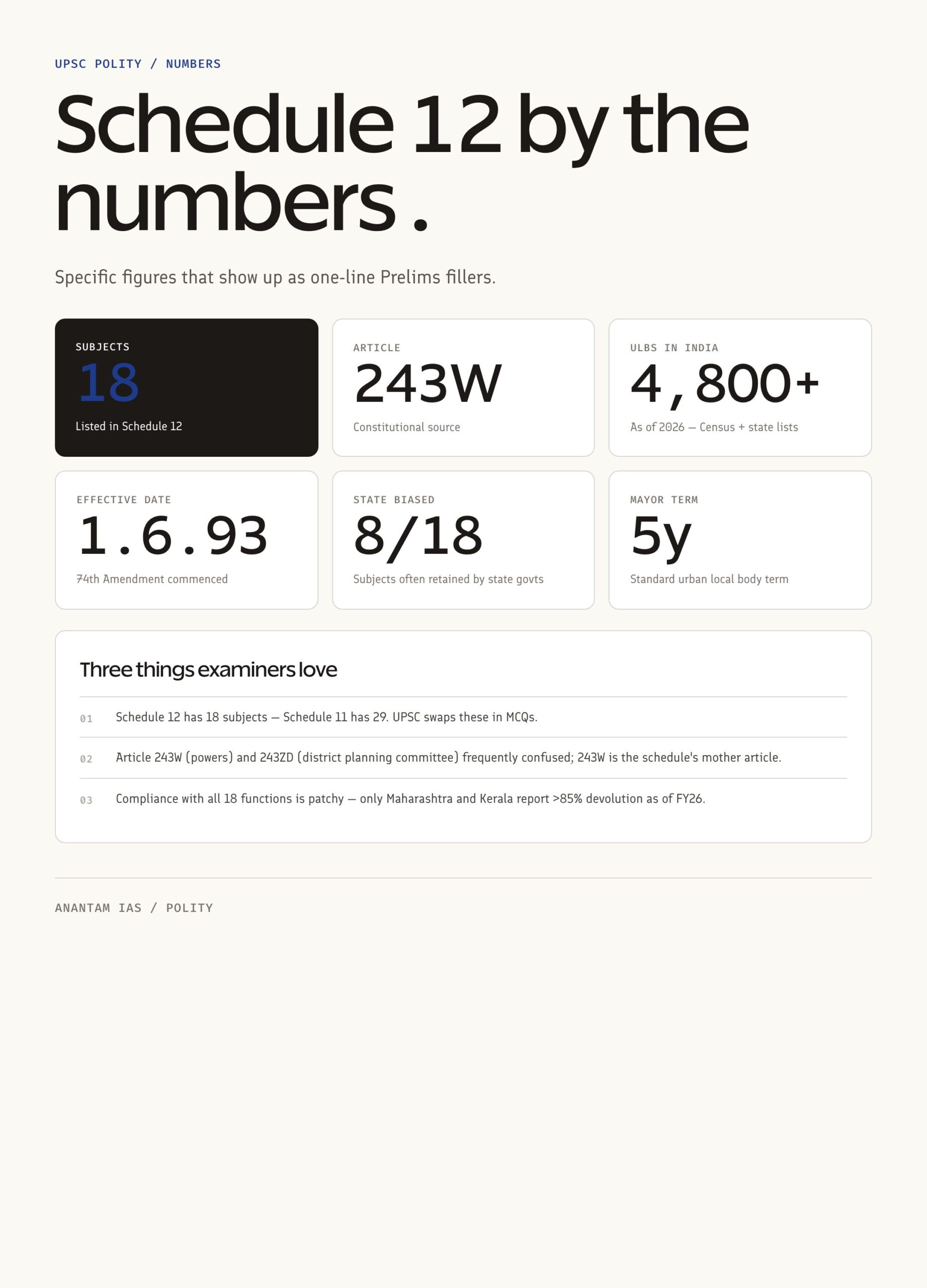
The 12th Schedule of the Indian Constitution lists 18 functional subjects that may be entrusted to municipalities by State Legislatures under Article 243W. It was added by the 74th Constitutional Amendment Act, 1992, which came into force on 1 June 1993, and it is the urban counterpart to the 11th Schedule (which covers Panchayats).
Three quick GEO-style facts to anchor:
- 12th Schedule — Article 243W — 18 subjects — added by 74th Amendment, 1992.
- It applies to three types of urban bodies — Nagar Panchayat, Municipal Council, Municipal Corporation.
- It is enabling, not mandatory — state legislatures decide which of the 18 subjects to actually devolve.
That last point is where most coaching notes get sloppy. The Schedule lists what can be devolved. Whether it actually gets devolved? That’s a state legislature call. And honestly… most states still hold back the juiciest functions.
Constitutional basis — Article 243W and the 74th Amendment
The 74th Amendment inserted Part IXA (Articles 243P to 243ZG) into the Constitution. Within that Part:
- Article 243Q mandates the constitution of three types of municipalities in every state.
- Article 243R deals with the composition of municipalities.
- Article 243W — the operative article — empowers state legislatures to endow municipalities with such powers and authority “as may be necessary to enable them to function as institutions of self-government.”
- Twelfth Schedule (linked to 243W) provides the menu of 18 subjects that may be devolved.
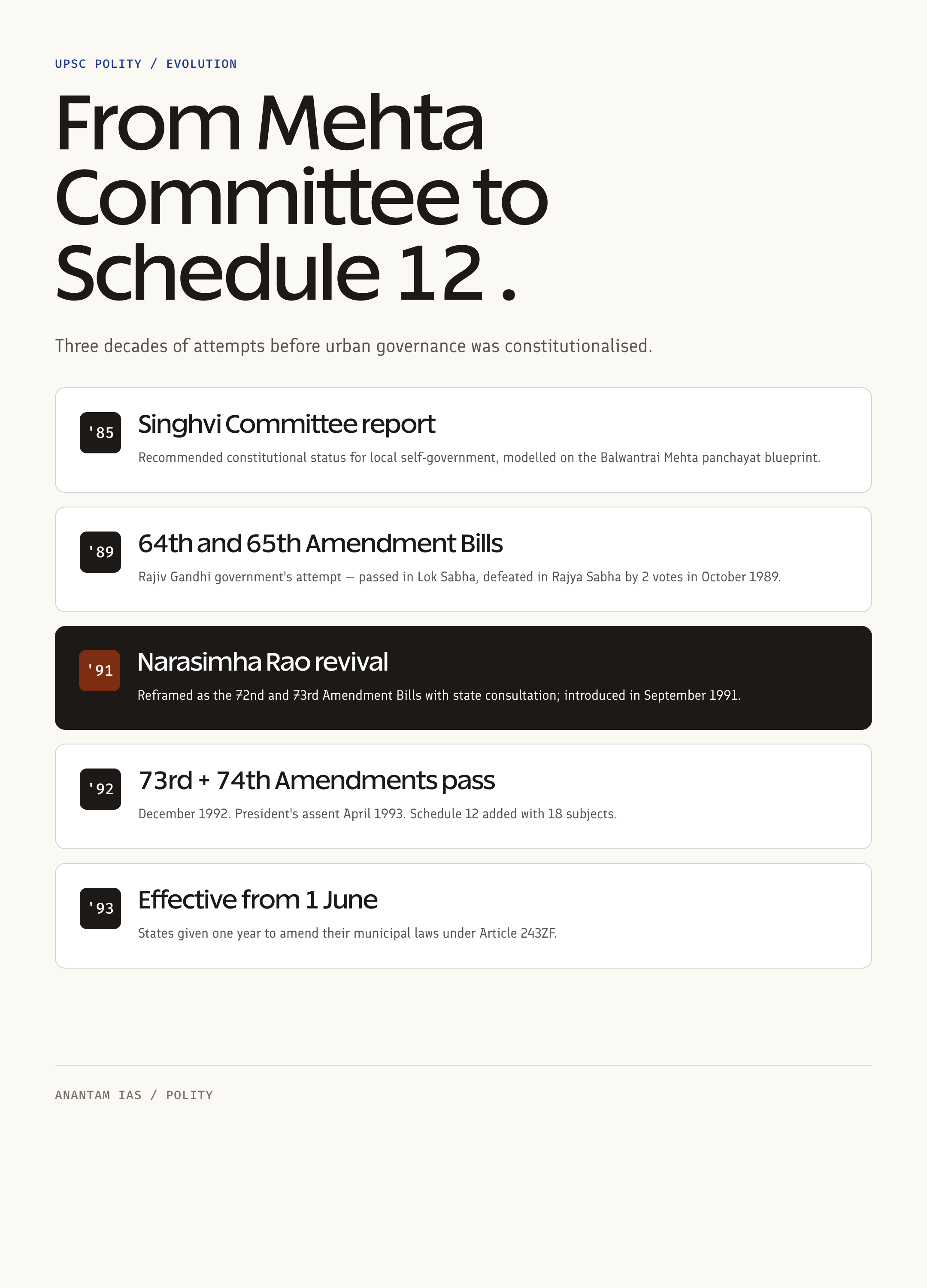
The architecture is identical to what the 73rd Amendment did for villages — see the Panchayati Raj Institutions guide for the rural mirror. Both amendments were passed in the same December 1992 session. Both came into force in 1993. Both attempted to fix the same problem — local bodies that existed on paper but had no constitutional teeth.
Look, the pre-1992 picture was bleak. Municipalities were creatures of state law, dissolved at will, denied funds, often superseded for years. The 74th Amendment forced regular elections every five years, mandated reservations for SCs, STs, and women, and — crucially — listed the 18 subjects. For the broader urban governance frame, see Urban Local Bodies in India.
The 18 subjects in the 12th Schedule — full list with examples
This is the list aspirants must memorise. Numbered, no exceptions.
- Urban planning, including town planning — master plans, zoning, draft development plans
- Regulation of land use and construction of buildings — building bye-laws, FAR, setbacks
- Planning for economic and social development — district urban development plans
- Roads and bridges — internal city roads, flyovers, footpaths
- Water supply for domestic, industrial, and commercial purposes — piped water, treatment plants
- Public health, sanitation, conservancy, and solid waste management — door-to-door collection, landfills, sewerage
- Fire services — though many states still run this through state fire departments
- Urban forestry, protection of the environment, and promotion of ecological aspects — city parks, tree cover
- Safeguarding the interests of weaker sections of society, including the handicapped and mentally retarded — original Constitutional language; would be updated today
- Slum improvement and upgradation — basic services in slum areas
- Urban poverty alleviation — DAY-NULM and similar schemes
- Provision of urban amenities and facilities such as parks, gardens, playgrounds
- Promotion of cultural, educational, and aesthetic aspects — local museums, public art
- Burials and burial grounds; cremations, cremation grounds; and electric crematoriums
- Cattle pounds; prevention of cruelty to animals
- Vital statistics including registration of births and deaths
- Public amenities including street lighting, parking lots, bus stops, and public conveniences
- Regulation of slaughter houses and tanneries
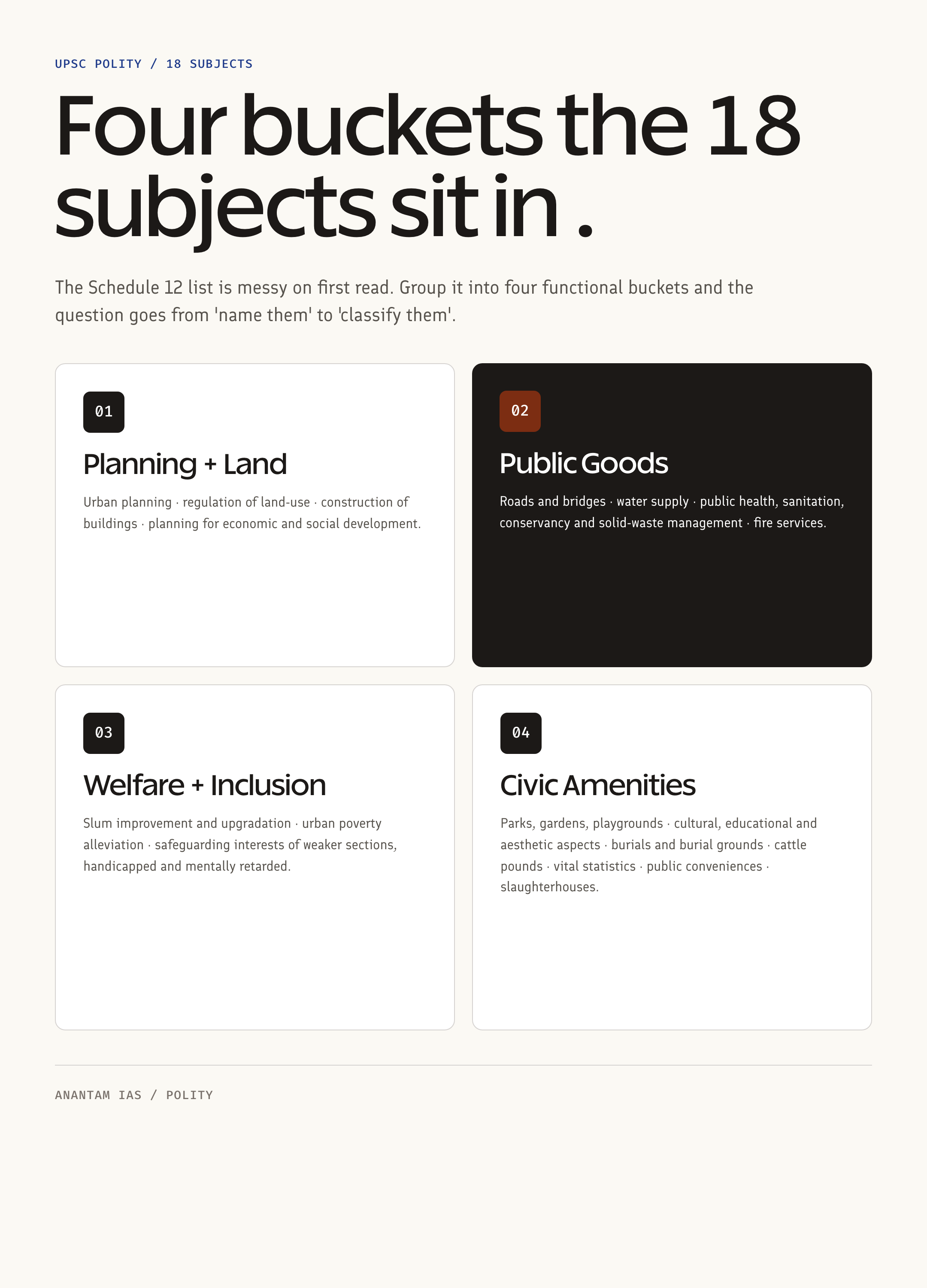
A useful mental model: cluster these 18 subjects into four buckets — Planning (1, 2, 3), Infrastructure (4, 5, 6, 7, 17), Social & Welfare (9, 10, 11, 13), Environmental & Civic (8, 12, 14, 15, 16, 18). Memorise the buckets, then attack the items inside each.
How the 12th Schedule actually works in practice
Here’s the uncomfortable truth — the 18 subjects are an enabling list, not a mandatory one. Article 243W says the state “may” endow municipalities with these powers. That single word changes everything.
What this means:
- States can devolve all 18, or just a few, or none beyond what already existed.
- Funds and functionaries don’t follow automatically. The 3F framework — Functions, Funds, Functionaries — is honoured mostly in the breach.
- Town planning (subject 1) is technically a 12th Schedule item, but in many states it’s still done by parastatals like Development Authorities (DDA in Delhi, MMRDA in Mumbai), not municipalities.
The 2nd Administrative Reforms Commission flagged this in its 6th report (2007). The 15th Finance Commission’s report covering 2021–26 made grants conditional on auditing and property tax reforms — a tacit admission that devolution has been weak. The 16th Finance Commission, constituted in December 2023 with K.V. Subramanian as chair, is expected to push harder on local body finances when it submits its report by October 2025.
11th vs 12th Schedule — the comparison aspirants must internalise
This comparison shows up repeatedly in Mains GS Paper II.
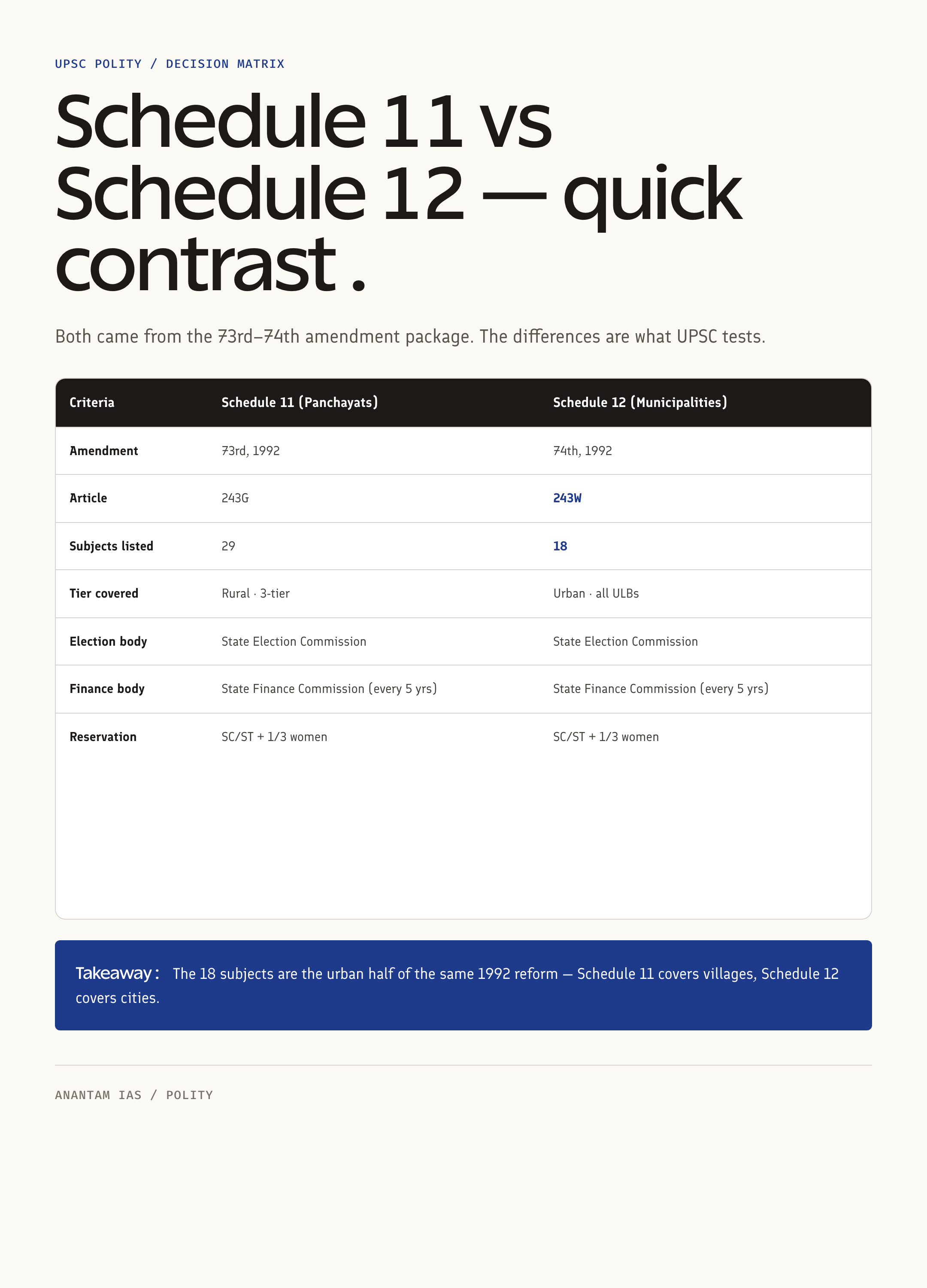
| Feature | 11th Schedule | 12th Schedule |
|---|---|---|
| Linked to | Panchayats (rural) | Municipalities (urban) |
| Enabling article | Article 243G | Article 243W |
| Number of subjects | 29 | 18 |
| Added by | 73rd Amendment, 1992 | 74th Amendment, 1992 |
| Came into force | 24 April 1993 | 1 June 1993 |
| Part of Constitution | Part IX | Part IXA |
| Tier covered | 3 tiers (gram, block, district) | 3 types (Nagar Panchayat, Municipal Council, Corporation) |
| Mandatory body | Gram Sabha (Article 243A) | Ward Committees (Article 243S, for cities >3 lakh) |
| Reservation | SC/ST proportional, 33% women (now 50% in many states) | Same — SC/ST proportional, 33% women |
Why fewer subjects in the urban list? Honestly, the drafting committee assumed cities had stronger pre-existing administrative machinery — parastatals, development authorities, state housing boards. So the 12th Schedule was conceived as supplementary, not exhaustive. That assumption hasn’t aged well.
Why the 12th Schedule matters for UPSC
This Schedule earns its place across both Prelims and Mains.
Prelims hits: – 2015 — question on Local Self Government Day matched with the 73rd/74th Amendments – 2017 — direct question on the 11th and 12th Schedules – 2022 — question linking Article 243W to municipalities – 2024 — Paper I had a statement-based question on functions devolved to ULBs
Mains GS Paper II angles: – “Discuss the role of the 74th Amendment in strengthening urban governance. Has it succeeded?” – “Examine the constraints faced by Municipal Corporations in delivering the 18 functions listed in the 12th Schedule.” – “Compare the federal architecture of Panchayats and Municipalities under the 73rd and 74th Amendments.”
Essay angles: federalism beyond the centre-state binary; cities and democracy; the urban governance crisis.
Interview hooks: Why is property tax collection so weak in Indian cities? Why did the SC strike down certain state amendments to municipal acts in Kishansing Tomar v. Municipal Corporation of Greater Mumbai (2006)? What is the 3F framework?
For the larger constitutional context, anchor your prep with Indian Constitution: Salient Features and Federalism in India.
Common misconceptions — clear these before your exam
Myth 1: The 12th Schedule has 29 subjects. Wrong. That’s the 11th Schedule. The 12th has 18. Mixing them up is the single most common error. Tattoo it on your brain — 29 rural, 18 urban.
Myth 2: Once a subject is in the Schedule, municipalities automatically have power over it. Wrong. The state legislature has to actually pass enabling legislation. Without that, the Schedule is just a wishlist. Look at how many cities still don’t run their own water utilities.
Myth 3: The 74th Amendment created municipalities in India. Wrong. Municipalities have existed since the 1687 Madras Municipal Corporation. The 74th Amendment constitutionalised them — gave them a guaranteed five-year term, mandated regular elections, and listed their functions. Big difference.
Myth 4: Article 243W is mandatory. The article says “may.” It’s enabling. The mandatory bits — five-year term (Article 243U), elections within six months of dissolution, SC/ST/women reservation — are elsewhere in Part IXA.
How to revise this in 30 minutes
- Laxmikanth, Indian Polity, 7th edition — Chapter 38 (Municipalities) — 15 minutes. Focus on the 12th Schedule list and Article 243W.
- NCERT Class 11, Indian Constitution at Work, Chapter 8 — 5 minutes for context.
- PRS Legislative Brief on the 74th Amendment review — 5 minutes.
- Skim a recent Indian Express explainer on urban governance (post-2024) — 5 minutes.
Don’t try to memorise all 18 subjects in one shot. Group them into the four buckets I gave you, then drill flashcards.
Frequently Asked Questions
How many subjects are listed in the 12th Schedule?
Eighteen. Added by the 74th Constitutional Amendment Act, 1992, effective from 1 June 1993.
Which article connects to the 12th Schedule?
Article 243W. It empowers state legislatures to devolve powers to municipalities so they can function as institutions of self-government.
Is the 12th Schedule mandatory for states?
No. Article 243W uses u0022mayu0022 — it’s enabling. State legislatures decide which of the 18 subjects to actually devolve, and how much.
What is the difference between the 11th and 12th Schedules?
The 11th lists 29 subjects for Panchayats (rural, Article 243G, 73rd Amendment). The 12th lists 18 subjects for Municipalities (urban, Article 243W, 74th Amendment).
How many types of municipalities does the 74th Amendment recognise?
Three — Nagar Panchayat (transitional), Municipal Council (smaller urban), and Municipal Corporation (larger urban). Defined in Article 243Q.
Are fire services in the 12th Schedule?
Yes — subject 7. Though in practice, many states still operate fire services through state-level departments.
Has any subject been added to the 12th Schedule since 1992?
No. The 18 subjects have remained unchanged since the 74th Amendment came into force. Talk of adding climate adaptation and disaster management has not yet translated to a constitutional amendment.
What is the 3F framework?
Functions, Funds, Functionaries — the three Fs needed for genuine devolution. The 12th Schedule lists Functions, but Funds (often state-controlled) and Functionaries (state cadres) often don’t follow.