New to UPSC
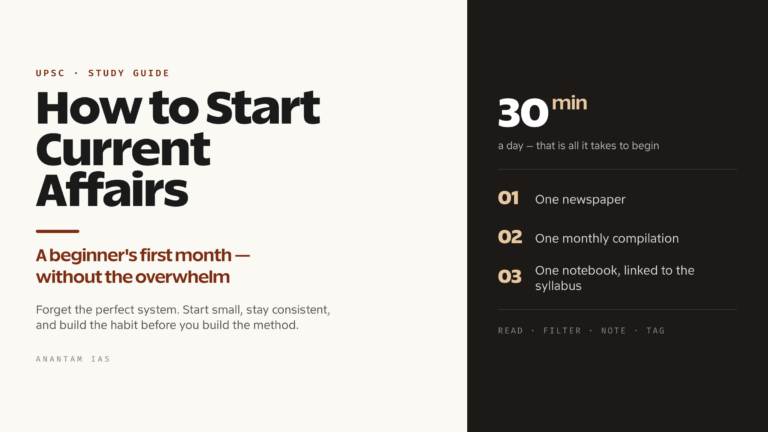
What the exam actually asks, how long it really takes, and the first four books to buy — before you spend money on anything else.

Free UPSC study hub
Prepare by exam stage, GS paper, subject, optional or language. Everything here is free to read — notes, daily current affairs and strategy guides, with practice questions and past-year papers to test what stuck.
Start here
Five routes into the same library. Pick the one that matches today, not the one that matches your plan for next year.
What the exam actually asks, how long it really takes, and the first four books to buy — before you spend money on anything else.
Fact recall under time pressure. Read the subject hubs, then test yourself against 1,605 topic-tagged MCQs including past-year papers.
Marks come from structure and practice, not from more reading. Start with answer writing, then work through model answers paper by paper.
The optional decides roughly a quarter of your Mains total. Compare subjects honestly first, then go deep — PSIR and Law are covered paper by paper.
हिंदी में लिखे गए नोट्स — अनुवाद मात्र नहीं। 2,071 नोट्स, वही पाठ्यक्रम, सरल हिंदी में।
Paper-wise entry points
Each paper hub carries the official syllabus, what every clause actually tests, and the note library beneath it. Counts overlap — one article can sit in more than one paper.
Prelims + Mains core
Twelve subject hubs. Each one rolls up topic notes, guides and the current affairs tagged to that subject, so a single page carries both the static base and what changed this month.
The paper, not a summary of it
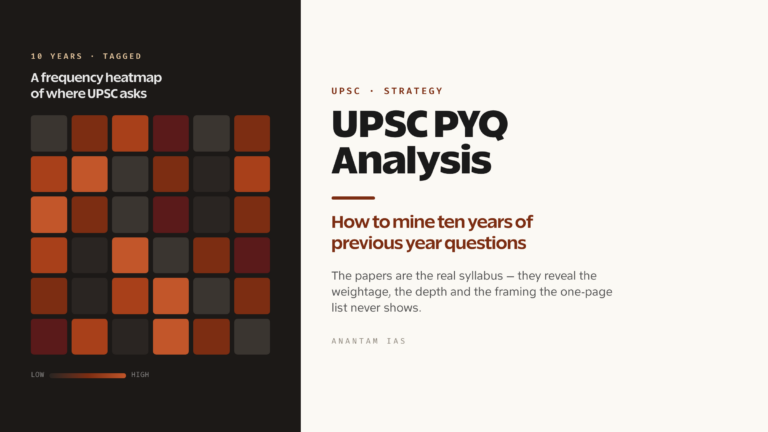
19 question papers and answer keys solved in full — every question reproduced, a model answer under each, section-wise weightage, and a free PDF where one exists.
All exam solutions — Prelims and Mains, the full archive.
Retrieval, not more reading
Reading a note and being able to answer from it are different skills, and only the second one is marked. 1,605 Prelims MCQs and 1,848 Mains model answers sit behind these links.
All free UPSC tools — CSAT safety margin, PYQ weightage, mapping tracker and more.
Written-stage areas
Four high-value Mains areas where structured writing and repeated practice matter more than fresh material. Society sits in GS I, Ethics and case studies in GS IV, and the Essay is its own paper.
Optional papers
A directory covering every optional the exam offers, plus our own detailed PSIR and Law resources, paper by paper.
हिंदी नोट्स
हिंदी माध्यम के अभ्यर्थियों के लिए — वही पाठ्यक्रम, सरल हिंदी में लिखा गया, शब्दशः अनुवाद नहीं।
Hand-picked
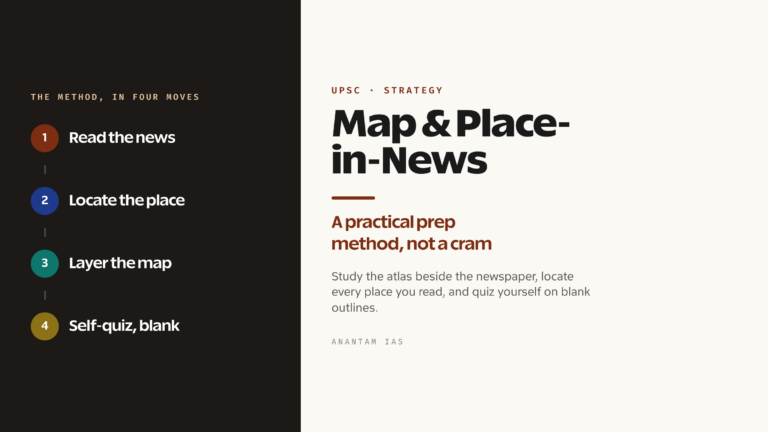
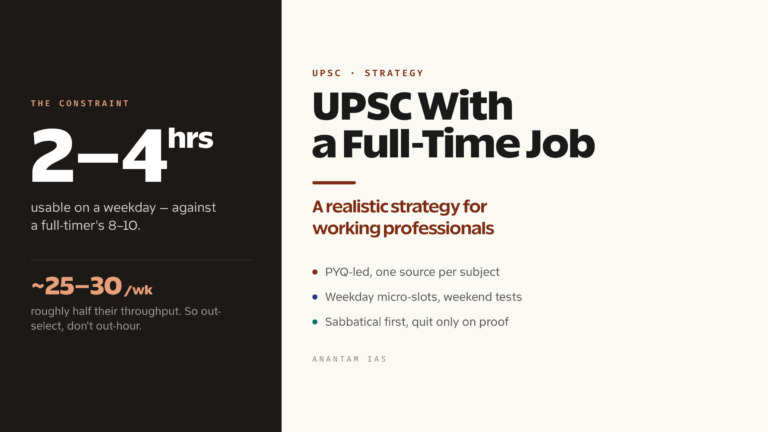
Eight guides covering different problems — starting out, current affairs, note making, mapping, preparing alongside a job, and Hindi medium.
Updated daily
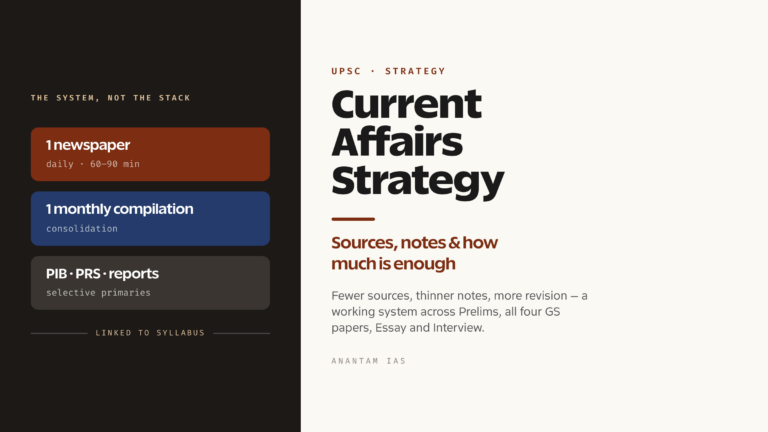
Pointer-form briefs built from The Hindu, Indian Express and primary government sources, each tagged to the syllabus areas it answers.
Environment & Ecology
Environment & Ecology
Constitutional and Statutory Bodies
Newest in the library
Static syllabus notes — the material that stays true between cycles, as opposed to the dated briefs above. One per subject, so you can see the spread.
All study notes — the full archive, paginated.
Before you rely on it
Free material is worth exactly what you can trust in it, so here is how these pages are built and where they come from.
Static notes work from standard references and primary documents — the Constitution, ministry reports, PIB releases, the Economic Survey and Budget, PRS summaries and NCERT texts. Current-affairs briefs cite the report they came from.
Every note is tagged to the GS paper and subject it answers, which is what the paper and subject hubs are built from. Tags overlap on purpose: one topic often serves Prelims recall and a Mains dimension at once.
Notes are produced by the Anantam IAS content desk and the faculty who teach these papers — the same people who run the classes and evaluate answer scripts. Meet the faculty.
Data moves — schemes get revised, judgments land, incumbents change. If you find something stale or wrong, tell us and we will fix the page rather than leave it. Report a correction.
If the notes are useful but you are still unsure what to study first, sit in a live GS session taught by ex-Rau's IAS faculty and leave with a starting order. No sales call, no brochure.