44th Amendment of Indian Constitution — Reversed 42nd — Restored FR Primacy, Property Out of FR
The 44th amendment to indian constitution is the only constitutional amendment ever passed with the explicit intent of correcting an earlier amendment. It was the Janata Party's answer to the Emergency.
The 44th amendment to indian constitution is the only constitutional amendment ever passed with the explicit intent of correcting an earlier amendment. It was the Janata Party’s answer to the Emergency. It pulled the right to property out of Fundamental Rights, locked Articles 20 and 21 against suspension, made the proclamation of Emergency much harder, and reverted the Lok Sabha’s term to five years. Most aspirants confuse the 42nd and 44th. They shouldn’t… the 44th is the correction, not a continuation. Here’s the complete read — exact provisions, articles affected, the political moment that produced it, and the reasons examiners ask about it every cycle.
What is the 44th Amendment of Indian Constitution?
The 44th Amendment Act, 1978 was passed by the Janata Party government under Prime Minister Morarji Desai to undo the most authoritarian provisions of the 42nd Amendment, 1976 enacted during the Emergency. It received Presidential assent from Neelam Sanjiva Reddy and was notified in the Gazette of India on 30 April 1979. Different sections came into force on different dates between June 1979 and June 1980.
Three quick factual triples for revision:
- 44th Amendment — 1978 — repealed the right to property as a Fundamental Right (Article 19(1)(f) and Article 31).
- Article 300A — inserted by the 44th — right to property is now a constitutional legal right, not a Fundamental Right.
- Article 359 — amended — Articles 20 and 21 cannot be suspended even during a national Emergency.
Why was the 44th Amendment passed? The Janata moment
Look, you can’t read the 44th Amendment in isolation. It’s a reaction. The 42nd Amendment of 1976, passed during the Emergency under Indira Gandhi, had stretched executive power, given Directive Principles primacy over Fundamental Rights, and barred judicial review of amendments. When the Janata Party — a coalition of parties opposed to the Emergency — won the March 1977 general election under Morarji Desai, undoing those changes was top of the agenda.
The story in five steps:
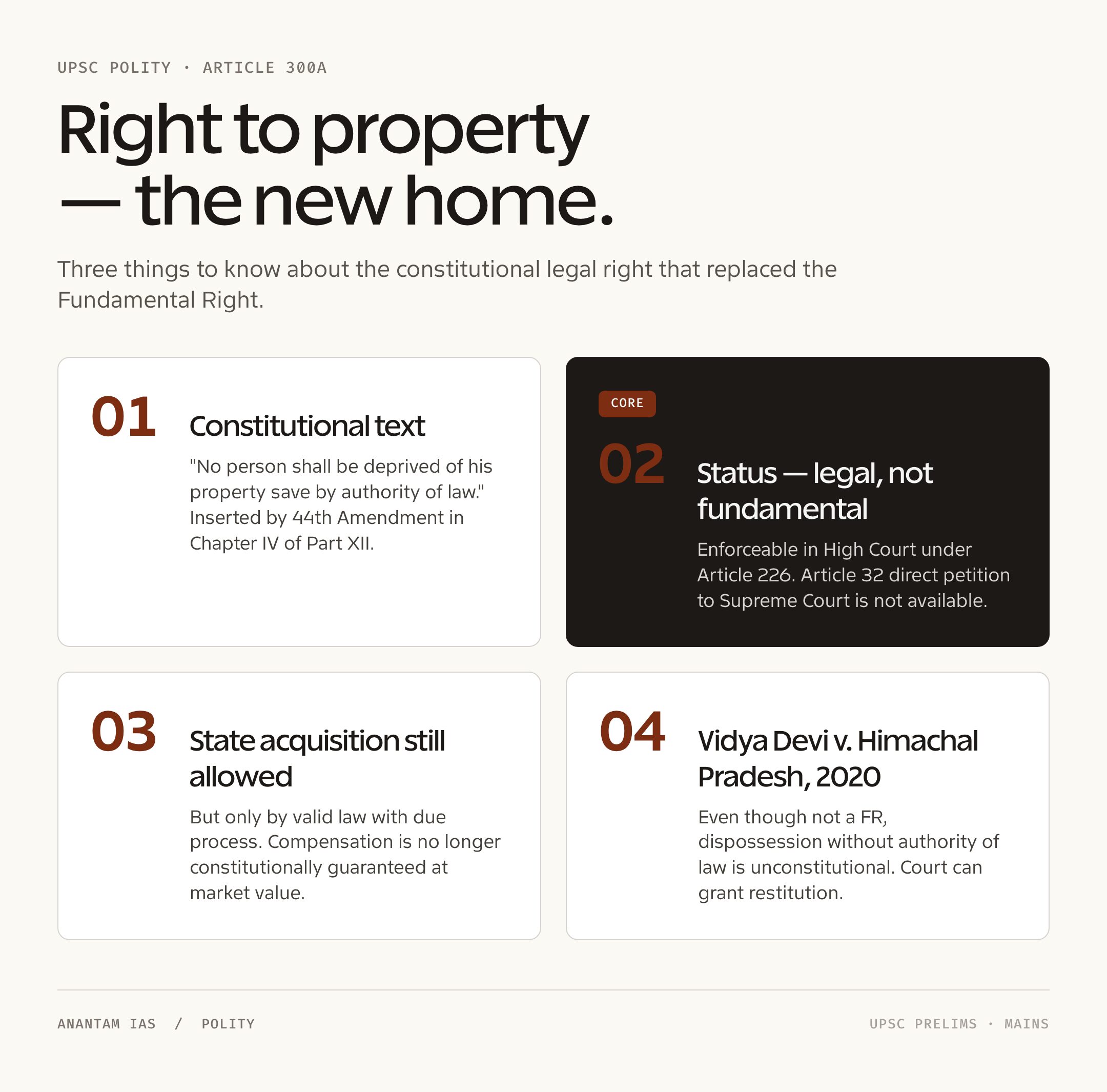
- March 1977 — Janata Party defeats Congress; Morarji Desai becomes Prime Minister.
- April 1977 — Emergency formally revoked (it had been lifted on 21 March 1977).
- 1978 — Constitution (Forty-fourth Amendment) Bill introduced.
- December 1978 — Both Houses pass the Bill.
- 30 April 1979 — President Neelam Sanjiva Reddy gives assent; Act notified.
The Janata government wanted three things: shrink the Emergency power back to size, restore Fundamental Rights primacy, and prevent any future government from doing what the 42nd Amendment had done. They got most of it. They didn’t get all of it… the bid to require referendum for any amendment to basic features failed in the Rajya Sabha.
What did the 44th amendment of indian constitution change?
This is the section to bookmark. The 44 amendment of indian constitution made changes across six buckets — Emergency provisions, Fundamental Rights, right to property, term of legislature, judicial review, and procedural safeguards. Every single change should be remembered with its parent article.
1. Right to property — out of Fundamental Rights
The single biggest change. The 44th Amendment:
- Repealed Article 19(1)(f) — the right to acquire, hold, and dispose of property.
- Repealed Article 31 — compulsory acquisition of property.
- Inserted Article 300A in a new Chapter IV of Part XII — “No person shall be deprived of his property save by authority of law.”
So the right to property became a constitutional legal right, not a Fundamental Right. The practical impact: a property law violation now goes to a high court under Article 226, not directly to the Supreme Court under Article 32.
This is the most-asked single fact about the 44th Amendment. Examiners ask it in Prelims almost every alternate year.
2. Articles 20 and 21 — protected even during Emergency
Article 359 originally allowed the President to suspend the right to move courts for the enforcement of all Fundamental Rights during a national Emergency. The 44th Amendment changed that… permanently.
Now, Article 359(1) explicitly excludes Article 20 (protection in respect of conviction for offences) and Article 21 (right to life and personal liberty) from suspension. Even if a national Emergency is in force, these two cannot be touched.
Well, why does this matter? In ADM Jabalpur v. Shivkant Shukla (1976), the Supreme Court had held that Article 21 could be suspended during the Emergency. The 44th Amendment locked that door. Today, Article 21 protection is absolute under any Emergency.
3. Stricter conditions for proclaiming Emergency
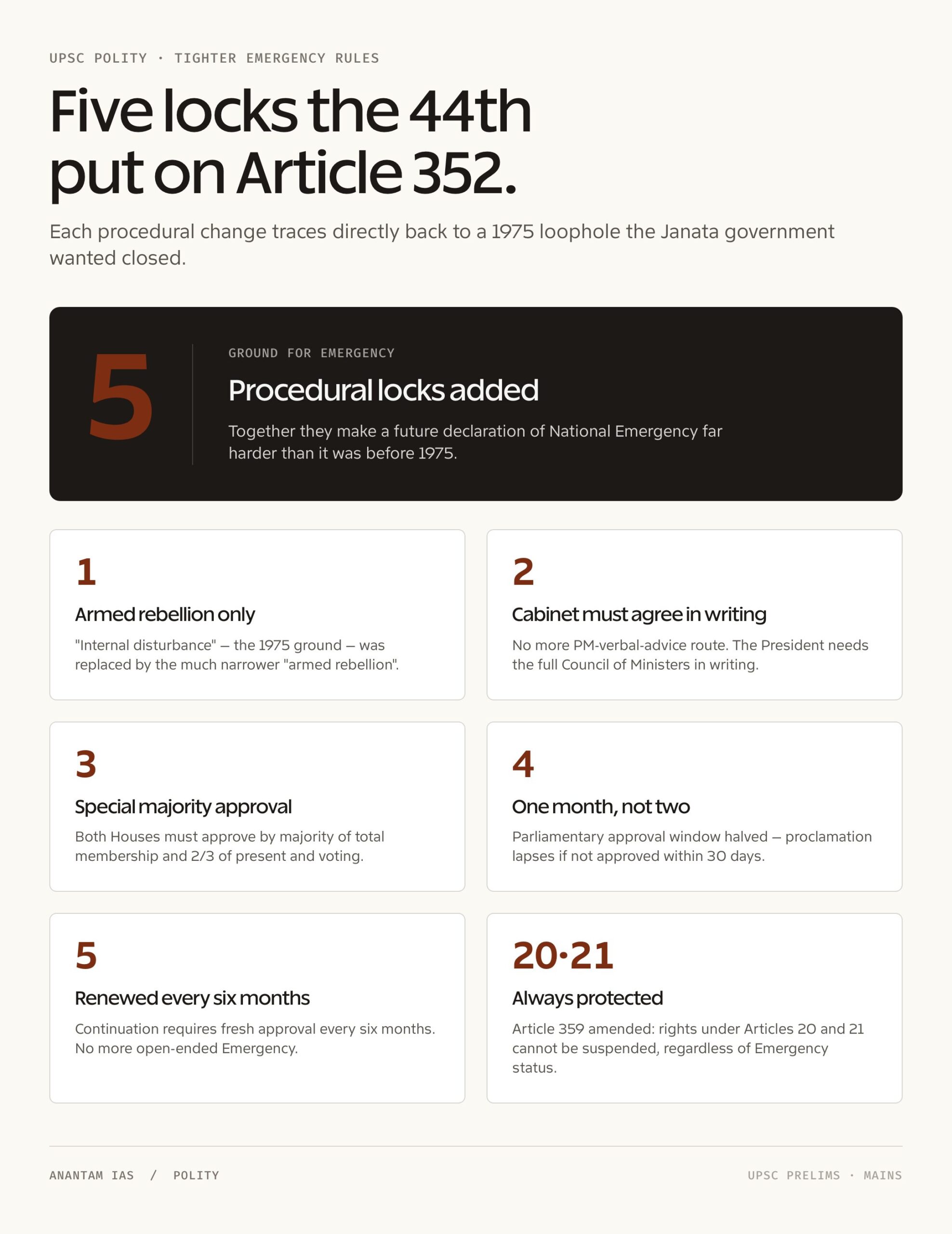
The 44th Amendment tightened the Emergency machinery in five ways:
- Article 352 — replaced “internal disturbance” with “armed rebellion” as a ground for national Emergency. So no future government can declare Emergency on a vague civil-unrest pretext.
- Written Cabinet recommendation — the President can proclaim Emergency only on the written advice of the Union Cabinet, not the Prime Minister alone. Indira Gandhi’s 1975 proclamation had been on the PM’s verbal advice — this loophole was closed.
- Parliamentary approval — special majority — proclamation must be approved by both Houses by a majority of total membership and a two-thirds majority of members present and voting (earlier: simple majority).
- Parliamentary approval — within one month — earlier the period was two months.
- Periodic renewal — six months — the Emergency must be renewed by Parliament every six months (earlier renewal was not periodic).
Aspirants often confuse these with provisions of Article 352 and the National Emergency — they’re actually the amended versions introduced by the 44th. Read both pieces together.
4. Term of Lok Sabha and State Assemblies — back to 5 years
The 42nd Amendment had extended the term of the Lok Sabha and State Assemblies from 5 years to 6 years. The 44th Amendment reverted this to 5 years. This is why every Lok Sabha since 1977 has run on a five-year term.
5. Removal of Article 31D and limits on Article 31C
- Article 31D — added by the 42nd to give Parliament power to make laws against “anti-national activities” — was repealed entirely.
- Article 31C — the 42nd had expanded it to give all Directive Principles primacy over Fundamental Rights. The 44th Amendment did not re-amend Article 31C. The Supreme Court did that work in Minerva Mills v. Union of India (1980) — striking down the expanded version and restoring the original (narrower) Article 31C, which still survives.
6. Other procedural changes
- Article 74 — added a clause saying the President can ask the Council of Ministers to reconsider advice once; if reconsidered advice is sent again, the President shall act in accordance with it.
- Article 134A — inserted to provide for the high court certifying matters fit for Supreme Court appeal.
- Reverted some 42nd Amendment changes to Articles 103 and 192 on the procedure for disqualification of legislators.
- Reverted certain restrictions on the High Courts that the 42nd had introduced (e.g., on writ jurisdiction).
Article 300A — the new home of property rights
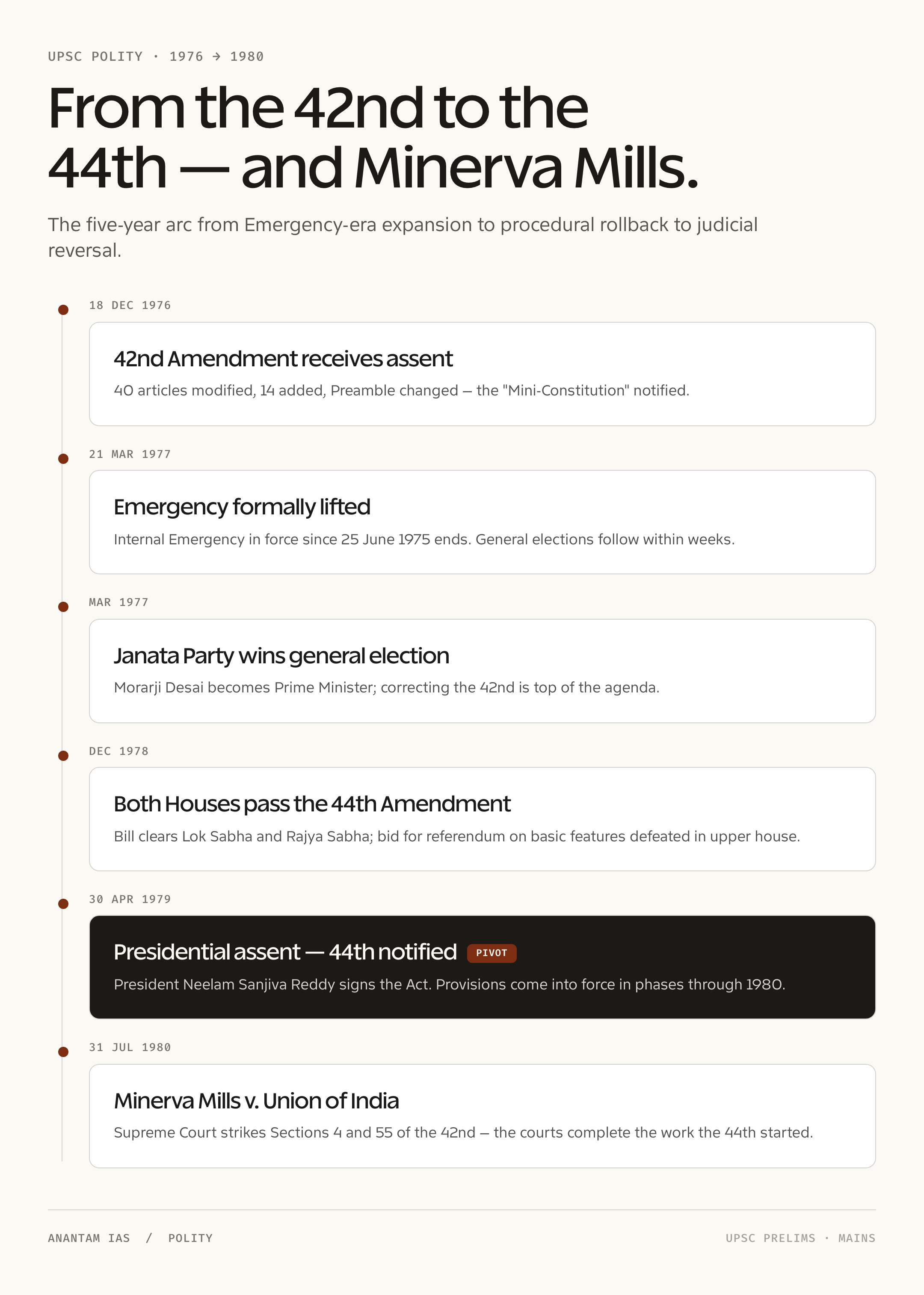
Look, if you remember one article from the 44th Amendment, make it Article 300A. Three things to know:
- Text — “No person shall be deprived of his property save by authority of law.”
- Status — A constitutional legal right, not a Fundamental Right. Enforceable in the High Court under Article 226, not directly in the Supreme Court under Article 32.
- Effect — The State can still acquire private property, but only through a valid law, with due process. Compensation is no longer constitutionally guaranteed at “market value” — Parliament decides the standard.
Recent Supreme Court rulings (e.g., Vidya Devi v. State of Himachal Pradesh, 2020) have held that even though Article 300A is not a Fundamental Right, the State cannot dispossess a citizen of property without authority of law — and where it does, the Court can grant restitution.
42nd vs 44th — what stayed, what reversed
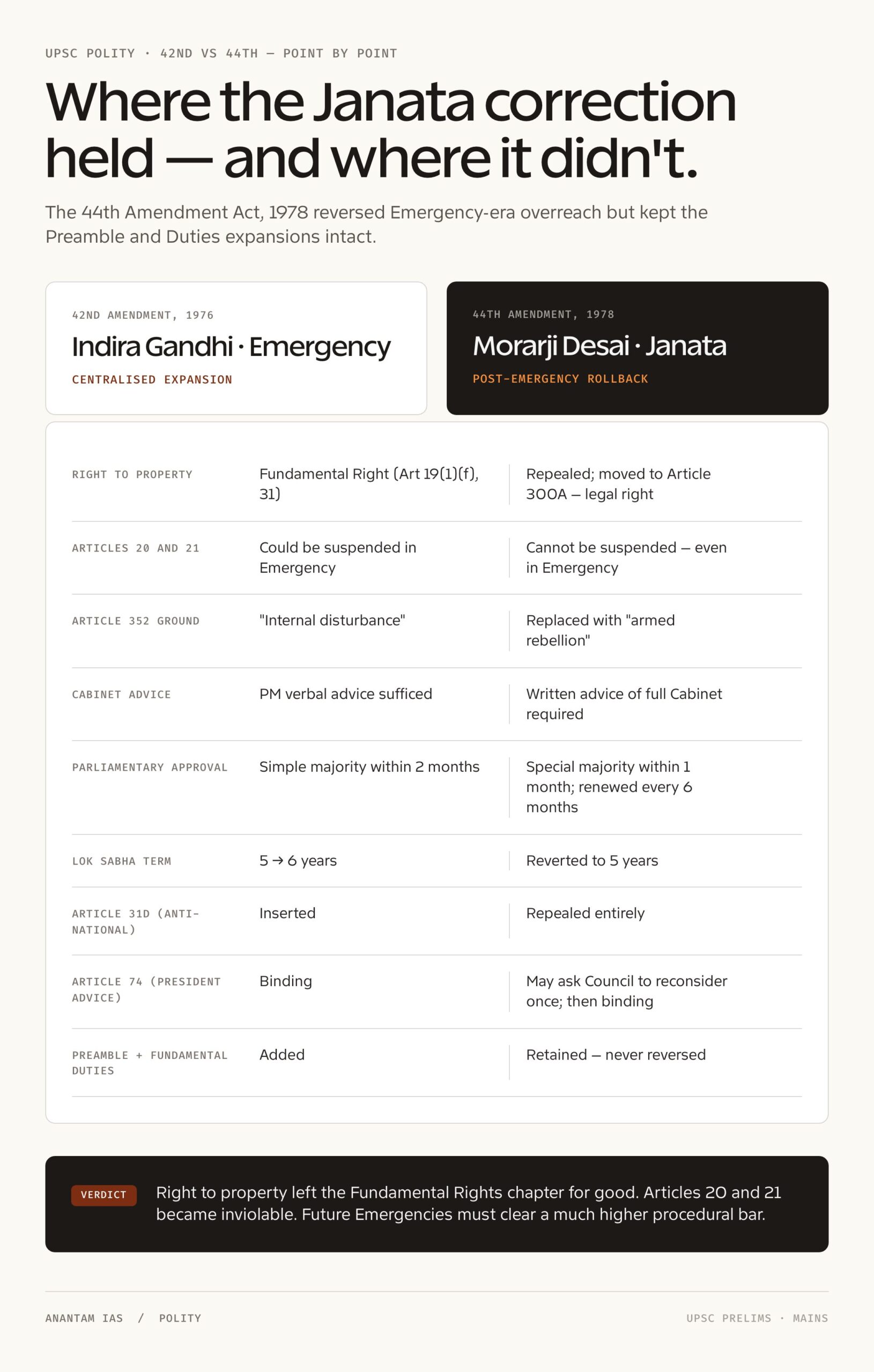
| Provision | 42nd Amendment (1976) | 44th Amendment (1978) |
|---|---|---|
| Preamble — Socialist, Secular, Integrity | Added | Retained |
| Fundamental Duties (Part IVA, Article 51A) | Added 10 duties | Retained |
| Article 31C — DPSP supremacy over FRs | Expanded to all DPSPs | Not re-amended; later struck by SC in Minerva Mills |
| Article 368 — bar on judicial review of amendments | Inserted clauses (4), (5) | Not re-amended; later struck by SC |
| Right to property (Article 19(1)(f), Article 31) | Retained as FR | Repealed; placed in Article 300A as legal right |
| Article 31D — anti-national activities law | Added | Repealed |
| Lok Sabha and State Assembly term | 5 → 6 years | 6 → 5 years |
| Article 359 — suspension of FRs in Emergency | All FRs suspendable | Articles 20 and 21 cannot be suspended |
| Grounds for Emergency under Article 352 | “Internal disturbance” | “Armed rebellion” |
| Cabinet’s written advice for Emergency | Not required | Required |
| Parliamentary majority for Emergency approval | Simple majority | Special majority (2/3 of present and voting) |
| Five subjects on Concurrent List | Shifted from State List | Retained |
Why this matters for UPSC
Three exam zones to know cold:
- Prelims — Article 300A, the year of assent (1979 — note: passed in 1978, assented 1979), the substitution of “armed rebellion” for “internal disturbance,” and the protection of Articles 20 and 21 during Emergency. UPSC has tested these in 2017, 2020, and 2024.
- Mains GS Paper II — “Discuss how the 44th Amendment to the Indian Constitution corrected the imbalance created by the 42nd Amendment. Refer to Minerva Mills v. Union of India (1980).” A standard 15-marker.
- Essay — “Constitutional democracy depends on procedural safeguards.” The 44th Amendment is the textbook example of how Parliament itself re-balanced executive overreach without needing the Court.
Most coaching notes get this wrong — they treat the 44th as a “minor amendment” because it doesn’t make headlines like the 42nd. Don’t fall for that… the 44th is the reason Articles 20 and 21 are inviolable today, the reason a future Emergency requires armed rebellion plus Cabinet’s written advice, and the reason the right to property is a legal right and not a Fundamental Right. Honestly, that’s three load-bearing pillars of post-1978 Indian Constitution.
Common misconceptions
Myth 1: “The 44th Amendment abolished the right to property.” Wrong. It removed property from the list of Fundamental Rights and placed it in Article 300A as a constitutional legal right. Citizens can still own and protect property — just not through Article 32.
Myth 2: “The 44th Amendment was passed in 1978.” Half right. It was passed by Parliament in December 1978, but received Presidential assent on 30 April 1979. The Act is therefore officially the Constitution (Forty-fourth Amendment) Act, 1978, even though provisions came into force in 1979 and 1980.
Myth 3: “The 44th Amendment reversed the entire 42nd Amendment.” Wrong. The 44th retained the Preamble changes, the Fundamental Duties, the new DPSPs (39A, 43A, 48A), the tribunals (323A, 323B), and the five subjects shifted to the Concurrent List. It only reversed the most authoritarian executive-power and judicial-review changes.
Myth 4: “Articles 20 and 21 cannot be suspended even by a constitutional amendment.” Subtle one. The 44th says they cannot be suspended during a national Emergency. Whether they can be amended out of existence is a separate question — and the answer, after Kesavananda Bharati, is no, because they’re part of the basic structure.
How to revise this in 30 minutes
Source priority for Mains-grade depth:
- Laxmikanth — *Indian Polity* — Chapter on amendments, sub-section on 44th.
- NCERT — Indian Constitution at Work (Class 11) — Chapter on Emergency.
- PRS Legislative Brief — Constitution (Forty-fourth Amendment) Act, 1978.
- The full list of amendments to the Indian Constitution for sequence and cross-reference.
- Emergency Provisions in India — for Articles 352, 356, 360 in their current (post-44th) form.
Make a one-page note with: Article 300A, Articles 20 and 21 protected, “armed rebellion,” Cabinet’s written advice, special majority, five-year term, Article 31D repealed. That covers any 10-marker.
Frequently Asked Questions
When was the 44th Amendment of Indian Constitution enacted?
Parliament passed it in December 1978. President Neelam Sanjiva Reddy gave assent on 30 April 1979. Provisions came into force in phases between June 1979 and June 1980.
What is Article 300A?
Article 300A, inserted by the 44th Amendment, provides that u0022no person shall be deprived of his property save by authority of law.u0022 It is a constitutional legal right — enforceable in the High Court under Article 226 — but not a Fundamental Right.
Can Article 21 be suspended during a national Emergency?
No. The 44th Amendment changed Article 359 to explicitly exclude Articles 20 and 21 from suspension during a national Emergency, regardless of which Article (352, 356, or 360) is invoked.
What did the 44th Amendment change about Article 352?
It substituted u0022armed rebellionu0022 for u0022internal disturbanceu0022 as a ground for declaring a national Emergency, required the Cabinet’s written advice, and raised the parliamentary approval threshold to a special majority.
Did the 44 amendment of indian constitution reverse the Preamble changes?
No. The u0022Socialist, Secular, Integrityu0022 additions made by the 42nd Amendment to the Preamble were retained.
What was the right to property before the 44th Amendment?
Before 1979, the right to property was a Fundamental Right under Article 19(1)(f) and Article 31, enforceable directly in the Supreme Court under Article 32. The 44th Amendment repealed both and replaced them with Article 300A.
Why did the Janata government pass the 44th Amendment?
To undo the most authoritarian provisions of the 42nd Amendment passed during Indira Gandhi’s Emergency, restore the primacy of Fundamental Rights, and put procedural safeguards on future Emergency proclamations.
How is the 44th Amendment different from the 42nd?
The 42nd centralised power and gave DPSPs primacy over Fundamental Rights; the 44th decentralised power, restored procedural safeguards, removed the right to property from Fundamental Rights, and made it harder to declare and continue an Emergency.