Agricultural Extension in India (UPSC Economy)
Agricultural extension is the link between a research breakthrough and a farmer who can actually use it. Here is how India's extension machinery works, where it is going digital, and where it still leaves small and women farmers behind.
Imagine a crop scientist at a state agricultural university develops a wheat variety that resists rust and yields a fifth more grain. That breakthrough is worth nothing to the farmer in the next district until someone reaches her field, shows her how to sow it, when to irrigate, and how much fertiliser to skip. That someone is the agricultural extension system. And in India, that bridge from the lab bench to the standing crop is half-built, overloaded, and quietly deciding whether millions of farmers stay poor or get better off.
Agricultural extension is one of those subjects that sounds dry until you notice how much rides on it. India has more than 145 million agricultural holdings, the lion’s share of them small and marginal. The country runs a vast research establishment and a thick file of subsidy schemes. The thing that connects the two — the advice, the demonstration, the hand-holding — is the weakest link. So if you care about farm incomes, climate resilience, or the Viksit Bharat 2047 promise, you end up caring about extension, whether you meant to or not.
What Agricultural Extension Actually Is
Let’s define it cleanly, because the word “extension” hides a simple idea. Agricultural extension is the system that extends knowledge — research findings, new technology, better practices, market and price information — out of laboratories and universities and into the hands of farmers, so they can grow more, earn more, and farm sustainably. It is education without a classroom, advisory without a prescription pad. A good extension worker does not just hand over a leaflet; she demonstrates a method on a real plot, answers the follow-up question three weeks later, and connects the farmer to a buyer.
Two gaps explain why this matters so much. The first is the gap between scientific best practice and what actually happens in the field — the yield a research station gets versus the yield the average farmer gets, a difference that runs to 30 to 50 percent for many crops. The second is the gap between the best farmers in a village and the rest. Extension exists to close both. Historically it did exactly that during the Green Revolution, when extension workers pushed high-yielding seed varieties, fertiliser, and irrigation across the wheat-and-rice belt. But that same input-heavy model strained soil and groundwater, so the job of extension today is harder: not just “use more inputs” but “use the right inputs, sustainably, for a profitable, climate-resilient crop.” That is a knowledge problem, and knowledge is exactly what a thin extension system struggles to deliver.
The other thing to grasp is that extension is no longer a government monopoly. It is meant to be pluralistic — public agencies, private agritech firms, farmer producer organisations, NGOs, and even fellow farmers all carry advice. The policy debate is really about how to weave these strands together so a small farmer in a remote block actually gets reliable, timely, unbiased guidance.
India’s Extension Architecture and the Reach Gap
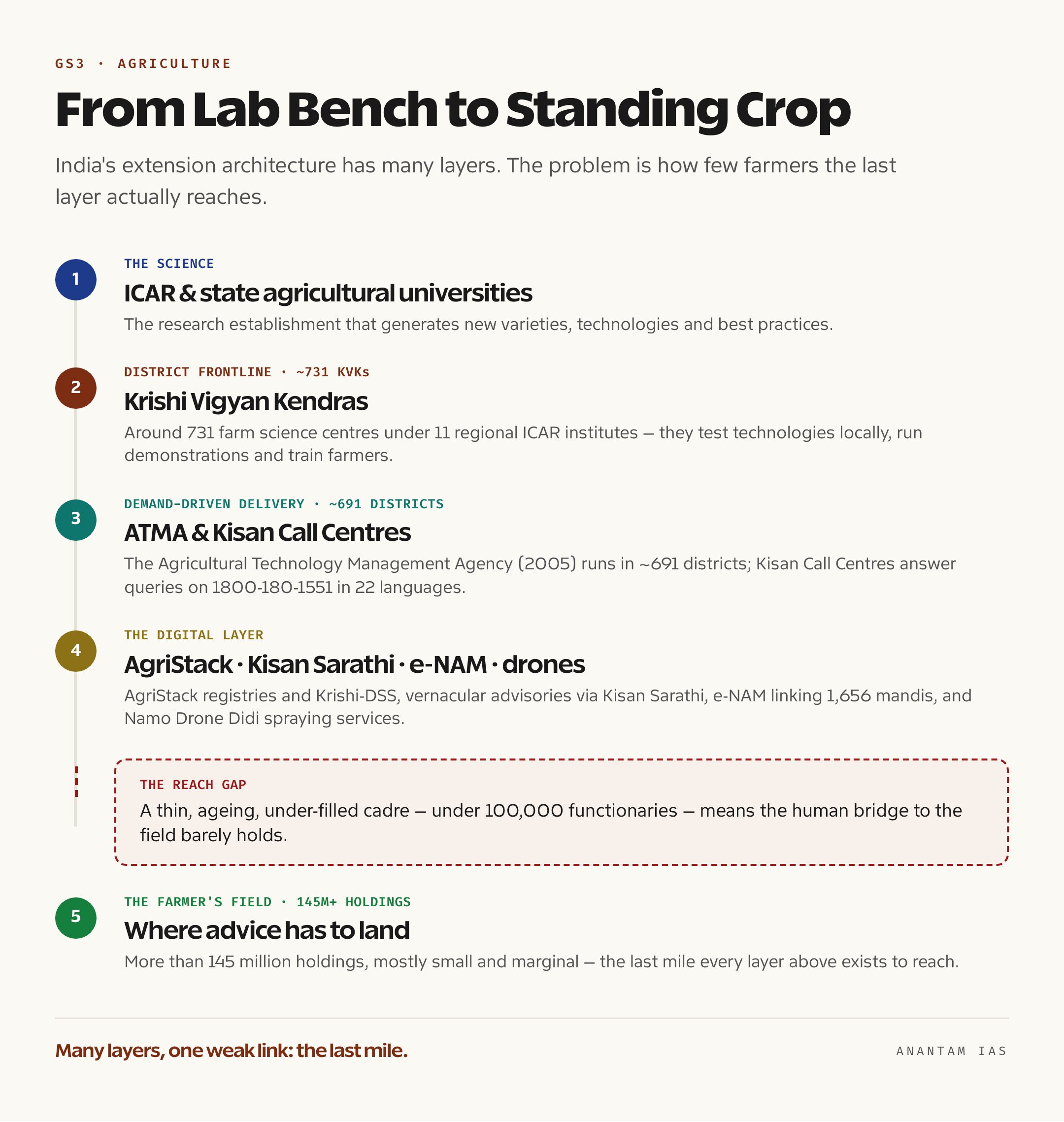
India did not build its extension system overnight, and the scaffolding shows. The backbone is the Indian Council of Agricultural Research (ICAR) and the state agricultural universities, which generate the science. The frontline is the Krishi Vigyan Kendra, the farm science centre at the district level. As of 2025 there are around 731 KVKs across the country, run under 11 regional ICAR institutes, with the bulk hosted by agricultural universities and others by ICAR institutes, NGOs, and state governments. KVKs test technologies in local conditions, run demonstrations, and train farmers and extension staff. ICAR marked the network’s golden jubilee in 2024, a reminder that the model is now half a century old and due for a serious rethink.
Layered on top is the ATMA scheme — the Agricultural Technology Management Agency — launched in 2005 as the country’s big move away from the old, top-down Training and Visit (T&V) system that the World Bank had funded in the 1970s and 80s. ATMA decentralises extension to the district, puts the District Collector in charge of a governing body, and is meant to make advisory demand-driven rather than dictated from the capital. It now runs in roughly 691 districts and sits inside the Sub-Mission on Agricultural Extension under the Krishonnati Yojana umbrella. Alongside it sit the Kisan Call Centres, reachable on the toll-free number 1800-180-1551, which answer farmer queries in 22 languages, and a clutch of mass-media and ICT channels.
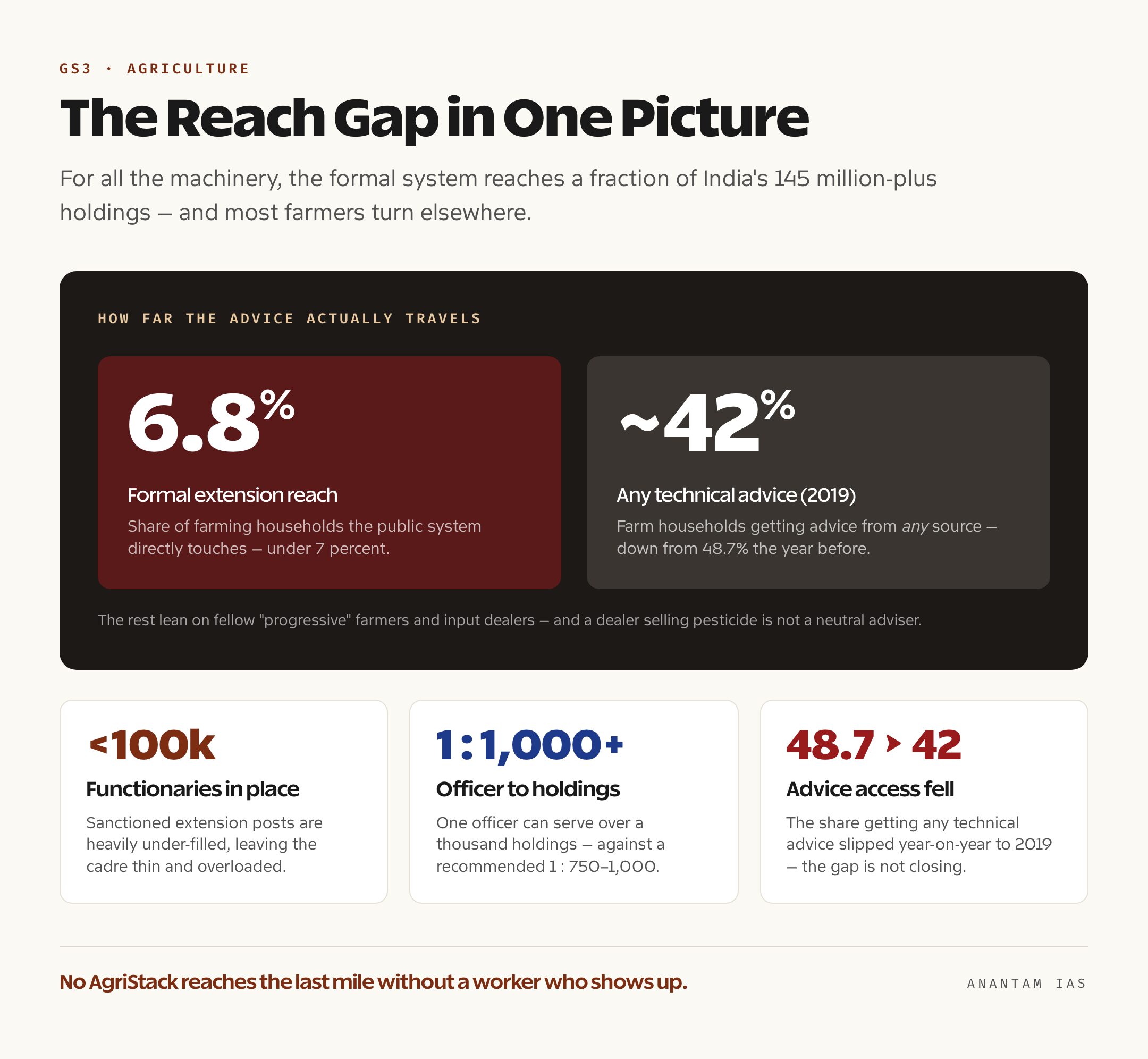
Now the uncomfortable number. For all this machinery, formal public extension reaches only a sliver of farmers. Studies of the system find that sanctioned extension posts are heavily under-filled — well under 100,000 functionaries actually in place — so the public system directly touches under 7 percent of farming households, and a single extension officer can be responsible for over a thousand holdings against a recommended ratio closer to one worker per 750 to 1,000 farmers. The National Sample Survey’s situation assessment of agricultural households found that only about 42 percent of farm households accessed any technical advice in 2019, from any source including radio and television, down from 48.7 percent the year before. Most farmers still lean on fellow “progressive” farmers and input dealers — and a dealer selling pesticide is not a neutral adviser. That is the hole the whole reform effort is trying to fill.
How the System Is Going Digital
Because boots-on-the-ground extension is so thin, India has bet heavily on technology to leapfrog the gap, and this is where the real action is now. In September 2024 the Union Cabinet approved the Digital Agriculture Mission with an outlay of Rs 2,817 crore, including a central share of Rs 1,940 crore. Think of it as digital public infrastructure for farming — the same idea as Aadhaar or UPI, applied to agriculture. Its core is AgriStack, a set of three foundational registries built by the states: a Farmers’ Registry that gives each farmer a unique digital ID, geo-referenced village maps, and a Crop Sown Registry that records what is actually growing in each plot.
The scale of the rollout is the part worth memorising. The government is targeting digital identities for 11 crore farmers — six crore in 2024-25, three crore the next year, two crore after that. By the end of March 2025, around 4.85 crore Farmer IDs had already been generated, and a Digital Crop Survey had covered hundreds of districts and crores of plots across the kharif and rabi seasons. Sitting on top of AgriStack is the Krishi Decision Support System (Krishi-DSS), which fuses satellite, weather, soil, and crop data so that advisories can become specific — not “spray now” in general, but “spray on your plot, this week, this dose.” The mission also includes mapping soil profiles across roughly 142 million hectares and replacing the old manual Crop Cutting Experiments with a Digital General Crop Estimation Survey.
Around this core spin the delivery channels. Kisan Sarathi, an ICAR-built platform, pushes KVK advisories straight to farmers’ phones in their own language. The electronic National Agriculture Market, e-NAM, has integrated 1,656 mandis across 23 states and four union territories, registered about 1.8 crore farmers, and handled trade worth roughly Rs 4.82 lakh crore since 2016 — extension’s market-information arm, telling a farmer what her produce is worth before she sells it. And then there are drones: the Namo Drone Didi scheme, approved with an outlay of Rs 1,261 crore for 2023-24 to 2025-26, aims to put agri-drones in the hands of 15,000 women self-help groups, who rent out spraying services to farmers and earn around a lakh a year doing it. It is extension, women’s livelihoods, and precision farming bundled into one rotor-powered package.
Where the System Still Falls Short
So the architecture is impressive on paper. But a UPSC answer that stops at the brochure misses the point — the gaps are the story. The first and biggest is the workforce. India’s extension cadre is thin, ageing, and badly distributed. With so many posts unfilled and serving officers buried in non-extension chores — distributing subsidies, inputs, and relief — there is little time left for the patient, repeat-visit advisory that actually changes how a farmer farms. You cannot run last-mile extension with a missing last mile.
The second gap is inclusion. Extension has historically followed the path of least resistance — to larger, better-off, better-connected male farmers near the road. Small and marginal holders, tenants, and women, who together do most of India’s farming, get the least attention, even though women contribute the bulk of farm labour in many regions. A drone scheme run by women’s groups is a deliberate corrective, but the broader system still under-serves exactly the people it most needs to reach. The third gap is the digital divide: AgriStack and app-based advisory assume a smartphone, decent data, and the literacy to use them. For an elderly, low-literacy farmer on a feature phone in a patchy-network village, a slick dashboard is no substitute for a person who shows up. Layering digital tools onto a hollow human network risks widening the gap rather than closing it.
There are quieter problems too. Public advice can be generic and out of date, while private agritech advice — from the genuinely useful platforms to the input dealer — carries a commercial pull toward selling something. Coordination is weak: KVKs, ATMA staff, state departments, and private players often work in silos rather than as one system. And data privacy worries shadow AgriStack, since a registry of who farms what, where, is sensitive information that needs guarding. None of this means the system is failing; it means the reform is unfinished.
The Way Forward
- Fix the human core first. Fill vacant extension posts, free serving officers from subsidy-distribution duties so they can actually advise, and invest in continuous retraining on natural farming, precision agriculture, and digital tools. Technology amplifies a working cadre; it cannot replace a missing one.
- Make extension genuinely pluralistic and coordinated. Bring public agencies, private agritech, NGOs, and FPOs under shared goals and quality standards rather than parallel silos, so a farmer gets consistent, trustworthy advice no matter who delivers it.
- Route advice through Farmer Producer Organisations. India crossed its target of 10,000 FPOs in early 2025, with around 30 lakh farmers — about 40 percent of them women — now organised. Embedding advisory inside FPOs scales reach, builds accountability, and ties knowledge to collective bargaining and market access.
- Build a para-extension layer. Train local “para-extension” volunteers — agri-graduates, krishi sakhis, lead farmers — to serve as the human bridge that carries digital advisories the last mile and feeds farmers’ questions back up.
- Design digital for the least-connected. Push voice, video, and vernacular-first advisory through Kisan Sarathi and Kisan Call Centres so that a feature phone and low literacy are not disqualifiers, and pair every app with a person.
- Move from transfer to co-creation. Treat farmers as partners whose own field knowledge shapes the advice, not as passive recipients of a packaged technology. The best extension listens before it instructs.
For Your Mains Answer
Agricultural extension is core GS Paper 3 territory — it maps directly onto “e-technology in the aid of farmers,” agricultural marketing, and the broader cropping-patterns and farm-income syllabus, and it threads into questions on doubling farmers’ income, digital public infrastructure, and inclusive growth. It is also a ready example for any answer on technology meeting last-mile delivery, and for essays on Viksit Bharat or rural transformation.
How to Build the Answer
Open by defining extension as the bridge from research to the farmer’s field, and name the two gaps it exists to close — science-to-field and best-farmer-to-average-farmer. Then move in three beats: the architecture (ICAR, KVKs, ATMA, Kisan Call Centres), the digital shift (Digital Agriculture Mission, AgriStack, Namo Drone Didi, e-NAM), and the gaps (thin workforce, weak inclusion, digital divide). Close with a balanced, reform-minded way forward. That arc — what it is, how it works, where it fails, how to fix it — fits almost any extension question.
Common Mistakes to Avoid
Don’t write a scheme-listing answer that just dumps acronyms; examiners reward the argument connecting them. Don’t present digital tools as a finished solution — flag the digital divide and the hollow human cadre. Don’t forget inclusion; an answer that ignores small, women, and tenant farmers misses the heart of the problem. And don’t overstate reach: be precise that formal extension touches a small fraction of farmers.
A Compact Answer Spine
Extension as the lab-to-field bridge → two gaps it closes → architecture (ICAR, 731 KVKs, ATMA in ~691 districts, Kisan Call Centres) → the digital leap (Digital Agriculture Mission Rs 2,817 cr, AgriStack’s 11-crore Farmer ID target, Krishi-DSS, e-NAM, Namo Drone Didi) → gaps (thin ageing workforce, ~7 percent reach, inclusion, digital divide) → way forward (fill posts, pluralistic and coordinated, FPO-routed, para-extension, vernacular-digital, co-creation).
Diagram or Flowchart Idea
Draw a horizontal pipeline: ICAR / SAU research → KVK demonstration → ATMA and Kisan Call Centre → digital layer (AgriStack, Kisan Sarathi, drones) → the farmer’s field. Mark a deliberate break or thin arrow at the last stage and label it “the reach gap.” A simple lab-to-field pipeline with the weak link flagged communicates the whole answer at a glance.
A Balanced-Conclusion Line
A line like this lands well: “India has built world-class agricultural research and is now building world-class digital rails — the unfinished task is the human bridge between them, and no AgriStack can reach the last mile without an extension worker who shows up.”
How to Use Data Without Cramming
Anchor with two or three figures, not ten. The strongest trio: around 731 KVKs; the Digital Agriculture Mission’s Rs 2,817-crore outlay targeting 11 crore Farmer IDs; and the reach gap — only about 42 percent of agricultural households get any technical advice, with formal extension touching under 7 percent. Pair each number with a point, and let the rest of the answer carry the argument.
FAQ
What is agricultural extension in simple terms? It is the system that carries useful knowledge — research findings, new technology, better practices, and market information — from laboratories and universities to farmers in their fields, so they can grow more and earn more sustainably. It is the bridge between agricultural science and the standing crop, delivered through demonstrations, training, advisories, and hand-holding rather than just leaflets.
What are KVKs and ATMA? A Krishi Vigyan Kendra (KVK) is a district-level farm science centre under ICAR that tests technologies locally and trains farmers; India has around 731 of them. ATMA, the Agricultural Technology Management Agency, is a district-led scheme launched in 2005 that decentralised extension and made it demand-driven, replacing the older top-down Training and Visit system; it runs in roughly 691 districts.
How is India digitising agricultural extension? Through the Digital Agriculture Mission (approved in 2024 with a Rs 2,817-crore outlay) and its AgriStack registries, which give farmers digital IDs — about 4.85 crore created by March 2025 against an 11-crore target. Tools like the Krishi Decision Support System, the Kisan Sarathi advisory app, e-NAM for markets, and the Namo Drone Didi scheme for women-run drone spraying together form the digital delivery layer.
Why does Indian agricultural extension fall short? The cadre is thin, ageing, and overloaded with non-advisory work, so formal extension reaches under 7 percent of farmers; only about 42 percent of farm households get any technical advice at all. Coverage skews toward larger, male, better-connected farmers, while small and women farmers are under-served, and the digital push risks leaving low-literacy, poorly-connected farmers behind unless it is paired with people on the ground.
Practice Questions
Prelims MCQs
- The ATMA scheme, launched in 2005 to decentralise agricultural extension, replaced which earlier model?
(a) National Agriculture Market
(b) Training and Visit (T&V) system
(c) Krishi Vigyan Kendra network
(d) Kisan Call Centre system
Answer: (b) — ATMA superseded the top-down World Bank-funded Training and Visit (T&V) system of the 1970s-80s, making advisory demand-driven and district-led. - AgriStack, the core of the Digital Agriculture Mission, is built around how many foundational registries?
(a) Two
(b) Three
(c) Four
(d) Five
Answer: (b) — AgriStack rests on three registries: a Farmers’ Registry, geo-referenced village maps, and a Crop Sown Registry. - Consider the Namo Drone Didi scheme. It aims to provide agri-drones to women self-help groups for renting out spraying services. Which is correct?
(a) Statement is correct; target is 15,000 women SHGs
(b) Statement is correct; target is 1.5 lakh women SHGs
(c) Statement is wrong; drones go to individual male farmers
(d) Statement is wrong; the scheme funds soil testing
Answer: (a) — Namo Drone Didi, with a Rs 1,261 crore outlay, targets putting agri-drones with 15,000 women SHGs who rent out spraying services. - According to the article, formal public agricultural extension in India directly reaches approximately what share of farming households?
(a) Under 7 percent
(b) About 23 percent
(c) About 42 percent
(d) Over 60 percent
Answer: (a) — The thin, under-filled cadre means the public system directly touches under 7 percent of households, while about 42 percent get advice from any source including media. - The Krishi Decision Support System (Krishi-DSS) primarily works by:
(a) registering farmers for digital IDs
(b) fusing satellite, weather, soil and crop data to generate plot-specific advisories
(c) integrating mandis for online trade
(d) replacing Kisan Call Centres
Answer: (b) — Krishi-DSS sits atop AgriStack and combines satellite, weather, soil and crop data to make advisories specific to a plot and time.
Mains Practice Questions
- “Agricultural extension is the weakest link between India’s research establishment and its farmers.” Critically examine the architecture and the reach gap of India’s extension system. (15 marks, 250 words)
- Discuss how the Digital Agriculture Mission and AgriStack seek to leapfrog India’s extension deficit, and evaluate the risks of layering digital tools onto a hollow human cadre. (15 marks, 250 words)
- “Indian agricultural extension under-serves exactly the farmers it most needs to reach.” Analyse the inclusion gap and suggest measures to make extension equitable for small, women and tenant farmers. (15 marks, 250 words)
- Examine the role of Farmer Producer Organisations and a para-extension layer in strengthening last-mile agricultural advisory in India. (10 marks, 150 words)
- The reform of agricultural extension requires fixing the human core before scaling technology. Critically evaluate this proposition in the context of India’s pluralistic extension model. (15 marks, 250 words)