Akshat Jain Anthropology Book: A Practical Reading Guide
Identify Akshat Jain's Anthropology Demystified, audit your copy against the syllabus and use a worked kinship example to make diagrams explain the right relationship.
The Akshat Jain anthropology book is easier to use when you know which job you’re giving it. A named optional guide can organize revision, but buying it doesn’t establish that every part of your syllabus is covered. Start with your own contents page and one topic you can test through a definition, example and diagram.
I recommend using Anthropology Demystified as a topic-based working source after checking a sample that matches your needs. Keep a usable copy you already own. Delay a purchase if the seller can’t identify the edition or show enough material to judge the explanation you need.
Identify Anthropology Demystified
The title is Anthropology Demystified, by Akshat Jain, associated with JICE Publications. It should not be described as a McGraw Hill book merely because other anthropology guides appear beside it in a search.
- The verified Amazon record for Anthropology Demystified identifies Akshat Jain and JICE.
- Another listing spells the title “Demistified” and adds a year to its sales title. A seller’s phrase “latest edition” doesn’t establish a numbered edition.
- Check the title page and copyright page before accepting edition claims. A release date and a substantive revision are different facts.
- This reading guide is in English and also has a Hindi adaptation. That doesn’t establish the availability of an authorized Hindi edition of the book.
The recommendation here is about how to assess and use a source. It isn’t a verdict that its illustrations, sample answers or complete syllabus coverage have been demonstrated by inspecting the full book.
Build A Coverage And Gap Matrix
Begin with separate Paper I and Paper II rows, then locate the corresponding sections in your copy. You should be able to say exactly which topic needs another source.
| Syllabus area to check | What to find in your copy | What you should produce |
|---|---|---|
| Paper I: social and cultural anthropology | Concepts and the argument explaining them | Definition, example and a boundary |
| Paper I: kinship and marriage | Descent, kinship relations and residence | A correctly labeled diagram with an explanation |
| Paper I: biological anthropology | Relevant process, terminology and evidence | A sequence or comparison you can explain |
| Paper I: research methods | Method, purpose and limitation | A method matched to a research problem |
| Paper II: Indian anthropology | The corresponding Indian syllabus topic | A source-based example with context |
| Paper II: tribal issues and applied work | The relevant topic and any dated evidence | An argument with verified supporting material |
This is a coverage audit for the reader, not a verified table of the book’s chapters. Mark each row “located,” “needs a fuller explanation” or “not located,” with page references from your edition.
The Anthropology Optional guide can help you place the book in the full preparation plan. One unfilled row is a specific reading problem; it doesn’t require buying a second complete book immediately.
Work Through A Kinship Example
A diagram helps when it makes a relationship easier to follow. It becomes misleading when the labels suggest more than the given information establishes.
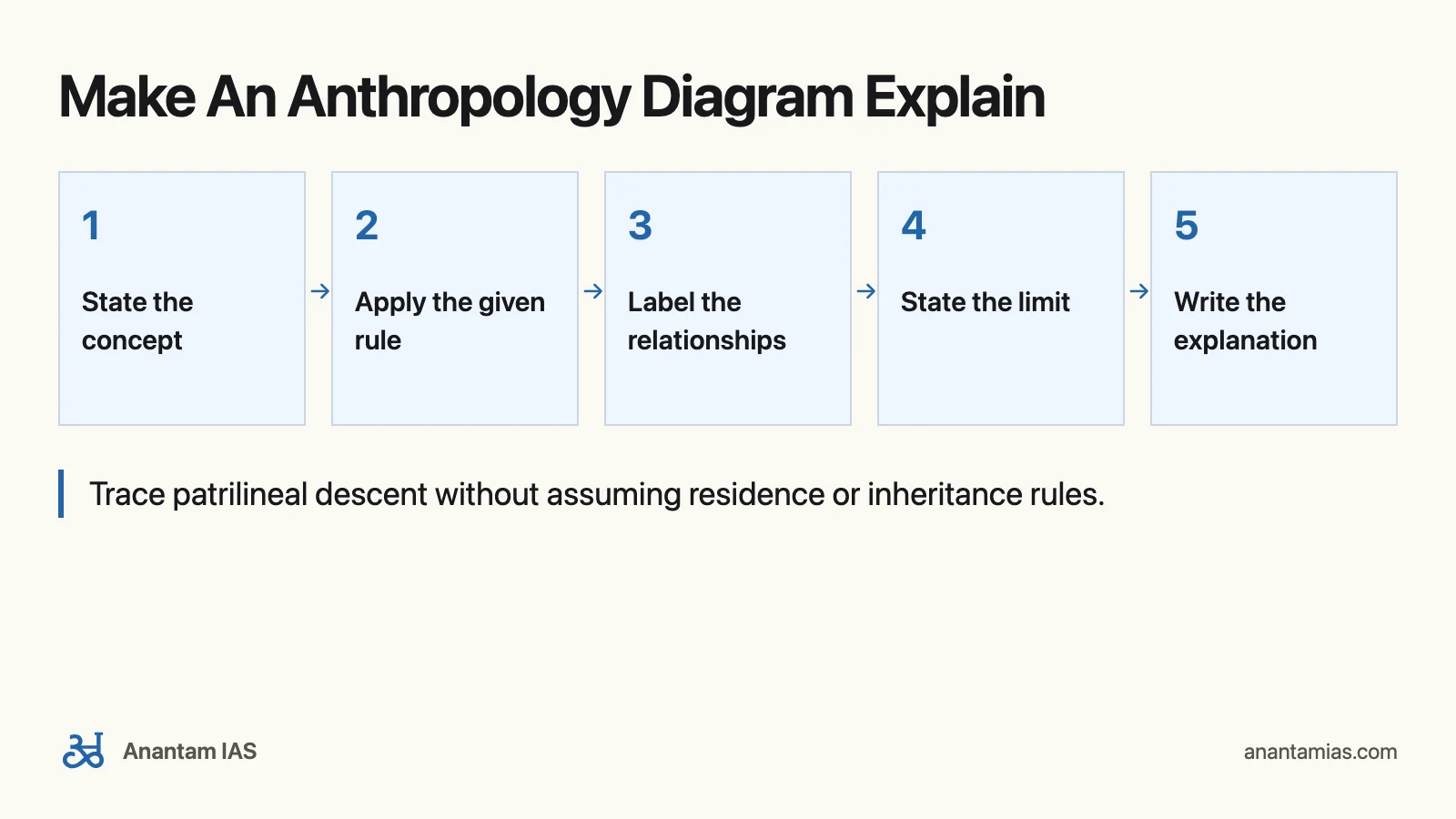
Original practice example, not a UPSC question: “Explain patrilineal descent and distinguish it from a rule about where a married couple lives.”
Assume a hypothetical group traces descent through the father’s line. Let Ego mean the person whose relationships we are mapping. Ego has a father, a mother, a brother and a paternal aunt. No residence or inheritance rule is supplied.
Here is the reasoning before the diagram:
- Define descent: It is the socially recognized tracing of ancestry and group membership.
- Apply the stated rule: Ego’s line is traced through the father and the father’s father. Ego’s brother follows that line too.
- Check the gender shortcut: The paternal aunt also belongs to her father’s descent group in this hypothetical patrilineal system. Patrilineal membership doesn’t mean that only males belong to the group; transmission is traced through male ancestors.
- Keep kinship broader: Ego’s mother remains a relative. Being outside the indicated patrilineage doesn’t make a person unrelated.
- Stop where the facts stop: We cannot infer the couple’s residence or specific property rights from the given descent rule.
OpenStax’s explanation of reckoning kinship provides a fuller introduction to these distinctions.
Now draw a simple sketch on paper. Start with this line, then branch it:
Father’s father → Father → Ego
- Add the father’s sister as another child of the father’s father.
- Add Ego’s brother as another child of the father.
- Place the mother beside the father and clearly label the parent relationship.
- Highlight the indicated patrilineage. Explain in the key that arrows show the ancestry being traced, not where anyone lives.
The sketch is a simplified teaching aid, not a complete conventional genealogical diagram. If you use formal anthropological symbols in an answer, provide a clear key and reproduce the relationships accurately.
Your answer can now follow a defensible sequence:
| Answer move | What to say |
|---|---|
| Definition | Patrilineal descent traces membership through the father’s line |
| Illustration | Show the line through the father’s father, father and Ego |
| Necessary qualification | Male and female descendants can belong; transmission follows male ancestors |
| Distinction | Patrilocal residence concerns living with or near the husband’s family |
| Limit | A descent rule alone doesn’t establish residence, inheritance details or the full distribution of authority |
A weak answer labels the diagram “men’s family” and concludes that everyone lives with the father. The repaired answer states which relationship the diagram shows. That’s the check you should apply to diagrams throughout your reading.
Read With Concept, Example And Diagram
Choose an output that suits the topic. Kinship may benefit from a relationship sketch; a biological process may need a sequence; an argument about policy may need a causal explanation instead of a decorative figure.
- Read for 20 minutes: Identify the definition and the distinction that matters.
- Recall for 10 minutes: Explain it without looking and mark the uncertain sentence.
- Draw or organize for 10 minutes: Make the appropriate sketch, sequence or argument map.
- Write for 15 minutes: Answer an original practice prompt, including the figure only if it helps the explanation.
- Check for 5 minutes: Inspect terms, relationships and unsupported conclusions.
This is a 60-minute sample cycle. Split it across two sessions if needed. A difficult definition may need the whole first session; adding a diagram before understanding it won’t save time.
At the week’s end, explain the same concept through a different hypothetical example. If the rule still works, compare it with a documented case from a reliable source. Don’t invent a named community’s customs to make the answer look specific.
Decide What Needs Another Source
Buy or consult a supplement for a diagnosed gap. The book’s name and the author’s exam background can’t substitute for that diagnosis.
- Biological explanations need accurate mechanisms and evidence. A short definition may need fuller reading if you cannot explain the steps.
- Indian cases need context and sources. A community name alone doesn’t support a claim about every member.
- Current policy or numerical evidence needs a date and current verification; an older print isn’t automatically current.
- Published Anthropology notes can help locate a topic, but keep the coverage matrix tied to the actual syllabus.
Begin with the kinship sketch and its limits. If you can explain why descent doesn’t determine residence, your reading has already produced a usable distinction.
Frequently Asked Questions
What is Akshat Jain’s anthropology book called?
The verified title is Anthropology Demystified, by Akshat Jain, associated with JICE Publications. A separate sales title misspells it as Demistified; use the actual title-page identity.
Which edition should I buy?
Check the seller’s title and copyright pages. A sales label saying latest edition or a release date does not establish a numbered or substantively revised edition.
Does the Hindi guide mean the book has a Hindi edition?
No. This article’s Hindi adaptation does not establish an authorized Hindi edition of the book. Check the publisher and seller for the language of the actual copy.
Can Anthropology Demystified replace every optional source?
This guide makes no full-syllabus claim. Audit both papers topic by topic, recording what is located, what needs a fuller explanation and what is missing.
What is the difference between patrilineal descent and patrilocal residence?
Patrilineal descent traces group membership through the father’s line. Patrilocal residence concerns living with or near the husband’s family after marriage. The descent rule alone does not establish the residence arrangement.