Algorithmic Governance and Algorithmic Bias: When Code Makes Public Decisions (UPSC Governance)
When the state lets an algorithm decide who gets a welfare benefit, a loan or a place in a job queue, a single line of biased code can discriminate against millions at once. Here is the full picture of algorithmic governance and algorithmic bias — where bias comes from, the cases that exposed it, and how India and the world are responding — explained for UPSC GS2.
A few years ago, the Dutch tax authority did something that sounded efficient and turned out to be a catastrophe. To catch childcare-benefit fraud, it let a risk-scoring algorithm flag which parents to investigate — and the algorithm quietly treated a foreign-sounding name or a second nationality as a warning sign. Between roughly 2005 and 2019, tens of thousands of families, most of them from immigrant backgrounds, were branded as fraudsters, ordered to repay benefits they were owed, and pushed into debt, bankruptcy and worse. The Dutch data-protection watchdog later called the method “unlawful, discriminatory and improper.” In January 2021 the entire government resigned over it. No single official had decided to ruin those families. A system had.
That is the question at the heart of this topic. When the state stops deciding case by case and lets code decide instead — who gets a loan, a welfare payment, a place in a queue, a visit from the police — what happens when the code is wrong in a way nobody can see? This is the terrain of algorithmic governance, the use of algorithms to make or guide public decisions, and its shadow, algorithmic bias, where those automated decisions discriminate at scale. For an aspirant, it sits squarely in the modern governance and ethics syllabus: it is about transparency, accountability, the right to equality, and the uncomfortable gap that opens up when “the computer says no” and no human can explain why.
What Algorithmic Governance Actually Means
Start with the plain idea before the jargon. Algorithmic governance is the use of algorithms — step-by-step computational rules, increasingly powered by machine learning — to make, support or automate decisions that governments and large institutions used to make by human judgment. The political theorists’ phrase for it is “algorithms as a mode of ordering behaviour”: rules that shape what people can do, not by passing a law and asking officials to apply it, but by encoding the decision into software that runs millions of times without tiring, arguing or being lobbied. A welfare department uses it to decide who gets flagged for a fraud check. A bank uses it to decide who is creditworthy. A police force uses it to decide which neighbourhoods to patrol. A platform uses it to decide which posts to take down.
Two features make this different from an old-fashioned rulebook, and both matter for governance. The first is the “black box.” Modern machine-learning models learn patterns from data rather than following rules a human wrote down, so even their designers often cannot fully explain why a particular person was scored high-risk. The reasoning is buried in millions of statistical weights. When a citizen is denied a benefit, there may be no readable reason to give them — and no clear thing to appeal against. The second is automation bias: the well-documented human tendency to over-trust a machine’s output and stop questioning it. An official looking at a screen that says “high risk” is far less likely to overrule it than to rubber-stamp it, because the number feels objective and neutral even when it is neither. Put those together and you get a decision that is fast, scalable, opaque and very hard to challenge — efficient governance and a due-process problem in the same package.
None of this is automatically bad. Done well, algorithms can make public decisions faster, more consistent and less prone to the moods and prejudices of an individual clerk. They can process millions of welfare claims or tax returns in the time a human takes for a handful, and they can — in principle — apply the same standard to everyone. The trouble is that an algorithm only knows what we taught it, and what we teach it is the past. If the past was unequal, the machine learns inequality and then applies it at industrial speed. That is where bias enters.
Where Algorithmic Bias Comes From
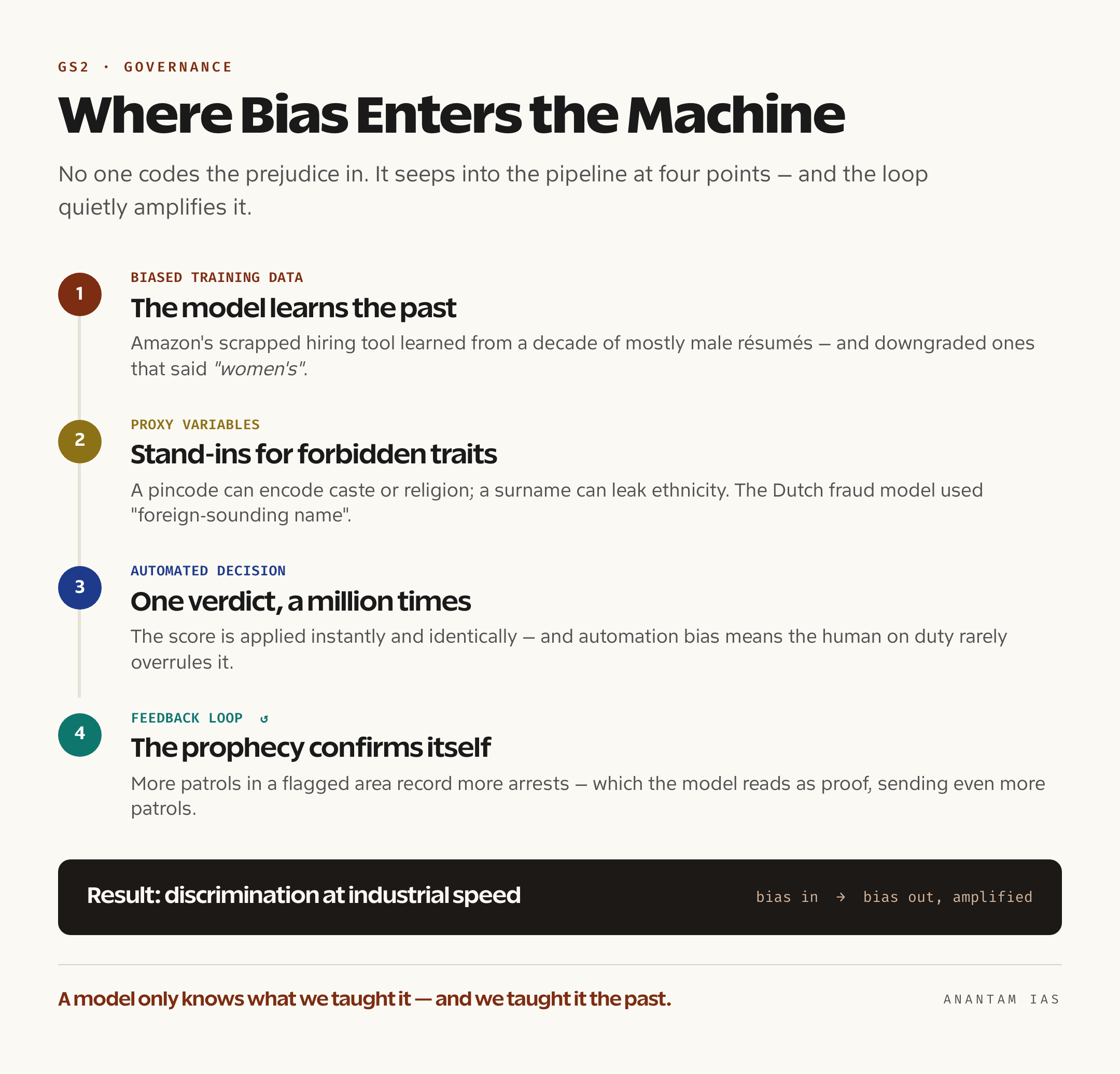
The single most important thing to understand — and the point that earns marks — is that algorithmic bias is usually not the result of a racist or sexist programmer. It is the result of a system faithfully learning from a biased world. There are three main doorways through which it enters.
The first and biggest is biased training data. A machine-learning model is only as fair as the examples it is fed, and historical data carries the fingerprints of historical discrimination. The cleanest illustration is Amazon’s experimental recruiting tool, scrapped in 2018. The company trained it on a decade of résumés it had received, then asked it to rank new applicants. Because the tech industry had hired mostly men, the model concluded that being male was a marker of a good candidate. It reportedly penalised résumés that contained the word “women’s” — as in “women’s chess club captain” — and downgraded graduates of two all-women colleges. Amazon never used it to hire and eventually killed it, having lost confidence it could be made neutral. The lesson is brutal in its simplicity: feed a model a biased past and it will recommend a biased future, with a veneer of mathematical objectivity on top.
The second doorway is proxy variables. Good designers know not to feed a model a forbidden trait like race or religion directly. But the model can reconstruct that trait from innocent-looking stand-ins. A postal code can be a near-perfect proxy for caste, religion or race in a segregated city. A surname can leak ethnicity. The Dutch childcare disaster ran on exactly this logic — “foreign-sounding name” and “dual nationality” became machine-readable proxies for “likely fraudster.” The model never needed a field labelled “ethnicity.” It just needed correlates, and society had supplied plenty. The third doorway is the feedback loop, the most insidious of the three. Predictive-policing tools are the textbook case: send more patrols to a neighbourhood the model flagged, and you record more arrests there simply because more officers are present, which the model reads as confirmation that the area is high-crime, so it sends even more patrols. The algorithm ends up validating its own prophecy. Bias gets baked in and then amplified, loop after loop.
The famous cases turned these abstractions into evidence. In the United States, ProPublica’s 2016 investigation of COMPAS — a proprietary risk-assessment tool used in courts to predict whether a defendant would reoffend — found that the system was nearly twice as likely to wrongly label Black defendants as future criminals than white defendants, while white defendants who did reoffend were more often mislabelled as low-risk. On facial recognition, the 2018 “Gender Shades” study by Joy Buolamwini and Timnit Gebru tested commercial systems from IBM, Microsoft and Face++ and found error rates of under one per cent for lighter-skinned men but as high as 34.7 per cent for darker-skinned women — the same technology that could be used to identify a suspect or unlock a benefit working far worse for the people most likely to be wronged by a mistake. Closer to home, scholars and civil-society groups have raised parallel worries about welfare and identity systems in India, where biometric authentication failures in schemes linked to Aadhaar have, in documented cases, wrongly cut off rations or pensions for the elderly and manual labourers whose worn fingerprints the machine could not read. The harm pattern repeats across every example: the system fails hardest on the most vulnerable, and the failure looks like neutral arithmetic.
The Harms: Discrimination, Opacity and the Accountability Gap
The damage from biased automated decisions clusters into a few recognisable shapes, and naming them is how you build a sharp answer. The first is discrimination at scale. A prejudiced human official harms the people in front of them; a prejudiced algorithm harms everyone it touches, instantly and identically. When the bias is in the code, it is not a few bad apples — it is the whole orchard, applied to a million decisions before anyone notices. The second is exclusion. Welfare and identity systems built for efficiency can lock out precisely the people they were meant to serve: the worker whose fingerprint won’t scan, the widow whose name is misspelt in a database, the migrant whose paperwork doesn’t match. Automation turns a small administrative error into a hard, automatic “no.”
The third harm is opacity, and it strikes at a basic principle of natural justice. A citizen has a right to know why the state has acted against them, so they can contest it. But a black-box model often produces no human-readable reason — just a score. “The computer says no” becomes an answer that cannot be argued with, because there is nothing to argue about. The fourth, and the one that ties the rest together, is the accountability gap. When a decision is made by a system stitched together from a private vendor’s model, a department’s data and an official’s rubber stamp, who is responsible when it goes wrong? The vendor points to the data; the department points to the vendor; the official points to the screen. The Dutch scandal showed how this diffusion of blame lets harm run for years before anyone owns it. Responsibility evaporates exactly when it is needed most.
There is a constitutional edge to all of this in the Indian context, and it is worth carrying into an answer. Article 14 of the Constitution guarantees equality before the law and the equal protection of the laws, and the Supreme Court has read into it a guarantee against arbitrariness — state action must be reasoned, non-arbitrary and non-discriminatory. An opaque algorithm that produces unexplained, discriminatory outcomes runs straight into that principle. The right to a fair hearing and a reasoned decision, a cornerstone of administrative law, is hard to honour when the decision-maker is a model nobody can interrogate. So algorithmic bias is not only an ethics problem or a technology problem; in the public sphere it is a rule-of-law problem, touching equality, due process and the citizen’s right to an accountable state.
The Responses: Transparency, Auditing and the Law Catching Up
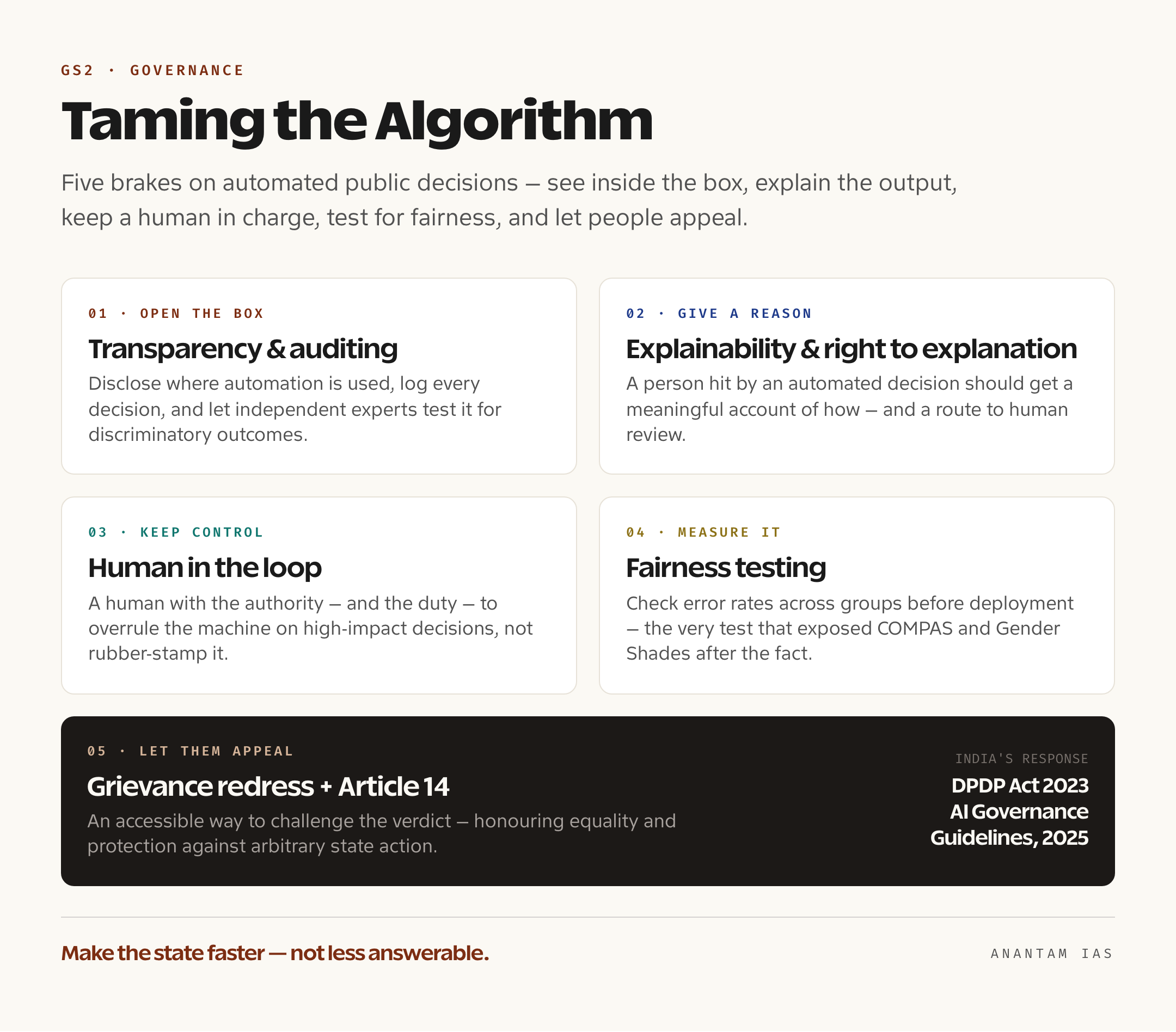
The good news is that the world is no longer treating this as science fiction, and the toolkit for taming algorithmic decisions is becoming clearer. The first response is algorithmic transparency and auditing — opening the box. This means disclosing where automated systems are used in public decisions, allowing independent experts to test them for discriminatory outcomes, and keeping logs so a decision can be traced after the fact. The second is explainability and the closely related idea of a “right to explanation”: the principle that a person subjected to an automated decision should be entitled to a meaningful account of how it was reached and a way to seek human review. A third is fairness testing — using statistical fairness metrics to check whether a model’s error rates differ across groups before it is deployed, the very test that exposed COMPAS and Gender Shades after the fact. And running through all of them is the oldest safeguard of all: keeping a human meaningfully in the loop, with the authority and the duty to overrule the machine rather than defer to it.
The law is now hard-coding some of these ideas. The European Union’s AI Act, the world’s first comprehensive AI law, takes a risk-based approach: it bans a handful of “unacceptable-risk” uses outright — those prohibitions took effect in February 2025 — and places strict obligations on “high-risk” systems, a category that expressly includes AI used in employment, credit and essential public services, law enforcement and the administration of justice. For these high-risk systems the Act demands quality data, documentation, logging, transparency and genuine human oversight, with the core obligations phasing in through 2026 and heavy penalties for breach. The Dutch courts had already moved in the same direction: in February 2020, the Hague District Court struck down SyRI, the government’s welfare-fraud risk-profiling system, ruling that it violated the right to private life under the European Convention on Human Rights because it was insufficiently transparent and verifiable and citizens could not see or challenge their own risk scores. That judgment is a landmark — a court telling a state that an opaque algorithm aimed at the poor is not lawful merely because it is efficient.
India is building its own answer, and this is the part to know cold. The Digital Personal Data Protection Act, 2023 — India’s first comprehensive privacy law — sets up the consent and data-handling rules within which any data-hungry algorithm must operate, and creates a Data Protection Board to enforce them; you can read the fuller picture in this guide to the DPDP Act and what it means for privacy in India. On top of that, in November 2025 the Ministry of Electronics and Information Technology released the India AI Governance Guidelines under the IndiaAI Mission, a principles-based framework that names discrimination from biased data, the black-box transparency-and-accountability gap and the digital divide among the core challenges to be governed, and lays out a multi-tier structure — an apex AI Governance Group for policy, sectoral regulators like the RBI and SEBI for domain-specific rules and grievances, advisory bodies like NITI Aayog, and standards bodies to build risk taxonomies and certification. The financial sector is already moving: the RBI’s 2025 framework for responsible AI in finance pushes regulated lenders towards board-approved AI policies, independent validation of credit-scoring models and human review of high-impact decisions. India has deliberately chosen a lighter, innovation-friendly, principles-based path over the EU’s hard-rules model — a bet that it can foster AI adoption and still hold it accountable, and a choice that is itself examinable. For the wider regulatory debate, see this explainer on AI governance in India.
For Your Mains Answer
This is a high-value, cross-cutting topic that lands mainly in GS Paper 2 — governance, transparency and accountability, the role of technology in administration, and issues relating to the rights guaranteed by the Constitution, especially Article 14. It also feeds GS Paper 4 (Ethics) as a case of values like fairness, justice and accountability colliding with technology, and GS Paper 3 where it overlaps with the science-and-technology and internal-security uses of AI. The skill examiners reward is the one this article models: explain a technical idea in plain governance language, anchor it with a couple of real cases, and connect it to constitutional principle and the Indian policy response.
How to Build the Answer
Move in a clean chain. Define algorithmic governance and why the state is adopting it (speed, scale, consistency) → name the two structural problems, the black box and automation bias → explain where bias comes from in three doorways: biased data, proxy variables, feedback loops → give one or two crisp cases (Dutch childcare scandal, COMPAS or Gender Shades) → list the harms: discrimination at scale, exclusion, opacity, the accountability gap → tie it to Article 14 and due process → close with the responses: transparency and auditing, explainability and the right to explanation, human oversight, and the law — the EU AI Act abroad and the DPDP Act plus the 2025 India AI Governance Guidelines at home. That arc — adopt, fail, diagnose, evidence, harm, principle, fix — fits almost any question on the theme.
Common Mistakes to Avoid
Don’t frame bias as a problem of evil programmers; the marks are in showing it is biased data and a biased world, learned faithfully and applied at scale. Don’t conflate algorithmic governance (a mode of decision-making) with AI in general — keep the focus on automated public decisions. Don’t list cases without a point; each case should illustrate a specific mechanism (Amazon = biased data, Dutch scandal = proxy variables, predictive policing = feedback loop). And don’t forget the Indian anchor — an answer that names Article 14, the DPDP Act and the 2025 India AI Governance Guidelines reads as current and rooted, not borrowed from foreign headlines.
A Compact Answer Spine
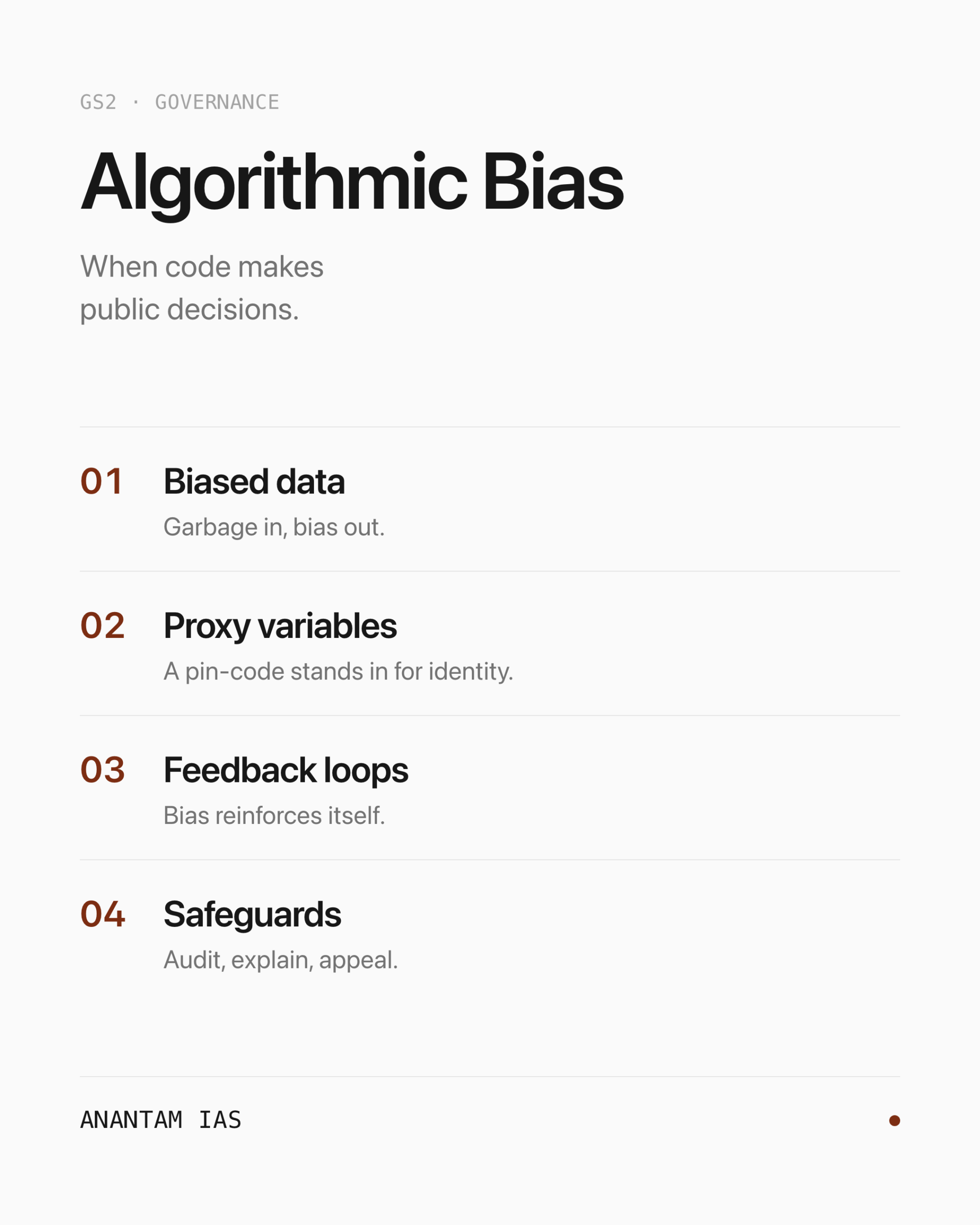
Algorithmic governance = algorithms making/guiding public decisions → adopted for speed, scale, consistency → two structural flaws: black box (no readable reason) + automation bias (humans over-trust the output) → bias enters via biased training data + proxy variables + feedback loops → cases: Dutch childcare scandal (govt fell, 2021), COMPAS, Gender Shades (34.7% error for darker-skinned women) → harms: discrimination at scale, exclusion, opacity, accountability gap → constitutional hook: Article 14, arbitrariness, due process → responses: transparency/auditing, explainability + right to explanation, human-in-the-loop, fairness testing; EU AI Act (risk-based, high-risk rules), SyRI struck down 2020; India = DPDP Act 2023 + India AI Governance Guidelines (Nov 2025) + RBI responsible-AI rules → verdict: efficiency must not buy out accountability.
Diagram or Flowchart Idea
Draw the bias pipeline as a left-to-right flow: Biased data → Model training → Proxy variables → Automated decision → Feedback loop curving back to the data. Beside it, a small column of four safeguards — transparency/audit, explainability, human oversight, grievance redress — pointing at the pipeline like brakes. A clean cause-and-cure visual like this shows the examiner you understand both the disease and the treatment.
A Balanced-Conclusion Line
A line that lands the marks: “An algorithm can make the state faster, but it must not make the state unaccountable — the test of good algorithmic governance is not how many decisions it automates, but how easily a citizen wronged by one can see the reason, challenge it, and find a human who will answer for it.”
How to Use Data Without Cramming
You need only a few anchors, not a database: the Dutch government’s resignation in 2021 over the childcare-benefits scandal; the Gender Shades finding of up to 34.7 per cent error for darker-skinned women against under one per cent for lighter-skinned men; the SyRI ruling of 2020; and the dates of India’s response — the DPDP Act of 2023 and the India AI Governance Guidelines of November 2025. Drop those into the right sentences, attribute them plainly, and the answer reads as authoritative without a single bracket.
Frequently Asked Questions
What is the difference between algorithmic governance and algorithmic bias?
Algorithmic governance is the use of algorithms — increasingly machine-learning systems — to make, support or automate decisions that public institutions used to make by human judgment, such as who gets a welfare benefit, a loan, a patrol or a content takedown. Algorithmic bias is the failure mode of that system: when those automated decisions systematically disadvantage particular groups, usually because the model learned from biased data or used discriminatory proxies. Governance is the practice; bias is the harm it can cause at scale.
Where does algorithmic bias come from if no one programs it deliberately?
From three main sources. Biased training data — a model that learns from a discriminatory past will recommend a discriminatory future, as Amazon’s scrapped hiring tool did when it downgraded women’s résumés. Proxy variables — innocent-looking inputs like a postal code or surname that stand in for protected traits like caste, religion or race. And feedback loops — where a model’s own outputs (more policing in a flagged area) generate the data that confirms its bias, amplifying it over time. The bias is in the world; the machine just learns and scales it.
Why is algorithmic bias a constitutional and governance problem in India, not just a tech issue?
Because Article 14 guarantees equality before the law and protection against arbitrary state action, and natural justice requires that a person be given a reasoned decision they can challenge. An opaque, biased algorithm that denies someone a benefit or flags them as a suspect — with no readable reason and no easy appeal — undermines equality, due process and the citizen’s right to an accountable state. So in the public sphere, algorithmic bias is a rule-of-law problem as much as an ethics or technology one.
What is India doing to govern algorithmic decision-making?
India has chosen a principles-based, innovation-friendly path. The Digital Personal Data Protection Act, 2023 sets the rules for how personal data — the fuel for these models — may be collected and used, enforced by a Data Protection Board. In November 2025 the Ministry of Electronics and Information Technology released the India AI Governance Guidelines under the IndiaAI Mission, naming bias, the black-box accountability gap and the digital divide as core challenges and setting up a multi-tier governance structure led by an AI Governance Group with sectoral regulators handling grievances. The RBI has also issued a framework pushing responsible AI in finance, including human review of high-impact decisions.
Practice Questions
Prelims MCQs
- With reference to “algorithmic bias” in automated decision-making, which of the following is the most accurate description of its primary cause?
(a) Deliberate insertion of discriminatory rules by programmers
(b) A model faithfully learning patterns from biased historical data and proxy variables
(c) A shortage of computing power to process all applicants equally
(d) The absence of any human involvement in writing the software
Answer: (b) Bias usually arises not from malicious coding but from models learning discriminatory patterns in their training data and reconstructing protected traits from proxy variables. - The Digital Personal Data Protection Act, which sets rules for how personal data may be processed in India, was enacted in which year?
(a) 2019
(b) 2021
(c) 2023
(d) 2025
Answer: (c) The DPDP Act was enacted in 2023 and establishes a Data Protection Board to enforce its provisions. - Which of the following best describes “automation bias”?
(a) A model’s tendency to favour automated industries
(b) The human tendency to over-trust and under-question a machine’s output
(c) The bias introduced when a system is fully automated with no data
(d) The preference of algorithms for faster hardware
Answer: (b) Automation bias is the documented human tendency to defer to a machine’s recommendation and stop independently scrutinising it, which makes opaque algorithmic decisions harder to correct. - The India AI Governance Guidelines, a principles-based framework naming bias, transparency and the digital divide as core challenges, were released in 2025 by which body?
(a) NITI Aayog
(b) The Reserve Bank of India
(c) The Ministry of Electronics and Information Technology
(d) The Supreme Court of India
Answer: (c) MeitY released the India AI Governance Guidelines under the IndiaAI Mission in November 2025, with NITI Aayog among the advisory bodies in the structure. - The constitutional provision most directly engaged when an opaque, discriminatory algorithm makes an adverse decision against a citizen in India is:
(a) Article 19, freedom of speech
(b) Article 21, life and personal liberty only
(c) Article 14, equality before the law and protection against arbitrary state action
(d) Article 32, the right to constitutional remedies
Answer: (c) Article 14 guarantees equality and, as read by the Supreme Court, protection against arbitrariness — directly engaged by unexplained, discriminatory automated decisions.
Mains Practice Questions
- “Algorithmic governance promises efficiency but risks accountability.” Examine how automated decision-making by the state can come into conflict with the right to equality and due process in India. (15 marks, 250 words)
- Explain the main sources of algorithmic bias in automated public decisions, using real-world examples. What safeguards can governments adopt to mitigate such bias? (15 marks, 250 words)
- Discuss the “black box” problem and “automation bias” in algorithmic decision-making. Why do they pose a particular challenge to the principles of natural justice and a reasoned decision? (10 marks, 150 words)
- Compare the European Union’s risk-based, hard-law approach to regulating AI with India’s principles-based approach under the India AI Governance Guidelines and the DPDP Act. Which model is better suited to a country like India, and why? (15 marks, 250 words)
- “An algorithm should make the state faster, not less answerable.” In the light of this statement, suggest a framework for the responsible use of automated decision-making in welfare delivery and law enforcement in India. (15 marks, 250 words)