PLI Scheme – Design, Benefits, Challenges and UPSC Notes
UPSC guide to India's Production Linked Incentive (PLI) scheme: 14 sectors, incentive design, investment outcomes, challenges and 2024-26 results.
The Production Linked Incentive (PLI) scheme is the single biggest manufacturing-policy pivot India has made since the 1991 reforms. Announced as part of the Aatma Nirbhar Bharat package in 2020-21 and scaled across 14 priority sectors, PLI has shifted subsidy design from input-based incentives to output-based rewards. For UPSC GS-III, PLI is central to questions on industrial policy, import substitution, export promotion and GVC integration.
What is PLI
Objective: boost domestic manufacturing, attract large investments, integrate India with global value chains.
Strategy: offer companies cash incentives on incremental sales of goods manufactured in India over a base year (typically 2019-20), conditional on meeting threshold investment and production targets.
Incentive structure: 4-7 per cent of incremental sales over a 5-year period (sectoral variation – 1 per cent for advanced chemistry cells, up to 10-20 per cent for specific mobile phone categories).
Eligibility: companies must cross pre-agreed thresholds on both incremental investment and incremental sales to earn the subsidy.
Tenure: 5 years, varying by sector.
The 14 PLI sectors
- Mobile manufacturing and specified electronic components
- Critical key starting materials, drug intermediates, APIs
- Medical devices
- Pharmaceuticals
- Telecom and networking products
- Food processing
- Textile products (MMF and technical textiles)
- White goods (ACs, LED)
- High-efficiency solar PV modules
- Automobile and auto components
- Advanced chemistry cell (ACC) batteries
- Speciality steel
- Electronic/IT hardware (laptops, tablets, servers)
- Drones and drone components
Semiconductor manufacturing is incentivised through a parallel Semicon India programme rather than the PLI framework.
Benefits of the PLI design
Output-linked subsidy
Earlier schemes like Phased Manufacturing Programme (PMP) raised customs duty on finished goods, creating disguised rent and protected inefficiency. PLI pays subsidy only after the firm actually produces and sells – aligning incentives with outcomes.
Result-oriented disbursement
Incentives are disbursed only after production has taken place in India. Official projections estimated PLI would add Rs 37 lakh crore (about $520 billion) to manufacturing output over five years.
Easy to administer
Disbursement is against objective criteria – investment and incremental sales – verified by certified auditors. This reduces discretionary risk.
Creating champions for GVCs
PLI favours size and scale by selecting players who can deliver on volumes. This nurtures lead firms capable of anchoring global value chains around themselves.
Technology adoption
PLI specifications often mandate advanced technology use – EV and ACC batteries in autos, 5G capability in telecom, MMF in textiles – pushing Indian firms up the value curve.
Linkages with MSMEs
Lead firms (Tier-1 suppliers) procure from Tier-2 and Tier-3 MSMEs, creating backward linkages and employment deep in the supplier ecosystem.
Self-reliance
By substituting imports in APIs, electronics, display panels, critical materials and advanced batteries, PLI strengthens strategic autonomy.
Employment generation
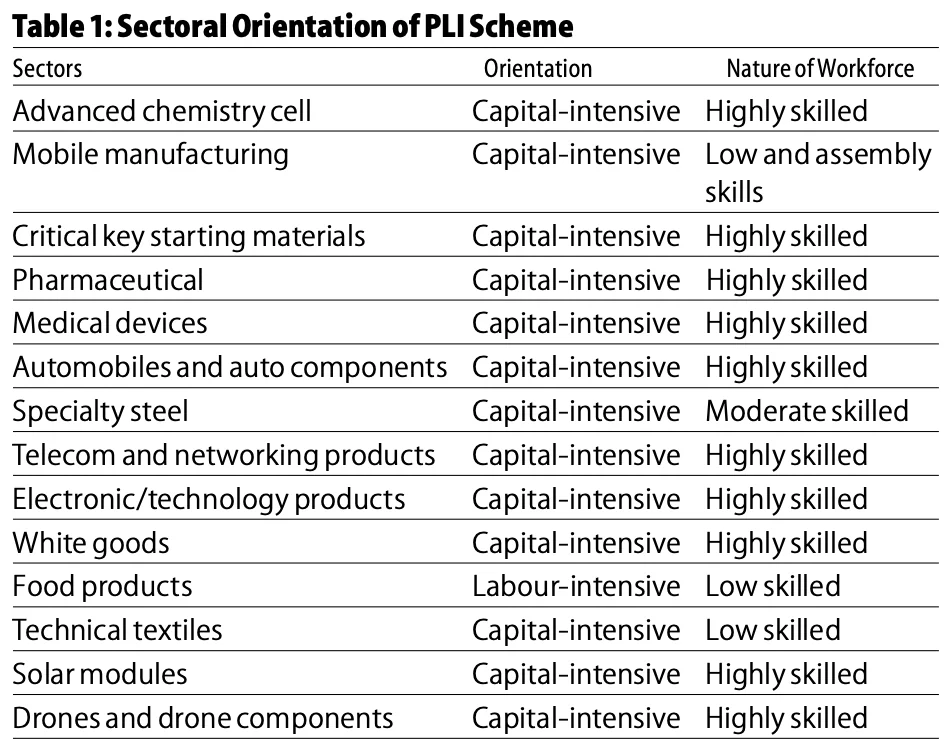
Incentivises traditional labour-intensive sectors (food processing, textiles, white goods) alongside capital-intensive ones.
Attracts firms exiting China
The China Plus One reallocation benefits India where PLI plus corporate tax cuts plus infrastructure investment converge. Apple's shift of a growing share of iPhone production to India is the headline case.
Challenges with PLI
Higher manufacturing cost
PLI is a partial offset for structurally high costs – land, logistics, labour, capital. Without underlying factor-market reforms, even the subsidy may leave India uncompetitive against Vietnam or Thailand.
Risk to domestic companies
Incentives apply uniformly to domestic and foreign companies incorporated in India. Deep-pocketed MNCs can capture most of the subsidy pool, squeezing domestic champions.
Cap on incentives
Incentives cannot exceed the notified financial outlay per sector. An over-performing company may exhaust its allocation prematurely.
Limited coverage
- Many labour-intensive sectors (leather, footwear, toys, furniture, garments) were initially excluded. Later additions (textiles MMF) partially address this.
- Only a handful of firms per sector are selected – 10 for mobile phone manufacturing, for instance – raising questions about competition and concentration.
Rent-seeking risk
Experience from the pre-liberalisation era suggests that large subsidy schemes can breed rent-seeking. Early PLI experience showed leading mobile manufacturers asking for relaxations in year-one thresholds.
Inward-looking protectionism
To make PLI-backed production commercially viable, the government has raised customs duties on many electronic components, EV inputs and telecom equipment. This revives protectionism, distorts prices for downstream users, and risks WTO disputes.
Fiscal cost
Across 14 sectors, PLI committed around Rs 1.97 lakh crore over five years. Fiscal hawks argue the same money could yield higher social returns if spent on infrastructure, education or health.
Latest developments (2024-26)
- Cumulative impact (as of early 2025). Over 750 firms approved across 14 sectors. Cumulative investment around Rs 1.5 lakh crore, production and sales of Rs 12.5 lakh crore, exports of Rs 4 lakh crore, employment over 9 lakh.
- Mobile phones. Apple contract manufacturers Foxconn, Pegatron and Wistron (now Tata) have ramped up. iPhone exports from India crossed $17 billion in FY25.
- Pharma and APIs. Domestic API production has begun in molecules like penicillin G, clavulanic acid and cephalosporin intermediates.
- Food processing. Strong uptake by F&B brands; labour-intensive exports rising.
- Semicon India. Five projects (Tata Dholera, Tata Morigaon, Micron Sanand, CG-Renesas, Kaynes Sanand) under execution. Second Semicon India tranche approved September 2024.
- ACC battery PLI 2.0. Second round concluded 2024; awardees include Ola, Reliance, Rajesh Exports.
- IT hardware. PLI 2.0 approved for laptops, tablets and servers in May 2023 with Rs 17,000 crore outlay; 27 companies onboarded including Dell, HP, Lenovo, Foxconn, Acer.
- Drones. Drone and drone components PLI has catalysed a Rs 3,000 crore industry by FY25.
- Textile PLI slow uptake. MMF segment has seen modest investment; government has been reviewing thresholds.
- Steel PLI Phase II under consultation for value-added grades.
- National Manufacturing Mission (Budget 2025-26) complements PLI with clean-tech focus, MSME anchor, and non-PLI reforms.
Way forward
- Extend PLI to labour-intensive sectors like leather, garments, toys, furniture, gems and jewellery.
- Tiered incentives calibrated to MSMEs and domestic champions to prevent MNC concentration.
- Sunset clause with automatic review rather than renewal by default.
- Complementary reforms – logistics (DFCs, multimodal parks), skilling, land (NIMZ), labour codes – without which PLI is a leaky bucket.
- Component-level PLI rather than just finished goods, to build deep supplier ecosystems.
- Export orientation rather than import-substitution alone – avoid the trap of protected but uncompetitive industries.
UPSC Relevance
For GS-III (industrial policy; mobilisation of resources; infrastructure; employment):
- Conceptual: input-based vs output-based subsidies; PLI as a departure from pre-1991 industrial policy.
- Sectoral: mobile phones (Apple case), pharma, semicon, ACC batteries – pick two for illustration.
- Critical: concentration risk, protectionism, fiscal cost, WTO compatibility.
- Current: latest outcome numbers, PLI 2.0 rollouts, semicon announcements.
A strong mains answer would pair PLI's design strengths with its structural limits (factor-market gaps) and argue for PLI 2.0 centred on labour-intensive sectors, component depth and export orientation.
Conclusion
The PLI scheme is India's most credible manufacturing-policy experiment in three decades. It has delivered visible outcomes in mobile phones, APIs and solar modules. But its ultimate test is not headline investment numbers – it is whether the incentive ends in genuine global competitiveness rather than perpetual subsidy dependence. For that, PLI must be the scaffold, not the building.