Angel Tax in India: What It Was, Why It Was Abolished, and What It Means for Startups (UPSC Economy)
Angel tax — the levy under Section 56(2)(viib) of the Income-tax Act on the share premium a closely-held company raised above fair market value — was abolished in the July 2024 Union Budget for all classes of investor, effective AY 2025-26. Here is the full picture: what it taxed, why DPIIT-recognised startups got hit, how FMV and the NAV and DCF methods worked, and why scrapping it matters for startups and FDI — explained for UPSC GS3.
For more than a decade, one obscure clause in India’s tax code did what no startup founder could have predicted: it taxed companies for the crime of being valued highly. The clause was Section 56(2)(viib) of the Income-tax Act, 1961, and the founders who fell foul of it gave it the name that stuck — angel tax, because the people it hit hardest were the angel investors writing the first cheques into young, unproven companies. Then, in the Union Budget for 2024-25 presented on 23 July 2024, Finance Minister Nirmala Sitharaman scrapped it in a single sentence. As she put it, to bolster the Indian startup ecosystem the angel tax would be abolished for all classes of investors. The provision ceased to apply from the assessment year 2025-26.
So the current status, up front, is simple: angel tax is gone. But understanding why it existed, why it became one of the most resented features of India’s tax landscape, and what its removal signals about the country’s appetite for risk capital is exactly the kind of arc UPSC rewards. This is a clean GS3 economy story that connects taxation, capital formation, the startup ecosystem and foreign investment — and because it has a clear beginning, a long middle of grievance and patchwork relief, and a decisive end, it gives an aspirant a ready-made narrative to deploy in an answer.
What Angel Tax Was and the Logic Behind Section 56(2)(viib)
Start with the mechanics, because the whole controversy lives inside one definition. When an unlisted, closely-held company — the legal form almost every startup takes in its early years — issues fresh shares to raise money, it sets a price. A share with a face value of, say, ten rupees might be sold to an investor for a hundred rupees. That extra ninety rupees is the share premium. Section 56(2)(viib) said that if the price an investor paid exceeded the fair market value, or FMV, of the share, the gap was not treated as capital the company had raised — it was treated as the company’s income, taxed under the head income from other sources at the full corporate rate, then above 30 per cent. A founder who thought they had just raised funding discovered the taxman saw part of it as profit.
The logic, when it was introduced, was about black money, not startups. The provision was inserted by the Finance Act, 2012, by the then Finance Minister Pranab Mukherjee, and the stated aim was to curb money laundering. The worry was that a person with unaccounted cash could route it into a shell company by buying its shares at an absurdly inflated premium — paying crores for shares worth almost nothing — and so launder the money while dressing it up as a legitimate investment. By taxing any premium received above fair value, the government hoped to choke off that channel. At the time it applied only to consideration received from Indian residents, and on paper it looked like a reasonable anti-abuse measure.
The trouble was the word “fair.” How do you fix the fair market value of a two-year-old company that owns little more than a prototype, a small team and a big idea? The Central Board of Direct Taxes, or CBDT, the apex body that administers direct taxes, prescribed the methods under Rule 11UA of the Income-tax Rules. Two were central. The Net Asset Value method, or NAV, values a company on its books — assets minus liabilities — which works for a factory but values an early-stage startup at almost nothing, because its worth lies in future potential, not present assets. The Discounted Cash Flow method, or DCF, values it on projected future earnings discounted to today, which is how investors actually price startups but which rests on forecasts a tax officer can always dispute. So the same company could be worth a pittance on one method and a fortune on another, and an assessing officer who picked the conservative number could declare almost the entire premium “excess” and tax it. That gap between how investors value startups and how the tax rules valued them is where angel tax went from anti-laundering tool to startup nightmare.
Why It Hurt Startups and the Reliefs That Followed
A measure aimed at launderers ended up landing on exactly the companies India most wanted to encourage. The problem was structural. A genuine startup raises money at a premium precisely because investors are betting on its future, not its balance sheet — that premium is the whole point of venture funding. But under Section 56(2)(viib), that same premium looked, to a tax officer applying the NAV method, like unexplained excess income. So founders who had done nothing wrong began receiving assessment notices demanding tax, sometimes interest and penalties, on money they had already spent building the business. Reports through the late 2010s described hundreds of recognised startups getting such demands, some for sums larger than the funding itself. Founders called it taxing a company for daring to dream big, and it had a chilling effect: angels grew wary of writing early cheques when the company they backed might be taxed for the valuation they had agreed to.
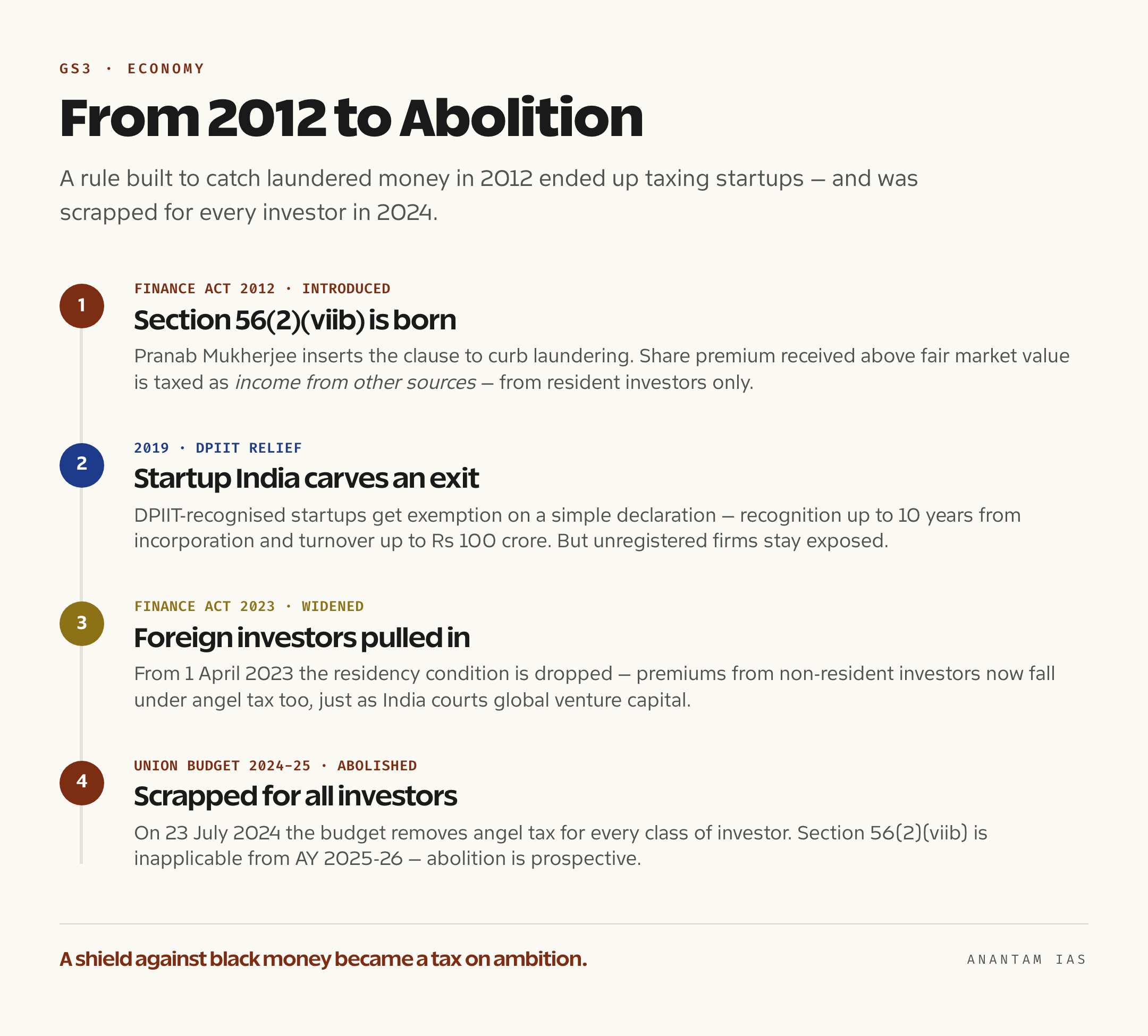
So the government began carving out relief, mostly through the Department for Promotion of Industry and Internal Trade, or DPIIT, the ministry arm that runs the Startup India programme launched in 2016. The first big exemption notification came on 11 April 2018, lifting Section 56(2)(viib) for DPIIT-recognised startups that met set conditions. But the conditions were tight and the paperwork heavy, so the relief was widened in February 2019. Under the revised norms, an eligible startup could stay recognised for ten years from incorporation, up from seven, and qualify with annual turnover up to a hundred crore rupees, up from twenty-five crore. A recognised startup that filed a simple declaration was freed from angel-tax scrutiny on its share premium up to specified limits. Startup India became the gateway: get DPIIT recognition, file the form, and the angel-tax sword was meant to be sheathed.
But the patch never fully held, because two gaps remained. First, the exemption protected only DPIIT-recognised startups — and plenty of small, genuine companies either had not registered or did not fit the definition, so they stayed exposed. Second, and more damaging, the Finance Act, 2023 widened the net rather than shrinking it. From 1 April 2023 the residency condition was dropped, so Section 56(2)(viib) now caught share premiums received from non-resident investors too. Until then foreign capital had been outside angel tax; suddenly the very overseas venture funds that powered India’s biggest rounds were inside it, valuation disputes and all. The CBDT softened the blow with fresh Rule 11UA valuation methods notified on 25 September 2023 and a list of exempt foreign investor classes — recognised funds, certain pension and endowment funds and broad-based pooled vehicles from specified countries. But the signal to global investors was the wrong one: India had just made its risk capital harder to deploy, not easier.

How Fair Market Value and the Valuation Methods Actually Worked
To answer well, you need to be able to explain the valuation machinery in plain terms, because that machinery is what turned a narrow rule into a broad grievance. Fair market value is the price a share would fetch between a willing buyer and a willing seller in an open market. For a listed company that is just the stock price. For an unlisted startup there is no market price, so the CBDT’s Rule 11UA had to prescribe formulae — and the choice of formula decided whether a company owed tax or not.
The Net Asset Value method values the company on what it owns minus what it owes, drawn from its books. It suits an asset-heavy business with factories and inventory, but it badly undervalues a startup whose real worth is a product, a user base or intellectual property that does not sit on the balance sheet. Run a high-growth startup through NAV and it can look almost worthless on paper, which means almost any premium an investor pays looks like taxable excess. The Discounted Cash Flow method takes the opposite tack: it estimates the company’s future cash flows and discounts them back to a present value, capturing the growth potential investors are actually paying for. DCF is the method venture investors and merchant bankers genuinely use. But it depends on assumptions about future revenue and growth rates, and an assessing officer could reject those projections as too optimistic, substitute conservative numbers, slash the fair value, and tax the difference. So the same funding round could be tax-free or heavily taxed depending on which method was used and how a tax officer chose to read the forecasts.
Because of that, the real damage of angel tax was less the tax collected and more the uncertainty created. A founder could not know in advance whether a round would trigger a demand, an investor could not price that risk cleanly, and disputes dragged on through appeals for years. And that is the deeper lesson for an answer: a tax becomes harmful not only when its rate is high but when its base is uncertain and its administration is discretionary. Angel tax failed on both counts. The 2023 valuation rules tried to add more methods and safe harbours to narrow the discretion, but they could not fix the underlying mismatch between how the law valued a startup and how the market did.
The Abolition in Budget 2024-25 and What It Means for Startups
That mismatch is why the cleanest fix turned out to be no tax at all. In the Union Budget for 2024-25, presented on 23 July 2024, the government abolished angel tax for all classes of investors. Legally, Section 56(2)(viib) was made inapplicable from the assessment year 2025-26 — meaning that for share issues on or after 1 April 2024, the premium received over fair market value is no longer treated as taxable income, whoever the investor is. The carve-outs for DPIIT-recognised startups and the tangle of valuation rules became moot for fresh fund-raising, because the charge itself was switched off. Resident angels, domestic venture funds and foreign investors alike now sit outside the provision. The only caveat worth flagging is that abolition is prospective: rounds raised in earlier years can still face assessment for those years, so legacy notices have not all vanished overnight.
What does removing it actually change on the ground? Most directly, it takes a layer of risk and friction out of early-stage fund-raising. A startup can now raise at the valuation it and its investors agree on without fearing that a tax officer will second-guess the price and tax the gap. That matters most at the seed and angel stage, where the cheques are smallest, the valuations are most speculative and the founders are least able to fight a tax dispute. And because the same relief now extends to non-resident investors, the move removes a specific deterrent to foreign direct investment into Indian startups that the 2023 extension had created — a useful signal at a time when global venture funding had cooled and India was competing hard for capital. Abolition also fits a broader policy posture: a government that has built Startup India, eased compliance and courted unicorns was sending a message that it wants risk capital to flow, not to be second-guessed.
It would be wrong, though, to oversell it. Abolishing angel tax does not on its own create a single new company or guarantee a single new investment; it removes an obstacle rather than adding a propellant. The original worry it was meant to address — laundering through inflated share premiums — has not disappeared, and the government will lean on other anti-abuse and disclosure tools to police that. So the balanced reading is that scrapping angel tax was a sensible course-correction: an honest admission that a blunt anti-laundering rule had become a tax on entrepreneurship, and that the cost in deterred investment and litigation outweighed whatever black money it ever caught. For the startup ecosystem and for India’s pitch to foreign capital, it is a clearing of the decks rather than a fresh stimulus.
For Your Mains Answer
This is a high-value topic for GS Paper 3, which covers the Indian economy, the mobilisation of resources, investment models and the effects of government policy on growth — angel tax sits squarely in the taxation, capital-formation and startup-ecosystem zone. It can answer questions on how tax policy shapes investment, on the startup and FDI environment, and on the trade-off between plugging revenue leakages and encouraging entrepreneurship. It also gives the Essay paper a crisp, dated case study on ease of doing business and the cost of policy uncertainty. The skill examiners reward here is the ability to tell the whole arc — intent, unintended harm, partial relief, clean abolition — and to judge it rather than just narrate it.
How to Build the Answer
Move in a logical chain: what angel tax was (the Section 56(2)(viib) charge on share premium above fair market value, taxed as income from other sources), why it was introduced in 2012 (to curb laundering through inflated premiums), why it backfired on startups (the FMV mismatch under NAV versus DCF and the resulting notices), the relief steps (DPIIT exemptions, the 2019 norms, Startup India), the 2023 widening to non-resident investors, and finally the 2024 abolition for all investors and what it signals. Close with a judgement on whether scrapping it was the right call. That arc — intent, mechanism, harm, relief, widening, abolition, verdict — fits almost any question on the topic.
Common Mistakes to Avoid
Don’t call angel tax a tax on angel investors’ income — it was a tax on the recipient company’s share premium above FMV, not on the investor. Don’t say it was abolished only for startups; the 2024 budget removed it for all classes of investors. Don’t muddle the dates: introduced in 2012, eased for startups in 2019, extended to non-residents in 2023, abolished in the 2024-25 budget, effective from AY 2025-26. And don’t claim the abolition wipes out past liabilities — it is prospective, so earlier years can still be assessed.
A Compact Answer Spine
Angel tax = Section 56(2)(viib) charge on share premium received above fair market value, taxed as income from other sources → introduced by the Finance Act, 2012 to curb laundering via inflated premiums → backfired on startups because FMV under NAV understates early-stage worth while DCF is disputable, triggering notices → relief through DPIIT exemptions and 2019 Startup India norms (10 years, turnover up to Rs 100 crore) → Finance Act, 2023 widened it to non-resident investors → Union Budget 2024-25 (23 July 2024) abolished it for all investors, effective AY 2025-26 → verdict: a sensible course-correction, prospective only.
Diagram or Flowchart Idea
Draw a simple horizontal timeline with four nodes — 2012 (introduced), 2019 (DPIIT relief), 2023 (extended to non-residents), 2024 (abolished) — and beside it a small two-box flow: “premium above FMV → taxed as income” with a line through it labelled “removed”. That pairing of the timeline and the mechanism communicates the whole story at a glance.
A Balanced-Conclusion Line
A line that lands the marks: “Angel tax began as a shield against laundered money and ended as a tax on ambition; abolishing it for every investor was less a giveaway than an admission that a rule whose base no one could pin down had cost India more in deterred capital than it ever recovered in revenue.”
How to Use Data Without Cramming
You need only a handful of anchors, not a timeline of every notification: Section 56(2)(viib) of the Income-tax Act, 1961; introduced 2012; the NAV and DCF valuation methods under Rule 11UA; DPIIT recognition up to 10 years and turnover up to Rs 100 crore (2019 norms); extended to non-residents from 1 April 2023; abolished in the 2024-25 budget for all investors, effective AY 2025-26. Attribute them plainly — “as the Finance Minister announced in the 2024-25 budget” — rather than scattering dates loose.
FAQ
What was angel tax in India? Angel tax was the colloquial name for the levy under Section 56(2)(viib) of the Income-tax Act, 1961. When an unlisted, closely-held company issued shares at a price above their fair market value, the excess premium was treated as the company’s income from other sources and taxed accordingly. It earned its nickname because it most often hit startups raising early money from angel investors.
Why was angel tax introduced? It was inserted by the Finance Act, 2012, by then Finance Minister Pranab Mukherjee, to curb money laundering. The fear was that unaccounted cash could be routed into shell companies by buying their shares at hugely inflated premiums, dressing up black money as investment. Taxing premiums received above fair value was meant to choke off that route. Initially it applied only to consideration received from resident investors.
When and why was angel tax abolished? It was abolished in the Union Budget for 2024-25, presented on 23 July 2024, for all classes of investors, with Section 56(2)(viib) made inapplicable from the assessment year 2025-26. The reason was that a rule meant to catch launderers had instead burdened genuine startups with valuation disputes and tax notices, and had been widened to foreign investors in 2023 — so removing it cleared a deterrent to investment, including foreign capital.
Does the abolition cover non-resident investors too? Yes. The Finance Act, 2023 had extended angel tax to share premiums received from non-resident investors from 1 April 2023, pulling foreign venture funding into its scope. The 2024-25 budget abolished the provision for all classes of investors — resident and non-resident alike — so fresh fund-raising from foreign investors is no longer caught by it.
Practice Questions
Prelims MCQs
- Angel tax in India was levied under which provision of the Income-tax Act, 1961?
(a) Section 80-IAC
(b) Section 56(2)(viib)
(c) Section 115BAB
(d) Section 54GB
Answer: (b) Section 56(2)(viib) taxed the share premium an unlisted company received above the fair market value of its shares as income from other sources. - Angel tax was originally introduced by which Finance Act, and with what stated objective?
(a) Finance Act, 2016, to fund Startup India
(b) Finance Act, 2012, to curb money laundering through inflated share premiums
(c) Finance Act, 2019, to widen the tax base
(d) Finance Act, 2023, to tax foreign investors
Answer: (b) It was inserted by the Finance Act, 2012, to prevent the routing of unaccounted money via shares issued at inflated premiums. - Which two valuation methods under Rule 11UA were central to determining the fair market value of unquoted shares for angel tax?
(a) Cost method and replacement method
(b) Net Asset Value (NAV) and Discounted Cash Flow (DCF)
(c) Market capitalisation and dividend yield
(d) Book value and rule-of-thumb method
Answer: (b) NAV values a company on its books while DCF discounts projected future cash flows; the mismatch between them drove most angel-tax disputes. - Consider the following about angel tax:
1. Exemptions were available to startups recognised by the DPIIT.
2. The Finance Act, 2023 extended it to non-resident investors.
3. It was abolished for all classes of investors in the Union Budget 2024-25. Which are correct?
(a) 1 and 2 only
(b) 2 and 3 only
(c) 1 and 3 only
(d) 1, 2 and 3
Answer: (d) DPIIT-recognised startups had exemptions, the 2023 Act widened the levy to non-residents, and the 2024-25 budget abolished it for all investors. - The abolition of angel tax announced in the Union Budget 2024-25 took effect from which assessment year?
(a) AY 2023-24
(b) AY 2024-25
(c) AY 2025-26
(d) AY 2026-27
Answer: (c) Section 56(2)(viib) was made inapplicable from AY 2025-26, covering share issues on or after 1 April 2024.
Mains Practice Questions
- Trace the evolution of angel tax in India from its introduction in 2012 to its abolition in 2024, and explain why a measure meant to curb money laundering ended up burdening startups. (15 marks, 250 words)
- “A tax becomes harmful not only when its rate is high but when its base is uncertain and its administration is discretionary.” Examine this statement in the light of the angel tax experience and the role of fair market value. (15 marks, 250 words)
- Discuss the relief measures introduced for startups against angel tax before its abolition, including the role of the DPIIT and Startup India. How adequate were they? (10 marks, 150 words)
- The Finance Act, 2023 extended angel tax to non-resident investors before the levy was abolished a year later. Analyse the implications of these back-to-back changes for foreign investment into Indian startups. (15 marks, 250 words)
- Critically evaluate the abolition of angel tax as a measure to strengthen India’s startup ecosystem. To what extent does removing a tax barrier, by itself, drive capital formation? (15 marks, 250 words)