Annapurna Yojana: Free Foodgrain Support for Destitute Senior Citizens Explained
The central Annapurna Scheme provides 10 kg of foodgrain free each month to destitute senior citizens left out of the old-age pension. Here is how it works, and how state schemes with the same name differ.
There is a specific kind of person the Indian welfare system keeps losing: an old man or woman with no income, no family support and no pension, who qualifies on paper for the old-age pension but is not actually receiving it because the state has run out of sanctioned slots. Annapurna was designed for exactly that person. It gives them 10 kg of foodgrain every month, free.
The scheme is small, quiet and often confused with other things. Half a dozen state governments run programmes called “Annapurna” that do entirely different work — free cooking-gas refills in one state, subsidised canteen meals in another. This piece deals with the central Annapurna Scheme first, in detail, and then sorts out the state schemes that share its name.
What the Annapurna Scheme Is and Where It Sits
The Annapurna Scheme was announced in the 1999-2000 Union Budget and came into effect from 1 April 2000, launched by the Ministry of Rural Development. Its founding logic was a gap, not a new idea. The National Old Age Pension Scheme covered destitute elderly people, but every state had a ceiling on how many pensioners it could sanction. People who met every eligibility condition and still sat outside the cap got nothing. Annapurna gave that residual group food instead of cash.
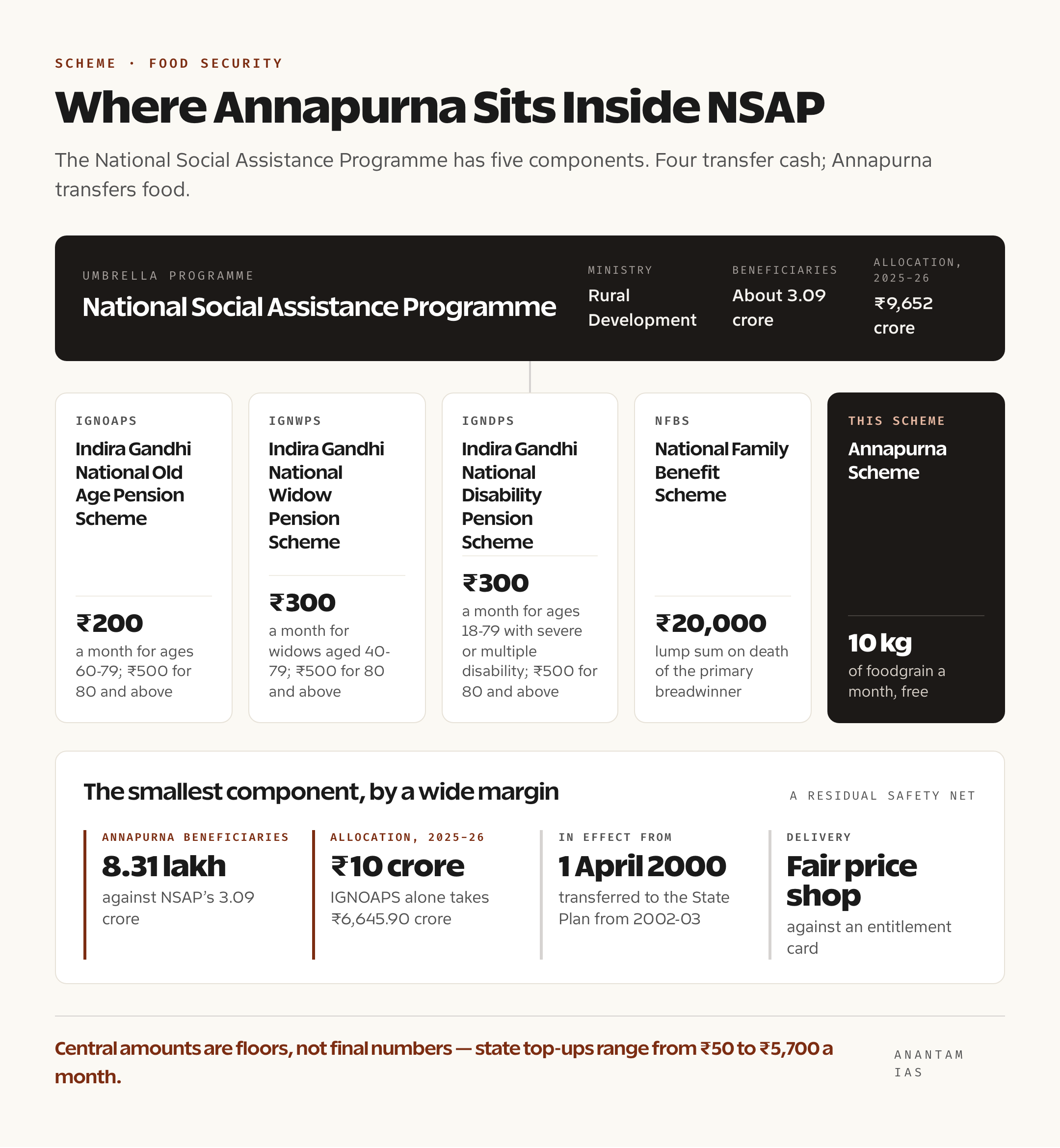
From 2002-03 the scheme was transferred to the State Plan along with the rest of the National Social Assistance Programme, which gave states operational control. NSAP itself was introduced on 15 August 1995 and is run by the Ministry of Rural Development as a fully centrally funded scheme, covering rural and urban areas alike, in fulfilment of the Directive Principles that ask the state to secure public assistance in old age and want.
Annapurna is one of five components of NSAP:
| Component | What it provides |
|---|---|
| Indira Gandhi National Old Age Pension Scheme (IGNOAPS) | ₹200 a month for ages 60-79; ₹500 for 80 and above |
| Indira Gandhi National Widow Pension Scheme (IGNWPS) | ₹300 a month for widows aged 40-79; ₹500 for 80 and above |
| Indira Gandhi National Disability Pension Scheme (IGNDPS) | ₹300 a month for ages 18-79 with severe or multiple disability; ₹500 for 80 and above |
| National Family Benefit Scheme (NFBS) | ₹20,000 lump sum on death of the primary breadwinner |
| Annapurna Scheme | 10 kg of foodgrain a month, free |
Those central amounts are floors, not final numbers. States are expected to top them up, and as the Ministry of Rural Development notes, top-ups currently range from ₹50 to ₹5,700 a month, taking the average old-age pension in many states and union territories to around ₹1,100.
What the Scheme Offers
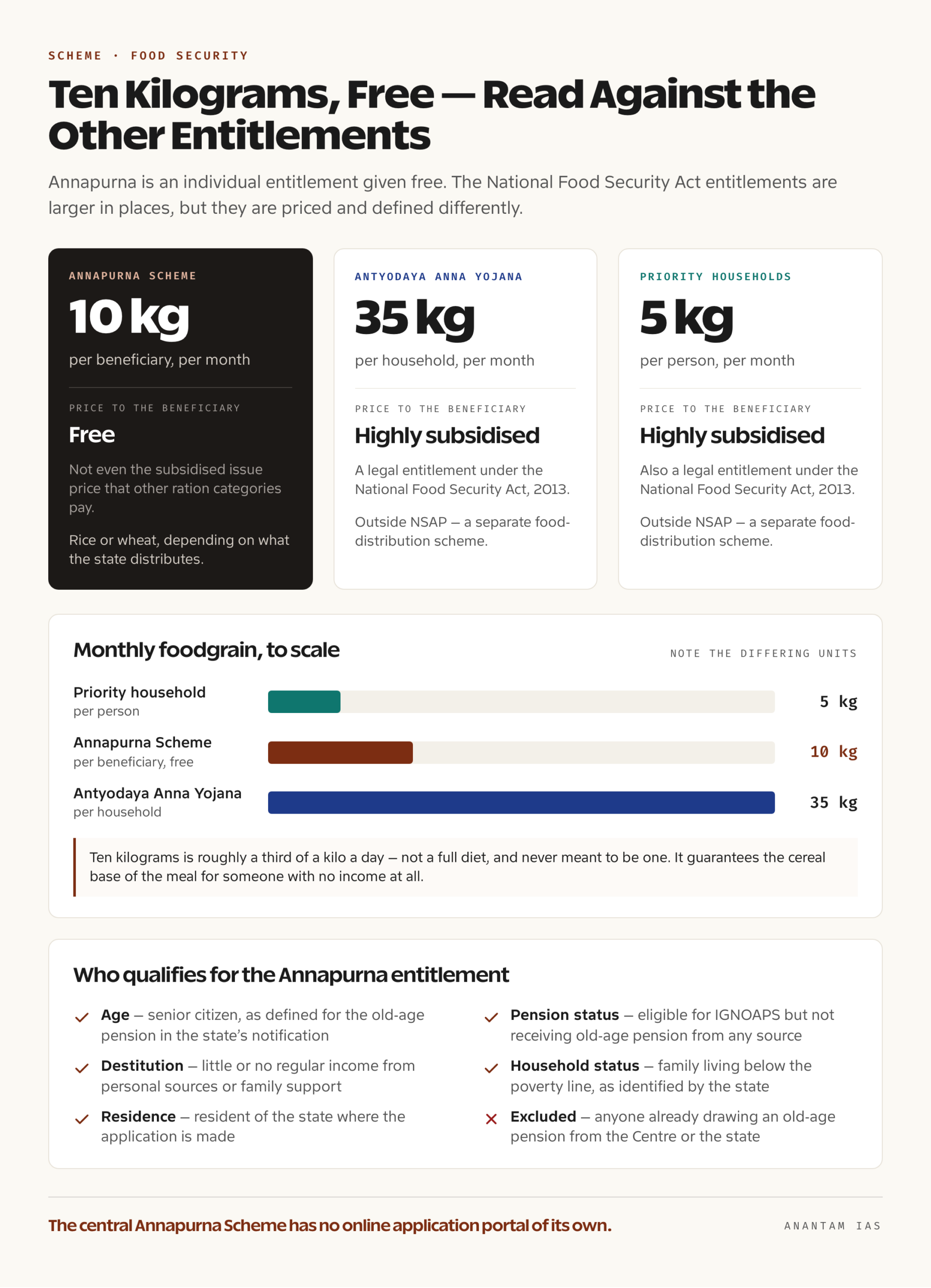
The entitlement is 10 kg of foodgrain — rice or wheat, depending on what the state distributes — delivered free every month to the beneficiary. Nothing is charged, not even the subsidised issue price that other ration categories pay.
Ten kilograms is roughly a third of a kilo a day. It is not a full diet and was never meant to be one. What it does is guarantee the cereal base of the meal for a person who has no income at all, which in practice is the difference between eating something every day and not.
| Feature | Detail |
|---|---|
| Benefit | 10 kg of foodgrain per beneficiary per month |
| Cost to beneficiary | Free |
| Launched | 1 April 2000 |
| Ministry | Rural Development |
| Umbrella programme | National Social Assistance Programme |
| Beneficiaries covered | About 8.31 lakh across the country |
| Budget allocation, 2025-26 | ₹10 crore for the Annapurna component |
| Delivery | Through the fair price shop network, against an entitlement card |
Set that against the rest of NSAP and the scale becomes clear. NSAP as a whole covers about 3.09 crore beneficiaries with a 2025-26 allocation of ₹9,652 crore, of which IGNOAPS alone takes ₹6,645.90 crore. Annapurna’s 8.31 lakh beneficiaries and ₹10 crore line make it the smallest component by a wide margin — a residual safety net rather than a mass programme.
Who Is Eligible
The eligibility test has an unusual shape. You must qualify for the old-age pension and not be receiving it. Someone already drawing IGNOAPS is excluded, because the scheme is designed to catch the people the pension misses.
| Criterion | Requirement |
|---|---|
| Age | Senior citizen, as defined for the old-age pension in the state’s notification |
| Pension status | Eligible for IGNOAPS but not receiving old-age pension from any source |
| Destitution | Destitute, with little or no regular income from personal sources or family support |
| Household status | Belonging to a family living below the poverty line, as identified by the state |
| Residence | Resident of the state where the application is made |
A note on the age threshold, because it is a common source of confusion. The Annapurna Scheme was framed around a 65-year threshold, matching the National Old Age Pension Scheme as it stood in 2000. The old-age pension age was later brought down to 60, and NSAP guidelines now tie Annapurna eligibility to IGNOAPS eligibility. Several state notifications and departmental pages still carry the older figure, so the operative age is the one in your state’s current notification — check it locally rather than assuming.
Who is excluded: anyone already receiving an old-age pension from the Centre or the state, anyone with adequate income or family support, and anyone above the poverty line by the state’s identification. Since a single household can hold only one ration card, the entitlement is issued against the individual beneficiary and drawn through the family’s fair price shop.
How to Apply and Receive the Entitlement
Annapurna is not an online, self-service scheme. Beneficiary selection is a local, participatory process, which is both its strength and its weakness.
- Identification at the Gram Sabha. Gram Panchayats in rural areas and municipalities in urban areas identify eligible people. The Gram Sabha vets the list in open meeting — an eligible destitute person is expected to be identified there rather than left to discover the scheme independently.
- Application to the local body. Apply to the Gram Panchayat, the block development office, or in urban areas the ward or municipal office. Some states route applications through the district Social Welfare or Food and Civil Supplies department. Forms are available at the panchayat or block office and on many state food-department websites.
- Documents to carry. Proof of age such as an Aadhaar card, voter ID or birth record; proof of residence; the BPL ration card or the household’s inclusion record; a written declaration of destitution and of not receiving any old-age pension; and recent photographs. States vary in what they add, so confirm the list at the counter.
- Verification. The panchayat or municipality verifies the claim, principally that the applicant qualifies for old-age pension and is not drawing one. The list goes to the block or district authority for sanction.
- Entitlement card. Once sanctioned, the Gram Panchayat issues the entitlement card. In several states the entitlement is endorsed on the existing ration card instead of a separate card.
- Collection. The beneficiary draws 10 kg of foodgrain each month from the designated fair price shop against that card. Since the entitlement is free, no cash should change hands at the shop.
How to check status. There is no single national tracking page for Annapurna. The NSAP portal at nsap.nic.in publishes beneficiary details for the programme’s components, and states run their own social-security and food-department portals with beneficiary search. Practically, the Gram Panchayat secretary, the block development office and the district Social Welfare office are the places that will actually answer. For grievances, the same offices are the first level, followed by the district collectorate.
For elderly beneficiaries who cannot reach a counter, it is worth knowing that NSAP has been steadily digitised. Beneficiary records have been fully digitised, more than 2.5 crore NSAP beneficiaries have Aadhaar linked to their accounts, and in July 2025 the Ministry of Rural Development launched an Aadhaar-based mobile application for digital life certificates so that pensioners no longer need to travel to prove they are alive.
The State Schemes That Share the Name
This is where most confusion starts. “Annapurna” is a popular name for food-related welfare, and at least four state programmes use it for completely different purposes.
| Scheme | State | What it actually does |
|---|---|---|
| Annapurna Scheme (central) | All states, under NSAP | 10 kg free foodgrain a month to destitute elderly not receiving old-age pension |
| Mukhyamantri Annapurna Yojana | Maharashtra | Three free domestic LPG refills a year to eligible households |
| Shri Annapurna Rasoi Yojana | Rajasthan | Subsidised cooked meals at community kitchens |
| Annapurna Bhandar Yojana | Rajasthan | Fair price shops upgraded to sell branded consumer goods |
Maharashtra’s Mukhyamantri Annapurna Yojana, launched in 2024, has nothing to do with the elderly. It provides three free refills of a domestic LPG cylinder a year, aimed at beneficiaries of the Pradhan Mantri Ujjwala Yojana and of the state’s own Ladki Bahin scheme. Conditions include the gas connection being in a woman’s name, a family of five or fewer members, and one beneficiary per ration card. Eligible households are covered automatically, without a separate application.
Rajasthan’s Shri Annapurna Rasoi Yojana is a community-kitchen programme. It was renamed from the Indira Rasoi Yojana in January 2024 by the Bhajan Lal Sharma government, and the terms were revised at the same time: the plate size went up to 600 grams and the government grant per plate to ₹22, with the beneficiary continuing to pay ₹8. Rajasthan separately ran the Annapurna Bhandar Yojana from 2015, a public-private arrangement that turned fair price shops into rural retail outlets stocking branded consumer goods alongside PDS commodities.
So when a page promises “Annapurna Yojana registration online”, check what it is actually selling. The central Annapurna Scheme has no online application portal of its own.
Challenges and What to Watch
The National Food Security Act changed the ground under it. The NFSA, passed in 2013, gives priority households 5 kg of foodgrain per person per month at highly subsidised prices, and Antyodaya Anna Yojana households 35 kg per household. A destitute elderly person in an AAY or priority household already receives grain under a legal entitlement, which has reduced Annapurna’s distinct role and helps explain why its coverage has stayed at a few lakh people.
It is a residual scheme by design, which caps its ambition. Annapurna exists to serve people the pension cannot reach. A better answer would be to raise the pension coverage cap so that fewer people need a food-only fallback. The central old-age pension has stood at ₹200 a month for the 60-79 group for years, and much of the demand for revision is aimed there.
Identification depends on local institutions. The Gram Sabha route is genuinely participatory when it works. When it does not — where the panchayat is captured, or where the most destitute do not attend meetings — the people least able to advocate for themselves are the ones who go unlisted. Destitute elderly people without family are, almost by definition, the hardest for a village meeting to notice.
Awareness is thin. Ten kilograms of free grain is a real benefit, and many eligible people have never heard of the scheme. State food-department pages carry it, but there is no sustained outreach comparable to the larger flagship programmes.
Watch the digitisation push. Aadhaar seeding, digital life certificates and portability of ration entitlements make small, scattered entitlements easier to deliver and to audit. They also carry the exclusion risks that follow biometric authentication for elderly people with worn fingerprints — a live problem across the food-security system, not one unique to this scheme.
FAQ
How much foodgrain does the Annapurna Scheme give? Ten kilograms of rice or wheat per beneficiary per month, free of cost, drawn through the fair price shop against an entitlement card.
Can I get Annapurna along with the old-age pension? No. The scheme is meant for people who qualify for the Indira Gandhi National Old Age Pension Scheme but are not receiving old-age pension from any source. Drawing a pension makes you ineligible.
Which ministry runs the Annapurna Scheme? The Ministry of Rural Development, as one of the five components of the National Social Assistance Programme. It was launched on 1 April 2000 and transferred to the State Plan from 2002-03.
Is there an online application for Annapurna Yojana? The central scheme has no national online application. Beneficiaries are identified by the Gram Sabha and apply through the Gram Panchayat, block or municipal office, though some states accept applications through their own social-welfare portals.
Is Maharashtra’s Annapurna Yojana the same scheme? No. Maharashtra’s Mukhyamantri Annapurna Yojana provides three free domestic LPG refills a year to eligible households and is unrelated to the central foodgrain scheme for destitute senior citizens.
Practice Questions
Prelims MCQs
- The Annapurna Scheme is administered by which ministry? (a) Ministry of Consumer Affairs, Food and Public Distribution (b) Ministry of Rural Development (c) Ministry of Social Justice and Empowerment (d) Ministry of Women and Child Development — Answer: (b) It is one of the five components of the National Social Assistance Programme run by the Ministry of Rural Development.
- Under the Annapurna Scheme, the monthly entitlement per beneficiary is: (a) 5 kg of foodgrain (b) 10 kg of foodgrain (c) 25 kg of foodgrain (d) 35 kg of foodgrain — Answer: (b) Ten kilograms of rice or wheat are supplied free each month.
- Which of the following is NOT a component of the National Social Assistance Programme? (a) Indira Gandhi National Widow Pension Scheme (b) National Family Benefit Scheme (c) Annapurna Scheme (d) Antyodaya Anna Yojana — Answer: (d) Antyodaya Anna Yojana is a food-distribution scheme outside NSAP, which has five components.
- The Annapurna Scheme targets senior citizens who: (a) live alone regardless of income (b) receive old-age pension but need more support (c) are eligible for old-age pension but are not receiving it (d) are above 80 years of age — Answer: (c) The scheme was created to cover destitute elderly left out of the old-age pension.
- The National Social Assistance Programme was introduced in which year? (a) 1985 (b) 1995 (c) 2000 (d) 2013 — Answer: (b) NSAP was launched on 15 August 1995; the Annapurna component was added with effect from 1 April 2000.
Mains Practice Questions
- Evaluate the National Social Assistance Programme as an instrument for giving effect to the Directive Principles relating to public assistance in old age and want. (15 marks, 250 words)
- “Food-based transfers and cash transfers serve different purposes in old-age social security.” Discuss with reference to India’s experience. (15 marks, 250 words)
- Examine the effectiveness of Gram Sabha-based identification of beneficiaries in welfare schemes, and suggest measures to reduce exclusion of the most vulnerable. (15 marks, 250 words)
- The central old-age pension has remained unchanged for years while state top-ups vary widely. Analyse the implications of this design for equity across states. (10 marks, 150 words)
- Assess how the National Food Security Act, 2013 reshaped the landscape of India’s food-based welfare schemes, and what role remains for residual programmes. (15 marks, 250 words)