Appointment of Ad-hoc Retired Judges in High Courts: Article 224A, Pendency, and the Lok Prahari Verdict
Ad-hoc judges in High Courts under Article 224A: dormant provision activated by the Supreme Court, vacancy and pendency triggers, status and emoluments, and comparison with ad-hoc appointments in the Supreme Court under Articles 127 and 128.
The Indian High Courts have been struggling with a permanent emergency of pendency for nearly four decades. Sanctioned strengths grow in fits and starts, vacancies remain unfilled for months and sometimes years, and the inflow of fresh cases consistently outpaces disposal. The arithmetic produces what judges and academic commentators have called a docket explosion. Cases pending for ten years are routine. Cases pending for twenty years are no longer rare. The constitutional remedy that was supposed to address this kind of crisis was written into the original Constitution and then promptly forgotten.
Article 224A allows the Chief Justice of a High Court, with the previous consent of the President, to request a retired judge to sit and act as a judge of that High Court. The provision has been in the Constitution since the original document came into force in 1950. It has been used a handful of times across the history of the Republic. It has been called, with some accuracy, a dormant provision.
The Supreme Court has now activated the provision through a series of orders in the Lok Prahari case and subsequent rulings, laying down detailed conditions under which High Courts must consider ad-hoc appointments. The framework is not yet fully implemented in practice, but the doctrinal architecture is in place. This article walks through the constitutional basis, the activation conditions, the comparative position with the Supreme Court, and the institutional questions that ad-hoc appointments raise.
Quick Facts on Article 224A and Ad-hoc Judges
A short orientation set before the deeper analysis.
- Constitutional source: Article 224A of the Indian Constitution, which deals with the appointment of retired judges at sittings of High Courts.
- Original Constitution: The provision was part of the Constitution from 1950 and has been amended only on minor points.
- Appointing authority: Chief Justice of the High Court initiates, the President of India grants previous consent.
- Consent requirements: Previous consent of the President of India and consent of the retired judge to be appointed.
- Lok Prahari ruling (2021): The Supreme Court laid down trigger conditions and procedural requirements for activating Article 224A.
- Vacancy trigger: Vacancies exceeding 20 percent of the sanctioned strength of the High Court.
- Pendency triggers: Cases pending over five years in any category, more than 10 percent of total backlog being old cases, or rate of disposal lower than rate of fresh institution.
- Tenure: Generally two to three years, subject to renewal.
- Status: All jurisdiction, powers, and privileges of a regular judge of that High Court, but not deemed a regular judge for purposes such as transfer or seniority.
- Emoluments: Honorarium fixed by the central government, generally the difference between full salary and pension, charged on the Consolidated Fund of the State.
What Article 224A Actually Provides
The text of Article 224A is brief. It states that the Chief Justice of a High Court for any state may at any time, with the previous consent of the President, request any person who has held the office of judge of that court or any other High Court to sit and act as a judge of the High Court for that state. The retired judge so requested must consent. While so sitting and acting, the retired judge has all the jurisdiction, powers, and privileges of a judge of that High Court, but is not deemed to be a judge of that High Court for any other purpose.
Three features of the text deserve close attention.
The previous consent of the President is required, not the Governor. This is unusual because High Courts are generally state institutions, and the Governor plays a role in appointments under Article 217. The choice of the President as the consenting authority signals that ad-hoc appointments engage Union interests, perhaps because the consolidated fund implications run through central financial coordination, perhaps because retired judges may be drawn from any state’s High Court.
The consent of the retired judge is required. This is a meaningful safeguard. Retired judges cannot be conscripted into service. The provision treats the appointment as an invitation that the retired judge may accept or decline.
The deeming proviso draws a sharp line. The retired judge has all judicial powers when sitting under Article 224A but is not deemed to be a regular judge for other purposes. This means that ad-hoc judges do not get seniority over sitting judges, are not eligible for transfer to other High Courts, and do not count toward the sanctioned strength.
Background and Historical Context
Ad-hoc appointment provisions have a longer pedigree than Article 224A. The Government of India Act of 1935 contained similar provisions for federal court appointments and had its own version of acting and additional judges. The Constituent Assembly retained the architecture and added Article 224A as a flexibility tool for High Courts that might face unexpected vacancies or workload spikes.
The provision was used sparingly in the early decades of the Republic. Madras and Bombay High Courts invoked it in the 1950s and 1960s. A few isolated appointments followed in subsequent decades. The provision was largely overshadowed by the regular appointment process under Article 217, the additional judges’ route under Article 224, and the practice of acting Chief Justices under Article 223.
The dormancy began to attract academic attention in the 1990s and 2000s as pendency figures climbed. Law Commission reports, parliamentary committees, and Supreme Court observations recognised that Article 224A could be a serviceable tool against backlog if it were activated. Successive Chief Justices of India referred to the provision in conferences. The legal aid organisation Lok Prahari filed a public interest petition seeking activation of the provision. The matter was heard by a three-judge bench led by Chief Justice S A Bobde.
The Lok Prahari judgment of April 2021 is the activation moment. The Court set out the trigger conditions for invoking Article 224A, the procedure to be followed, and the broad terms of appointment. The judgment is now the operating manual for ad-hoc High Court appointments. Several High Courts have since used the framework to make ad-hoc appointments, with mixed results in terms of practical impact on pendency.
Key Provisions and the Lok Prahari Framework
The Lok Prahari framework rests on three pillars. Trigger conditions, procedural requirements, and post-appointment terms.
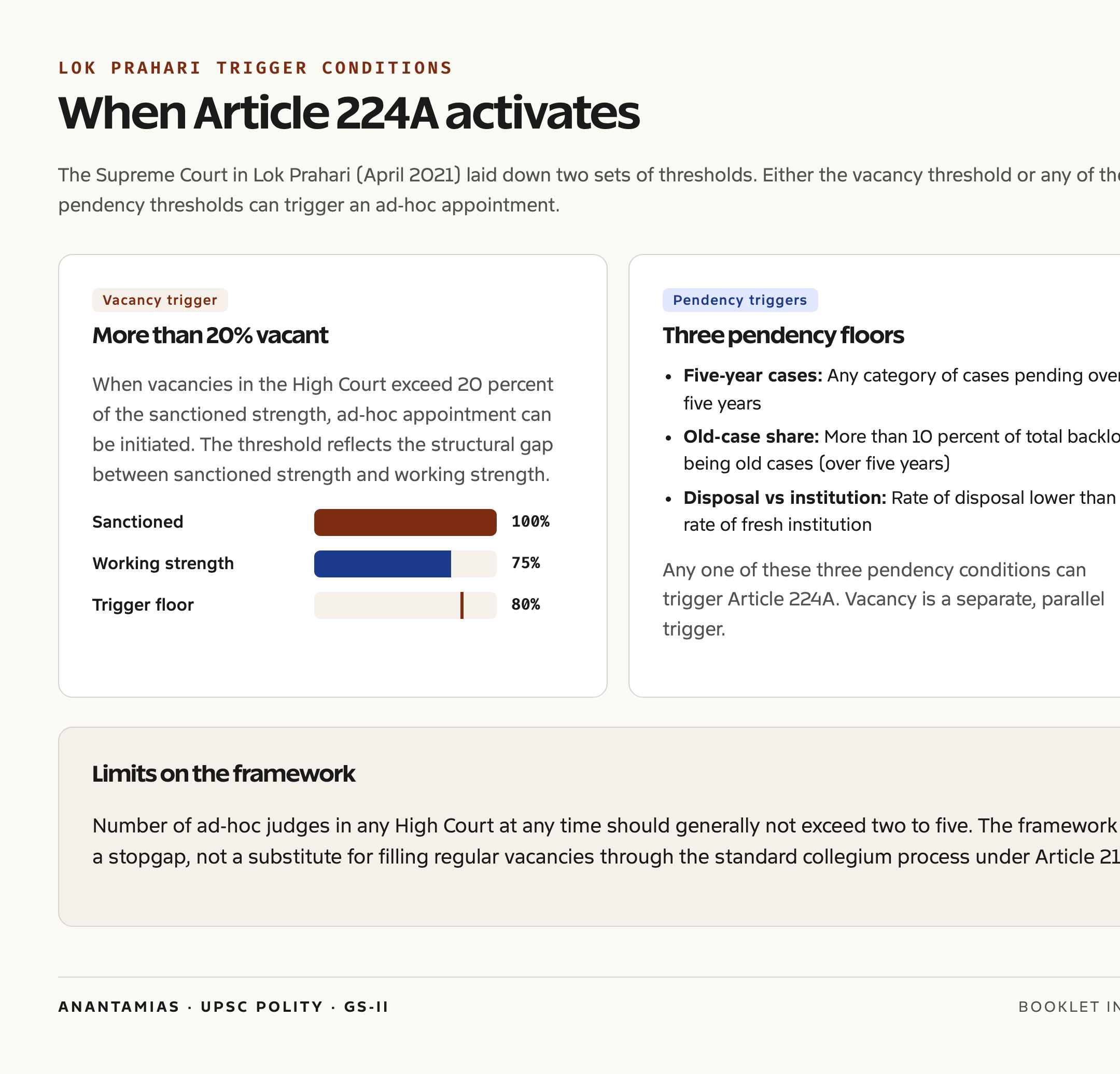
Trigger conditions. The Court held that ad-hoc appointments under Article 224A should be considered when at least one of the following is met. Vacancies in the High Court exceed 20 percent of the sanctioned strength. Cases pending in any particular category have remained pending for more than five years. More than 10 percent of the total pendency consists of old cases. The rate of disposal is lower than the rate of fresh institution.
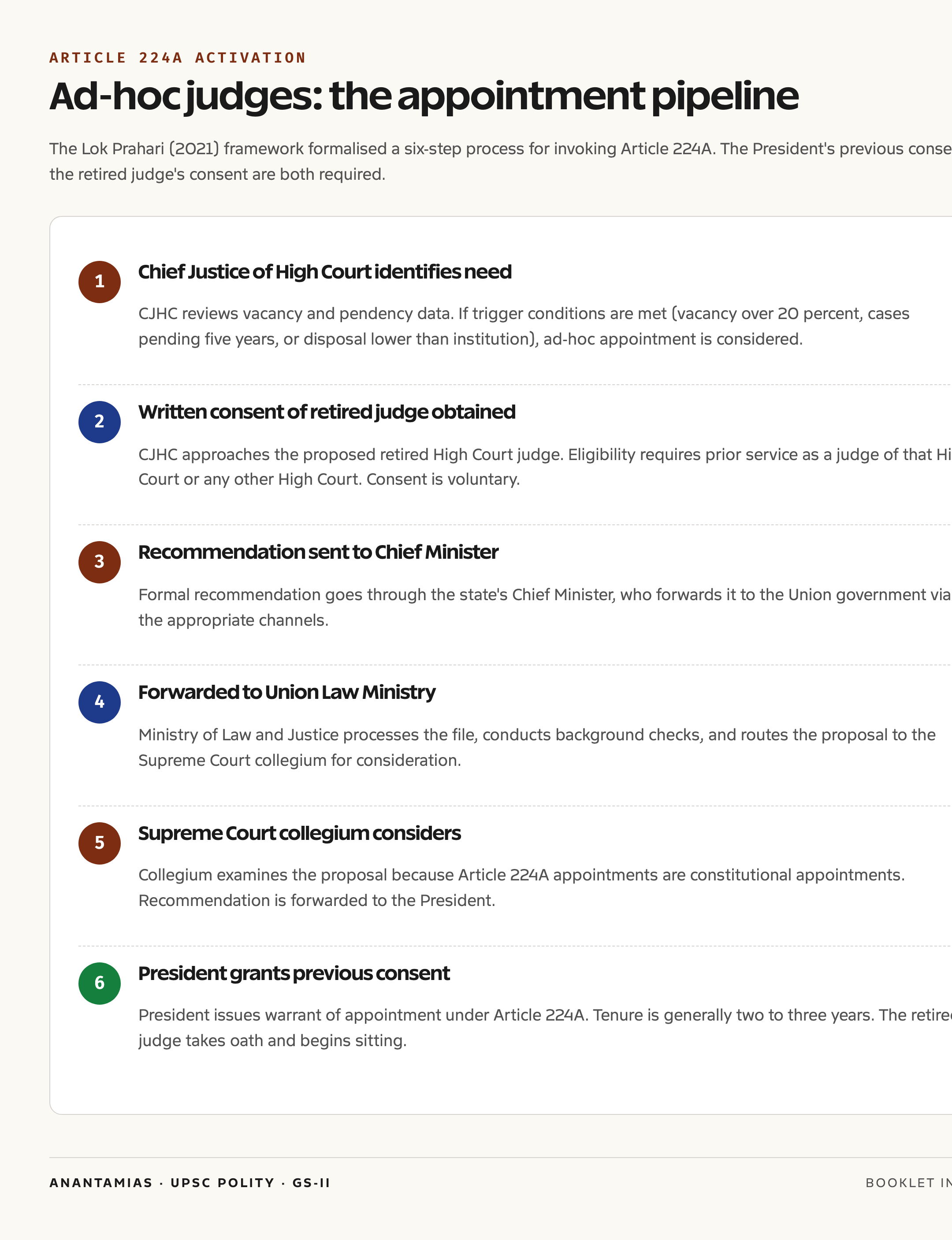
Procedural requirements. The process begins with the Chief Justice of the High Court identifying the need and the candidates. Written consent of the candidate is obtained. The recommendation is sent through the Chief Minister of the state, who forwards it to the Union Law Ministry. The Supreme Court collegium considers the proposal, given that ad-hoc appointments are constitutional appointments. The President grants previous consent and the warrant of appointment is issued.
Post-appointment terms. The tenure is generally two to three years, subject to extension if conditions persist. The retired judge typically handles cases in the category where pendency is most acute, allowing regular judges to focus on fresh institutions. Emoluments take the form of an honorarium that, combined with the existing pension, brings the retired judge to a level comparable with the salary of a sitting judge. The honorarium is charged on the Consolidated Fund of the State.
The Court also placed limits on the practice. The number of ad-hoc judges in any High Court at any time should generally not exceed two to five. The appointment should not become a substitute for filling regular vacancies through the standard collegium process. The framework should be used when regular appointments cannot be made fast enough to address an immediate pendency or vacancy crisis.
Why the Activation Matters
Three reasons explain why the activation of Article 224A is significant beyond the immediate practical consequences for individual High Courts.
Pendency as a constitutional issue. The Supreme Court in Lok Prahari treated pendency not as an administrative inconvenience but as a constitutional problem affecting access to justice under Article 21. The framing matters. It elevates docket reduction from a managerial priority to a duty of the constitutional courts and the executive.
Federal coordination. Ad-hoc appointments require coordination between the High Court Chief Justice, the state Chief Minister, the Union Law Ministry, the Supreme Court collegium, and the President. The framework therefore stitches together state and Union institutions in a way that the regular appointment process under Article 217 already does, but with the added flexibility of being able to draw retired judges from any High Court.
Institutional memory. Retired judges bring decades of experience that is often lost when a judge demits office. The Lok Prahari framework allows that experience to be tapped for a few additional years on specific dockets. Whether this institutional benefit is actually realised depends on careful selection and on ensuring that ad-hoc judges are placed where their expertise is most useful.
Detailed Analysis: Status, Powers, and Emoluments
The Article 224A appointment is constitutional but the package of rights and obligations differs from a regular appointment in three important ways.
Jurisdiction and powers. The ad-hoc judge has all the jurisdiction, powers, and privileges of a sitting judge of that High Court. They can sit on division benches, decide writ petitions, hear appeals, and perform any function that any other judge of the High Court performs. There is no functional limitation. The Chief Justice of the High Court allocates work, and ad-hoc judges typically receive dockets in the category where pendency is most pronounced.
Transfer and seniority. The ad-hoc judge is not deemed a regular judge for purposes outside the immediate function. They cannot be transferred to another High Court. They do not gain seniority over sitting judges or among themselves. They cannot be appointed to the Supreme Court on the basis of an ad-hoc appointment, though prior service as a regular judge before retirement remains relevant for that consideration.
Emoluments. The retired judge already receives a pension based on the salary they earned at retirement. The Article 224A appointment adds an honorarium that brings the total to a level comparable with the salary of a sitting judge. The exact formula is set by central government rules and is currently calibrated to make ad-hoc service financially equivalent to regular service. The honorarium is charged on the Consolidated Fund of the State, like other High Court judicial salaries under Article 202.
Tenure and renewal. The standard term is two years, extendable to three. The Chief Justice can renew the appointment if the underlying conditions persist. The retired judge can also resign, generally on three months’ notice, and the President can terminate the appointment in extraordinary circumstances, though this has not occurred in any reported case.
Comparative Frame: Articles 127, 128, and 224A
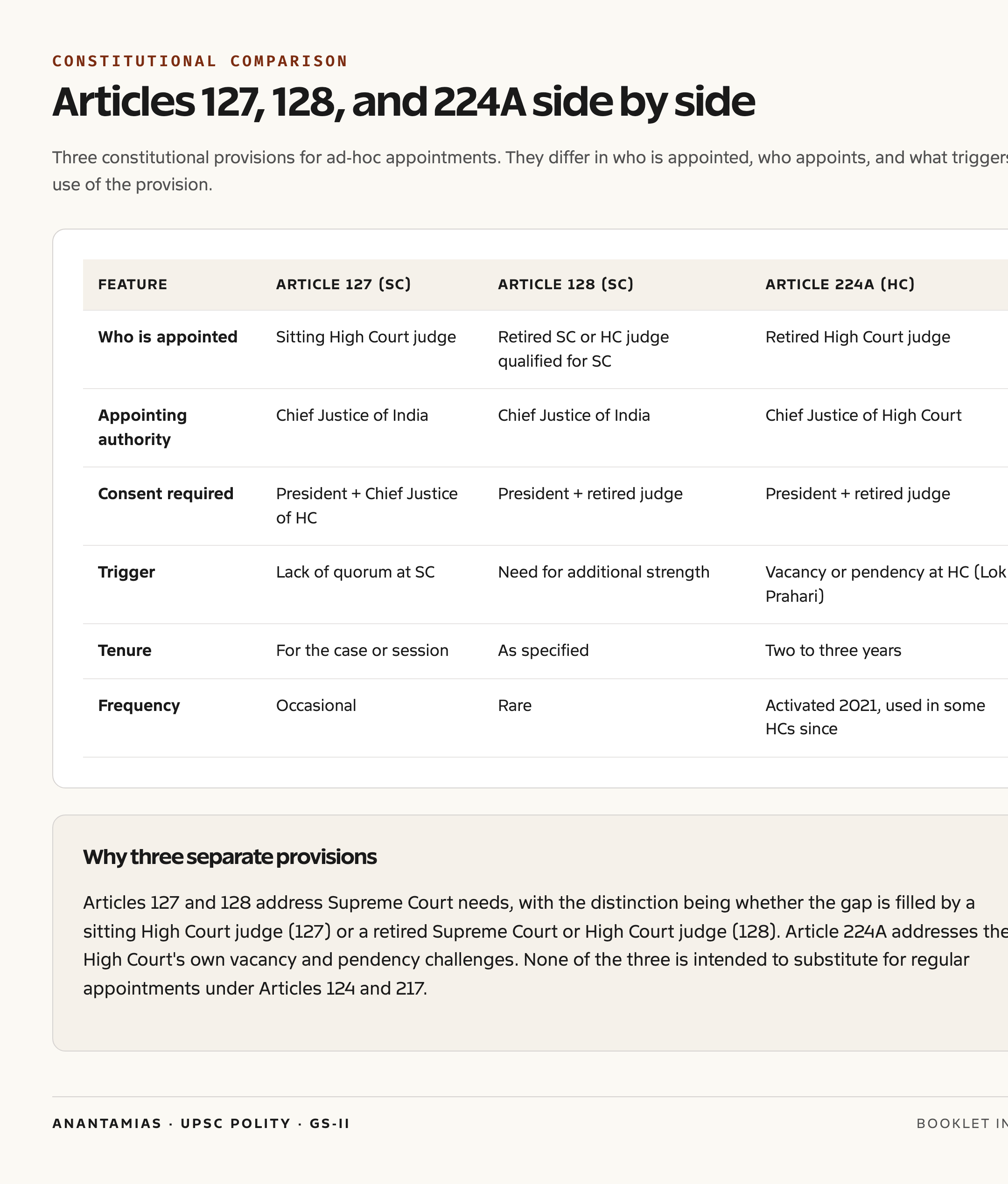
Aspirants frequently confuse the three constitutional provisions for ad-hoc appointments. The differences are clean once tabulated.
| Feature | Article 127 (Supreme Court) | Article 128 (Supreme Court) | Article 224A (High Court) |
|---|---|---|---|
| Who is appointed | A sitting judge of a High Court | A retired judge of the Supreme Court or a High Court who is qualified to be a Supreme Court judge | A retired judge of any High Court |
| Appointing authority | Chief Justice of India | Chief Justice of India | Chief Justice of the High Court concerned |
| Consent required | Previous consent of the President and the President of the High Court | Previous consent of the President and the consent of the retired judge | Previous consent of the President and the consent of the retired judge |
| Trigger | Lack of quorum at the Supreme Court | Need for additional judicial strength at the Supreme Court | Vacancy or pendency at the High Court, on Lok Prahari conditions |
| Status | Acts as a judge of the Supreme Court for that purpose | Acts as a judge of the Supreme Court for that purpose | All powers of a High Court judge but not deemed a regular judge |
| Tenure | For the case or session | As specified | Generally two to three years |
| Frequency in practice | Used occasionally | Used rarely | Activated by Lok Prahari (2021), used in a small number of High Courts since |
The provisions complement rather than overlap. Articles 127 and 128 address Supreme Court needs. Article 224A addresses High Court needs. None of the three is intended to substitute for the regular appointment process.
Challenges and Open Questions
Several open questions surround the practical implementation of Article 224A.
The willingness of retired judges. Many retired High Court judges move into arbitration, post-retirement tribunals, or private legal practice that pays significantly more than the ad-hoc honorarium. The pool of willing candidates is therefore smaller than the formal eligibility list suggests. High Courts have sometimes struggled to find suitable retired judges who are both available and acceptable to the collegium.
Coordination with regular appointments. The Lok Prahari framework is meant to address immediate gaps, not substitute for regular appointments. In practice, executive delays in regular collegium recommendations sometimes make Article 224A appointments a stopgap that lasts longer than intended. The risk is that ad-hoc service becomes a parallel pipeline that reduces pressure to fill regular vacancies promptly.
Allocation of work. Ad-hoc judges are typically given old cases and specific category dockets. The Chief Justice’s allocation power means that ad-hoc judges may be confined to specialised work that does not always make the best use of their expertise. Whether the allocation framework is delivering measurable pendency reduction is an open empirical question.
Accountability and discipline. Ad-hoc judges are subject to the same code of conduct as regular judges. The mechanisms for addressing misconduct, however, are slightly different because ad-hoc judges are not deemed regular judges for all purposes. The exact procedure for impeachment-equivalent processes against an ad-hoc judge has not been tested.
Federal financial implications. Ad-hoc judge honoraria are charged on the Consolidated Fund of the State, but central financial rules determine the formula. State governments occasionally raise concerns about the additional burden, especially in financially stressed states. The federal cost-sharing question has not been fully resolved.
Prelims Pointers
A compact list of facts most likely to appear in objective questions.
- Article 224A deals with the appointment of retired judges at sittings of High Courts.
- The provision has been part of the Constitution since 1950.
- The Chief Justice of the High Court initiates the appointment process.
- The previous consent of the President of India is required.
- The retired judge must consent to the appointment.
- Article 127 deals with ad-hoc appointment of sitting High Court judges to the Supreme Court when there is a lack of quorum.
- Article 128 allows the CJI, with the President’s consent, to request a retired Supreme Court or High Court judge qualified for Supreme Court appointment to sit and act in the Supreme Court.
- The Lok Prahari case was decided in April 2021 by a three-judge bench led by CJI S A Bobde.
- The vacancy trigger for Article 224A under Lok Prahari is 20 percent of sanctioned strength.
- The pendency triggers include cases over five years, more than 10 percent old cases, and disposal rate lower than institution rate.
- The standard tenure is two to three years.
- Emoluments take the form of an honorarium charged on the Consolidated Fund of the State.
- Ad-hoc judges have all the powers of a regular judge but are not deemed regular judges for transfer or seniority.
Mains Practice Questions
These are the kinds of analytical prompts the topic invites.
- Examine the constitutional basis and procedural framework of ad-hoc judge appointments in High Courts under Article 224A. How has the Lok Prahari ruling activated the provision?
- Pendency in Indian High Courts is a constitutional concern, not merely an administrative one. Discuss the role that Article 224A can play in addressing the docket explosion.
- Compare the ad-hoc appointment provisions under Articles 127, 128, and 224A of the Constitution. What is the rationale behind the differences?
- Critically analyse the Lok Prahari trigger conditions for invoking Article 224A. Are they appropriate, or do they need recalibration?
- Should the regular appointment process under Article 217 be reformed to reduce reliance on ad-hoc appointments under Article 224A? Discuss with reference to the Memorandum of Procedure debate.
Way Forward
A workable agenda for ad-hoc judge appointments needs three components.
Strengthen the regular appointment pipeline. The Article 217 collegium process must operate at a pace that prevents long vacancies. Ad-hoc appointments should be the exception, not a permanent supplementary track. The Memorandum of Procedure debate, which has dragged for nearly a decade, should be resolved to give the regular process predictability and speed.
Build a transparent ad-hoc appointment register. High Courts should publish their pendency data, vacancy figures, and ad-hoc judge proposals on their websites. The transparency would allow public assessment of whether the Lok Prahari framework is actually being used where it is most needed, and would prevent the framework from becoming a discretionary tool of individual Chief Justices.
Calibrate honorarium and supporting infrastructure. The current honorarium structure is workable but minimalist. Ad-hoc judges should receive the same chamber, library, research assistant, and stenographer support as sitting judges. Without that infrastructure, the experience of returning to judicial work after retirement can be more demoralising than rewarding, which discourages future candidates.
Article 224A is a genuinely useful constitutional tool that the Republic has under-used for seventy years. The Lok Prahari activation is a welcome correction, but the real test will be whether High Courts use the framework consistently, whether retired judges are willing to serve, and whether pendency actually declines as a result. The provision will earn its place in the constitutional architecture only if the answer to all three questions is yes.
Frequently Asked Questions
What is Article 224A of the Indian Constitution?
Article 224A allows the Chief Justice of a High Court, with the previous consent of the President of India, to request a retired judge of that or any other High Court to sit and act as a judge of the High Court for a specified period. The retired judge must consent to the appointment. While serving, the retired judge has all the jurisdiction, powers, and privileges of a regular judge of that High Court, but is not deemed to be a regular judge for purposes such as transfer or seniority. The provision has been part of the Constitution since 1950.
Who can be appointed under Article 224A?
Only a person who has held the office of judge of that High Court or of any other High Court is eligible. The candidate must be willing to consent to the appointment. In practice, the Chief Justice of the concerned High Court identifies retired judges with relevant experience, particularly in the dockets where pendency is most pronounced, and seeks their consent before initiating the formal recommendation process. The Supreme Court collegium considers the proposal because Article 224A appointments are constitutional appointments.
What is the difference between Article 127, 128, and 224A?
Article 127 deals with sitting High Court judges being asked to sit on the Supreme Court when a quorum cannot be formed. Article 128 deals with retired Supreme Court or High Court judges sitting on the Supreme Court when additional strength is needed. Article 224A deals with retired High Court judges sitting on a High Court when there is a vacancy or pendency crisis. Articles 127 and 128 are exercised by the Chief Justice of India, while Article 224A is exercised by the Chief Justice of the High Court concerned. The President’s previous consent is required in all three cases.
What was the Lok Prahari case?
Lok Prahari v Union of India, decided in April 2021 by a three-judge bench of the Supreme Court led by Chief Justice S A Bobde, activated Article 224A by laying down detailed trigger conditions and procedural requirements. The judgment specified that ad-hoc appointments should be considered when vacancies exceed 20 percent of sanctioned strength, when cases have been pending over five years, when more than 10 percent of pendency is old cases, or when the rate of disposal is lower than the rate of fresh institution. The framework remains the operating standard for Article 224A appointments.
What are the trigger conditions for ad-hoc appointments?
Under the Lok Prahari framework, ad-hoc appointments under Article 224A should be considered when at least one of the following is met. Vacancies in the High Court exceed 20 percent of the sanctioned strength. Cases in any particular category have been pending for more than five years. More than 10 percent of total pendency consists of cases pending over five years. The rate of disposal is lower than the rate of fresh institution. The Chief Justice of the High Court applies these conditions and initiates the recommendation process.
Do ad-hoc judges get full salary?
No. Ad-hoc judges already receive a pension based on the salary they earned at retirement, and Article 224A appointments add an honorarium that brings the total to a level comparable with the salary of a sitting judge. The exact formula is set by central government rules and ensures that ad-hoc service is financially equivalent to regular service. The honorarium is charged on the Consolidated Fund of the State, like other High Court judicial salaries.
How long does an ad-hoc judge serve?
The standard tenure under the Lok Prahari framework is two years, extendable to three years if the underlying pendency or vacancy conditions persist. The Chief Justice of the High Court can renew the appointment by initiating a fresh recommendation through the collegium and the President. The retired judge can resign, generally on three months’ notice, and the President can in principle terminate the appointment, although this has not occurred in any reported case.
Are ad-hoc judges appointed in the Supreme Court?
Yes, under Articles 127 and 128. Article 127 covers sitting High Court judges asked to sit on the Supreme Court when there is a lack of quorum. Article 128 covers retired Supreme Court or High Court judges who are qualified to be Supreme Court judges, with the previous consent of the President. Article 128 has been used a few times in recent decades, most notably during periods of heavy workload. The provisions are distinct from Article 224A, which applies to High Courts.
Can an ad-hoc judge be promoted to the Supreme Court?
An ad-hoc appointment under Article 224A does not by itself qualify the judge for elevation to the Supreme Court. However, the judge’s prior service as a regular High Court judge before retirement remains fully relevant for any consideration of Supreme Court appointment under Article 124. In practice, retired judges who have already crossed the conventional age and experience window for Supreme Court appointments are unlikely to be considered for elevation, regardless of their ad-hoc service.
What is the criticism of Article 224A appointments?
Critics argue that ad-hoc appointments can become a stopgap that reduces pressure on the executive to fill regular vacancies promptly. The current honorarium and chamber-support arrangements may also discourage suitable candidates, especially those who can earn significantly more in arbitration or private practice. Selection processes have been opaque in some High Courts, with no public register of candidates considered or rejected. Critics also note that ad-hoc judges typically receive specialised dockets that may not always match their expertise, raising questions about whether the framework is delivering measurable pendency reduction. The fixes are more transparency, faster regular appointments, and better support infrastructure, not abandonment of the provision.