Article 141: Supreme Court’s Binding Precedent Power
Article 141 of the Indian Constitution makes law declared by the Supreme Court binding on all courts, cementing its role as the apex judicial authority.
Introduction
Article 141 of the Indian Constitution is the textual foundation of the Supreme Court's role as the final interpreter of law in India. It provides that the law declared by the Supreme Court shall be binding on all courts within the territory of India. In a single sentence, Article 141 anchors the doctrine of stare decisis — binding precedent — in the Indian legal system, aligning the country with the common law tradition inherited from Britain. It explains why every judgment of the Supreme Court on a point of law matters far beyond the immediate parties and why High Courts, tribunals and subordinate courts must follow its pronouncements. For UPSC, Article 141 is a recurring topic in both prelims identification questions and mains discussions of judicial activism.
What Article 141 Says
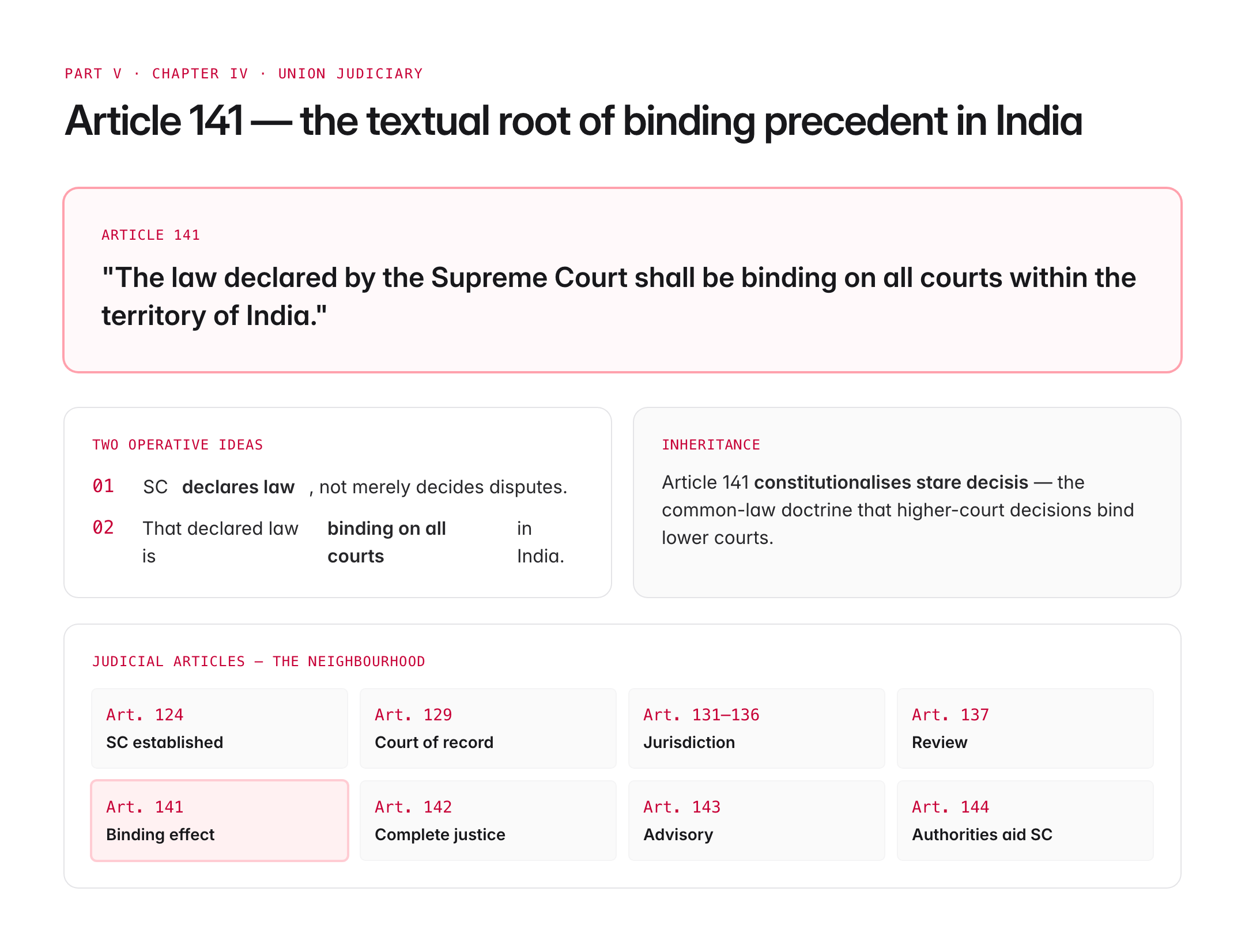
Article 141 contains two key operative ideas:
- The Supreme Court declares law, not merely decides disputes.
- That declared law is binding on all courts within India.
"All courts" means every court subordinate to the Supreme Court in the hierarchy — High Courts, district courts, and all tribunals and quasi-judicial bodies that function as courts. The Supreme Court itself is not bound by its own judgments; it can overrule its prior decisions, usually through a larger bench.
Location and Context
Article 141 is placed in Part V, Chapter IV of the Constitution, which deals with the Union Judiciary. Its neighbouring articles provide a coherent architecture for judicial power:
| Article | Subject |
|---|---|
| 124 | Establishment of the Supreme Court |
| 129 | Supreme Court as a court of record |
| 131–136 | Jurisdiction of the Supreme Court |
| 137 | Review of judgments |
| 141 | Binding effect of Supreme Court law |
| 142 | Power to do complete justice |
| 143 | Advisory jurisdiction |
| 144 | Civil and judicial authorities to assist the Supreme Court |
Articles 141 and 142 together make the Supreme Court a uniquely powerful apex judicial body.
The Doctrine of Precedent
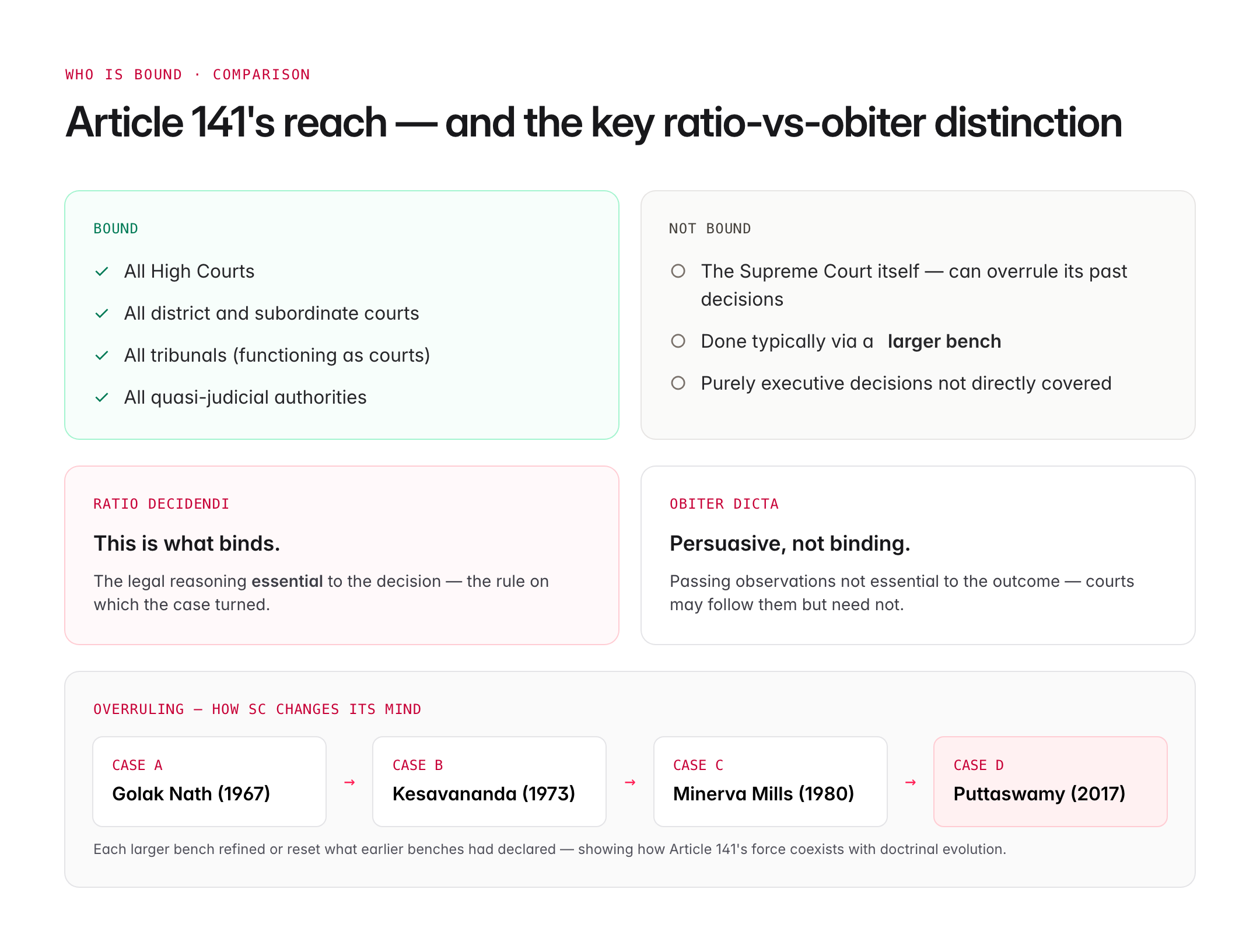
India inherits from English common law the principle that past decisions of higher courts bind lower courts. Article 141 constitutionalises this principle. Two technical concepts matter:
- Ratio decidendi — the legal reasoning that is essential to a decision; this is what binds other courts.
- Obiter dicta — passing observations not essential to the decision; these are persuasive but not binding.
Courts look for the ratio in a Supreme Court judgment to determine what Article 141 actually binds them to follow. The task of distilling ratio can be complex, especially when a bench delivers multiple opinions or obiter observations extend far beyond the dispute.
Who Is Bound and Who Is Not
A careful reading of Article 141 produces the following:
- Bound: All courts in India, including High Courts; all tribunals; all quasi-judicial authorities.
- Not bound: The Supreme Court itself; it can overrule its earlier judgments.
- Not directly covered: Purely executive decisions, though administrative authorities generally follow Supreme Court pronouncements.
When a later Supreme Court bench disagrees with earlier law, it typically refers the matter to a larger bench. Landmark constitutional cases such as Golak Nath, Kesavananda Bharati, Minerva Mills, Indira Gandhi v. Raj Narain, Maneka Gandhi and K.S. Puttaswamy have illustrated this process of overturning or refining earlier precedent.
Article 141 and the Supreme Court's Role
Article 141, read with Articles 32 (writ jurisdiction), 136 (special leave to appeal), 142 (complete justice), and 143 (advisory jurisdiction), equips the Supreme Court with three intertwined roles:
- Final arbiter of the Constitution — interpreting its provisions authoritatively.
- Final court of appeal — through Articles 132–136.
- Law-declaring court — the reasoning of which binds all other courts.
This framework has allowed the Supreme Court to evolve judicial doctrines such as the basic structure doctrine, public interest litigation, right to privacy, and continuing mandamus — all of which cascade down the judicial system through Article 141.
Limits and Critiques
Though powerful, Article 141 is not absolute. Notable limits and debates:
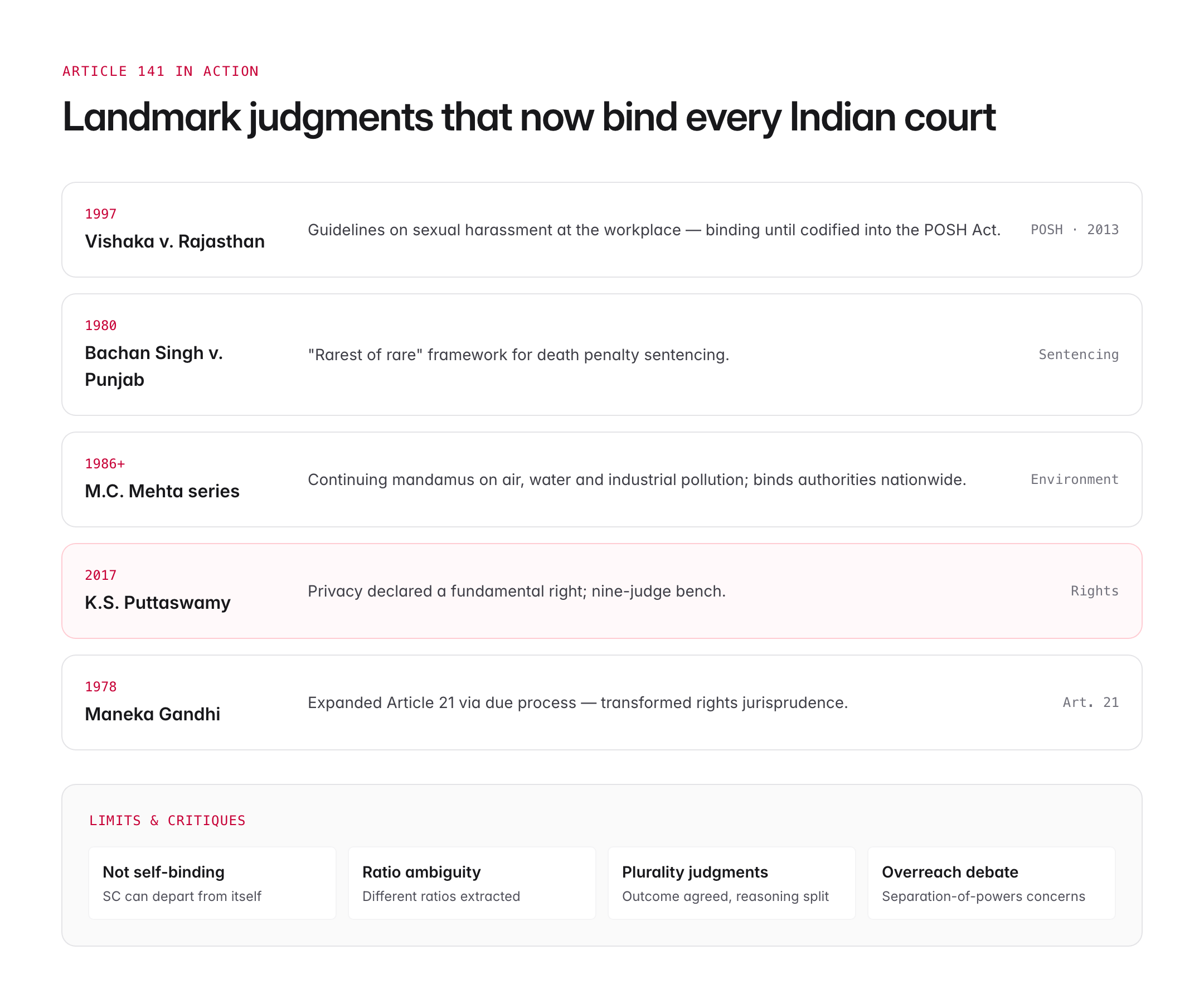
- Not binding on itself: The Supreme Court can depart from past decisions, usually through a bench of larger strength.
- Ambiguity of ratio: Different judges may extract different ratios from the same judgment.
- Plurality judgments: Where multiple opinions agree on the outcome but disagree on reasoning, subordinate courts face interpretive difficulties.
- Judicial overreach concerns: Critics argue that extensive use of Article 141 combined with Article 142 can blur the separation of powers.
- Lack of codified reporting: Though the Supreme Court Reports series is official, rapid judgment flow complicates consistent application.
Despite these concerns, Article 141 remains an indispensable pillar of the Indian rule of law.
Article 141 in Action
Common contexts where Article 141 is directly invoked:
- Guideline-based judgments: Vishaka v. State of Rajasthan (1997) on sexual harassment, followed until the POSH Act 2013.
- Sentencing principles: Bachan Singh (1980) setting the "rarest of rare" framework for the death penalty.
- Environmental law: M.C. Mehta series of judgments binding all authorities on pollution control.
- Rights jurisprudence: K.S. Puttaswamy (2017) declaring privacy a fundamental right.
In each of these, the Supreme Court's legal reasoning continues to bind courts nationwide.
UPSC Relevance
Prelims focus: Article 141 makes Supreme Court-declared law binding on all courts in India. It is distinct from Article 142 (complete justice) and Article 144 (authorities aiding the Supreme Court). The Supreme Court is not bound by its own previous decisions.
Mains GS-II angle: Use Article 141 when discussing judicial review, judicial activism, the doctrine of precedent, and the basic structure doctrine's evolution. It also supports essays on separation of powers and the rule of law.
Sample PYQ angle: UPSC has asked about the Supreme Court's role, the concept of binding precedent, and the sources of Indian law. Article 141 is the anchor for each. A concise prelims-ready formulation is: "Law declared by the Supreme Court is binding on all courts in India, but not on the Supreme Court itself."