Article 142 of the Indian Constitution — Supreme Court Power to Do Complete Justice
You searched for Article 142 of Indian Constitution because the phrase "complete justice" keeps showing up in news headlines and you want to know what the Supreme Court can and cannot do under this clause.
You searched for Article 142 of Indian Constitution because the phrase “complete justice” keeps showing up in news headlines and you want to know what the Supreme Court can and cannot do under this clause. Most coaching notes treat Article 142 as a polite footnote — “extraordinary power”, “Bhopal gas case”, move on… that’s incomplete. After the 2024 Chandigarh Mayor case, the 2025 Tamil Nadu Governor “deemed assent” verdict, and the Vice President’s public criticism of “judicial overreach”, Article 142 is the most contested provision in current SC jurisprudence. Examiners have asked it in 2019, 2022, and as a UPSC current-affairs anchor in 2024. This article gives you the doctrine, the cases, and the limits.
What is Article 142 of the Indian Constitution?
Article 142 of the Indian Constitution empowers the Supreme Court to pass any “decree or order” necessary for doing complete justice in any cause or matter pending before it. It sits in Part V, Chapter IV (Articles 124–147) of the Constitution, dealing with the Union Judiciary. The order so passed is enforceable throughout the territory of India “in such manner as may be prescribed by or under any law made by Parliament”. It is widely called the SC’s extraordinary jurisdiction — a residual power that lets the court fill gaps where ordinary statute is silent or inadequate.
- Article 142 — Part V, Chapter IV — applies only to the Supreme Court, not High Courts.
- Article 142(1) — empowers SC to pass any order for complete justice.
- Article 142(2) — gives SC powers regarding attendance of persons, production of documents, and contempt.
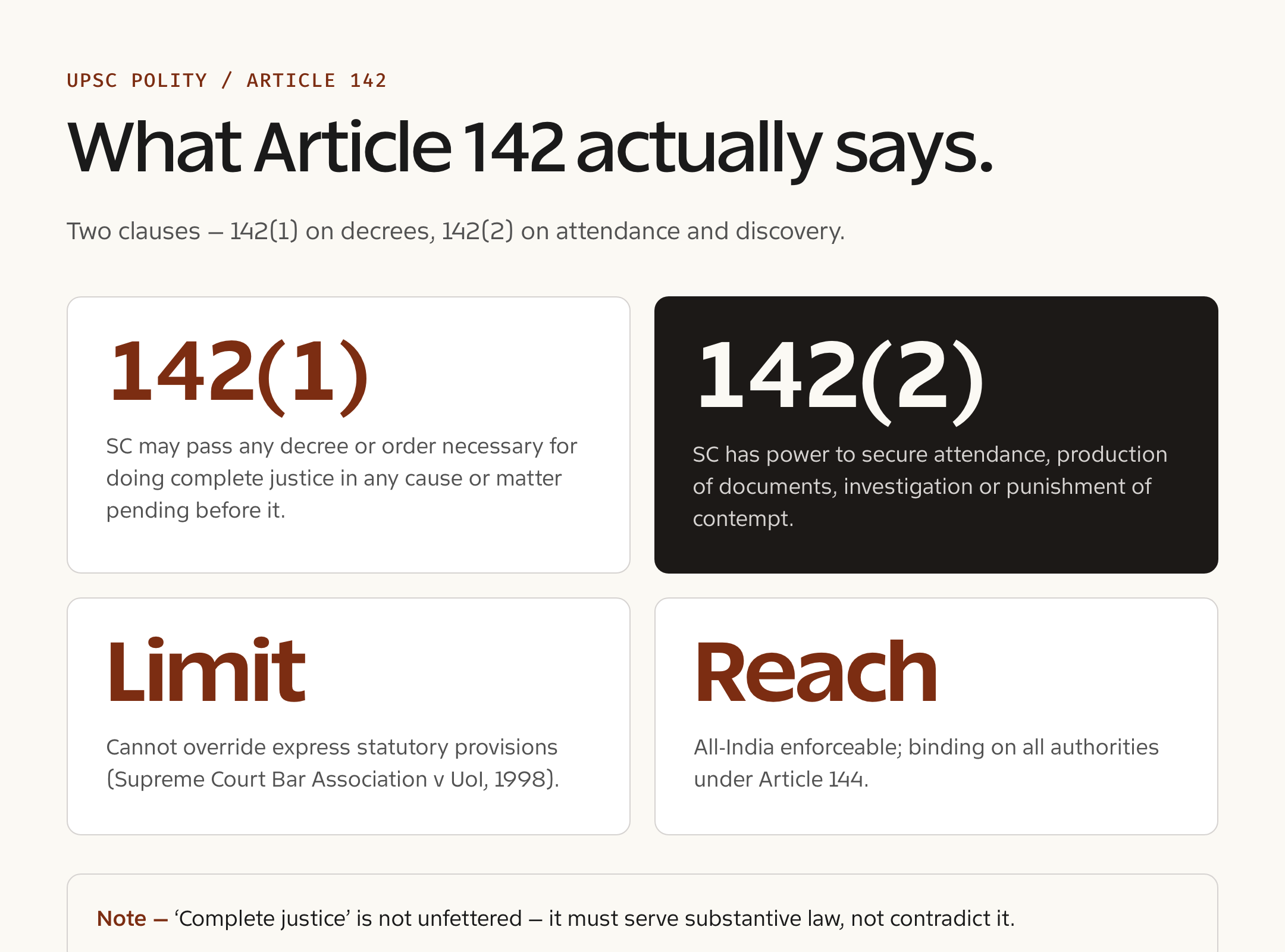
Constitutional basis — what the text actually says
Two clauses. Read them carefully… they’re shorter than you’d expect.
Article 142(1) — The Supreme Court in the exercise of its jurisdiction may pass such decree or make such order as is necessary for doing complete justice in any cause or matter pending before it, and any decree so passed or order so made shall be enforceable throughout the territory of India in such manner as may be prescribed…
Article 142(2) — Subject to the provisions of any law made in this behalf by Parliament, the Supreme Court shall have all and every power to make any order for the purpose of securing the attendance of any person, the discovery or production of any documents, or the investigation or punishment of any contempt of itself.
The drafters borrowed the design loosely from the Privy Council’s practice and similar provisions in the US and Canadian constitutions. The intent was to give the apex court a tool to deliver justice in cases where existing statutes had gaps — pending matters where the rigid application of law would produce injustice.
The “complete justice” doctrine — what it covers
Three strands of practice have emerged.
1. Filling legislative gaps
When the legislature has not provided for a particular remedy, the SC fills the gap. Vishaka v. State of Rajasthan (1997) — the SC framed sexual harassment guidelines for workplaces under Article 142, until Parliament enacted the POSH Act, 2013.
2. Doing equity where strict law would harm
In Ashok Kumar Gupta v. State of UP (1997), the court used Article 142 to balance reservation rules with seniority concerns. In 2024, the SC used Article 142 to admit a Dalit student to IIT Dhanbad after he missed the fee deadline due to circumstances beyond his control.
3. Final settlement of long-pending disputes
The classic Bhopal and Ayodhya invocations sit here. The court ends decades-long litigation by passing one comprehensive order.
Landmark invocations — the case bank you must memorise
Five cases. Be ready to write three to four lines on each.
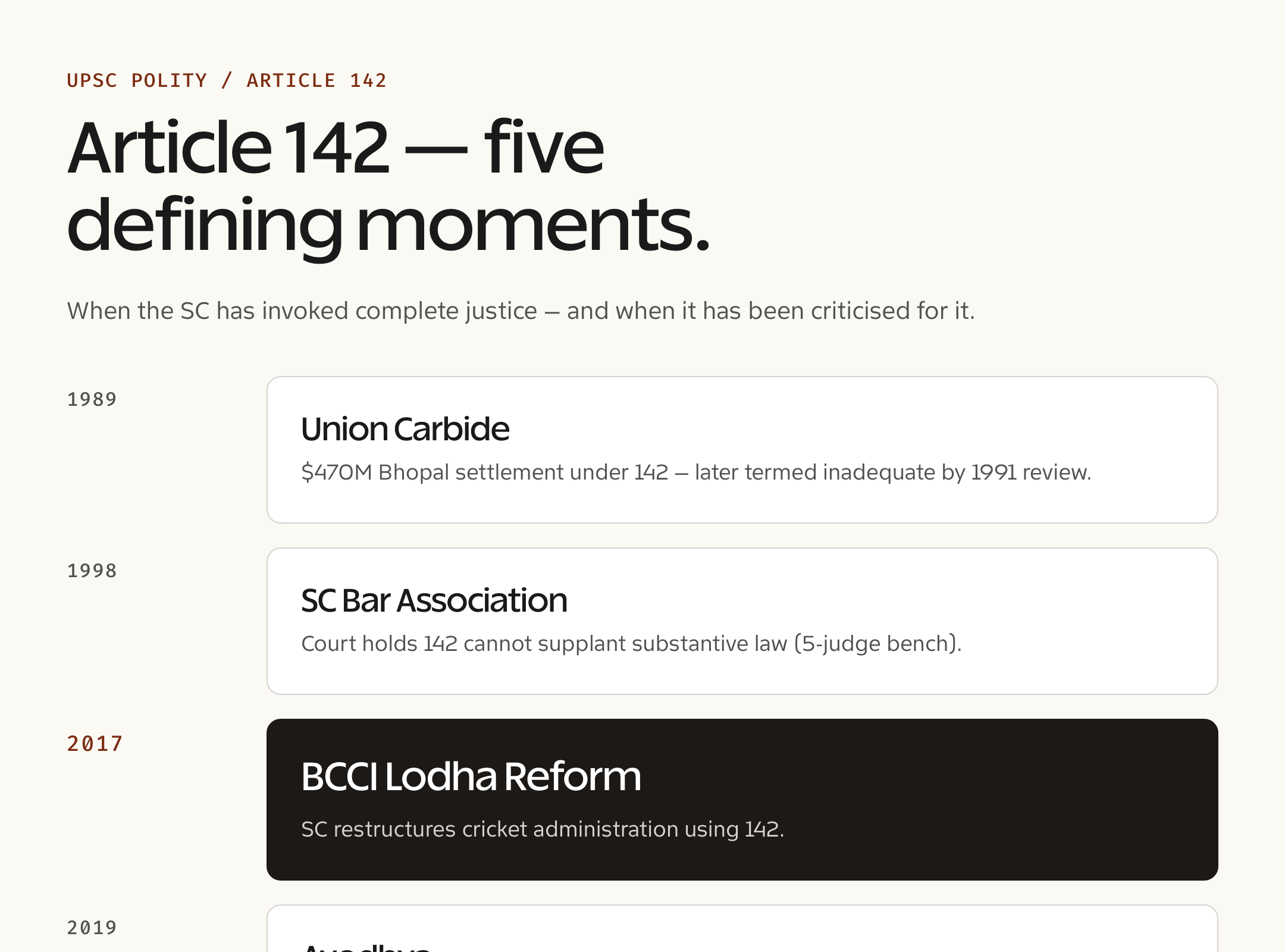
1. Union Carbide Corporation v. Union of India (1991) — Bhopal Gas Tragedy
The 1984 Bhopal disaster killed thousands and injured hundreds of thousands. The court invoked Article 142 to:
- Approve a settlement of $470 million between Union of India and Union Carbide.
- Quash all pending civil and criminal cases against Union Carbide and its officials.
- Bypass standard tort and criminal procedure to deliver compensation faster.
This was the first major modern invocation. It also drew the first wave of “judicial overreach” criticism — the SC effectively legislated tort settlement.
2. M. Siddiq (D) Thr. Lrs. v. Mahant Suresh Das (2019) — Ayodhya / Babri land dispute
A five-judge bench unanimously decided the Ram Janmabhoomi-Babri Masjid land dispute. Article 142 was invoked to:
- Direct the Centre to form a trust to construct a Ram Mandir on the disputed site.
- Allot 5 acres of alternative land to the Sunni Waqf Board for a mosque.
The court explicitly used Article 142 because no ordinary civil decree could resolve a 100-year-old title dispute with such broad social implications.
3. Shayara Bano v. Union of India (2017) — Triple Talaq
The court struck down talaq-e-biddat. Article 142 was invoked to grant immediate relief and bridge the period until Parliament legislated. Parliament passed the Muslim Women (Protection of Rights on Marriage) Act, 2019.
4. Anil Kumar Bishnoi v. UoI (2024) — Chandigarh Mayoral Election
In February 2024, the CJI D.Y. Chandrachud bench used Article 142 to set aside the rigged mayoral poll in Chandigarh and declare the petitioner the duly elected Mayor. Justice Chandrachud’s words: “We cannot allow democracy to be murdered like this.” The court did not order a fresh poll — it directly declared the result. A textbook Article 142 application.
5. State of Tamil Nadu v. Governor of Tamil Nadu (2025) — Deemed Assent
In April 2025, a two-judge bench held that 10 bills pending with the Tamil Nadu Governor were “deemed to have been assented” under Article 142. This is the most controversial invocation since Vishaka. Vice President Jagdeep Dhankhar publicly called it judicial overreach, arguing the SC had effectively legislated by short-circuiting Article 200 and Article 201.
Other notable invocations
- Prem Chand Garg (1962) — first laid down that Article 142 cannot override substantive statutory provisions.
- Supreme Court Bar Association v. Union of India (1998) — five-judge bench held Article 142 cannot “supplant” existing substantive law.
- Manohar Lal Sharma v. Principal Secretary (Coal Block case, 2014) — cancellation of 214 coal blocks.
- Rural Litigation v. State of UP (Doon Valley case) — environment protection orders.
- Common Cause v. UoI (2018) — recognised passive euthanasia and “living will”.
The constitutional limits — what Article 142 cannot do
This is where most aspirants get the answer wrong. Article 142 is broad but not boundless.
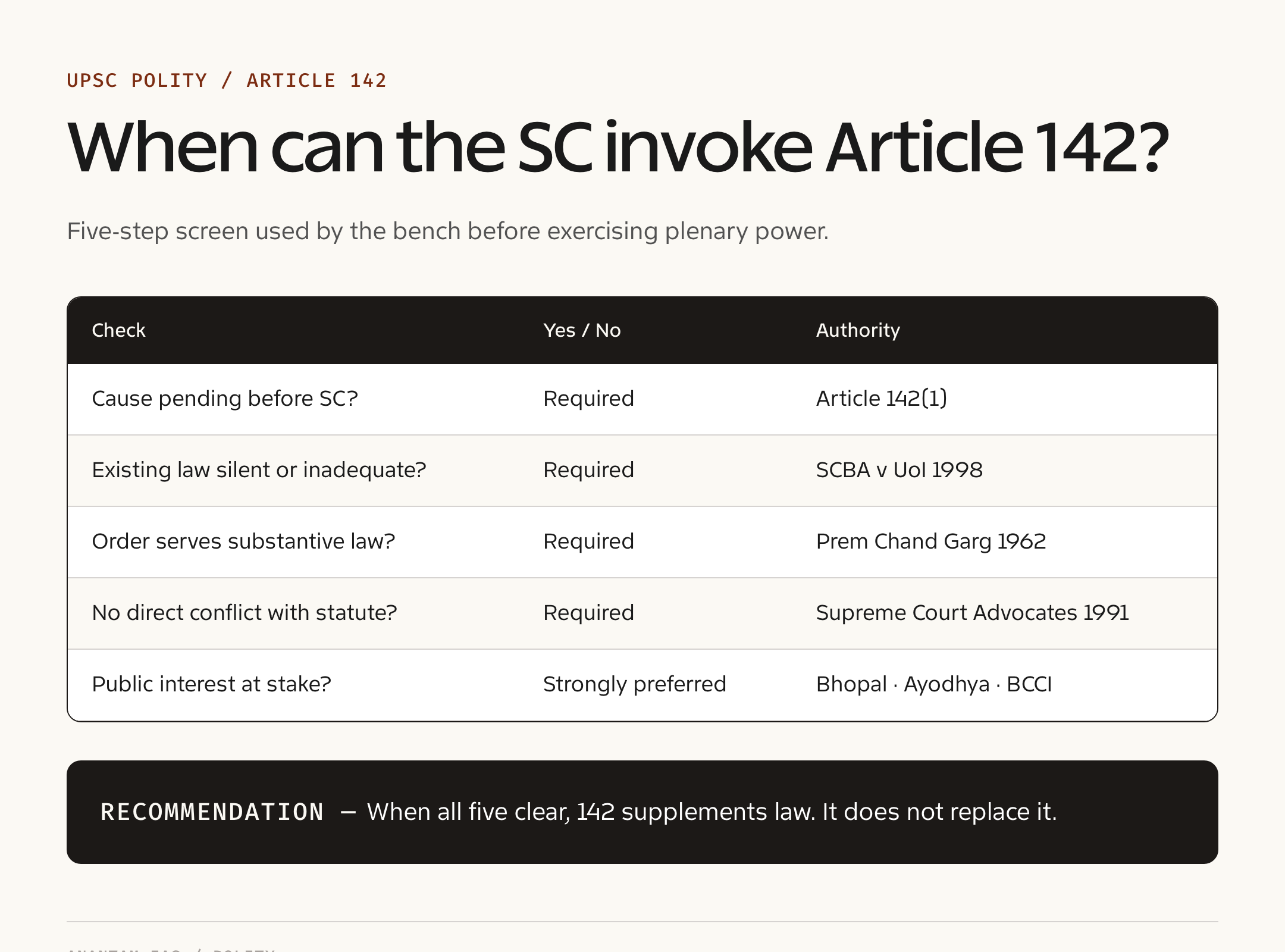
1. Cannot supplant substantive statute
In Supreme Court Bar Association v. UoI (1998), a Constitution Bench held that Article 142 is supplementary, not substitute. Where Parliament has enacted a substantive law, Article 142 cannot be used to override it.
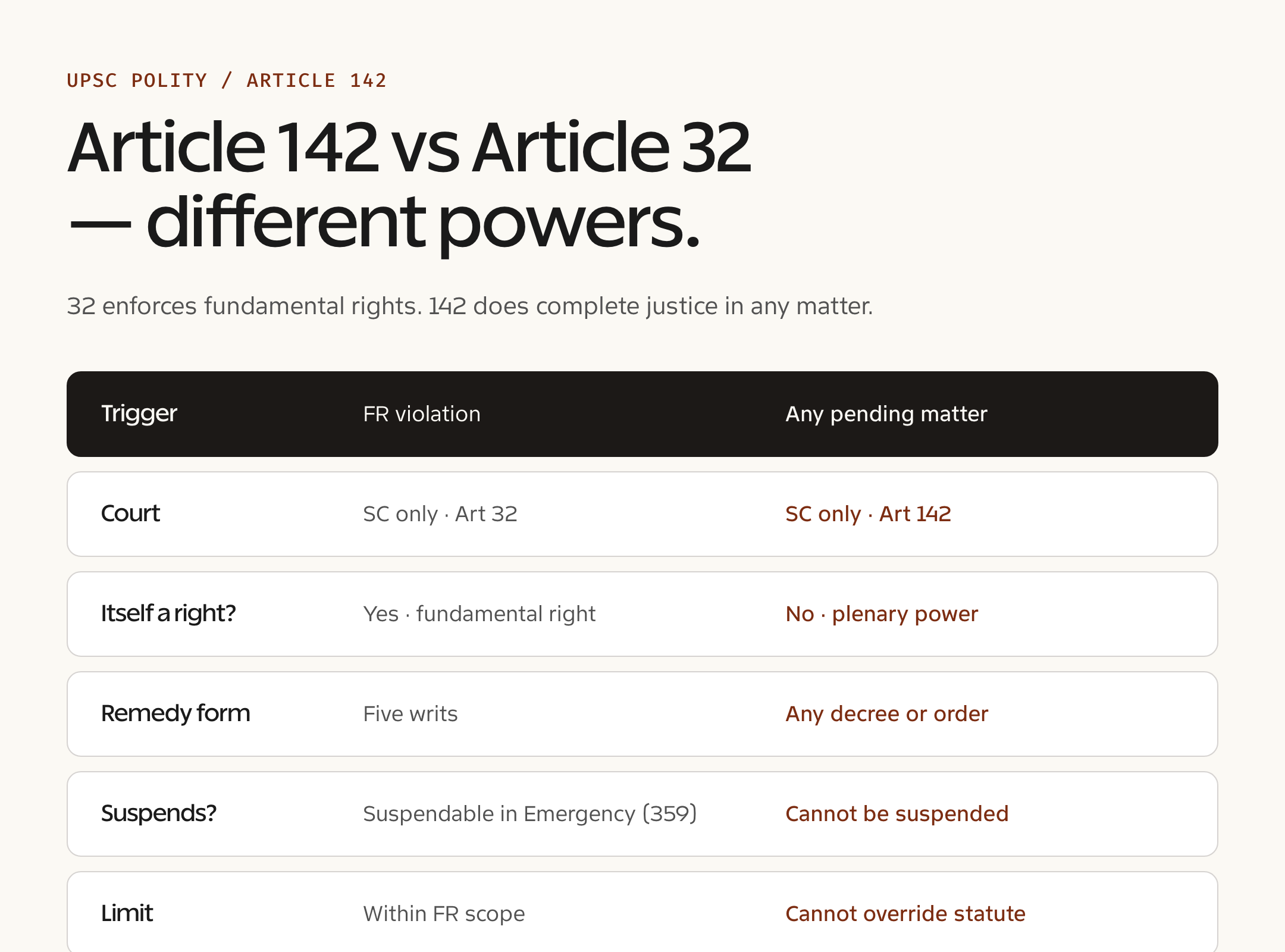
2. Cannot violate fundamental rights
The SC itself is bound by Part III. An Article 142 order cannot dilute Articles 14, 19, 21.
3. Cannot violate basic structure
After Kesavananda Bharati (1973), the SC’s powers are themselves part of basic structure but constrained by it. An order that destroys federalism or judicial review would be vulnerable to recall.
4. Cannot vacate HC stay automatically
In High Court Bar Association, Allahabad (2024), a five-judge bench held that Article 142 cannot be invoked to automatically vacate stay orders passed by High Courts after six months — overruling an earlier 2018 ruling. This was a deliberate self-correction.
5. Cannot routinely appoint arbitrators in commercial disputes
A 2024 Constitution Bench cautioned against using Article 142 to appoint arbitrators when Parliament has prescribed a specific procedure under the Arbitration and Conciliation Act.
The judicial overreach debate
This is the Mains-and-Interview anchor in 2026.
Critics’ position:
- Article 142 has no built-in standard. “Complete justice” is undefined and entirely judge-dependent.
- The provision has been used to legislate (Vishaka guidelines, deemed assent), not just adjudicate.
- Vice President Dhankhar’s April 2025 remark — “Article 142 has become a nuclear missile against democratic forces” — captures the political backlash.
Defenders’ position — and honestly, this is the more nuanced read…
- Article 142 is needed for cases where statutes are silent (Bhopal had no precedent for class settlement).
- Self-restraint cases (SCBA 1998, HCBA Allahabad 2024) prove the court polices itself.
- Without Article 142, decades of litigation would have continued in Bhopal and Ayodhya.
A common reform proposal: mandatory five-judge bench for any Article 142 invocation that creates new procedural law or overrides statute. Worth knowing for Mains.
Why this matters for UPSC
- Prelims — Direct factual MCQs. Part V, Chapter IV. Article 142(1) vs 142(2). What it means for “complete justice”. Asked 2018, 2022, 2024.
- Mains GS-II — “Discuss the scope and limits of Article 142.” Or — “Is Article 142 an instance of judicial overreach?” Both versions appeared in 2024 mock tests by major coaching institutes; UPSC has hinted at this in past patterns.
- Mains GS-IV — Ethics of judicial discretion.
- Essay — “Separation of powers in India” / “Justice must be tempered with mercy”.
- Interview — Almost guaranteed if you have Polity / PSIR optional. Have an opinion. Argue both sides.
Common misconceptions
- “Article 142 is available to High Courts.” No. Only the Supreme Court. High Courts have similar inherent powers under Article 226 + Section 482 CrPC, but those are not the same.
- “Article 142 can override statutes.” It cannot — not after SCBA (1998). It is supplementary.
- “Article 142 was invented for Bhopal.” Wrong. It existed in the original Constitution, 1950. Bhopal (1991) was just its most prominent modern use.
- “Vishaka guidelines are still in force.” Partially true. They were operationalised by the POSH Act, 2013, which now governs the field.
- “The SC always uses Article 142 to expand its power.” No. SCBA (1998) and HCBA Allahabad (2024) are explicit self-restraint judgments.
How to revise this in 30 minutes
- Bare Constitution — Article 142(1) and (2) — 2 minutes.
- Laxmikanth — Supreme Court chapter — Article 142 box. 5 minutes.
- Supreme Court Observer — Complete Justice under Article 142 podcast and brief — 10 minutes.
- Indian Express — TN Governor case explainer (Apr 2025) — 5 minutes.
- Drishti IAS — Article 142 daily news analysis pages — 8 minutes for the 2024 Chandigarh case.
Skip the random YouTube debates… go to the original judgments — Bhopal, Ayodhya, Chandigarh, TN Governor — and read just the relevant paragraphs.
Frequently Asked Questions
Where is Article 142 placed in the Constitution?
Article 142 is in Part V, Chapter IV, dealing with the Union Judiciary. It applies only to the Supreme Court of India.
Can High Courts pass orders under Article 142?
No. Only the Supreme Court has Article 142 powers. High Courts use their inherent powers under Article 226 (writ jurisdiction) and Section 482 CrPC.
What is the meaning of u0022complete justiceu0022 under Article 142?
The phrase is undefined in the text. Through case law, it means whatever order is necessary to deliver substantive justice in a pending matter — including filling legislative gaps, granting equitable relief, or ending long disputes.
Has the Supreme Court placed limits on Article 142?
Yes. In Prem Chand Garg (1962) and SCBA v. UoI (1998), the SC held Article 142 cannot supplant existing substantive law. In HCBA Allahabad (2024), it cannot be used to automatically vacate HC stays.
What was the most controversial recent use of Article 142?
The April 2025 Tamil Nadu Governor case, where the SC declared 10 bills u0022deemed assentedu0022 under Article 142. Vice President Jagdeep Dhankhar publicly called it overreach.
Why is Article 142 considered u0022extraordinary jurisdictionu0022?
Because it sits outside ordinary appellate, original, and writ jurisdiction. It allows the SC to pass orders even where no specific statutory provision authorises them, in order to secure complete justice.
Can Article 142 violate the basic structure?
No. The SC is itself bound by basic structure. Any Article 142 order destroying federalism, judicial review, or fundamental rights would be open to recall.