Article 143 of Indian Constitution: Presidential Reference Guide
Article 143 of Indian Constitution empowers the President to seek the Supreme Court's advisory opinion on legal and public-importance questions.
Article 143 of the Indian Constitution empowers the President of India to refer any question of law or fact of public importance to the Supreme Court for its advisory opinion. This provision, which forms the backbone of the Supreme Court's advisory jurisdiction, allows the executive to consult the apex court before finalising a policy or executive action that raises complex constitutional issues. Unlike a regular writ or appeal, a reference under Article 143 does not settle a dispute between parties; instead, it produces a non-binding opinion that carries enormous persuasive and moral authority. The provision has been used sparingly, but the references made under it — from the Kerala Education Bill to the Ram Janmabhoomi reference — have shaped Indian constitutional history.
What Article 143 Says
Article 143 falls in Part V, Chapter IV of the Constitution, dealing with the Union Judiciary. It has two clauses:
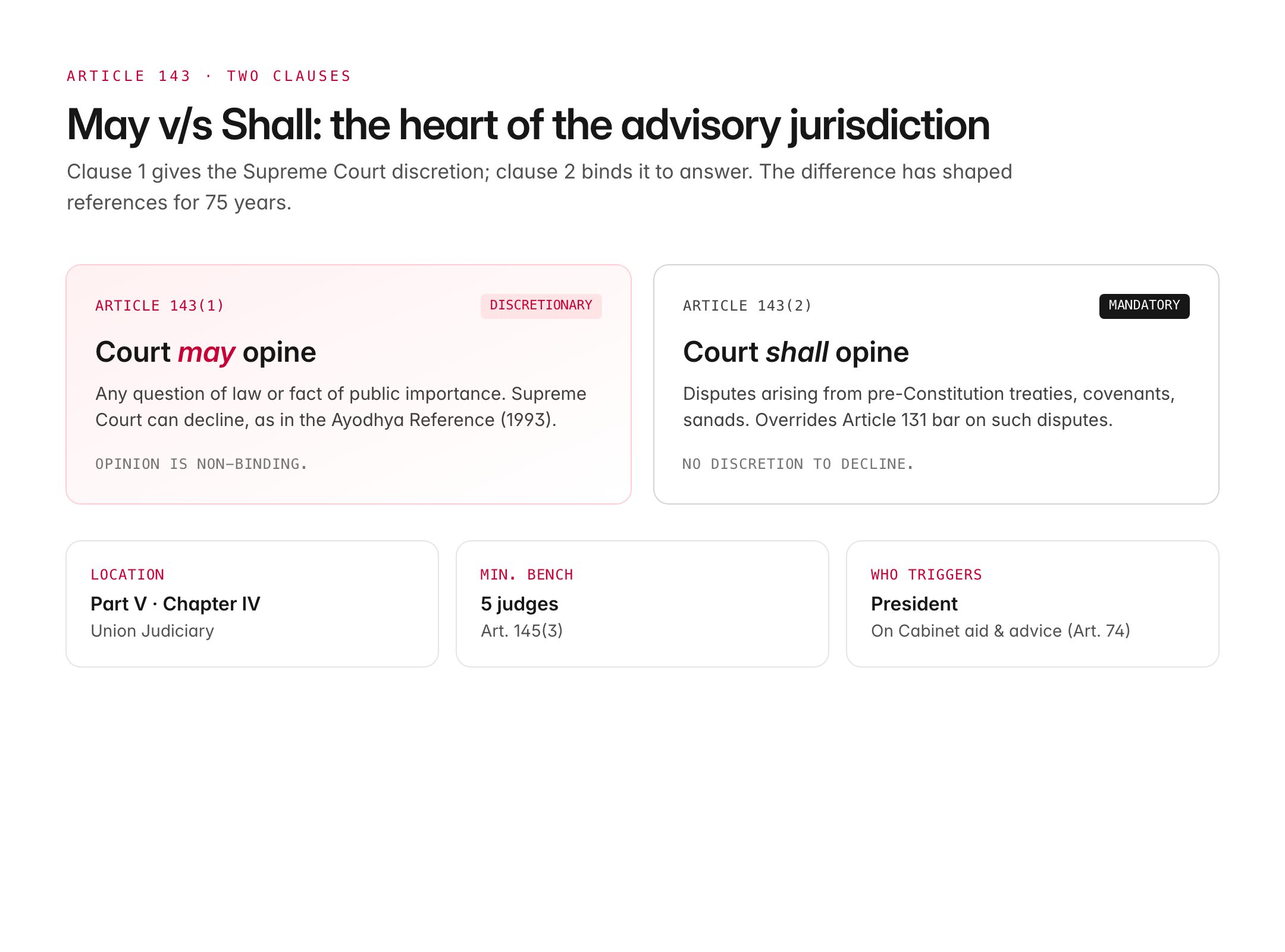
- Article 143(1): If it appears to the President that a question of law or fact has arisen, or is likely to arise, which is of such a nature and of such public importance that it is expedient to obtain the opinion of the Supreme Court, he may refer the question to that Court for consideration, and the Court may report its opinion.
- Article 143(2): The President may refer to the Supreme Court a dispute arising out of any pre-Constitution treaty, agreement, covenant, engagement, sanad or similar instrument, and the Court shall report its opinion. This clause overrides the bar on such disputes under Article 131.
The key distinction: under 143(1), the Court has discretion to decline, whereas under 143(2) it is bound to give an opinion.
Nature of the Advisory Jurisdiction
Three features define the advisory jurisdiction:
- Non-binding opinion. The Supreme Court's answer is advisory and does not have the force of a judgment. However, it is treated as authoritative and followed in practice by courts and the government.
- President acts on aid and advice. Under Article 74, the President refers matters on the aid and advice of the Council of Ministers, so in effect the executive decides when to invoke Article 143.
- Discretion to decline under 143(1). In the Ayodhya Reference (1993), the Supreme Court returned the reference unanswered, holding that answering it would be redundant and unnecessary.
A minimum of five judges must hear any reference under Article 143, as mandated by Article 145(3), because every reference is deemed a substantial question of constitutional interpretation.
Major References Under Article 143
India has seen several landmark references that have clarified important constitutional principles.
| Year | Reference | Core Issue |
|---|---|---|
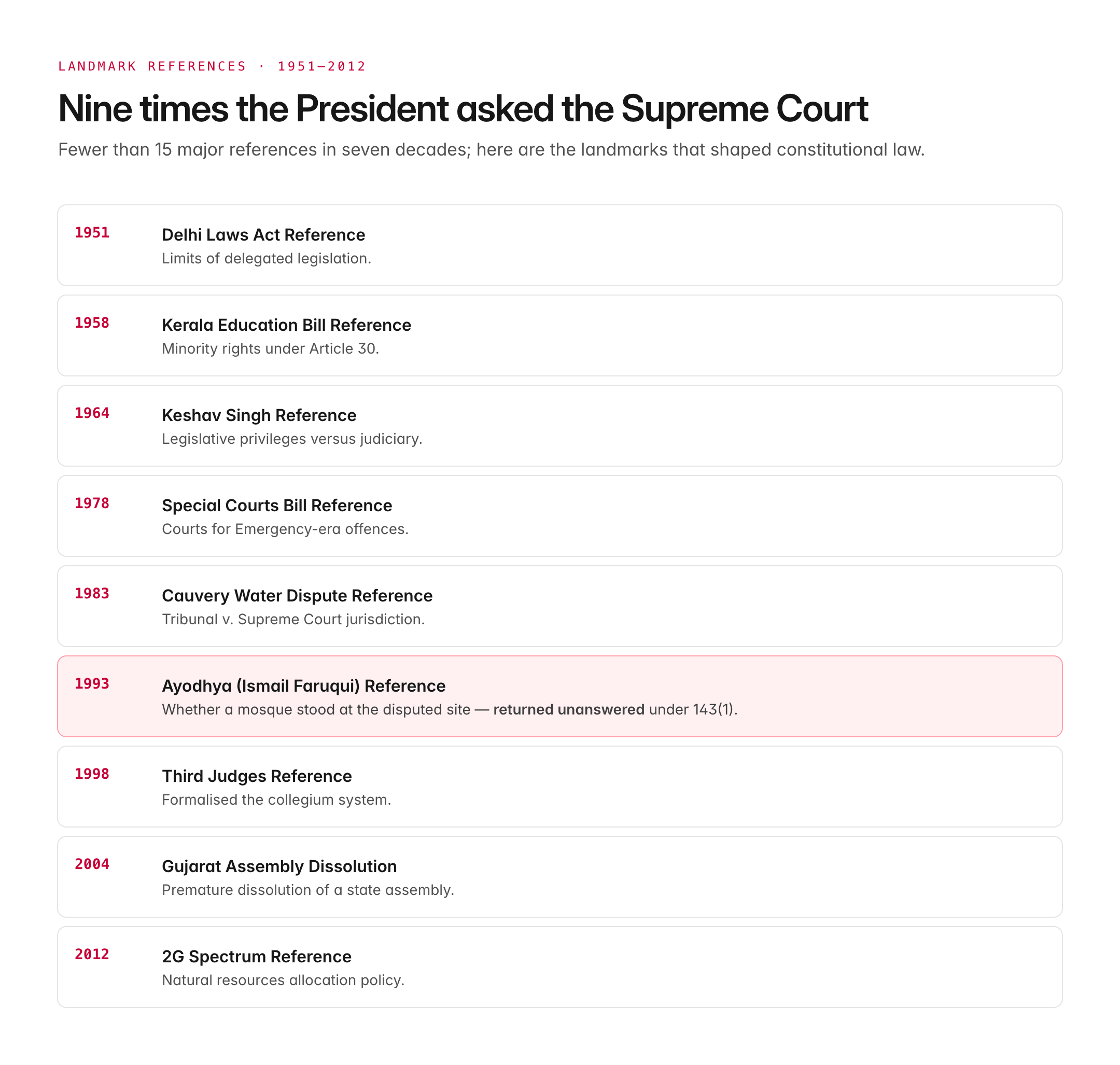
| 1951 | Delhi Laws Act Reference | Permissible limits of delegated legislation |
| 1958 | Kerala Education Bill Reference | Minority rights under Article 30 |
| 1964 | Keshav Singh Reference | Privileges of legislatures vs. judiciary |
| 1978 | Special Courts Bill Reference | Constitutionality of special courts for emergency offences |
| 1983 | Cauvery Water Dispute Reference | Tribunal vs. Supreme Court jurisdiction |
| 1993 | Ayodhya (Ismail Faruqui) Reference | Whether a mosque stood at the disputed site — returned unanswered |
| 1998 | Third Judges Case Reference | Collegium system and judicial appointments |
| 2004 | Gujarat Assembly Dissolution Reference | Premature dissolution of a state assembly |
| 2012 | 2G Spectrum Reference | Natural resources allocation policy |
The Third Judges Reference (1998) is especially significant because it formalised the collegium system for appointing Supreme Court and High Court judges.
Procedure for Making a Reference
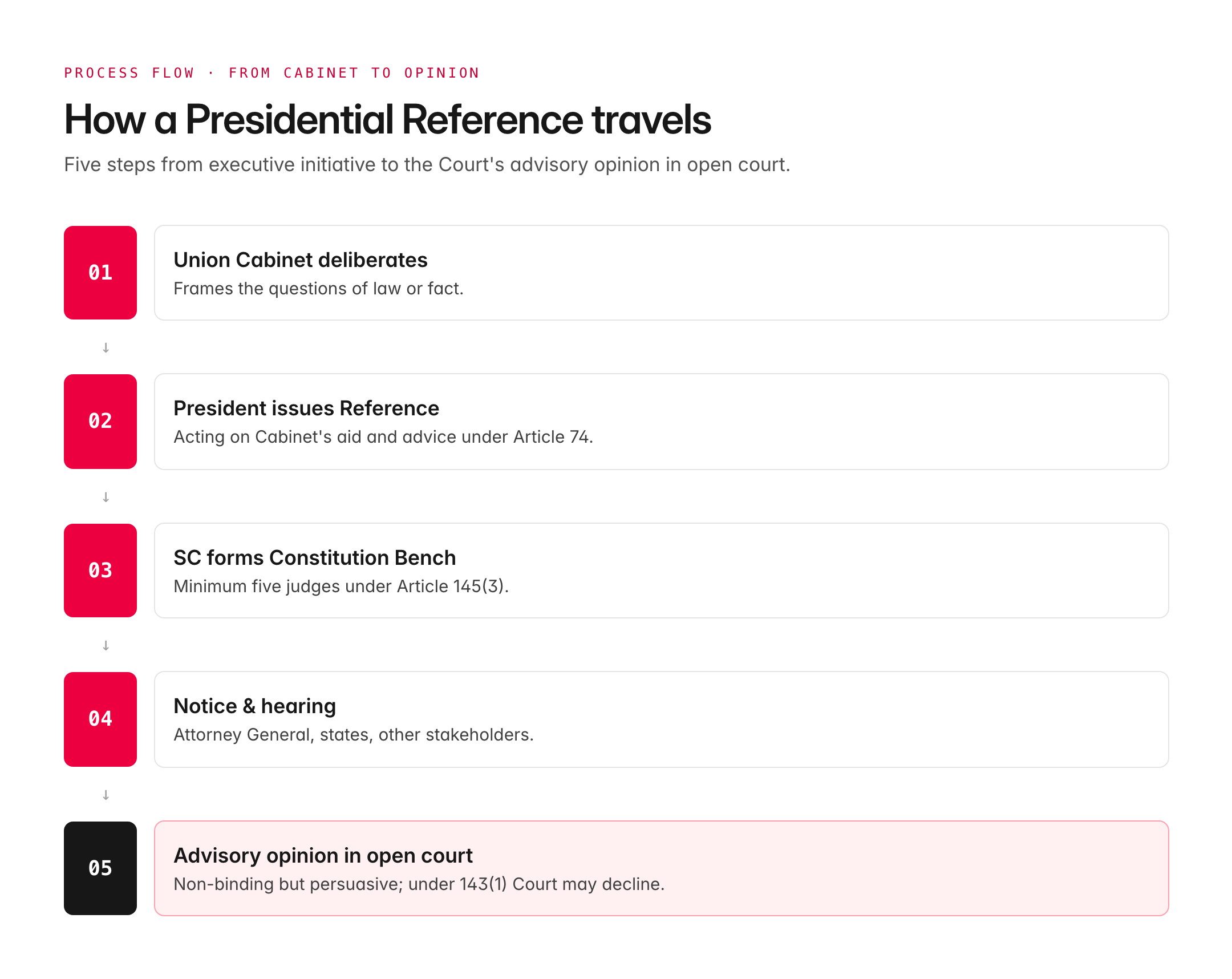
The procedure blends executive initiative and judicial review:
- The Union Cabinet deliberates on the need for a reference and formulates the questions.
- The President, acting on Cabinet advice, issues a formal Presidential Reference.
- The Supreme Court constitutes a Constitution Bench of at least five judges.
- Notice is issued to the Attorney General, state governments, and other stakeholders.
- After hearing, the Court renders an advisory opinion in open court.
Under Article 143(1), the Court can decline; in the Ayodhya reference, it cited that the reference was politically motivated and that answering it would not serve any useful purpose.
Significance and Utility
Article 143 serves several important functions in Indian constitutional practice:
- Proactive constitutional guidance. It allows the executive to test the constitutional validity of a law before enacting it, avoiding litigation afterwards.
- Conflict prevention. Sensitive federal or communal questions can be examined judicially without a full adversarial contest.
- Dialogue between institutions. References create a structured conversation between the executive and the judiciary.
- Legal clarity. Even though opinions are advisory, they set influential precedents and shape legislative drafting.
Comparable provisions exist in Canada (Supreme Court Act reference power) and in Ireland, but the Indian provision is unique in combining both law/fact questions under 143(1) and the mandatory treaty-dispute jurisdiction under 143(2).
Limitations and Criticisms
Despite its utility, Article 143 has been criticised on several grounds:
- Politicisation risk. Governments can use references to postpone hard political decisions.
- Non-binding nature can weaken enforcement in politically charged matters.
- Judicial overreach concerns. Critics argue that advisory opinions expand judicial scope into executive policy zones.
- Sparing use. Fewer than 15 major references in seven decades means the jurisdiction is underused for its intended purpose.
The Supreme Court itself has noted that references should not be used to resolve political disputes or questions already pending before courts.
UPSC Relevance
Prelims focus: article number, part and chapter of the Constitution (Part V, Chapter IV), difference between 143(1) and 143(2), minimum bench strength (five judges under Article 145(3)), and factual recall of at least three landmark references.
Mains GS angle:
- GS II — functions and responsibilities of the Union, structure of the judiciary, separation of powers, appointment and role of higher judiciary.
- Analytical questions on the nature of advisory jurisdiction, its comparison with writ jurisdiction (Article 32) and appellate jurisdiction (Articles 132–134).
Sample PYQ angle: UPSC has asked whether the Supreme Court is "bound" to give its opinion on a reference under Article 143 — a classic differentiation between clauses (1) and (2). A strong answer cites the Ayodhya Reference (1993) where the Court declined under 143(1), contrasted with the mandatory nature of 143(2), and ends with evaluative comments on the provision's role in constitutional governance.