Asola Bhatti Wildlife Sanctuary: Delhi’s Aravalli Lung & UPSC Notes
Asola Bhatti Wildlife Sanctuary in Delhi spans 32.7 sq km of Aravalli ridge forest. Flora, fauna, threats, and UPSC-focused notes.
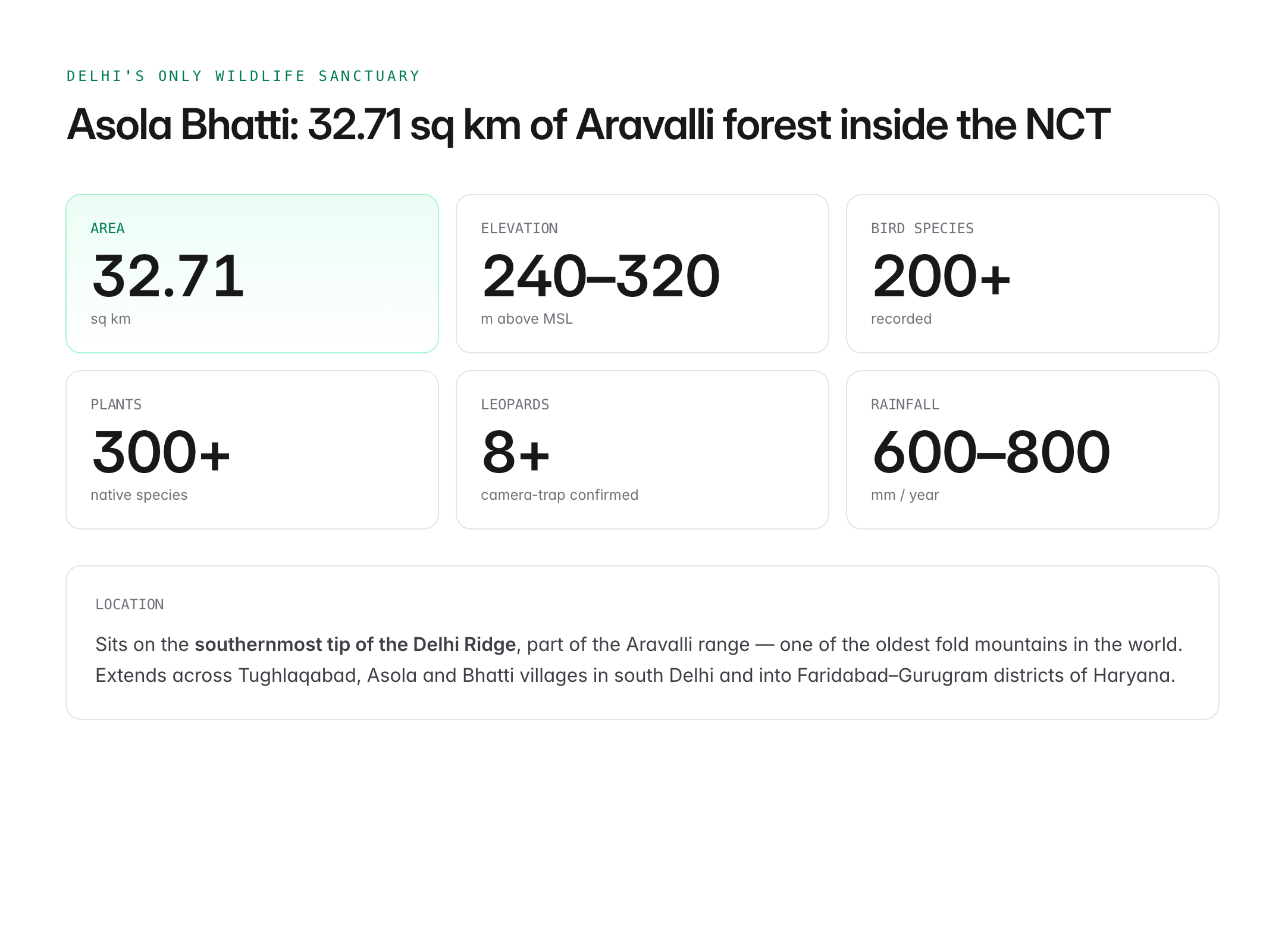
The Asola Bhatti Wildlife Sanctuary is a 32.71 sq km protected area on the southern edge of Delhi, extending into the Faridabad and Gurugram districts of Haryana, and is the last significant stretch of the Aravalli range forest inside the National Capital Territory. Notified in phases between 1986 and 1991 under the Wildlife (Protection) Act, 1972, it is the only wildlife sanctuary in Delhi and acts as a critical green lung for the city, sheltering leopards, hyenas, jackals, porcupines, over 200 bird species, and rare Aravalli flora. For UPSC, Asola Bhatti matters because it sits at the intersection of urban ecology, the Aravalli ecosystem debate, and Supreme Court interventions on mining and deforestation.
Location and Landscape
Asola Bhatti Wildlife Sanctuary lies on the southern Delhi Ridge, part of the larger Aravalli range, one of the oldest fold mountains in the world. Key geographic facts:
- Area: 32.71 sq km.
- Location: South Delhi (Tughlaqabad, Asola, Bhatti villages) and adjoining Faridabad–Gurugram.
- Terrain: Semi-arid Aravalli scrub, rocky outcrops, and abandoned quarry pits.
- Elevation: 240–320 m above mean sea level.
- Climate: Hot semi-arid, 600–800 mm annual rainfall.
It forms the southernmost tip of the Delhi Ridge, which is divided into Northern, Central, South-Central, and Southern Ridges. Asola Bhatti is the largest and ecologically richest of them.
Notification History
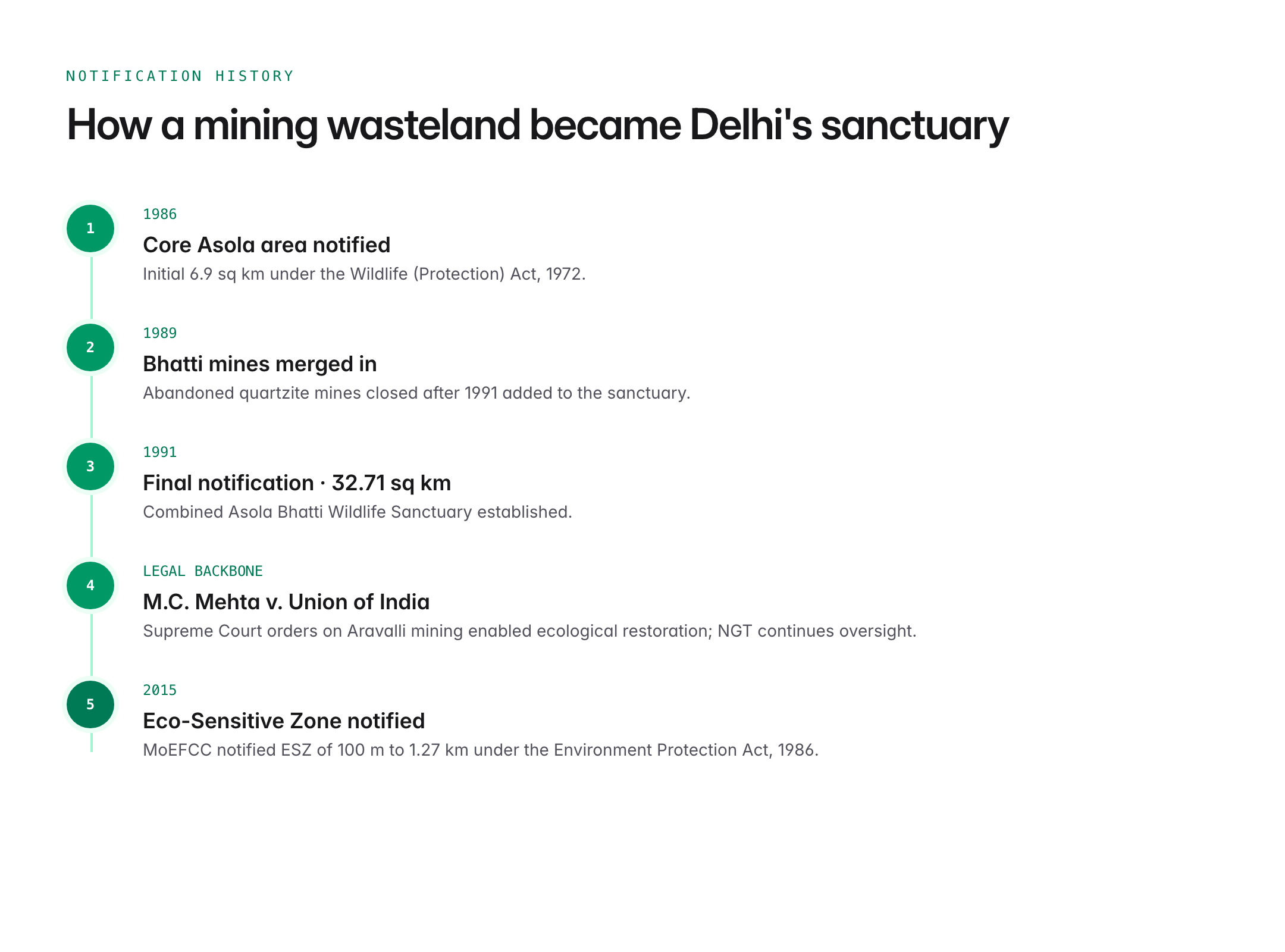
The sanctuary came into being in three stages:
| Year | Event |
|---|---|
| 1986 | Core Asola area notified (~6.9 sq km) |
| 1989 | Expanded to include Bhatti mines (abandoned quartzite mines closed after 1991) |
| 1991 | Final notification of combined Asola Bhatti Wildlife Sanctuary (32.71 sq km) |
| 2015 | Eco-Sensitive Zone (up to 100 m–1.27 km) notified by MoEFCC |
The Bhatti Mines were legally shut down following sustained court orders and Supreme Court judgments (M.C. Mehta v. Union of India) on Aravalli mining, paving the way for ecological restoration.
Flora: Aravalli Dry Forest
The sanctuary supports tropical dry deciduous and thorn forest vegetation typical of the Aravalli ecosystem:
- Native trees: Dhau (Anogeissus pendula), Ronjh (Acacia leucophloea), Kikar (Acacia nilotica), Hingot, Salai, Palash (Butea monosperma), Ber, Khejri (Prosopis cineraria).
- Invasive alien species: Prosopis juliflora (vilayati kikar), Lantana camara — major ecological threats.
- Medicinal plants: Arjuna, Neem, Bael, Amla, Harsingar.
- Over 300 native plant species have been documented, many through the Aravalli Biodiversity Park restoration model.
The Delhi government's Biodiversity Parks programme, anchored by CEMDE (Centre for Environmental Management of Degraded Ecosystems), has aggressively removed invasive vilayati kikar and replanted native Aravalli species inside and around the sanctuary.
Fauna
The sanctuary hosts surprisingly rich wildlife given its urban setting:
Mammals:
- Indian leopard (Panthera pardus) — confirmed through camera traps; estimated 8+ individuals.
- Striped hyena, golden jackal, Indian fox.
- Nilgai, sambar, chital (reintroduced), blackbuck (small numbers).
- Porcupine, jungle cat, civet, mongoose, palm civet.
Birds (200+ species):
- Indian peafowl (state bird of Delhi's Ridge ecosystem).
- Spotted owlet, Indian grey hornbill, shikra, black kite.
- Winter migrants — greylag geese, northern shoveler, common teal, painted stork at Neeli Jheel.
Reptiles and others: Indian rock python, monitor lizard, spectacled cobra, saw-scaled viper; numerous butterfly species.
Ecological and Social Significance
Asola Bhatti performs multiple critical functions for the National Capital Region.
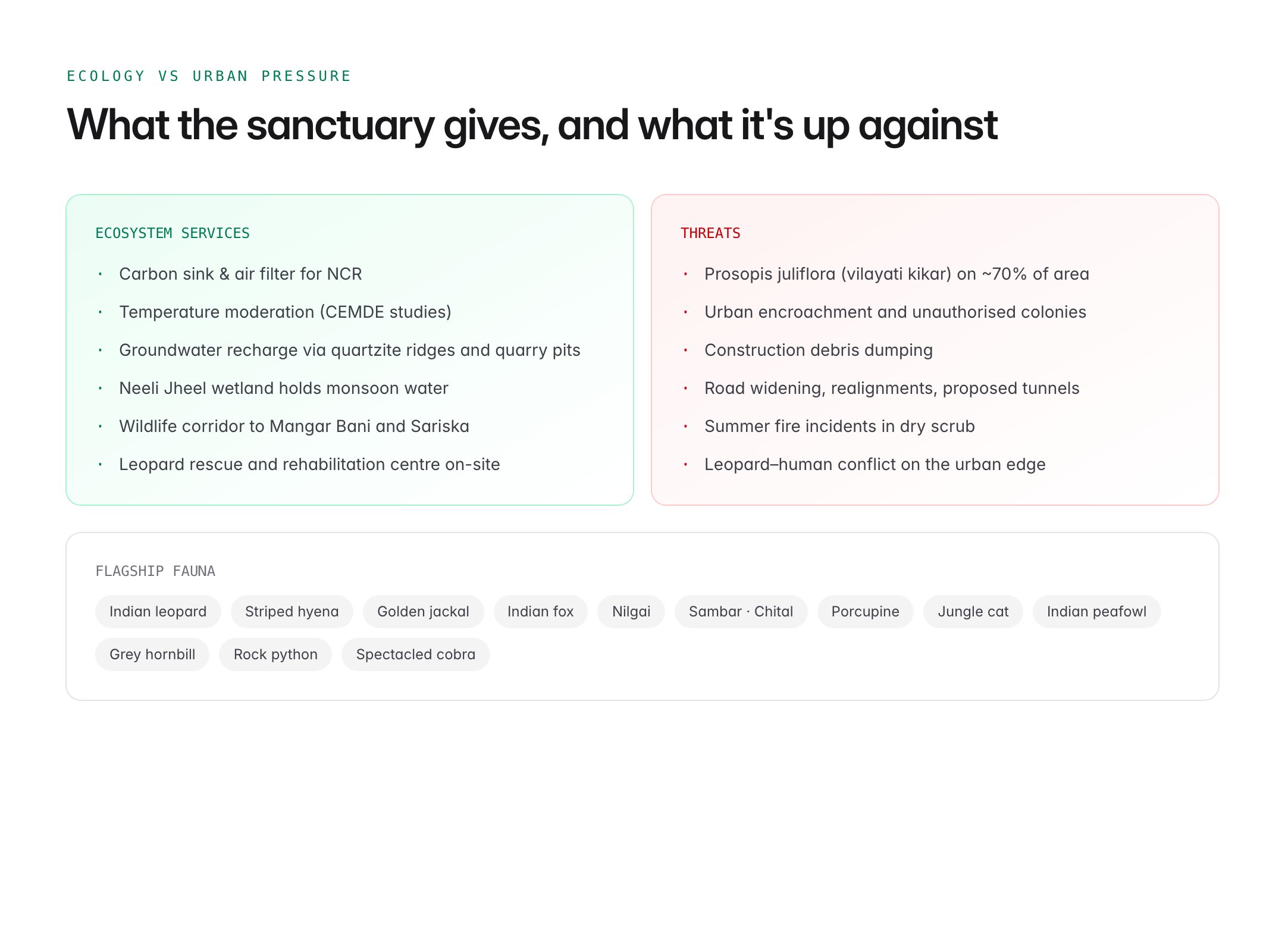
Climate and air quality. The sanctuary acts as a carbon sink and air filter for the NCR, which consistently ranks among the world's most polluted urban regions. Studies by CEMDE have documented measurable temperature moderation inside the sanctuary compared with adjoining urban areas.
Groundwater recharge. Quartzite ridges and recovered quarry pits act as natural aquifer recharge zones. Restored wetlands like Neeli Jheel hold monsoon water through much of the year.
Wildlife corridor. The sanctuary links the Aravalli forests of Haryana and Rajasthan, providing a corridor for leopards moving between Mangar Bani, Sariska, and the broader Aravalli landscape.
Cultural heritage. The sanctuary surrounds heritage sites like Tughlaqabad Fort, Adilabad, and the Surajkund area, weaving conservation with history.
Challenges and Threats
Despite its protected status, Asola Bhatti faces pressure on several fronts:
- Urban encroachment — construction and unauthorised colonies nibble at the boundary.
- Invasive vilayati kikar dominates nearly 70% of the area and outcompetes natives.
- Waste dumping in adjoining stretches, including construction debris.
- Fragmentation — road widening, realignments, and proposed tunnels threaten animal movement.
- Fire incidents in dry summer months.
- Leopard–human conflict as the sanctuary abuts dense urban neighbourhoods.
Legal milestones have shaped its management: the Supreme Court's 2018 order on demolishing illegal structures in the Aravallis, the NGT's repeated interventions on dumping and mining, and the Environment Protection Act, 1986 notifications for the Delhi Ridge.
Governance and Management
Asola Bhatti is managed jointly by multiple authorities:
- Delhi Forest Department (primary authority).
- Haryana Forest Department for adjoining corridor stretches.
- Central Zoo Authority coordinates the Asola Rescue Centre for leopards and other confiscated wildlife.
- CEMDE, University of Delhi — scientific restoration partner.
- National Green Tribunal (NGT) — continuous oversight.
Asola Bhatti Leopard Rescue and Rehabilitation Centre, established within the sanctuary, rehabilitates leopards rescued from conflict zones across Delhi and Uttarakhand.
UPSC Relevance
Prelims focus:
- Asola Bhatti is the only wildlife sanctuary in Delhi, area 32.71 sq km.
- Lies in the Aravalli range, on the southern Delhi Ridge.
- Notified under the Wildlife (Protection) Act, 1972 between 1986 and 1991.
- Key species: Indian leopard, striped hyena, nilgai, Indian peafowl.
- Invasive species issue: Prosopis juliflora (vilayati kikar).
- Nearby Biodiversity Parks: Aravalli Biodiversity Park, Yamuna Biodiversity Park, Neela Hauz, Tilpath Valley.
Mains GS-III angle:
- Role of urban wildlife sanctuaries in climate adaptation and ecosystem services for mega-cities.
- Aravalli conservation and the Supreme Court/NGT's role in mining bans and eco-restoration.
- Invasive species management — Prosopis juliflora removal as a model for degraded-land restoration.
Sample PYQ angle: "How does biodiversity vary in India? How is the Biological Diversity Act, 2002 helpful in conservation?" — Asola Bhatti is a useful case study showing how national legislation, state sanctuaries, Supreme Court interventions, and biodiversity park science combine to revive a degraded ridge ecosystem within one of the world's largest urban agglomerations.