Attitude and Values — Distinction, Types of Attitude, and Relevance for Civil Servants (UPSC GS IV)
How attitude and values differ, why values are more stable, types of attitude (positive, negative, neutral, explicit, implicit), and the civil-service relevance. UPSC GS Paper IV.
A civil servant who holds the value of equality holds it across every encounter. A civil servant who holds a positive attitude toward a particular community holds it only toward that community. The two are related; they are not the same. UPSC GS-IV asks the candidate to distinguish them cleanly and to know how attitudes can be classified, how values evolve, and how the two interact in the life of a public servant. This guide expands the compass extract on Attitude & Values into a Mains-quality reference.
The Core Distinction
The compass extract opens with the precise distinction.
Attitude is related to a particular object, whereas values are general in nature.
The example sharpens it:
If a person has a liberal attitude, then that is for a particular thing — like caste, gender issues, LGBT rights, dressing style. But if a person has the virtue or value system of liberty, then he will be liberal towards everything.
In other words: attitude is local; value is global. A person can have liberal attitudes toward gender and conservative attitudes toward dress code at once — these are object-specific dispositions. But if the underlying value is liberty, then liberal attitudes will tend to spread across all relevant domains because the value is general.
| Dimension | Attitude | Value |
|---|---|---|
| Specificity | Object-specific | General |
| Stability | Moderate | High — relatively enduring |
| Number | Many — one per object | Few — a small core set |
| Source | Experience with the specific object | Deep socialisation, reflection |
| Scope | One domain | All relevant domains |
| Intensity | Variable | Usually intense |
| Change mechanism | New experience with the object | Major life event or sustained reflection |
The reflective civil servant therefore audits values as the upstream condition and attitudes as the downstream expressions.
Stability — The Compass Insight
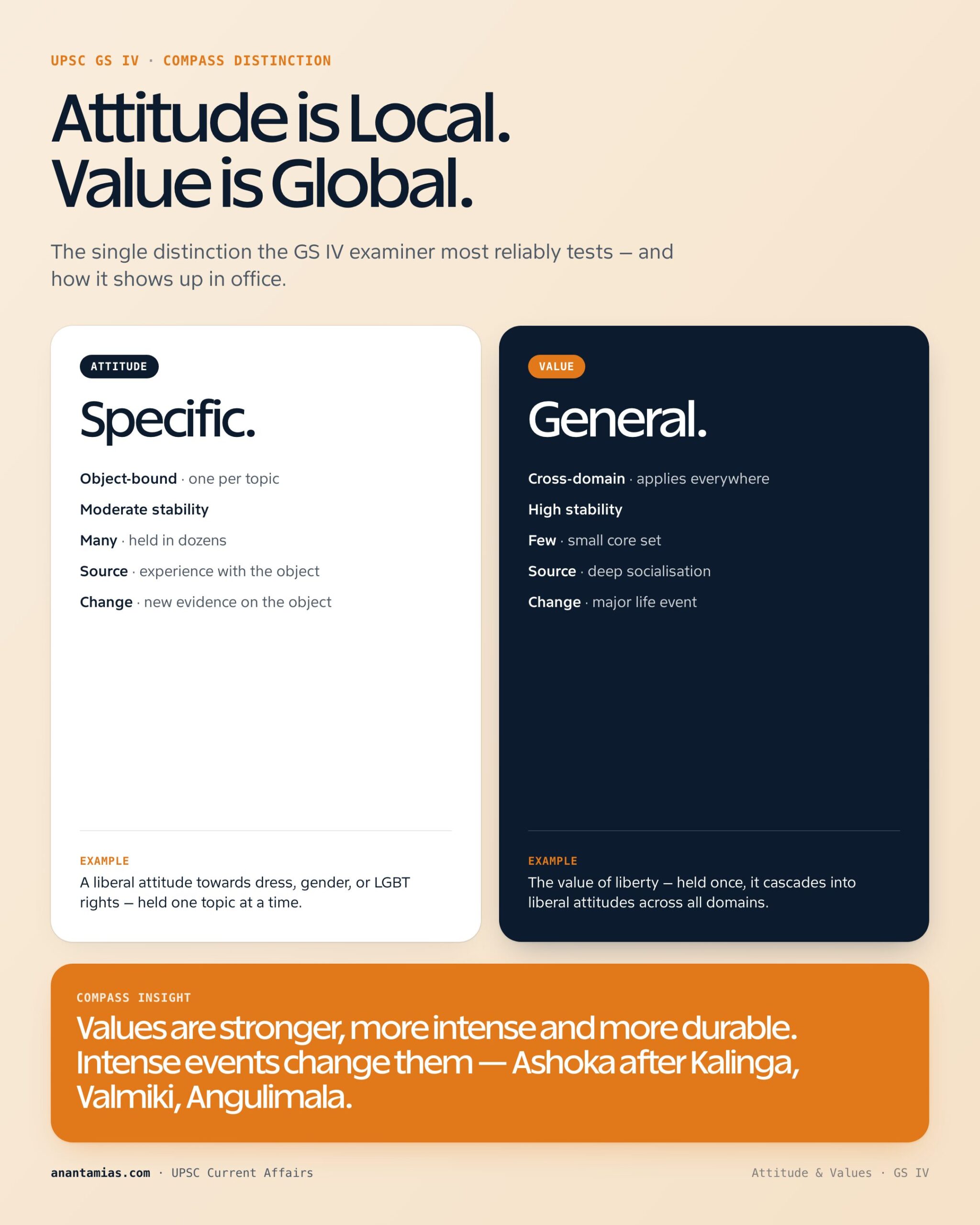
The compass adds: attitudes may change with the situation, but values are relatively stable and enduring. However, the compass does not claim values never change. Intense incidents in life can change the value system.
Indian and world examples of value-transformation through intense events:
- Ashoka after Kalinga — from imperial conquest values to dhamma values.
- Angulimala after meeting the Buddha — from violence to non-violence.
- Valmiki — from highway robbery to authorship of the Ramayana.
- Kalidas — from boorishness to refined poetic sensibility.
- Saul / Paul on the road to Damascus — from persecutor to apostle.
"The Kingdom of God is within you." — frequently quoted by Tolstoy to describe his own value transformation late in life.
For most civil servants, value transformation is not the dramatic single-event variety; it is the slow accretion of small course corrections — books read, mentors chosen, citizens actually listened to. The ethical career is, in this sense, a values-formation arc, not a values-static one.
Why Values Are "Stronger, More Intense and More Durable"
The compass states: thus values are stronger, more intense and durable than attitude. Three reasons explain why.
- Generality. Because a value applies across many situations, it gets reinforced more often.
- Identity-anchoring. Values become part of how the person sees herself. Changing a value means changing identity. Most agents resist this.
- Cultural backing. Values are usually shared with family, community, profession; attitudes can be more idiosyncratic. The shared structure of values makes them harder to dislodge.
The civil-service training implication is sharp: changing an officer's attitudes (toward a new technology, a new cohort of citizens) is much easier than changing her values. Training therefore typically targets attitudes — and, where values are genuinely misaligned with the constitutional order, training relies on time, exposure, and modelling rather than persuasion alone.
Types of Attitude — The Compass Classifications
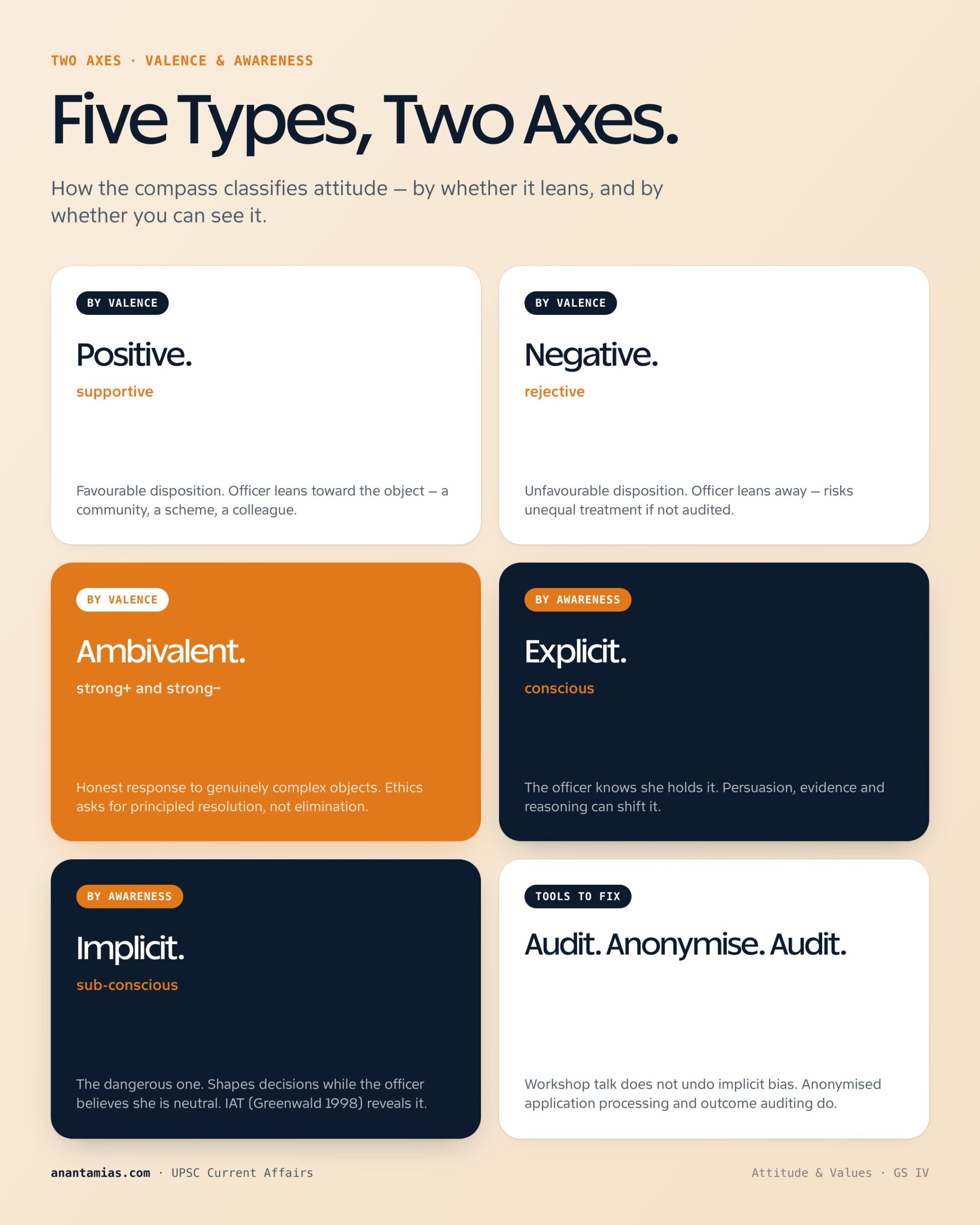
The compass extract distinguishes attitudes along two axes.
By Valence
- Positive (supportive) — favourable disposition toward the object.
- Negative (rejective) — unfavourable disposition.
- Neutral or ambivalent — neither clearly supportive nor clearly rejective.
A few clarifications.
- A truly neutral attitude — no evaluative weight — is rare; it usually reflects either weak engagement with the object or genuine ambivalence.
- Ambivalent is technically different from neutral: an ambivalent attitude is simultaneously strong-positive and strong-negative. The two-dimensional view of attitude (covered in a sister chapter) explains how this is possible.
The civil servant's attitude toward a politically connected applicant might be ambivalent — admiration for political engagement combined with concern about corruption risk — and the ethical question is which side the office acts on.
By Awareness
- Explicit attitude (conscious) — the person is aware of the attitude and how it shapes behaviour. Such attitudes are formed consciously.
- Implicit attitude (sub-conscious) — the person is unaware of the attitude and how it influences behaviour. Such attitudes are formed subconsciously.
The gap between explicit and implicit attitudes is one of the most studied phenomena in modern social psychology. The Implicit Association Test (Greenwald, 1998) shows that many people who explicitly endorse equality have implicit associations that contradict it.
For a civil servant, the implicit attitude is the dangerous one. She can say all the right things in a sensitisation workshop and still treat citizens of a particular community with subtly less attention. The corrective is structured exposure, peer feedback, and outcome auditing — which surface implicit attitudes by their behavioural traces.
"Until you make the unconscious conscious, it will direct your life and you will call it fate." — C.G. Jung
How Values and Attitudes Interact
Three patterns.
Pattern 1 — Values Generate Aligned Attitudes
The value of compassion generates positive attitudes toward the marginalised, the elderly, the disabled, the homeless. The agent does not have to derive each attitude separately; the value cascades.
Pattern 2 — Attitudes Constellate into Values
A consistent set of attitudes — toward women's education, women's employment, women's mobility, women's autonomy — eventually crystallises into the value of gender equality. Many adolescents arrive at values this way, by attitudes accumulating into pattern.
Pattern 3 — Values and Attitudes Conflict
The agent holds the value of equality but a particular attitude (toward a specific community) is negative. The conflict is uncomfortable and typically resolves either by:
- Updating the attitude to align with the value (the ethical preferred path).
- Carving out an exception — "I support equality for everyone except…" (the rationalisation path).
- Compartmentalising — separating the value-context from the attitude-context (the cognitive-dissonance path).
The reflective civil servant detects these resolutions in herself and chooses the first path even when it is uncomfortable.
Two Indian Case Studies
Case 1 — Babu Jagjivan Ram and the Generalised Value of Equality
Born into a Dalit family in 1908, Babu Jagjivan Ram lived in a society whose dominant attitudes toward Dalits were rejective. He internalised the value of equality so deeply that his attitudes across many domains — labour rights, education, agricultural workers, women — radiated from that central value. Once equality became his organising value, the attitudes followed automatically. The case illustrates Pattern 1 — value generating aligned attitudes.
Case 2 — The Officer Who Audited Her Implicit Bias
A senior IAS officer in 2022, after reading research on implicit caste bias, organised an internal exercise in her department: anonymised application processing with applicant identifiers masked, followed by comparison of decision patterns when names were revealed. The exercise revealed measurable differences in decisions on identical applications. The officer's explicit attitude was unambiguously equality-affirming; the implicit attitude told a different story. Reform combined sensitisation, structural anonymisation in initial review, and team-level decision audit. The case shows the explicit-implicit gap in operation — and a path to closing it.
The Civil-Service Implication
Audit Values First
Before training attitudes, identify values. An officer whose underlying value of impartiality is firm needs only mild training on specific attitudes. An officer whose value of impartiality is shaky cannot be reliably retrained at the attitude layer alone.
Match Training to Type
For explicit attitudes, persuasion, evidence, and reasoning work. For implicit attitudes, exposure, modelling, and structural intervention work better than persuasion. Workshop-talk does not undo implicit bias; changed daily practice does.
Use Identity Anchoring for Ambivalent Cases
When attitudes are ambivalent, link the chosen direction to identity — "this is what an honest officer does" — to leverage the stability of values for unstable attitudes.
UPSC Syllabus Relevance
GS-IV explicitly names attitude — content, structure, function; its influence and relation with thought and behaviour alongside values — their dimensions; role of family, society and educational institutions in inculcating values. Distinguishing attitude from value, and knowing the types of attitude, is therefore directly testable.
Past-Year Prompts
- "Distinguish between the following: (a) Personal ethics and Professional ethics." — 2015 (involves attitude/value distinction).
- "What is meant by 'crisis of conscience'? How does it manifest in the public-domain?" — 2017.
- "State the three basic values, universal in nature, in the context of civil service and bring out their importance." — 2018.
- "What do you understand by 'values' and 'ethics'? In what way is it important to be ethical along with being professionally competent?" — 2013.
- "Differentiate between attitude and value with examples." — 2020 paraphrased.
Mains Answer-Writing Tips
- Open with the specificity vs generality distinction — examiner recognises it immediately.
- Use one value-transformation example (Ashoka, Valmiki, Angulimala).
- List the two-axis classification of attitude — valence + awareness — and elaborate at least one.
- Bring in the explicit-implicit gap with IAT as a citation.
- Close with the value-first audit as a practical civil-service application.
Prelims Pointers
- Milton Rokeach (1973), The Nature of Human Values — terminal vs instrumental values.
- Shalom Schwartz — Theory of Basic Human Values; ten universal values.
- Greenwald, McGhee, Schwartz (1998) — Implicit Association Test.
- Allport (1935) — definition of attitude as a learned predisposition.
- 2nd ARC, 4th Report (2007) — civil-service values foundation.
FAQ
Can a person have a positive attitude without an underlying value?
Yes — many attitudes are isolated, formed from specific experience without connecting to a larger value system. Such attitudes are typically less stable and predict behaviour less reliably.
Can a value exist without expressing itself in attitudes?
Rarely. A value that does not generate any attitudes is not really a value — it is a stated preference without operational reality. The compass insight that values are stronger and more durable presumes that values manifest through aligned attitudes.
Is ambivalence a moral failing?
Not necessarily. Ambivalence is the honest response to genuinely complex objects (a politically connected citizen who is also a community leader; a tradition that includes both wisdom and injustice). Ethics asks not for the elimination of ambivalence but for principled resolution of it.
Can the state change citizens’ values?
Within constitutional limits, yes — slowly. The Preamble's values (justice, liberty, equality, fraternity) have been gradually internalised by Indian society over seven decades through education, law, public discourse, and lived constitutional practice.
Should officers be selected for values or for attitudes?
Selection panels can read explicit attitudes in interviews. Values are deeper; they emerge over the first years of service. UPSC's combination of objective examination, essay, and interview is an attempt at value-screening — incomplete but the best instrument so far devised.
The distinction between attitude (specific) and values (general) is not just a definitional point. It is the architecture by which a civil servant's ethical life is built. Strong values produce coherent attitudes; coherent attitudes produce consistent behaviour; consistent behaviour produces public trust. Working on the value layer pays compounding returns over a career.
The distinction between attitude (specific) and values (general) is not just a definitional point. It is the architecture by which a civil servant's ethical life is built. Strong values produce coherent attitudes; coherent attitudes produce consistent behaviour; consistent behaviour produces public trust. Working on the value layer pays compounding returns over a career.