The Banking Laws (Amendment) Act, 2025: Key Provisions and Significance (UPSC Economy)
The Banking Laws (Amendment) Act, 2025 amends five banking statutes at once — letting account holders name up to four nominees, resetting governance thresholds and easing compliance. Here is what it changes and why it matters for UPSC Economy.
Most banking reform in India arrives one statute at a time. This one arrived as a bundle. The Banking Laws (Amendment) Act, 2025 rewrites parts of five different laws in a single stroke — and the change most people noticed is also the smallest-sounding: from now on you can name up to four nominees on a bank account, locker or deposit instead of just one. That tiny shift speaks to a much larger problem the government has been chasing for years, which is the mountain of money that sits unclaimed in Indian banks because the person who deposited it died and nobody could prove who it belonged to.
But the nominee rule is only the headline. Underneath it sits a set of governance and compliance changes that quietly reset thresholds last touched in the 1960s, ease the paperwork banks file with the Reserve Bank, and give cooperative banks a little more room to keep experienced directors. The Finance Minister had first flagged the idea back in the 2023-24 Budget speech, and the law that finally emerged tries to do three things at once — protect depositors, tighten governance, and make life simpler for compliance teams. For anyone preparing UPSC Economy, it is a clean, current case study in how India modernises its banking architecture without ripping it up.
Why the Old Laws Needed a Refresh
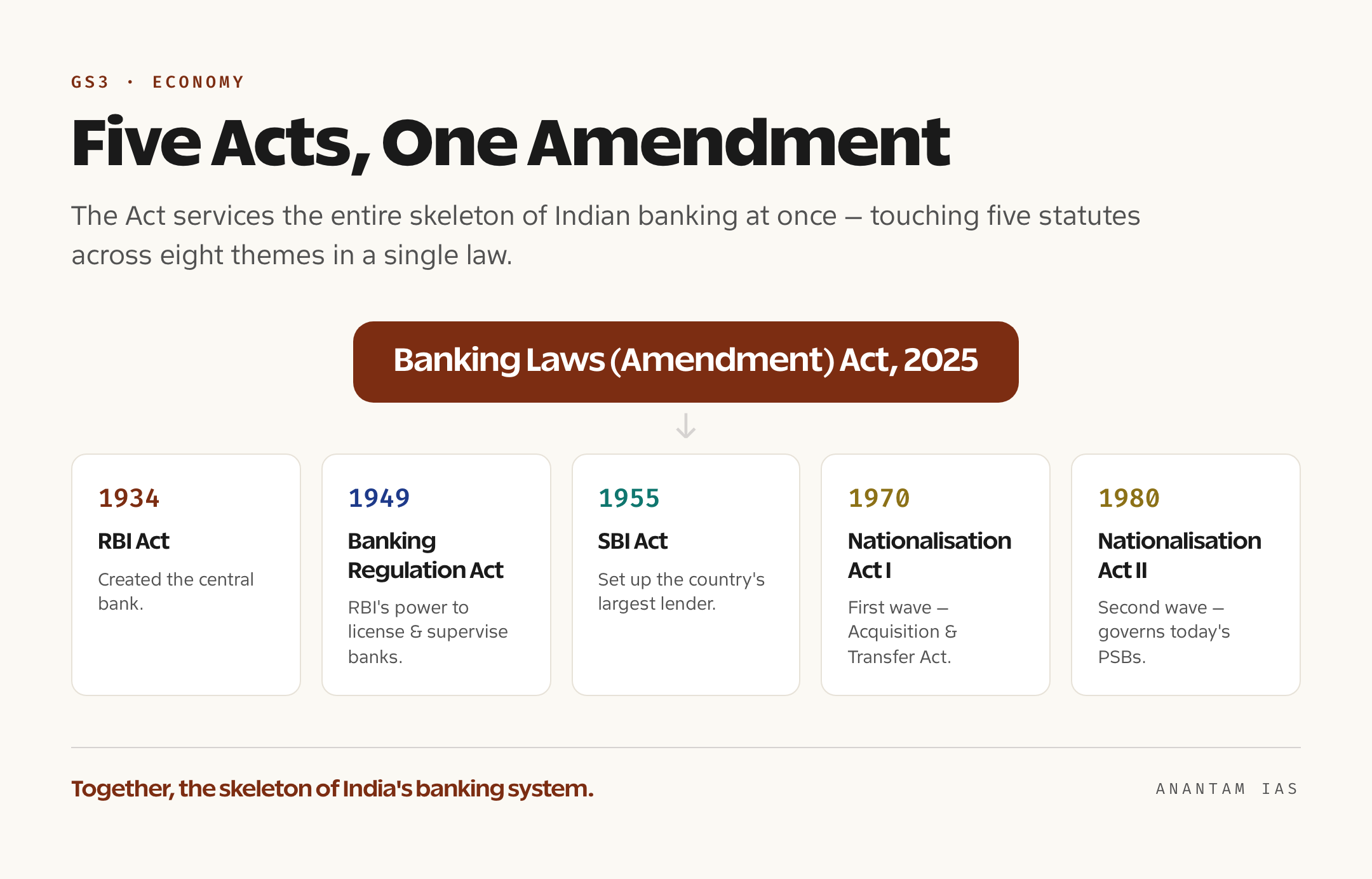
To see why a single Act had to touch five statutes, you have to understand how layered Indian banking law actually is. The Reserve Bank of India Act, 1934 created the central bank. The Banking Regulation Act, 1949 gave the RBI its powers to license and supervise banks. The State Bank of India Act, 1955 set up the country’s largest lender. And the two Banking Companies (Acquisition and Transfer of Undertakings) Acts — one from 1970, one from 1980 — are the laws that nationalised the big private banks in two waves and still govern today’s public sector banks. Together they form the skeleton of the system. The trouble is that the skeleton was set decades ago and parts of it had stopped matching the body.
Take the rule on “substantial interest.” Under the Banking Regulation Act, a person was deemed to have a substantial interest in a company — which matters for deciding who can sit on a bank board without a conflict — if they held shares worth more than five lakh rupees, or ten per cent of the company’s paid-up capital, whichever was less. That five-lakh figure was set in 1968. Six decades of inflation later, five lakh rupees is a rounding error in corporate India, so the threshold had quietly become meaningless. The same staleness ran through other corners of the law: banks were still required to report their statutory positions to the RBI on the “second and fourth Friday” of a month, an awkward calendar that no longer matched how anyone keeps accounts.
So the government’s logic was not to overhaul the system but to service it — to update numbers, harmonise dates, and close the gaps that had opened between the law and modern banking practice. As the Finance Minister’s office put it when the Bill was moved, this was a single law touching five Acts across eight different themes, designed to deliver the promise made in the Budget speech. The fix was deliberately incremental. Whether incremental was enough is a fair question, and we will come back to it.
What the Act Actually Changes
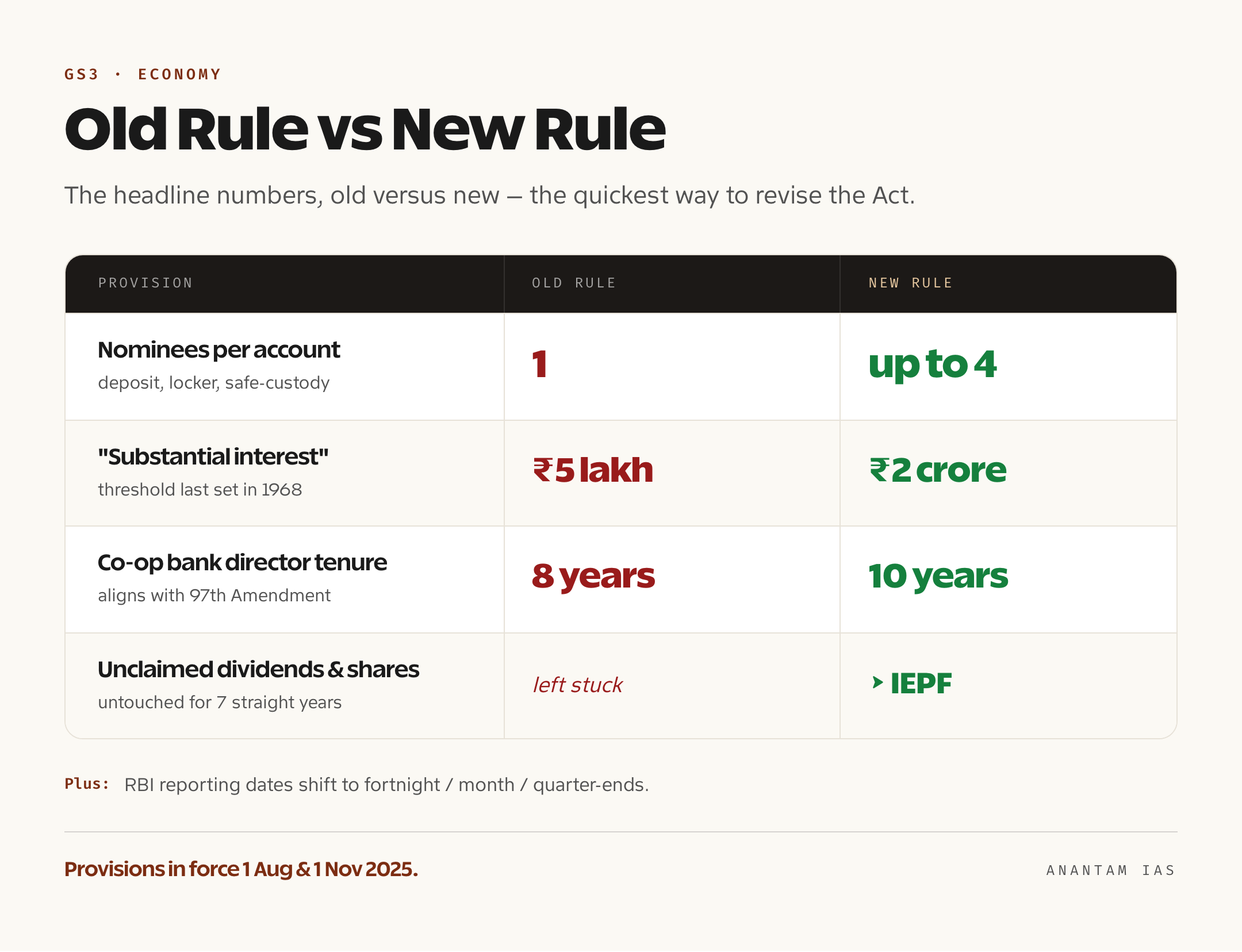
Start with the change that matters most to ordinary depositors. Until now, you could name only one nominee on a bank account, fixed deposit, safe-custody article or locker. The Act lets you name up to four — and it gives you two ways to do it. The first is simultaneous nomination: you list up to four people and assign each a percentage share that must add up to a hundred, so the bank knows exactly how to split the money the moment it is claimed. The second is successive nomination: you list up to four people in order of priority, and the second one becomes the nominee only if the first has died, the third only if the second has died, and so on. Lockers and safe-custody items only allow the successive route, because you cannot physically split a single locker among four people. These nomination rules came into force on 1 November 2025.
Why does a nominee count matter so much? Because of the unclaimed-money problem. When a depositor dies with a single nominee who has also died, or with no valid nominee at all, the money gets stuck. Deposits that stay unclaimed for ten years are moved to the RBI’s Depositor Education and Awareness (DEA) Fund, and the pile has grown into the tens of thousands of crores. During the parliamentary debate, the scale of unclaimed funds across the financial system was put at well over a lakh crore rupees. Four nominees, and a clear share for each, is meant to stop new money from ever joining that pile.
Next come the governance changes. The Act lifts the “substantial interest” threshold from that stale five lakh rupees all the way to two crore rupees, and lets the government revise it later by simple notification rather than fresh legislation — so it will not freeze for another sixty years. For cooperative banks, the maximum tenure of a director (other than the chairman or a whole-time director) goes up from eight years to ten years. That is not random: it aligns the banking law with the 97th Constitutional Amendment of 2011, which had already set a cooperative-society director’s term at five years renewable, and the change is meant to let cooperative banks retain experienced people. In the same spirit, the Act now allows a director of a central cooperative bank to also sit on the board of a state cooperative bank, removing an old restriction that kept talented cooperative-sector people boxed in.
Then there is the compliance and housekeeping bucket. Banks no longer have to report to the RBI on the second and fourth Friday; the statutory reporting dates shift to the end of each fortnight, month or quarter, which is how banks already close their books. Public sector banks get to decide the remuneration of their own statutory auditors instead of waiting on the RBI and the government — a small step towards operational autonomy. And the Act widens the funnel into the Investor Education and Protection Fund (IEPF): unpaid or unclaimed dividends, and the shares attached to them, plus unpaid interest or redemption amounts on bonds left untouched for seven straight years, can now be transferred to the IEPF, with a clear route for the rightful owner to claim them back later. The first batch of these governance and compliance provisions took effect on 1 August 2025, with the nomination rules following on 1 November 2025.
Why It Matters for India
So why should an Economy aspirant care about a law that mostly tweaks numbers? Because each tweak maps onto a real fault line in Indian banking, and the four together tell you how the state is thinking about the sector.
The first is depositor protection, and this is where the Act earns its keep. Indian banking has a trust problem at the edges — the unclaimed-deposit pile, the slow and document-heavy process of claiming a dead relative’s account, the locker disputes that drag on for years. Letting a depositor name up to four nominees with fixed shares is a small, cheap, high-leverage fix: it pre-decides who gets what, so families are not left fighting the bank and each other after a death. Combined with the cleaner IEPF route for unclaimed shares and bonds, the message is that money parked with the formal financial system should reach its owner, not vanish into a fund.
The second is governance, which runs straight through the Act. Resetting “substantial interest” to two crore rupees makes the conflict-of-interest test mean something again, so that genuinely interested parties are screened from bank boards while small shareholders are not needlessly caught. Letting public sector banks set their own auditors’ pay nudges them towards the autonomy that the long-running reform conversation — from the P. J. Nayak Committee onwards — has been demanding. These are not dramatic moves, but governance reform rarely is; it is the accumulation of small rules that decides whether a board behaves.
The third is ease of compliance, which connects to the wider “ease of doing business” push. Aligning RBI reporting to fortnight, month and quarter ends, and giving the government a notification-based power to update thresholds, means the law can keep pace with practice instead of waiting years for Parliament. Less time spent reconciling odd reporting calendars is, in the end, time and cost that a bank can redirect to lending.
The fourth is cooperative-bank governance, the most politically sensitive piece. Cooperative banks sit at a federal seam — they are creatures of state cooperative law but regulated for banking by the RBI — and they have been the site of India’s ugliest small-bank failures, the 2019 PMC Bank collapse being the textbook example. Extending director tenure to ten years and letting central-bank directors serve on state-bank boards is pitched as retaining experience and aligning with the 97th Amendment. Critics, including MPs during the debate, read the same change the other way: longer tenures can entrench the very insiders whose grip on weak cooperative banks caused the trouble in the first place, especially when the RBI is already levying hundreds of penalties on the sector every year. Both readings are worth carrying into an answer.
What the Act Leaves Untouched
A balanced view has to state the limits, and here the honest verdict is that this is a servicing job, not a structural one. The Act modernises the plumbing; it does not redesign the house. Three big questions it pointedly does not answer are worth knowing.
It does not touch deposit insurance. The amount the Deposit Insurance and Credit Guarantee Corporation guarantees per depositor per bank stayed at five lakh rupees — the figure raised in 2020 — and many argue that real depositor protection means lifting that cover, not just adding nominees. It does not advance public sector bank privatisation or consolidation, the structural reform that successive Budgets have hinted at; the two Bank Nationalisation Acts of 1970 and 1980 are amended only at the edges, not repealed. And it does not fundamentally change cooperative-bank supervision, despite a string of failures — the dual control between state registrars and the RBI survives largely intact.
There are sharper criticisms too. Capping nominees at four struck some MPs as arbitrary — why not more? — and consumer-protection voices noted that adding nominees does little for the families already stuck trying to reclaim old unclaimed deposits, where the real friction is process, not nominee count. On the cooperative side, the entrenchment worry is genuine given the sector’s record. None of this makes the Act bad law; it makes it a first, modest step. For an aspirant, that is the sophisticated line to land: a useful, overdue tidy-up of the rulebook that buys depositor convenience and a little governance hygiene, while the harder reforms — insurance cover, ownership structure, cooperative supervision — are left for another day.
For Your Mains Answer
This Act sits squarely in GS Paper 3, under “Indian Economy — mobilisation of resources, banking, and growth,” and it doubles as ready material for any question on banking-sector reforms, financial inclusion, or governance of institutions. The smart framing is to treat it as a case study in incremental modernisation — a law that improves depositor protection and governance at the margins while leaving structural reform untouched — because that lets you show both knowledge and judgement.
How to Build the Answer
Open with what the Act does in one line — amends five banking statutes to strengthen depositor protection, governance and compliance — and resist the urge to dump the legislative dates in the first sentence. Then organise the body around the government’s own three or four objectives (depositor protection, governance, ease of compliance, cooperative-bank governance), giving each one a concrete provision as proof: nominees up to four for protection, the two-crore threshold for governance, the reporting-date harmonisation for compliance. Close with the balance — name what the Act leaves out (deposit insurance, privatisation, cooperative supervision) so the examiner sees you can weigh a reform, not just describe it.
Common Mistakes to Avoid
Don’t list all seven provisions as flat bullet points with no argument tying them together — group them under objectives. Don’t confuse the dates: the Bill was introduced in 2024 and the Act came in 2025, with provisions phased in from 1 August and 1 November 2025. Don’t overstate the Act as a “landmark” or “transformative” reform; it is incremental, and saying so signals maturity. And don’t forget the cooperative-bank angle, which is where the genuine debate lives.
A Compact Answer Spine
Five statutes amended in one Act → depositor protection (up to four nominees, simultaneous or successive; cleaner IEPF route for unclaimed funds) → governance (substantial interest reset 5 lakh to 2 crore; PSB auditor autonomy) → ease of compliance (RBI reporting shifted to fortnight/month/quarter ends; notification-based threshold updates) → cooperative-bank governance (director tenure 8 to 10 years, aligned with the 97th Amendment) → limits (deposit insurance unchanged at 5 lakh, no privatisation, dual control survives) → verdict: an overdue tidy-up, not a structural overhaul.
Diagram or Flowchart Idea
Draw a simple hub-and-spoke: a central box labelled “Banking Laws (Amendment) Act, 2025” with five spokes out to the five statutes (RBI Act 1934, BR Act 1949, SBI Act 1955, Nationalisation Acts 1970 and 1980), and a second row of four boxes for the objectives — depositor protection, governance, compliance, cooperative banks. It shows scope and intent in one glance and is quick to sketch.
A Balanced-Conclusion Line
“The Act is a welcome servicing of India’s banking rulebook — better depositor convenience and a little governance hygiene — but the harder reforms of deposit-insurance cover, bank ownership and cooperative supervision still await their own legislation.”
How to Use Data Without Cramming
Two or three precise anchors beat a paragraph of figures. Use “nominees up from one to four,” “substantial interest reset from five lakh (1968) to two crore,” and “deposit insurance unchanged at five lakh.” Add one date — provisions phased in from 1 August and 1 November 2025 — and you have shown currency without turning the answer into a ledger.
FAQ
How many nominees can I now add to a bank account? Up to four. The Banking Laws (Amendment) Act, 2025 lets you name up to four nominees on a deposit, locker or safe-custody article, either simultaneously — with a fixed percentage share for each that totals a hundred — or successively, where the next nominee becomes operative only if the previous one has died. The nomination provisions came into effect on 1 November 2025.
Which laws does the Banking Laws (Amendment) Act, 2025 amend? Five. It amends the Reserve Bank of India Act, 1934; the Banking Regulation Act, 1949; the State Bank of India Act, 1955; and the two Banking Companies (Acquisition and Transfer of Undertakings) Acts of 1970 and 1980, which govern the public sector banks. Touching five statutes in one Bill is what makes this law unusual.
What changed about cooperative banks? Two things. The maximum tenure of a director — other than the chairman or a whole-time director — rises from eight years to ten, to align with the 97th Constitutional Amendment and retain experienced people. And a director of a central cooperative bank can now also serve on the board of a state cooperative bank, a restriction the old law had blocked.
Does the Act raise the deposit insurance limit? No. The amount insured by the Deposit Insurance and Credit Guarantee Corporation stays at five lakh rupees per depositor per bank, the level set in 2020. The Act focuses on nominee flexibility and unclaimed-fund handling rather than expanding insurance cover, which is one of its main criticisms.
Practice Questions
Prelims MCQs
- With reference to the Banking Laws (Amendment) Act, 2025, consider the following statements about nominees. Which is/are correct?
(a) An account holder can now name up to four nominees
(b) Simultaneous nomination requires the shares of all nominees to total 100 per cent
(c) Lockers can have only successive, not simultaneous, nomination
(d) All of the above.
Answer: (d) All three statements correctly describe the new nomination regime, with lockers limited to successive nomination since a single locker cannot be split. - The Banking Laws (Amendment) Act, 2025 amends how many statutes?
(a) Three
(b) Four
(c) Five
(d) Six.
Answer: (c) It amends five — the RBI Act 1934, Banking Regulation Act 1949, SBI Act 1955, and the two Bank Nationalisation Acts of 1970 and 1980. - The Act revised the threshold for “substantial interest” under the Banking Regulation Act. The change was from:
(a) ₹1 lakh to ₹1 crore
(b) ₹5 lakh to ₹2 crore
(c) ₹5 lakh to ₹5 crore
(d) ₹10 lakh to ₹2 crore.
Answer: (b) The threshold, last set in 1968 at five lakh rupees, was raised to two crore rupees, with future revisions allowed by notification. - Regarding cooperative banks, the Act:
(a) raised the maximum tenure of a director (other than chairman/whole-time director) from 8 to 10 years
(b) aligned the change with the 97th Constitutional Amendment
(c) allowed a central cooperative bank director to serve on a state cooperative bank board
(d) all of the above.
Answer: (d) All three are provisions of the Act relating to cooperative-bank governance. - Which of the following did the Banking Laws (Amendment) Act, 2025 NOT change?
(a) The number of nominees permitted on a deposit
(b) The statutory reporting dates banks file with the RBI
(c) The deposit insurance limit guaranteed by the DICGC
(d) The remuneration of statutory auditors of public sector banks.
Answer: (c) The DICGC cover stayed at five lakh rupees per depositor per bank; the Act did not touch deposit insurance.
Mains Practice Questions
- The Banking Laws (Amendment) Act, 2025 has been described as “incremental modernisation rather than structural reform.” Critically examine this characterisation with reference to its key provisions. (15 marks, 250 words)
- “Depositor protection in India remains a work in progress.” In light of the nominee and unclaimed-funds provisions of the Banking Laws (Amendment) Act, 2025, discuss the strengths and gaps in India’s framework for protecting bank depositors. (15 marks, 250 words)
- Examine how the Banking Laws (Amendment) Act, 2025 seeks to improve governance in the banking sector. Do the changes to “substantial interest” and auditor remuneration go far enough? (10 marks, 150 words)
- The extension of cooperative-bank director tenure has been read both as a stability measure and as a risk of entrenchment. Discuss this tension in the context of cooperative-bank failures and the dual-control problem. (15 marks, 250 words)
- “Ease of compliance and depositor protection need not be in conflict.” Using the Banking Laws (Amendment) Act, 2025 as an example, evaluate how regulatory reform can serve banks and customers simultaneously. (10 marks, 150 words)