Belief — Meaning, Types, Formation and Role in Ethics (UPSC GS IV)
Belief defined, peripheral vs core beliefs, role of beliefs in attitude, values and behaviour, with civil-service applications. UPSC GS Paper IV.
Before there are values, before there are attitudes, before there is action — there is belief. A belief is what a person takes to be true about how the world is, how it works, and what counts as evidence. The civil servant's beliefs about citizens, about her own role, about what governance is for, quietly determine every visible decision she makes. UPSC GS-IV places belief among the foundational concepts of the ethics syllabus, alongside attitude, values and emotional intelligence.
This guide expands the compass extract on Belief into the depth a Mains answer requires.
What Is a Belief?
The compass extract gives a precise working definition.
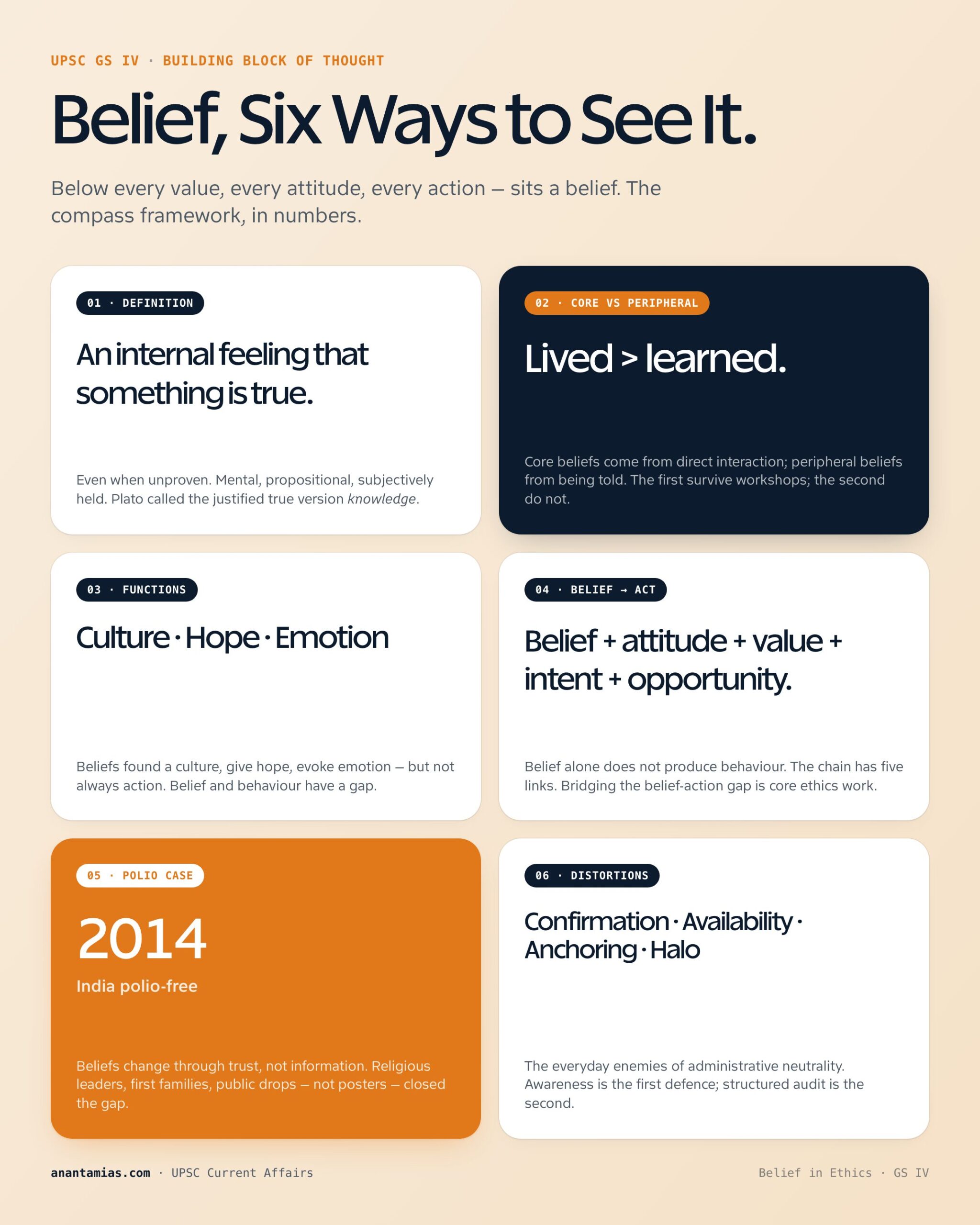
Belief is an internal feeling that something is true, even if it is unproven or irrational; things we hold to be true. Belief is the simplest form of mental representation and, therefore, the building block of our thought process.
A belief is therefore:
- Mental — it lives inside the head, not in the world.
- Propositional — it can be put as a statement: "the poor deserve respect", "corruption can be defeated", "my caste is superior to others".
- Subjectively held — the holder feels it to be true even when others reject it.
- A simpler unit than attitude — many beliefs combine to form one attitude.
Philosophers since Plato have asked: what is the difference between true belief and knowledge? Plato's answer in the Theaetetus — knowledge is justified true belief. A belief becomes knowledge only when it is true and the holder has good reasons for it. Many of our beliefs do not meet this bar — but they still operate.
What Beliefs Contain
The compass extract lists what beliefs are made of:
- Fables — moral stories passed through generations.
- Myths — origin stories that explain identity and order.
- Folklore — community wisdom and warning.
- Traditions — inherited practices.
- Superstition — beliefs without evidential basis.
- Verifiable facts — empirical knowledge.
- History — collective memory.
- Legends — partly factual, partly mythologised.
The mind does not separate these neatly. A civil servant carries scientific beliefs about disease, religious beliefs about the soul, cultural beliefs about caste — often without auditing how they fit together.
"Man is what he believes." — Anton Chekhov
Why Beliefs Matter — Three Functions
1. Beliefs Lay the Foundation of a Cultural Group
A culture is, in part, a shared system of beliefs. The reason a community coheres is that its members hold roughly similar beliefs about creation, family, gender, work, death, divinity, and moral worth. Without shared belief, social cooperation collapses.
The compass extract makes a sharp observation: Beliefs are often invisible to the group that holds them. We see foreign cultures' beliefs as beliefs; we experience our own as facts. This is belief asymmetry, and it is the root of much intercultural friction — and of administrative failure when officers from one cultural belief system govern citizens from another.
2. Beliefs Give Hope
The compass puts it directly: A human being thrives on what he/she believes in. Belief is psychologically necessary. The officer who believes the system can be reformed will work for reform. The officer who believes it cannot, will not.
"Faith is taking the first step even when you don't see the whole staircase." — Martin Luther King Jr.
3. Beliefs Evoke Emotion (But Not Necessarily Action)
This is a subtle compass point. Beliefs evoke emotions, but not necessarily actions. A person can believe corruption is wrong and still pay a bribe. Belief alone does not produce behaviour. Belief must combine with attitude, value, intention, opportunity, and self-efficacy to produce behaviour. This is the belief-action gap — and bridging it is one of the central tasks of ethical training.
Types of Belief
Peripheral vs Core (the compass distinction)
| Type | Source | Strength | Reformability |
|---|---|---|---|
| Peripheral (weak) | Indirect — heard, read, told | Low | Easily updated |
| Core (strong) | Direct interaction / experience | High | Hard to change |
The compass example is unforgiving: for patriarchs, women are weak — a core belief formed by direct lived patriarchal interaction. Such a belief survives one workshop, one law, one good female officer. It changes only through sustained exposure to evidence, peer pressure, and lived alternative experience.
Other Useful Distinctions
- Descriptive belief — about how the world is ("monsoons fail in El Niño years").
- Normative belief — about how the world ought to be ("public officials should be honest").
- Inferential belief — derived from reasoning ("if subsidy leakage is X%, direct transfer is preferable").
- Intuitive belief — held without explicit reasoning ("she seems trustworthy").
- Implicit belief — held without conscious awareness ("I would not trust a man with a beard for this job").
- Explicit belief — consciously stated.
For a civil servant, the dangerous beliefs are usually implicit and core — they shape decisions while the officer believes she is being neutral.
Belief, Attitude, Value — How They Differ
| Concept | What It Is | Specificity | Stability |
|---|---|---|---|
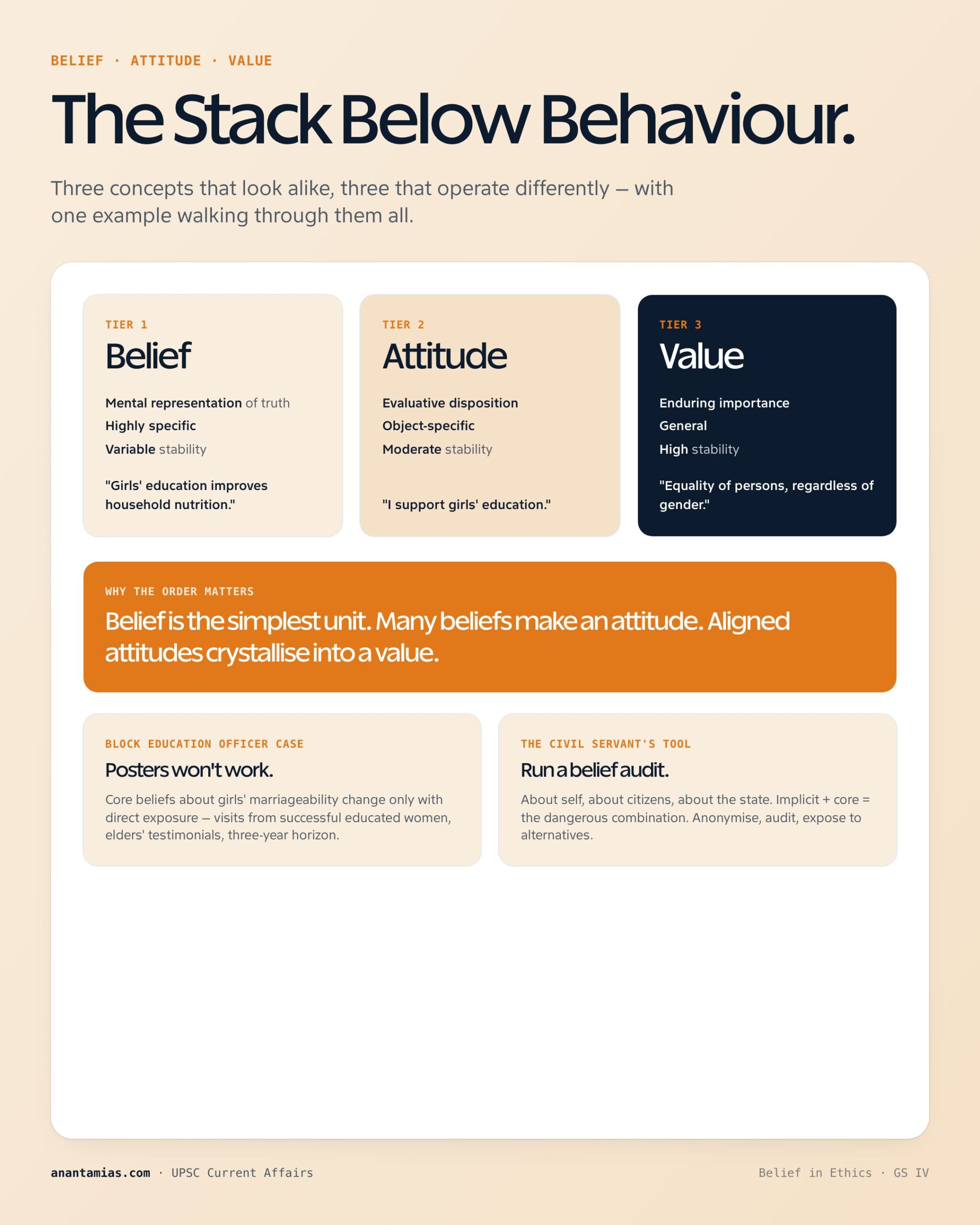
| Belief | Mental representation of truth | Highly specific | Variable |
| Attitude | Evaluative disposition toward an object | Object-specific | Moderate |
| Value | Enduring preference for what is important | General | High |
A belief is a proposition held to be true. An attitude is a disposition to act, think and feel a certain way toward something. A value is an enduring importance.
Example: Belief — "girls' education improves household nutrition." Attitude — favourable disposition toward girls' education. Value — equality of persons, regardless of gender.
Two Indian Case Studies
Case 1 — The Belief Audit of a Block Education Officer
A Block Education Officer (BEO) finds enrolment of girls dropping in three villages. She investigates and finds that the core belief in those villages is educated girls are unmarriageable. No amount of peripheral belief messaging — posters, slogans, pamphlets — will overturn it.
She organises a structured intervention:
- Direct exposure — successful educated women from neighbouring blocks visit and speak.
- Peer endorsement — village elders who have educated their daughters share outcomes.
- Material reframing — government data on increased dowry-and-marriage prospects of educated girls is publicly displayed.
- Patient time horizon — three years, not three months.
The case shows the operating principle: peripheral beliefs change through information; core beliefs change through direct lived experience.
Case 2 — Belief and the Polio Eradication Drive
The Pulse Polio campaign in north India ran into a wall of religious beliefs — that polio drops were a sterilisation conspiracy. Public-health beliefs (vaccine safety, herd immunity) collided with cultural beliefs (suspicion of state intentions). The breakthrough came when community-religious leaders were trained as ambassadors and first families in resistant communities publicly took the drops in front of their neighbours. India became polio-free in 2014. The lesson: belief change is a function of trust, not of information.
Cognitive Distortions of Belief
The civil servant should know the standard ways belief goes wrong.
- Confirmation bias — we notice evidence that supports existing belief, ignore evidence that contradicts it.
- Availability heuristic — beliefs formed from vivid recent examples ("crime is rising" because of a recent newspaper headline).
- Anchoring — first information encountered shapes later belief disproportionately.
- In-group favouritism — beliefs about own caste/community/region are more positive than warranted.
- Halo effect — one positive trait spills over to unrelated belief about the person.
These are the everyday enemies of administrative neutrality. Awareness of them is the first defence.
How Beliefs Change
The compass notes that beliefs can be challenged. Peripheral beliefs can also be changed. The literature identifies several mechanisms.
- New direct evidence that contradicts the belief.
- Trusted source providing alternative belief.
- Cognitive dissonance — the discomfort of holding contradictory beliefs forces revision.
- Identity reconstruction — joining a new community reshapes the belief set.
- Lived counter-experience — meeting one Dalit IAS officer dismantles many peripheral caste beliefs.
- Repeated exposure — the mere-exposure effect: familiarity itself shifts belief.
"It is impossible for a man to learn what he thinks he already knows." — Epictetus
Belief and the Civil Servant — Three Practical Domains
Beliefs About Self
What do I believe about my own competence, my own caste, my own gender, my own religion, in the context of office? An officer who believes she has earned her seat behaves differently from one who believes she occupies it on sufferance.
Beliefs About Citizens
Officers carry inherited beliefs about the rural, the tribal, the slum-dweller, the Muslim, the Dalit, the woman applicant. Constitutional duty requires periodic belief audit — identifying these beliefs and testing them against evidence.
Beliefs About the State
Some officers believe the state is a service-delivery instrument; others believe it is a regulator; others believe it is a patron. The operating belief shapes posture, workflow and citizen experience.
UPSC Syllabus Relevance
GS-IV names attitude — content, structure, function, its influence and relation with thought and behaviour. Belief is the foundational unit underneath this — beliefs combine into attitudes, attitudes shape behaviour.
Past-Year Prompts
- "What do you understand by 'values' and 'ethics'? In what way is it important to be ethical along with being professionally competent?" — 2013.
- "Differentiate between the following: (a) Law and Ethics (b) Ethical management and Management of ethics (c) Discrimination and Preferential treatment (d) Personal ethics and Professional ethics." — 2015.
- "Beliefs influence values; values influence attitudes and attitudes influence behaviour. Examine." — frequent paraphrased prompt in 2018, 2020.
- "Discuss the role of cultural beliefs in shaping public administration in India." — 2022.
Mains Answer-Writing Tips
- Open with belief defined, then move to belief vs attitude vs value.
- Use the peripheral / core distinction with the patriarch example.
- Quote Plato (justified true belief) for philosophical depth.
- Use the polio case as the standard Indian example.
- Close with the belief audit as a practical tool for the civil servant.
Prelims Pointers
- Plato's Theaetetus — knowledge as justified true belief.
- Leon Festinger (1957) — cognitive dissonance — the engine of belief revision.
- Daniel Kahneman, Thinking, Fast and Slow — System 1 (fast, belief-driven) vs System 2 (slow, reasoned).
- Walter Lippmann, Public Opinion (1922) — the role of belief in mass society.
FAQ
Are beliefs the same as opinions?
No. An opinion is a stated position; a belief is a deeper conviction the opinion expresses. A person may hold a belief without ever stating it as opinion.
Are beliefs always conscious?
No. Implicit beliefs operate below awareness and influence behaviour without being articulated. Implicit-association tests reveal these.
Can the state legitimately try to change citizens’ beliefs?
Yes, within constitutional limits. Public-information campaigns (Beti Bachao, Swachh Bharat, polio) explicitly aim at belief change. The constraints are: truthful information, non-coercion, respect for personal autonomy in matters of religion and conscience.
How is a core belief different from a value?
A core belief is a deeply held proposition about how the world is; a value is an enduring preference for what should be important. The two interact — a core belief that women are weak supports a value-system that does not prioritise gender equality.
Can an officer act against her own beliefs?
Yes, and often must. Constitutional duty overrides personal belief in office. An officer who personally believes a particular religious community is untrustworthy must still treat its members as constitutional equals at her counter. Where the conflict is too sharp, the ethical path is recusal, not silent prejudice.
Belief is the substrate of the ethical life. Values, attitudes, virtues and conduct all rest on the underlying beliefs the agent has absorbed and audited. A civil servant who learns to identify, examine and update her own beliefs is doing the most fundamental ethical work of her career — quietly and continuously.
Belief is the substrate of the ethical life. Values, attitudes, virtues and conduct all rest on the underlying beliefs the agent has absorbed and audited. A civil servant who learns to identify, examine and update her own beliefs is doing the most fundamental ethical work of her career — quietly and continuously.