BRICS Full Form: Brazil Russia India China South Africa
BRICS full form is Brazil, Russia, India, China, South Africa. Learn BRICS origin, summits, New Development Bank, 2024 expansion, BRICS+ countries, and economic data.
BRICS Full Form: Brazil Russia India China South Africa
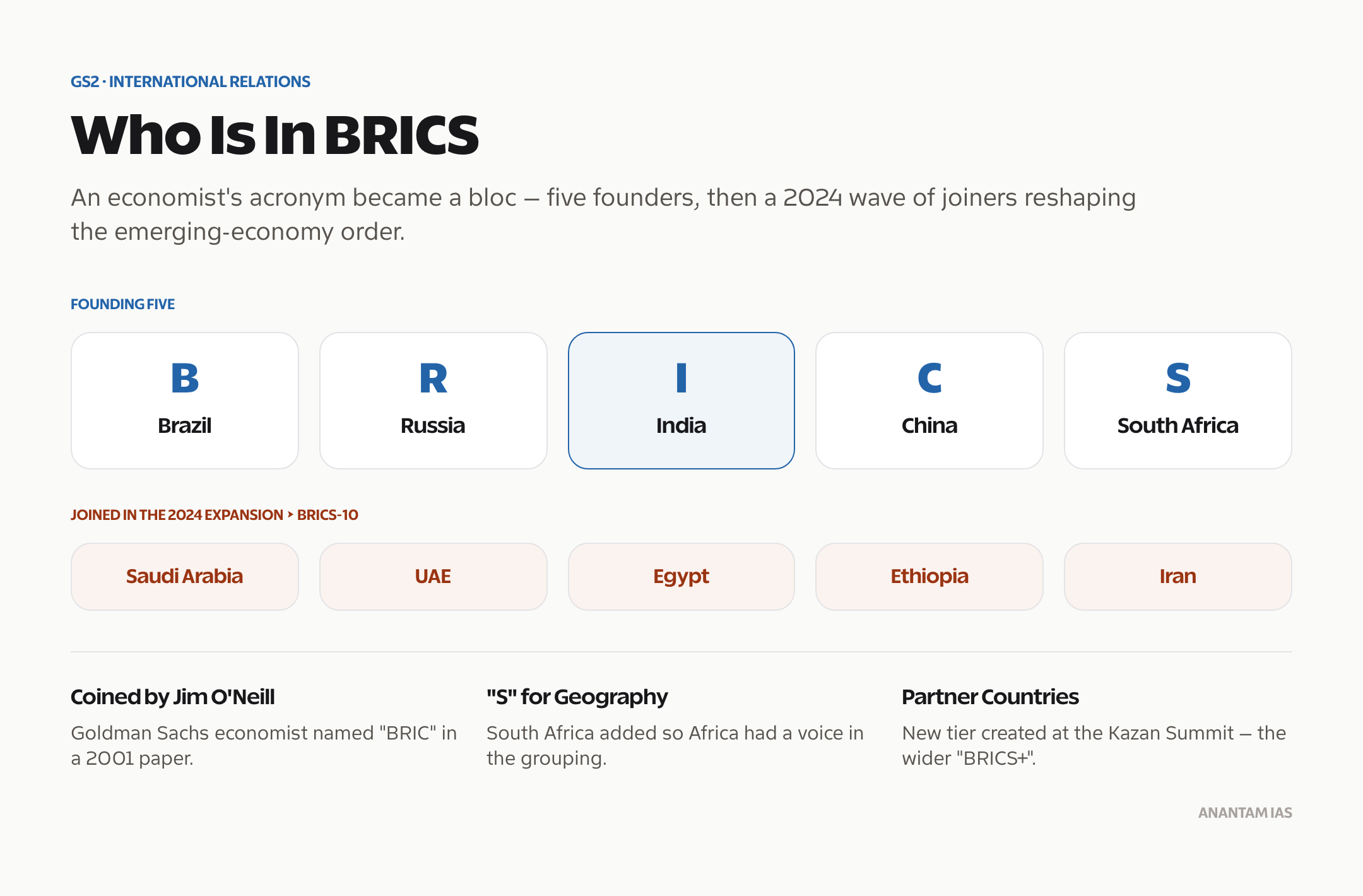
BRICS stands for Brazil, Russia, India, China, and South Africa. It’s the grouping of five — now more — major emerging economies that together represent a significant share of the world’s population, land area, and GDP.
BRICS is not a formal treaty-based alliance with legal obligations. It’s a multilateral grouping with annual summits, joint working groups, and a development bank — built around shared interest in reforming the Western-dominated global order.
BRICS Full Form and Origin
The term BRIC was coined by Jim O’Neill, a Goldman Sachs economist, in a 2001 research paper titled “Building Better Global Economic BRICs.” O’Neill argued that Brazil, Russia, India, and China would be the dominant economies of the 21st century and needed greater representation in global governance institutions.
The acronym was initially analytical — an economist’s shorthand, not a political grouping. But the governments liked it.
Timeline of BRIC becoming BRICS:
| Year | Event |
|---|---|
| 2001 | Jim O’Neill coins “BRIC” at Goldman Sachs |
| 2006 | First BRIC Foreign Ministers’ Meeting (on sidelines of UNGA) |
| 2009 | First BRIC Summit — Yekaterinburg, Russia |
| 2010 | South Africa invited; becomes BRICS |
| 2011 | South Africa participates in Sanya Summit; BRICS formally five members |
| 2023 | Johannesburg Summit — 6 new members invited |
| 2024 | Saudi Arabia, UAE, Egypt, Ethiopia, Iran join; BRICS expands to 10 |
South Africa was added not purely on economic grounds (its GDP is smaller than the others) but for geographic representation — Africa needed a voice in the grouping.
BRICS vs the G7
BRICS is often positioned as a counterweight to the G7 (USA, UK, France, Germany, Italy, Japan, Canada + EU). The framing is deliberate:
| Metric | BRICS (2024, ~10 members) | G7 |
|---|---|---|
| Share of world population | ~45% | ~10% |
| Share of world land area | ~30% | ~16% |
| Share of world GDP (PPP) | ~35%+ | ~30% |
| Share of world GDP (nominal) | ~26% | ~44% |
At PPP (purchasing power parity), BRICS economies collectively exceed the G7. At nominal exchange rates, the gap is reversed. Both framings are politically used.
BRICS Summits: Key Milestones
BRICS holds annual summits, rotating among member countries. Each summit has a theme and produces a joint declaration.
| Summit | Year | Host | Key Outcome |
|---|---|---|---|
| 1st (BRIC) | 2009 | Russia (Yekaterinburg) | Formal launch; called for multipolar world order |
| 2nd (BRIC) | 2010 | Brazil (Brasília) | Reform of IMF and World Bank quotas |
| 3rd | 2011 | China (Sanya) | South Africa joins; BRICS formally |
| 4th | 2012 | India (New Delhi) | Development Bank discussions begin |
| 5th | 2013 | South Africa (Durban) | “BRICS and Africa” — NDB concept paper |
| 6th | 2014 | Brazil (Fortaleza) | NDB and CRA agreements signed |
| 7th | 2015 | Russia (Ufa) | NDB becomes operational |
| 10th | 2018 | South Africa (Johannesburg) | BRICS Plus format launched |
| 13th | 2021 | India (Virtual) | BRICS Counter-Terrorism Action Plan |
| 15th | 2023 | South Africa (Johannesburg) | Historic expansion — 6 countries invited |
| 16th | 2024 | Russia (Kazan) | New members’ first summit; de-dollarisation discussions |
India hosted the 13th BRICS Summit in 2021 under the theme “BRICS@15: Intra-BRICS Cooperation for Continuity, Consolidation and Consensus.”
New Development Bank (NDB)
The New Development Bank is BRICS’s flagship institutional creation — a multilateral development bank designed as an alternative to the World Bank and IMF.
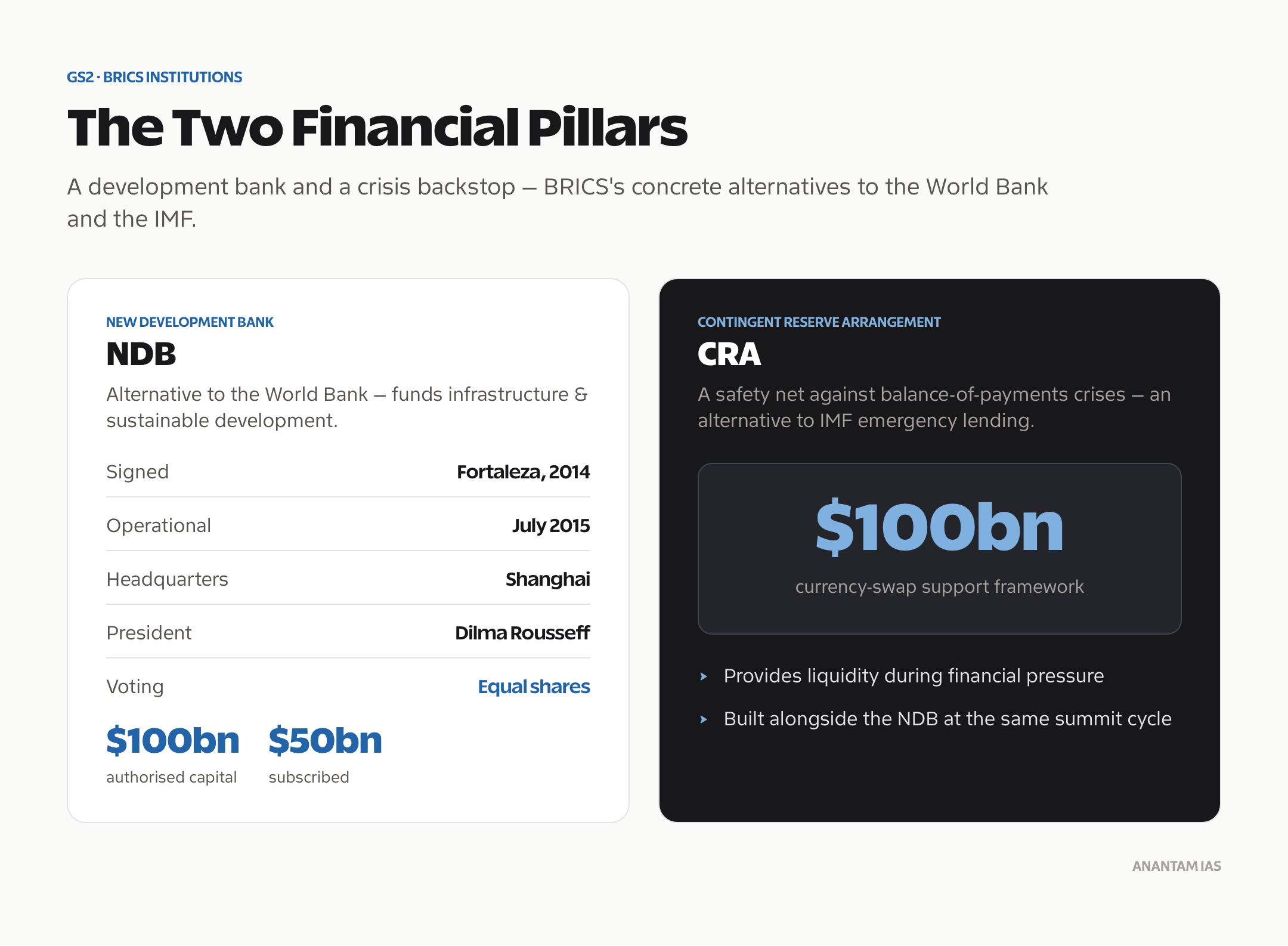
- Established: Agreement signed at 6th BRICS Summit, Fortaleza, Brazil (2014)
- Operational: July 2015
- Headquarters: Shanghai, China
- President: Dilma Rousseff (Brazil, since 2023); previously K.V. Kamath (India)
- Initial authorised capital: US$100 billion
- Subscribed capital: US$50 billion (equal contributions from founding five members)
The NDB lends primarily for infrastructure and sustainable development projects in member and non-member countries. Projects include renewable energy, transport, urban development, and water.
NDB’s Significance
The NDB represents a concrete institutional challenge to Western-dominated multilateral finance. Unlike the World Bank (where voting power is proportional to economic weight and the US has historically held disproportionate influence), NDB founding members have equal voting shares.
New members joining NDB: Bangladesh, UAE, Uruguay, Egypt, Algeria — expanding beyond BRICS.
Contingent Reserve Arrangement (CRA)
Alongside the NDB, BRICS created the Contingent Reserve Arrangement (CRA) — a $100 billion framework for mutual financial support during balance-of-payments crises.
The CRA was designed as an alternative to IMF emergency lending. However, it has rarely been used, partly because China holds the largest share (41%) and accessing CRA funds above 30% of one’s allocation requires an IMF programme — diluting the “IMF alternative” logic.
NATO Full Form: North Atlantic Treaty Organization
BRICS 2024 Expansion: The New Members
The 15th BRICS Summit in Johannesburg (August 2023) was a landmark. Six countries were invited to join as full members from 1 January 2024: Saudi Arabia, UAE, Egypt, Ethiopia, Iran, and Argentina.
Argentina subsequently declined under newly elected President Milei, who pulled out before membership activated.
The actual 2024 expansion brought in: Saudi Arabia, UAE, Egypt, Ethiopia, and Iran — making BRICS-10.
Why This Expansion Matters
| Country | Why It Matters |
|---|---|
| Saudi Arabia | World’s largest oil exporter; potential shift from petrodollar |
| UAE | Major global financial hub; gateway to Gulf capital |
| Egypt | Suez Canal control; largest Arab country by population |
| Ethiopia | Africa’s second most populous; African Union headquarters |
| Iran | Major energy reserves; symbolically anti-Western |
The Saudi Arabia inclusion was the headline. If Saudi Arabia joins BRICS and prices any oil in non-dollar currencies, it directly threatens the petrodollar system — the arrangement by which oil is globally traded in US dollars, giving the US currency its reserve status.
BRICS Partner Countries (2024)
At the Kazan Summit (2024), a new “Partner Country” category was created (below full member). Countries accepting this: Nigeria, Turkey, Malaysia, Vietnam, Algeria, Cuba, Bolivia, Indonesia, Uganda, Belarus, and others.
This makes the broader “BRICS+” grouping of 30+ countries.
BRICS and De-dollarisation
De-dollarisation — reducing dependence on the US dollar in international trade and finance — is a recurring BRICS discussion theme.
Why BRICS countries want alternatives:
- US dollar dominance lets the US impose financial sanctions unilaterally (as with Russia after 2022)
- Exchange rate volatility in dollar-denominated debt hurts emerging economies
- SWIFT exclusion (as imposed on Russia) can be economically devastating
What’s actually happening:
- Russia-China trade: Increasingly settled in rubles and yuan
- India-Russia trade: Mixed settlement in rupees, rubles, dirhams
- BRICS currency: Discussed extensively at summits; no concrete currency or settlement system agreed
A common BRICS currency is unlikely in the near term. The economic asymmetries are too large — China’s economy is roughly 2.5x the combined GDP of the other four original BRICS members. A shared currency would either be China-dominated or unviable.
More realistic near-term goals: cross-border use of national currencies, BRICS-specific payment messaging system (alternative to SWIFT), and expanded NDB lending in local currencies.
India’s Role in BRICS
India has been an active participant but maintains distinct positions from China and Russia:
- India-China tensions: Despite BRICS membership, India and China have ongoing border disputes (Galwan clash, 2020) and strategic competition. India sometimes uses BRICS platforms to raise concerns about connectivity and sovereignty.
- India’s pushback on NDB: India has been cautious about China’s dominance in NDB decision-making and Belt and Road connectivity projects.
- De-dollarisation: India is broadly supportive of reducing dollar dependence (has signed rupee trade agreements with UAE, Russia) but doesn’t support an explicit anti-US posture.
- BRICS expansion: India supported expansion in principle but raised concerns about criteria and pace — particularly about expanding to countries with poor democratic records.
India hosted the G20 Presidency in 2023 (alongside India’s BRICS participation) — a diplomatic double that India used to frame itself as a “voice of the Global South” in both Western and non-Western multilateral contexts.
BRICS Economic Data (2024)
| Country | GDP (nominal, USD tn) | Population (bn) | GDP Growth (2023) |
|---|---|---|---|
| Brazil | ~2.1 | 0.22 | 2.9% |
| Russia | ~2.2 | 0.14 | 3.6% |
| India | ~3.7 | 1.44 | 8.2% |
| China | ~18.5 | 1.41 | 5.2% |
| South Africa | ~0.4 | 0.06 | 0.6% |
China dominates BRICS economically. India is the fastest-growing major economy and is on track to overtake China as the most populous country (already has). This economic asymmetry is both BRICS’s strength (combined weight) and its tension (who leads).
UPSC Relevance
BRICS appears in UPSC Prelims and Mains (GS-II International Relations):
- Full form, founding year, headquarters of NDB
- BRICS summits India has hosted
- Significance of CRA and NDB
- BRICS expansion and its geopolitical implications
- India’s position within BRICS
- De-dollarisation debate
Frequently Asked Questions
What is the full form of BRICS?
BRICS stands for Brazil, Russia, India, China, and South Africa. The term was coined by Goldman Sachs economist Jim O’Neill in 2001 as u0022BRICu0022 (without South Africa), referring to the world’s major emerging economies.
When was BRICS formed?
The first BRIC Summit was held in 2009 in Yekaterinburg, Russia — the formal beginning of the grouping as a political forum. South Africa joined in 2010 (participating from the 2011 Sanya Summit), making it BRICS. The original BRIC acronym was coined by Jim O’Neill in 2001.
What is the New Development Bank?
The New Development Bank (NDB) is the multilateral development bank created by BRICS nations. Established under an agreement signed at the 2014 Fortaleza Summit, NDB began operations in 2015. Its headquarters are in Shanghai. Founding members (Brazil, Russia, India, China, South Africa) have equal voting shares, unlike the World Bank.
Which countries joined BRICS in 2024?
Saudi Arabia, UAE, Egypt, Ethiopia, and Iran became full members of BRICS from 1 January 2024, following the invitation at the 15th BRICS Summit (Johannesburg, 2023). Argentina was also invited but declined after a change of government.
What is the BRICS Contingent Reserve Arrangement?
The CRA is a $100 billion mutual financial support framework among BRICS nations for balance-of-payments emergencies. It was created as a potential alternative to IMF emergency lending. China contributes $41 billion, Brazil, India, and Russia $18 billion each, and South Africa $5 billion.