Central Government Health Scheme (CGHS): Cards, Eligibility, Wellness Centres and Rates
The Central Government Health Scheme covers serving employees, pensioners and their dependants through wellness centres and empanelled hospitals. Here are the card types, contribution slabs, ward entitlements and referral rules.
The Central Government Health Scheme is India’s oldest continuously running public health insurance arrangement, and it does not work like insurance at all. There is no premium quoted on a policy schedule, no claim ratio and no insurer in the middle. A serving central government employee pays a small monthly contribution deducted from salary, gets a card, and draws outpatient care, medicines and hospitalisation through a network the Ministry of Health and Family Welfare runs and pays for directly.
It began on 1 July 1954 in Delhi as the Contributory Health Service Scheme, and it now runs in around 80 cities for a beneficiary base of well over forty lakh people — serving employees, pensioners, family pensioners and their dependants. Because contributions are tied to pay level and entitlements to basic pay, almost every practical question about CGHS ends up being a question about which slab you sit in.
What CGHS Is and Who Runs It
CGHS is a central sector scheme of the Ministry of Health and Family Welfare, administered through a Director General in Delhi and Additional Directors in each covered city. Its delivery unit is the wellness centre — what older documents still call a dispensary — where a beneficiary registers, sees a medical officer, collects medicines and gets referred onward.
The scheme is unusual in Indian public health for covering six systems of medicine, not one. Alongside allopathy, CGHS runs Ayurveda, Yoga, Unani, Siddha and Homoeopathy units, and beneficiaries can register with an AYUSH centre for treatment in those systems. The network is a mix of several hundred allopathic wellness centres, a smaller set of AYUSH centres and a handful of polyclinics offering specialist consultation in one place.
Anything the wellness centre cannot do is bought in. CGHS empanels private hospitals, diagnostic centres, dental clinics and eye centres in each city, and pays them at notified CGHS rates rather than their own price lists. That empanelment machinery is the part of CGHS that most affects a beneficiary’s out-of-pocket cost, and it is the part that changes most often.
Coverage is geographic, and that is the scheme’s hardest limitation. CGHS operates only in notified cities. A central government pensioner who retires to a town without a wellness centre is not covered by the full scheme and has to fall back on a Fixed Medical Allowance or the Central Services (Medical Attendance) Rules, which is why demand to extend CGHS to more cities comes up in Parliament every session.
What the Scheme Offers
For a cardholder inside a CGHS city, the package covers most of what a household actually spends on health.
| Service | What CGHS provides |
|---|---|
| Outpatient care | Consultation at the wellness centre, and dispensing of prescribed medicines |
| Medicines | Supplied free at the wellness centre; non-available drugs procured through authorised local chemists |
| Specialist consultation | At polyclinics, government hospitals, or empanelled private hospitals on referral |
| Diagnostics | Laboratory and imaging investigations at CGHS rates through empanelled centres |
| Hospitalisation | Cashless treatment at empanelled hospitals, within ward entitlement |
| Maternity and dental | Covered as part of the package, subject to rules |
| AYUSH treatment | Ayurveda, Yoga, Unani, Siddha and Homoeopathy through dedicated units |
| Devices and appliances | Hearing aids, artificial limbs and similar items with prior approval |
The economics run on package rates. CGHS notifies a price for each procedure, and empanelled hospitals must treat cardholders at that price. Where cashless treatment is available, the hospital bills CGHS directly; where the beneficiary pays, the reimbursement is capped at the CGHS rate rather than the amount actually billed.
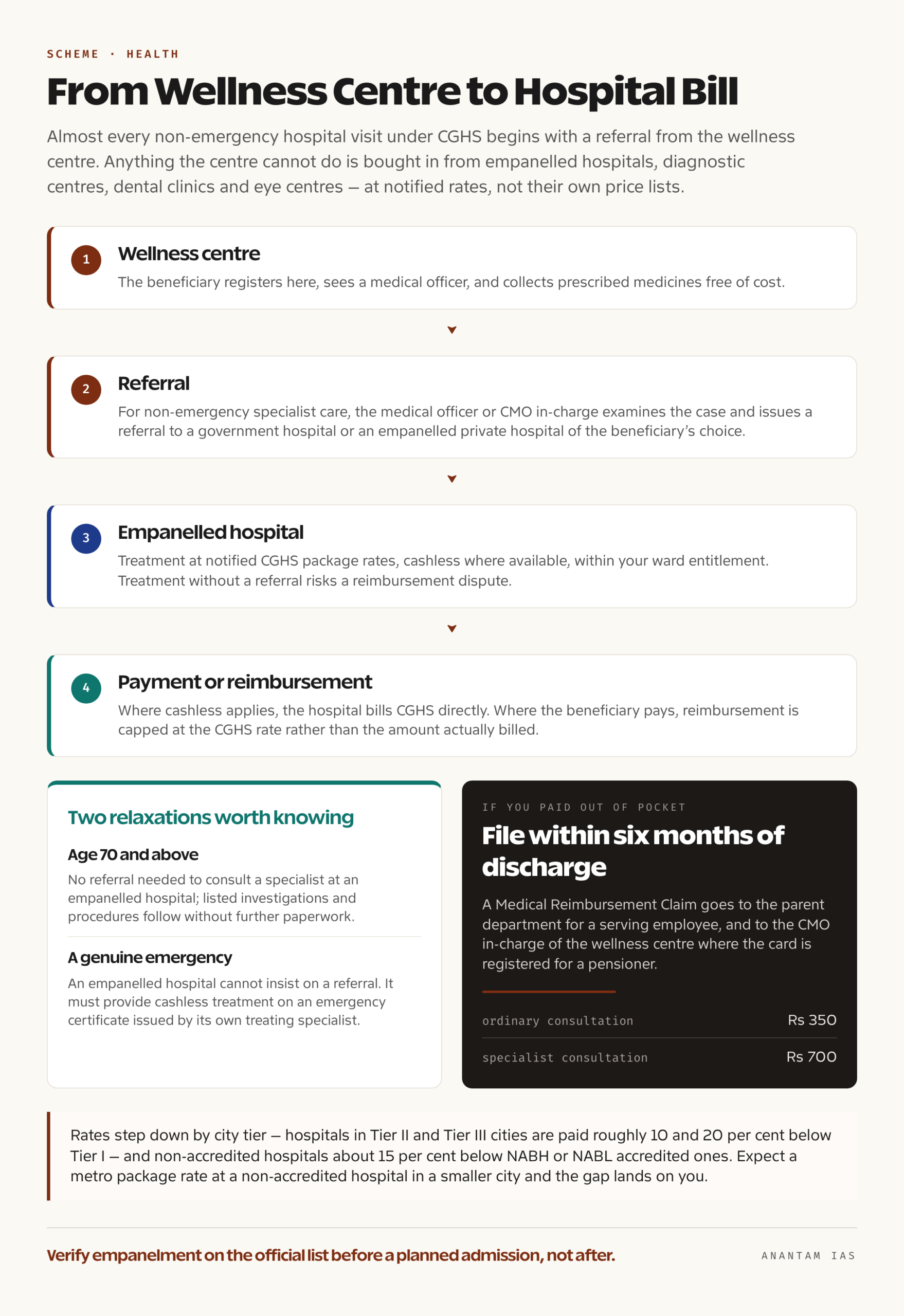
That rate structure was reworked in the revision notified in October 2025, which moved CGHS from a mostly flat national list to a tiered one covering roughly two thousand procedures. Consultation charges were standardised at Rs 350 for an ordinary outpatient or inpatient consultation and Rs 700 for a specialist consultation. Package rates are now built on a base of a semi-private room, with a downward adjustment of about 5 per cent for general-ward entitlement and an upward adjustment of about 5 per cent for private-ward entitlement. Rates also step down by city tier — hospitals in Tier II and Tier III cities are paid roughly 10 per cent and 20 per cent below Tier I — and non-accredited hospitals are paid about 15 per cent below NABH or NABL accredited ones.
Understanding that grid is the practical difference between an unexpected bill and none. If you are treated at a non-accredited hospital in a smaller city and expect the metro package rate, the gap will land on you.
Who Is Eligible and What Cards Exist
Eligibility is defined by employment and residence together. You have to belong to a covered category and live in a CGHS city.
The covered categories are wider than most people assume. They include serving central government employees paid from Central Civil Estimates, central government pensioners and family pensioners, sitting and former Members of Parliament, sitting and retired judges of the Supreme Court and High Courts, freedom fighters, employees of certain autonomous and statutory bodies extended CGHS coverage, accredited journalists in Delhi, and Delhi Police personnel. Railway, Defence and postal employees have their own parallel health arrangements and are covered there rather than under CGHS.
Dependants are where most disputes arise. The scheme’s family definition covers the spouse, dependent parents, dependent sons and daughters, and dependent siblings, subject to a residence and income test. A dependant qualifies if income from all sources — including pension and family pension — stays within a notified ceiling, which after the Seventh Pay Commission was set at Rs 9,000 per month plus the dearness relief admissible on a basic pension of Rs 9,000. A son remains eligible until he starts earning, marries, or turns 25, whichever comes first. A daughter remains eligible until she starts earning or marries, with no age ceiling.
Card types matter for pensioners in particular:
| Card type | Who it is for | What it covers |
|---|---|---|
| Serving employee card | Central government employees in CGHS cities | Full outpatient and inpatient benefits, contribution deducted from salary |
| Pensioner comprehensive card | Pensioners not drawing Fixed Medical Allowance | Full outpatient and inpatient benefits |
| Pensioner IPD-only card | Pensioners who continue to draw Fixed Medical Allowance | Cashless inpatient treatment at empanelled and designated government hospitals only |
| Electronic card | All beneficiaries | Same legal validity as the plastic card, accessible through the CGHS website, the myCGHS app or DigiLocker |
A pensioner has to choose between the Fixed Medical Allowance, which is a cash payment for outpatient expenses, and full CGHS outpatient cover. You cannot draw both.
Contribution Slabs and Ward Entitlement
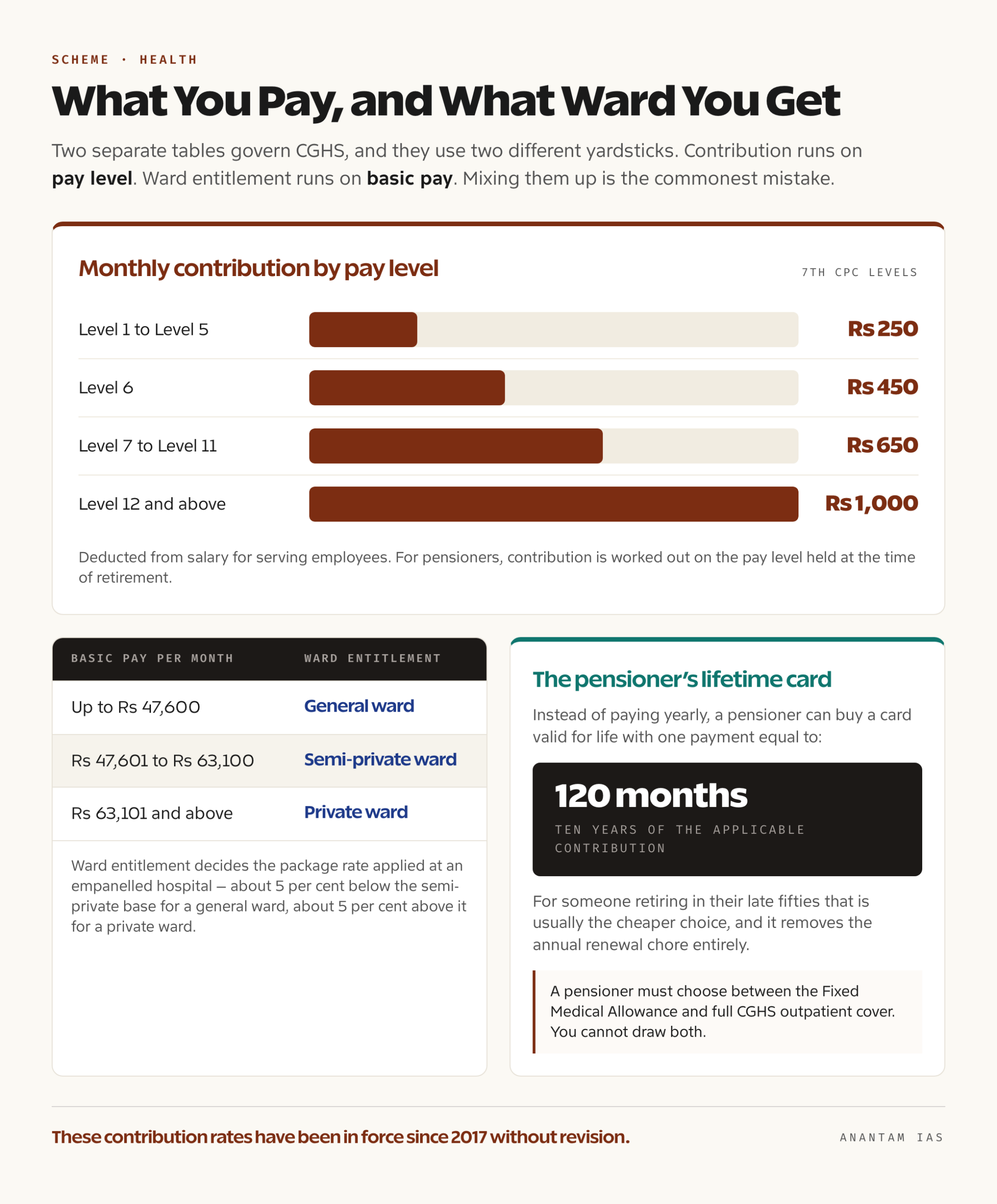
Two separate tables govern what you pay and what you get, and they use two different yardsticks. Contribution runs on pay level; ward entitlement runs on basic pay.
| Pay level (7th CPC) | Monthly CGHS contribution |
|---|---|
| Level 1 to Level 5 | Rs 250 |
| Level 6 | Rs 450 |
| Level 7 to Level 11 | Rs 650 |
| Level 12 and above | Rs 1,000 |
These rates were notified after the Seventh Pay Commission and have been in force since 2017 without revision, which means the contribution has quietly fallen in real terms for nearly a decade.
| Basic pay drawn per month | Ward entitlement in empanelled hospitals |
|---|---|
| Up to Rs 47,600 | General ward |
| Rs 47,601 to Rs 63,100 | Semi-private ward |
| Rs 63,101 and above | Private ward |
For pensioners, contribution is worked out on the pay level held at the time of retirement, and there is an option worth taking seriously: instead of paying yearly, a pensioner can buy a lifetime card by making a one-time payment equal to 120 months — ten years — of the applicable monthly contribution. For someone retiring in their late fifties, that is usually the cheaper choice, and it removes the annual renewal chore entirely.
How to Get a Card and Use the Referral System
Getting the card is a hybrid process — mostly online, with one physical submission.
- Open the CGHS portal and start a new card application. The system generates a temporary reference number for your application.
- Fill in the details — personal particulars, pay level or pension details, the wellness centre you want to be attached to, and the full list of dependants you are claiming.
- Print the completed form, sign it, and attach photographs of all family members along with proof of identity, proof of residence, proof of pay level or the pension payment order, and the dependency declaration for parents and adult children.
- Submit it — a serving employee submits through the department’s administrative wing, a pensioner to the Additional Director of the CGHS city.
- Pay the contribution. Serving employees have it deducted from salary; pensioners pay yearly or make the one-time lifetime payment.
- Collect the card, and download the electronic version through the CGHS website, the myCGHS app or DigiLocker. The electronic card has the same validity as the plastic one, and carrying it on a phone is enough.
Using the card follows a referral chain. For non-emergency specialist care, a beneficiary first goes to the wellness centre, where the medical officer or CMO in-charge examines the case and issues a referral to a government hospital or an empanelled private hospital of the beneficiary’s choice. Treatment at an empanelled hospital without that referral risks a reimbursement dispute.
There are two important relaxations. Beneficiaries aged 70 and above do not need a referral to consult a specialist at an empanelled hospital, and listed investigations and procedures follow without further paperwork. And in a genuine emergency, an empanelled hospital cannot insist on a referral at all — it must provide cashless treatment on the strength of an emergency certificate issued by its own treating specialist.
Where treatment happens in a non-empanelled hospital in an emergency, or where the beneficiary has paid out of pocket, a Medical Reimbursement Claim has to be filed within six months of discharge — by a serving employee to the parent department, by a pensioner to the CMO in-charge of the wellness centre where the card is registered.
Where CGHS Stands and What to Watch
The contribution has not moved since 2017. Medical cost inflation has run well ahead of it, so the gap between what beneficiaries pay in and what the scheme spends has widened. Any future revision — and pay commission cycles are the usual trigger — will be politically sensitive precisely because the current rates feel like a settled entitlement.
Empanelment churn is the everyday problem. Hospitals periodically exit the panel over rate disputes or delayed payments, and a beneficiary who checked the list a year ago can arrive at a hospital that no longer accepts the card. Verify empanelment on the official list before a planned admission, not after.
Geography still decides access. A pensioner in a CGHS city and one in a district town with the same service record get very different health cover. Extending the scheme to more cities has been announced repeatedly and delivered slowly, because a new wellness centre requires premises, sanctioned posts for doctors, pharmacists and nurses, and a minimum beneficiary density to justify it.
The 2025 rate revision cuts both ways. Tiering rates by city and accreditation is a more honest reflection of cost, and hospitals broadly welcomed the increase after years of stagnant rates. It also means a beneficiary’s effective cover now varies by where they are treated, which is a new thing to check.
Convergence with Ayushman Bharat. With PM-JAY and the Ayushman Vay Vandana cover for those above 70 now operating alongside CGHS, there is a live policy question about whether India needs several parallel publicly funded health packages with different rate schedules and different empanelled networks. Discussions of universal health coverage increasingly turn on exactly this fragmentation.
FAQ
Who is eligible for a CGHS card? Serving central government employees paid from Central Civil Estimates, central government pensioners and family pensioners, sitting and former MPs, sitting and retired judges of the Supreme Court and High Courts, freedom fighters, employees of certain autonomous bodies, accredited journalists in Delhi and Delhi Police personnel — provided they reside in a city where CGHS operates.
How much is the CGHS monthly contribution? Rs 250 for pay levels 1 to 5, Rs 450 for level 6, Rs 650 for levels 7 to 11, and Rs 1,000 for level 12 and above. These rates have been unchanged since 2017.
Can a pensioner get a CGHS card for life? Yes. A pensioner can pay a one-time amount equal to 120 months of the applicable monthly contribution and receive a card valid for life, instead of renewing it annually.
Do I need a referral to go to an empanelled hospital? For non-emergency specialist treatment, yes — the medical officer or CMO in-charge at your wellness centre issues it. Beneficiaries aged 70 and above are exempt, and in an emergency an empanelled hospital must treat you cashless on an emergency certificate without asking for a referral.
What are CGHS rates and why do they matter? CGHS notifies a package price for each procedure that empanelled hospitals must charge cardholders. Reimbursement is capped at that rate. Since the October 2025 revision, rates vary by city tier, by hospital accreditation and by ward entitlement, so the same procedure can carry different approved prices in different places.
Practice Questions
Prelims MCQs
- The Central Government Health Scheme functions under which ministry? (a) Ministry of Personnel, Public Grievances and Pensions (b) Ministry of Health and Family Welfare (c) Ministry of Labour and Employment (d) Ministry of Finance Answer: (b) CGHS is a central sector scheme of the Ministry of Health and Family Welfare.
- In which year was the Central Government Health Scheme started? (a) 1948 (b) 1954 (c) 1962 (d) 1971 Answer: (b) It began on 1 July 1954 in Delhi as the Contributory Health Service Scheme.
- The monthly CGHS contribution for an employee in Pay Level 12 and above is: (a) Rs 250 (b) Rs 450 (c) Rs 650 (d) Rs 1,000 Answer: (d) Level 12 and above pay Rs 1,000 a month; levels 7 to 11 pay Rs 650.
- Which of the following systems of medicine are covered under CGHS? (a) Allopathy only (b) Allopathy and Homoeopathy only (c) Allopathy, Ayurveda, Yoga, Unani, Siddha and Homoeopathy (d) Ayurveda and Siddha only Answer: (c) CGHS runs dedicated units across all six systems.
- Under CGHS rules, a pensioner can obtain a card valid for life by paying: (a) 60 months of contribution in one instalment (b) 84 months of contribution in one instalment (c) 120 months of contribution in one instalment (d) a flat fee unrelated to pay level Answer: (c) A one-time payment equal to ten years of the applicable monthly contribution buys a lifetime card.
Mains Practice Questions
- CGHS, PM-JAY and employer-specific health schemes together create a fragmented publicly funded health financing landscape. Examine the case for consolidation. (15 marks, 250 words)
- “CGHS is an occupational entitlement, not a public health programme.” Critically evaluate this characterisation with reference to its coverage and financing design. (15 marks, 250 words)
- Discuss how the geographic restriction of CGHS to notified cities affects equity among central government pensioners, and suggest workable alternatives. (10 marks, 150 words)
- Administered price schedules such as CGHS package rates are used to contain public spending on privately delivered care. Analyse their effectiveness and their unintended consequences. (15 marks, 250 words)
- Contributions under CGHS have remained unchanged for close to a decade while medical costs have risen sharply. Assess the fiscal sustainability of contributory health schemes for government employees. (15 marks, 250 words)