The Circular Economy: Designing Out Waste (UPSC Economy & Environment)
A linear take-make-dispose economy throws away value at every step. The circular economy designs out waste, keeps products and materials in use, and regenerates natural systems. Here is the full picture — the butterfly diagram, the 9R strategies, the new business models, and India's EPR-led policy push — explained for UPSC GS3.
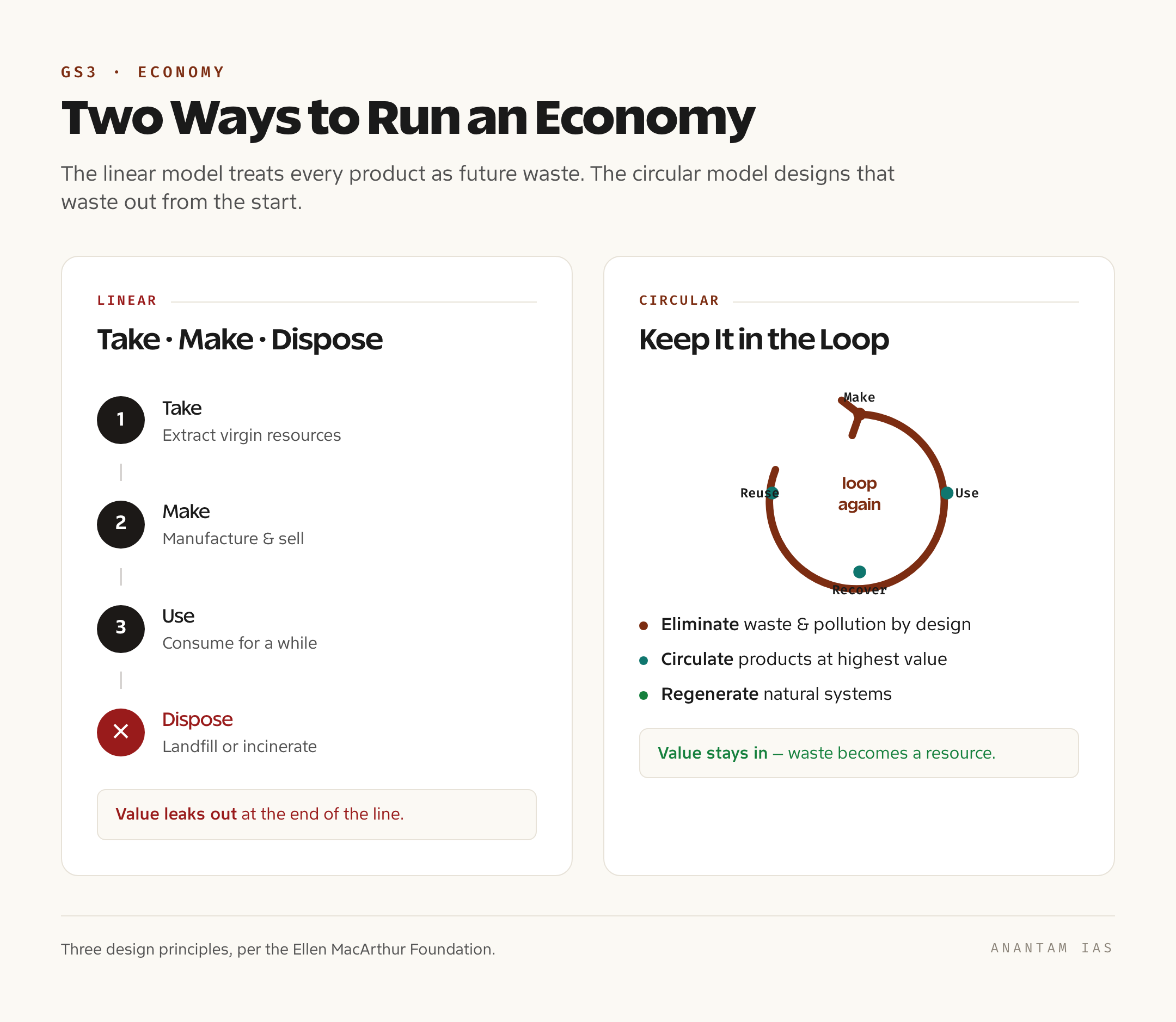
For most of the industrial age, the economy has run on a straight line. We dig up raw materials, turn them into products, use those products for a while, and then throw them away. Take, make, dispose — three steps, and at the end of the line sits a landfill or an incinerator. It is a model so familiar that we rarely notice how strange it is: we spend enormous energy mining metals, refining plastics and felling forests, and then we treat the finished product as garbage the moment it stops being useful. The waste is not an accident of the system. It is built into the design.
The circular economy is the attempt to bend that straight line into a loop. Instead of asking how to dispose of waste more cleanly, it asks a sharper question — how do we design so that there is no waste in the first place? Keep products and materials circulating at their highest value for as long as possible, and let what cannot be reused return safely to the soil. For an aspirant, this is not a fringe green idea. It sits at the heart of GS3 — resource security, pollution, climate, employment and the new industrial policy — and India has quietly built one of the world’s busiest circular-economy policy stacks around it, from producer-responsibility rules to a vehicle scrappage programme. The candidate who can explain the concept cleanly, name its strategies, and map them onto Indian schemes is holding a topic that pays off across the environment and economy papers alike.
What the Circular Economy Actually Means
Start with the contrast, because the whole idea is defined against what it replaces. The linear economy is “take-make-dispose”: extract a resource, manufacture a product, consume it, discard it. Value flows in one direction and leaks out at the end. The circular economy closes that loop. It is a model of production and consumption that, as the Ellen MacArthur Foundation — the organisation that did most to popularise the concept — puts it, rests on three principles, all driven by design. First, eliminate waste and pollution. Second, keep products and materials in use, circulating at their highest possible value. Third, regenerate nature, so that the system actively rebuilds the natural capital it draws on rather than depleting it.
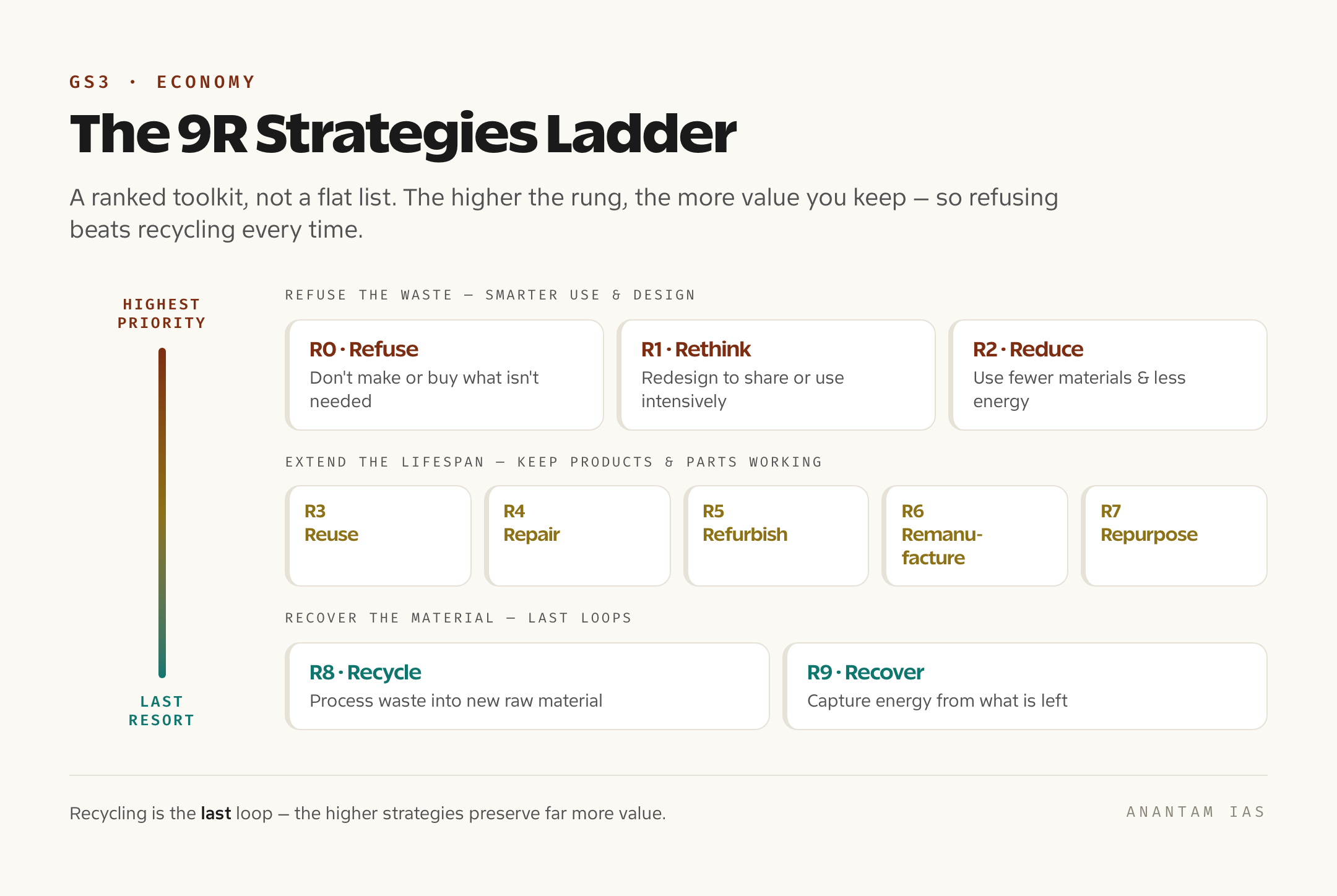
The phrase “highest possible value” is doing quiet but heavy work, and it is worth slowing down on. There is a hierarchy of how you keep a thing in use. Reusing a working appliance preserves all the value, labour and energy locked inside it. Recycling it for raw material recovers only the metal and plastic, throwing away the manufacturing effort. Both are circular, but the first is far better. So the circular economy is not a synonym for recycling — that is the common confusion, and getting it wrong in an answer is a giveaway. Recycling is the last loop, the safety net you reach for only when keeping the product whole is no longer possible.
The Foundation captures the full picture in what it calls the butterfly diagram, a visual that has become the field’s standard reference and is well worth carrying into your mental notes. It splits all materials into two cycles, drawn as the two wings of a butterfly. On the right sits the technical cycle: products and materials that do not biodegrade — metals, plastics, electronics — kept in circulation through tightening inner loops of maintenance and reuse, then repair, then refurbishment and remanufacturing, and only at the outermost loop, recycling. On the left sits the biological cycle: materials that can safely re-enter the living world, like food, timber and cotton, which after use are composted or returned to the soil through processes like anaerobic digestion, regenerating the nutrients that grew them. Designing a product means deciding, up front, which wing it belongs to and making sure it can actually complete the loop. That single discipline — design for the cycle — is what separates a genuinely circular product from a recyclable afterthought.
The R-Strategies and the New Business Models
If the three principles are the philosophy, the R-strategies are the toolkit, and they are the most exam-friendly part of the topic because they form a clean, rankable list. The widely used version is the 9R framework, set out by researchers and now standard in circular-economy literature. Read top to bottom, the strategies move from the smartest, lowest-impact options to the last resorts: Refuse (don’t make or buy what you don’t need), Rethink (redesign so a product is shared or used more intensively), Reduce (use fewer materials and less energy), then Reuse, Repair, Refurbish, Remanufacture and Repurpose (the middle loops that keep a product or its parts working), and finally Recycle (recover the material) and Recover (extract energy from what is left, usually by incineration). The order is the message. The strategies near the top eliminate waste before it is created; the ones near the bottom merely manage it once it exists. A higher R is almost always better than a lower one — refusing a single-use item beats recycling it every time.
This ladder only works if business models change to support it, and here the circular economy stops being abstract and starts touching company balance sheets. A handful of models recur. The sharing model raises how intensively each product is used — one car or one drill serving many users instead of sitting idle — so fewer need to be made at all. Product-as-a-service flips ownership on its head: the customer pays for the outcome, not the object, leasing light, mobility or laundry while the manufacturer keeps owning the physical product. That alignment is powerful, because a firm that still owns its product has every reason to make it last, repair it and recover its parts rather than build in obsolescence. Take-back and resource-recovery models close the final loop, with producers reclaiming used goods to refurbish or mine for materials. The benefits, when these models scale, are exactly the ones GS3 rewards: resource security and lower import dependence as recovered materials replace virgin ones, lower emissions because making things from recovered material is far less energy-hungry than extraction, and new employment in repair, refurbishment and recycling, which are inherently labour-intensive. The barriers are just as real — consumer habits built around buying-and-binning, the upfront cost and design effort of circular products, complex mixed materials that resist clean recovery, and the simple fact that virgin resources are often still cheaper than recovered ones because their environmental cost is not priced in.
Why It Matters: Resources, Climate and Jobs
The case for going circular is not sentimental; it is strategic, and it lands hardest for a resource-hungry, import-dependent economy like India’s. Begin with resource security. India imports much of the copper, lithium, cobalt and crude oil that its growth depends on, and global supplies of these are concentrated, contested and increasingly weaponised. Every tonne of metal recovered from old wiring, dead batteries or scrapped vehicles is a tonne that does not have to be mined abroad and shipped in — the practice often called urban mining. A circular economy is, in this light, a quiet form of self-reliance, turning the country’s own waste stream into a domestic resource base and insulating industry from the shocks of foreign supply.
Then comes the climate dividend, which is larger than most people assume. A great deal of a product’s lifetime emissions are locked in before it is ever switched on — in the mining, smelting and manufacturing that made it. Keeping a product in use, or rebuilding it from recovered parts, avoids repeating that upfront carbon cost. Global analyses by circular-economy researchers suggest that circular strategies, applied across construction, food, transport and manufacturing, could cut a very large slice of global greenhouse-gas emissions that energy efficiency and clean power alone cannot touch, because they attack the emissions embedded in materials themselves. For India, chasing a net-zero-by-2070 target while still building out its cities and industry, that material-side lever is not optional — it is one of the few ways to grow without the carbon growing in lockstep.
The third gain is employment, and it may be the most politically attractive. A linear economy automates and discards; a circular one repairs, refurbishes and recovers, all of which need hands and skills rather than only machines. India’s environment ministry has estimated that a full circular transition could unlock a market worth over $2 trillion and create close to 10 million jobs by 2050 — a figure echoed by senior policymakers including the country’s former G20 Sherpa. Whether or not that exact number holds, the direction is sound: a country with a vast, young workforce and a large informal recycling sector is unusually well placed to turn circularity into livelihoods, provided it can formalise and upgrade the work that millions of waste-pickers and small repairers already do.
India’s Policy Push: From EPR to Scrappage
India has not waited for the theory to settle before acting, and the policy architecture is now dense enough to be a strong answer on its own. The organising idea across much of it is Extended Producer Responsibility, or EPR — the principle that a producer’s responsibility for a product does not end at the cash counter but extends to its end of life, obliging the maker to ensure a set share of what it sells is collected and recycled. India has rolled EPR out, stream by stream, across the most stubborn waste categories: plastic packaging, electronic waste, batteries, waste tyres, used oil and end-of-life vehicles, with mandates tightened in successive 2024 and 2025 amendments — including, for the first time, a requirement that certain rigid plastic packaging contain a minimum share of recycled material, and a unified producer-registration portal run by the Central Pollution Control Board. The deeper logic of EPR is pure circular economy: make the producer pay for the loop, and the producer starts designing products that are easier to recover. The mechanics of these rules across plastic and e-waste are worth studying in their own right, and you can read the full breakdown in this guide to Extended Producer Responsibility in India, with the electronics-specific picture in our notes on e-waste management in India.
Around that EPR core sits a wider scaffolding. NITI Aayog set up a dedicated Circular Economy Cell in September 2022 and has since finalised sectoral action plans for ten priority waste categories — among them lithium-ion batteries, e-waste, scrap metal, tyres, end-of-life vehicles, gypsum, solar panels and municipal solid waste — handed to the relevant ministries to implement. The National Vehicle Scrappage Policy, formally the Voluntary Vehicle-Fleet Modernisation Programme, pushes old and unfit vehicles through automated fitness and scrapping centres, deliberately reframing a scrapped car not as junk but as a recoverable bundle of steel, aluminium, copper and plastic — a NITI Aayog assessment has warned that India’s end-of-life vehicles could roughly double from about 23 million in 2025 to around 50 million by 2030, making this loop urgent. On the biological wing, the GOBARdhan scheme — Galvanizing Organic Bio-Agro Resources Dhan — turns cattle dung and farm and kitchen waste into biogas and bio-slurry, a textbook regeneration loop, while the Swachh Bharat Mission has pushed waste segregation and processing at scale. Underpinning all of it, the National Resource Efficiency framework and the behavioural campaign Mission LiFE — Lifestyle for Environment, India’s pitch for mindful, low-waste consumption launched on the global stage — supply the demand-side and citizen-behaviour half that no producer rule can reach. Read together, these are not scattered schemes but the early skeleton of a circular industrial strategy.
For Your Mains Answer
This is a high-value, cross-cutting topic for GS Paper 3, which covers conservation, environmental pollution, and the Indian economy including growth, resource mobilisation and employment. Questions on solid-waste and e-waste management, sustainable development, resource efficiency, or India’s climate and self-reliance strategies can all be lifted by circular-economy framing. It also feeds GS Paper 2 (government policies and schemes like EPR, the scrappage policy and GOBARdhan) and offers a ready spine for the Essay paper on sustainability, consumption and growth. The skill that scores is to define the concept against the linear model, name a strategy framework, and then anchor it in concrete Indian schemes with a figure or two.
How to Build the Answer
Open with the contrast — linear take-make-dispose versus the closed loop — and state the three design principles (eliminate waste and pollution, keep materials in use at highest value, regenerate nature). Then move from concept to action: name the R-strategy hierarchy to show it is more than recycling, sketch the new business models (product-as-a-service, sharing, take-back), and lay out the threefold payoff of resource security, lower emissions and jobs. Land the answer firmly in India with EPR, the NITI Aayog action plans, the scrappage policy and GOBARdhan, then close with the main barriers and a balanced verdict. That arc — define, strategise, justify, localise, evaluate — fits almost any circular-economy or waste-management question.
Common Mistakes to Avoid
Don’t equate the circular economy with recycling — recycling is the last loop; reuse, repair and remanufacture rank higher because they preserve more value. Don’t list schemes without the connecting idea; EPR, scrappage and GOBARdhan only impress when you show each one closing a specific loop. Don’t ignore the biological cycle — many candidates treat circularity as a metals-and-plastics story and forget composting, biogas and regenerative agriculture. And don’t present it as cost-free: name the real barriers — consumer habits, upfront design cost, cheap virgin resources — or the answer reads as a brochure rather than an analysis.
A Compact Answer Spine
Linear economy = take-make-dispose, waste designed in → circular economy closes the loop on three principles (eliminate waste/pollution, keep materials in use at highest value, regenerate nature) → butterfly diagram = technical cycle (reuse → repair → remanufacture → recycle) + biological cycle (compost, biogas) → 9R hierarchy, Refuse to Recover, higher R is better → enabled by business models: product-as-a-service, sharing, take-back → benefits: resource security/urban mining, lower embedded emissions, jobs (~$2 trillion, ~10 mn jobs by 2050 estimate) → India: EPR across plastic/e-waste/battery/tyre/oil/ELV, NITI Aayog Circular Economy Cell + 10 action plans, vehicle scrappage (VVMP), GOBARdhan, Mission LiFE → barriers: consumer habits, design cost, cheap virgin material → verdict: a self-reliance and climate strategy, not just waste management.
Diagram or Flowchart Idea
Draw a simple loop: Resources → Design → Make → Use → and a return arrow from Use back to Make labelled with the inner R-loops (reuse, repair, remanufacture, recycle), contrasted with a straight linear arrow ending in a crossed-out bin. Beside it, a short vertical ladder of the 9Rs from Refuse at top to Recover at bottom communicates the whole hierarchy in seconds and is quick to sketch under time pressure.
A Balanced-Conclusion Line
A line that lands the marks: “For a resource-importing, fast-urbanising India, the circular economy is less an environmental nicety than an economic strategy — it converts waste into a domestic resource, cuts the carbon locked inside materials, and turns repair and recovery into jobs, provided policy can shift the cost advantage away from virgin extraction.”
How to Use Data Without Cramming
You need only a few anchors, not a catalogue: the three principles, the 9R count, EPR’s six covered streams (plastic, e-waste, batteries, tyres, used oil, end-of-life vehicles), the ten NITI Aayog sectoral action plans, and the headline $2-trillion-and-near-10-million-jobs-by-2050 estimate. Attribute them plainly — “as NITI Aayog’s Circular Economy Cell has set out” or “the environment ministry estimates” — rather than scattering numbers loose.
Frequently Asked Questions
What is the difference between a linear and a circular economy?
A linear economy follows “take-make-dispose”: resources are extracted, made into products, used, and thrown away, so value leaks out at the end and waste is built into the design. A circular economy closes that loop — it designs out waste from the start, keeps products and materials circulating at their highest value through reuse, repair, refurbishment, remanufacturing and recycling, and returns biological materials safely to nature. The aim is to grow economic value while shrinking the flow of virgin resources and waste.
Is the circular economy just another word for recycling?
No, and this is the most common misunderstanding. Recycling is only the last loop of a circular economy — the one you use when keeping a product whole is no longer possible. Strategies that rank higher, like reuse, repair, refurbishment and remanufacturing, preserve far more of the value, labour and energy locked into a product, so they come first. Refusing or redesigning a product to need fewer materials sits higher still. Recycling matters, but a circular economy is much broader than it.
What are the 9R strategies of the circular economy?
They are a ranked toolkit, from smartest to last resort: Refuse, Rethink, Reduce, Reuse, Repair, Refurbish, Remanufacture, Repurpose, Recycle and Recover. The strategies near the top prevent waste before it is created — refusing or redesigning a product — while those near the bottom only manage waste once it exists, by recovering materials or energy. The hierarchy is the point: a higher R almost always keeps more value and causes less impact than a lower one.
What is India doing to build a circular economy?
India runs one of the world’s busiest circular-economy policy stacks. Its backbone is Extended Producer Responsibility, which makes producers responsible for collecting and recycling a share of what they sell, now applied to plastic packaging, e-waste, batteries, waste tyres, used oil and end-of-life vehicles. Around it sit NITI Aayog’s Circular Economy Cell and ten sectoral action plans, the National Vehicle Scrappage Policy that recovers metals from old vehicles, the GOBARdhan scheme turning organic waste into biogas, the National Resource Efficiency framework, and Mission LiFE’s push for low-waste consumption.
Practice Questions
Prelims MCQs
- The three core principles of the circular economy, as popularised by the Ellen MacArthur Foundation, are which of the following?
(a) Eliminate waste and pollution, keep products and materials in use, regenerate nature
(b) Recycle, incinerate and landfill in equal measure
(c) Maximise extraction, minimise cost, externalise pollution
(d) Reduce, reuse and recycle only
Answer: (a) The circular economy rests on designing out waste and pollution, circulating materials at their highest value, and regenerating natural systems. - In the Ellen MacArthur Foundation’s “butterfly diagram,” the two cycles into which materials are divided are:
(a) the urban cycle and the rural cycle
(b) the technical cycle and the biological cycle
(c) the import cycle and the export cycle
(d) the carbon cycle and the water cycle
Answer: (b) The technical cycle keeps non-biodegradable products (metals, plastics, electronics) in use; the biological cycle returns materials like food and timber safely to nature. - In the 9R framework of the circular economy, which of the following strategies ranks highest, signalling the least resource use?
(a) Recycle
(b) Recover
(c) Refuse
(d) Remanufacture
Answer: (c) Refuse — choosing not to make or buy what is not needed — sits at the top of the hierarchy; Recycle and Recover are the last-resort loops at the bottom. - The principle of Extended Producer Responsibility (EPR), central to India’s circular-economy push, requires that:
(a) consumers pay a deposit on every product
(b) the government recycles all waste directly
(c) producers take responsibility for the collection and recycling of their products at end of life
(d) imports of recycled material be banned
Answer: (c) EPR shifts the duty for end-of-life collection and recycling onto producers, importers and brand owners, and in India now covers plastic, e-waste, batteries, tyres, used oil and end-of-life vehicles. - Which body in India set up a dedicated Circular Economy Cell and finalised sectoral action plans for ten priority waste categories?
(a) The Reserve Bank of India
(b) NITI Aayog
(c) The Securities and Exchange Board of India
(d) The Election Commission
Answer: (b) NITI Aayog established its Circular Economy Cell in 2022 and finalised action plans for categories such as e-waste, batteries, tyres, scrap metal and end-of-life vehicles.
Mains Practice Questions
- “The circular economy is not a synonym for recycling.” Examine this statement with reference to the principles and the R-strategy hierarchy of the circular economy. (15 marks, 250 words)
- Discuss how a shift from a linear to a circular economy can strengthen India’s resource security and reduce its import dependence. (15 marks, 250 words)
- Evaluate India’s policy framework for the circular economy, with special reference to Extended Producer Responsibility, the National Vehicle Scrappage Policy and the GOBARdhan scheme. (15 marks, 250 words)
- Distinguish between the technical and biological cycles of the circular economy, and explain how India’s schemes map onto each. (10 marks, 150 words)
- “For a fast-growing, resource-importing economy, circularity is an economic strategy, not merely an environmental one.” Critically analyse the benefits and barriers of a circular transition in the Indian context. (15 marks, 250 words)
Watch on YouTube
Related video from the Anantam IAS YouTube channel.
GOBARdhan Scheme and the Idea of a Circular Economy