Citizenship in India: Acquisition & Termination
Citizenship in India explained — constitutional provisions, Citizenship Act 1955, modes of acquisition and termination, CAA 2019, and UPSC Polity notes.
Citizenship in India: Acquisition & Termination
Citizenship in India is governed by Articles 5–11 in Part II of the Constitution and the Citizenship Act, 1955. India follows single citizenship — unlike the USA where citizens hold both state and federal citizenship, every Indian is simply a citizen of India. The concept determines who enjoys Fundamental Rights (like Articles 15, 16, 19, 29, and 30) available only to citizens and is a frequently tested UPSC Polity topic.
Constitutional Provisions (Articles 5–11)
The Constitution provides for citizenship at its commencement (26 January 1950). These provisions were transitional in nature — they determined who became citizens on Day 1. Parliament was given the power to regulate citizenship by law thereafter.
Articles 5–8: Citizenship at Commencement
Article 5: Every person domiciled in India and born in India, or whose parents were born in India, or who had been ordinarily resident for at least five years before commencement, became a citizen.
Article 6: Persons who migrated from Pakistan to India before 19 July 1948 became citizens automatically. Those who migrated between 19 July 1948 and 26 January 1950 became citizens if they registered with the appropriate authority.
Article 7: Persons who migrated from India to Pakistan after 1 March 1947 lost citizenship — unless they returned with a permit for resettlement.
Article 8: Persons of Indian origin residing outside India could register as citizens with Indian diplomatic missions.
Articles 9–11: Additional Provisions
Article 9: If a person voluntarily acquires citizenship of a foreign country, they cease to be an Indian citizen.
Article 10: Every person who is or is deemed to be a citizen shall continue to be such, subject to any law made by Parliament.
Article 11: Parliament has the power to make any provision regarding citizenship — acquisition, termination, and all related matters.
The Citizenship Act, 1955
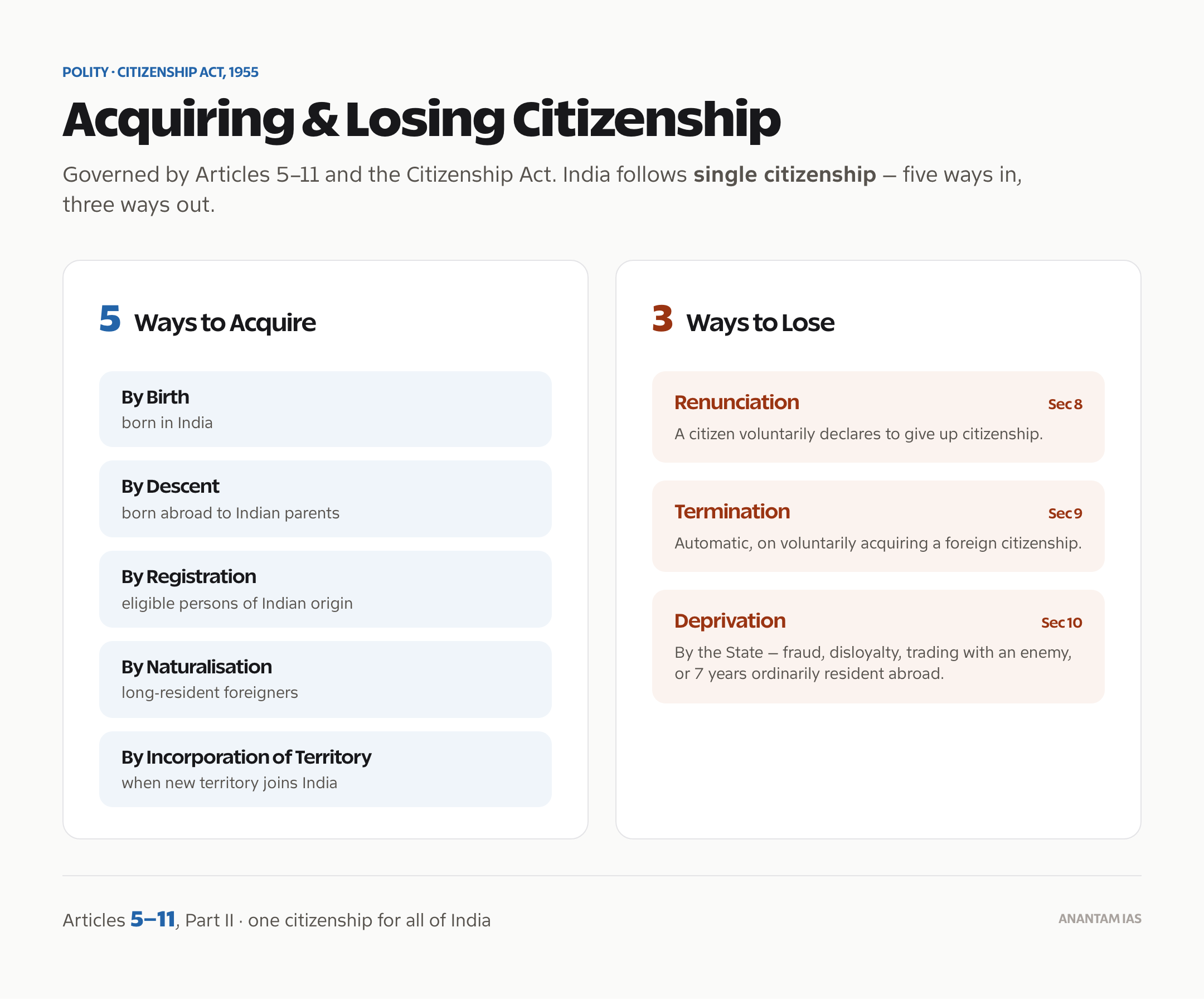
Parliament enacted the Citizenship Act, 1955 under Article 11. It has been amended multiple times — in 1986, 1992, 2003, 2005, 2015, and most significantly in 2019.
Five Modes of Acquiring Citizenship
| Mode | Key Conditions |
|---|---|
| Birth | Born in India on or after 26.01.1950 but before 01.07.1987: citizen irrespective of parents’ nationality. Born 01.07.1987–02.12.2004: at least one parent must be Indian citizen. Born after 03.12.2004: both parents must be citizens, OR one parent citizen and other not an illegal migrant |
| Descent | Born outside India to a parent who is an Indian citizen. Registration with Indian consulate required within one year (extendable). At least one parent must have been citizen at time of birth |
| Registration | Persons of Indian origin married to Indian citizens (7 years residence), minor children of Indian citizens, persons registered as Overseas Citizens of India for 5 years |
| Naturalisation | Foreign nationals who have resided in India for 12 months before application + 11 of the preceding 14 years. Must know a language in the Eighth Schedule. Must renounce previous citizenship |
| Incorporation of Territory | When foreign territory becomes part of India, the Government specifies who becomes citizens (e.g., Goa in 1961, Sikkim in 1975) |
Three Modes of Losing Citizenship
Renunciation (Section 8): Any citizen of full age and capacity can voluntarily renounce citizenship by making a declaration. When a person renounces, every minor child also loses citizenship (they can resume within one year of turning 18).
Termination (Section 9): If an Indian citizen voluntarily acquires citizenship of another country, Indian citizenship automatically terminates. This aligns with Article 9 of the Constitution.
Deprivation (Section 10): The government can compulsorily deprive a citizen of citizenship if:
- Citizenship was obtained by fraud, false representation, or concealment
- The citizen showed disloyalty to the Constitution
- The citizen traded or communicated with an enemy during war
- The citizen was ordinarily resident outside India for 7 continuous years
- The citizen was sentenced to imprisonment for 2+ years within 5 years of registration/naturalisation
Citizenship (Amendment) Act, 2019 (CAA)
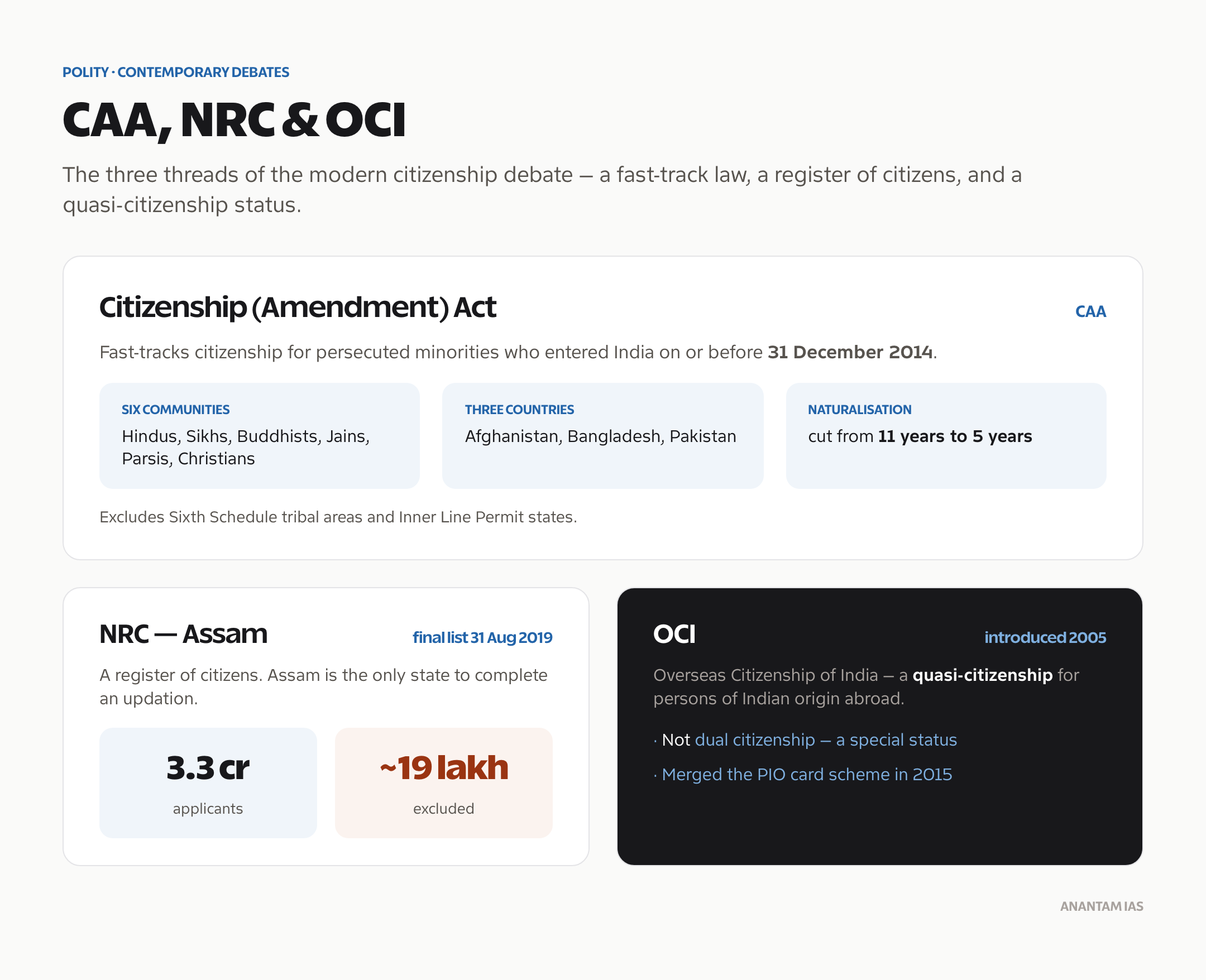
The most controversial amendment to the Citizenship Act, the CAA fast-tracks citizenship for persecuted minorities — Hindus, Sikhs, Buddhists, Jains, Parsis, and Christians — from Afghanistan, Bangladesh, and Pakistan who entered India on or before 31 December 2014.
Key Provisions
- Reduces the naturalisation requirement from 11 years to 5 years for eligible persons
- Applies only to members of the six specified religions from three specified countries
- These persons won’t be treated as “illegal migrants” despite entering without valid documents
- Doesn’t apply to tribal areas of Assam, Meghalaya, Mizoram, and Tripura (Sixth Schedule areas)
- Doesn’t apply to states with Inner Line Permit regime (Arunachal Pradesh, Nagaland, Mizoram, Manipur)
Constitutional Challenges
The CAA faces challenges on grounds of violating:
- Article 14 (Right to Equality): Classification based on religion — excluding Muslims from the same three countries
- Article 21 (Right to Life): Potential impact on existing residents
- Secularism: Using religion as a criterion for citizenship contradicts the secular character of the Constitution
The Supreme Court is yet to deliver a final verdict on the CAA’s constitutionality. The government’s position is that it’s a humanitarian measure for persecuted minorities from specific theocratic states.
Overseas Citizenship of India (OCI)
The OCI scheme, introduced by the 2005 amendment, provides a form of quasi-citizenship to persons of Indian origin living abroad. OCI isn’t dual citizenship — it’s a special status.
OCI vs Indian Citizen
| Feature | Indian Citizen | OCI Card Holder |
|---|---|---|
| Voting Rights | Yes | No |
| Government Employment | Yes | No |
| Holding Public Office | Yes | No |
| Agricultural Property | Yes | No (restrictions apply) |
| Multiple Entry Visa | N/A | Yes (lifelong) |
| Parity with NRIs | N/A | In economic, financial, and educational matters |
| Registration Required | Based on mode of acquisition | Must register with government |
The OCI scheme replaced the dual citizenship/Person of Indian Origin (PIO) card scheme. PIO cards were merged with OCI in 2015.
National Register of Citizens (NRC)
The NRC is a register of all legitimate Indian citizens. Currently, Assam is the only state that has conducted an NRC updation exercise (completed 2019, final list published on 31 August 2019).
Assam NRC Results: Out of 3.3 crore applicants, approximately 19 lakh were excluded from the final list. Those excluded can appeal to Foreigners’ Tribunals.
A nationwide NRC has been discussed but not formally initiated. The combination of CAA + nationwide NRC has generated significant debate — critics argue that together they could disenfranchise Muslims who lack documentation, while supporters maintain both are necessary to identify illegal immigrants.
Comparison: Citizenship Laws Across Countries
| Feature | India | USA | UK | Germany |
|---|---|---|---|---|
| Citizenship Type | Single | Dual (federal + state) | Single | Single |
| Birth-based (Jus Soli) | Restricted (post-2004) | Unrestricted | Restricted | No |
| Descent-based (Jus Sanguinis) | Yes | Yes | Yes | Yes |
| Dual Citizenship | Not allowed | Allowed | Allowed | Limited |
| Naturalisation Period | 11 years (5 for CAA) | 5 years | 5 years | 8 years |
| Religion-based Criteria | Yes (CAA 2019) | No | No | No |
Important Supreme Court Judgments
- Izhar Ahmad v. Union of India (1962): Persons who migrated to Pakistan and returned with permits are entitled to citizenship
- State of UP v. Shah Mohammed (1969): Burden of proving citizenship lies on the person claiming it
- Sarbananda Sonowal v. Union of India (2005): IMDT Act (which made it difficult to detect illegal migrants in Assam) struck down as unconstitutional
- Assam Sanmilita Mahasabha v. Union of India (2015): Directed updation of NRC in Assam under Supreme Court monitoring
Fundamental Rights Indian Constitution CAA and NRC Related Issues
Frequently Asked Questions
Does India allow dual citizenship?
No. India follows single citizenship under the Constitution. Article 9 clearly states that any person who voluntarily acquires citizenship of a foreign state ceases to be an Indian citizen. The Overseas Citizen of India (OCI) card provides certain benefits to persons of Indian origin living abroad, but it’s not dual citizenship — OCI holders can’t vote, hold public office, or buy agricultural land.
What is the difference between CAA and NRC?
The Citizenship Amendment Act (CAA) 2019 provides a pathway to Indian citizenship for persecuted minorities from Pakistan, Bangladesh, and Afghanistan. The National Register of Citizens (NRC) is a register identifying legitimate citizens. CAA grants citizenship; NRC verifies it. They’re separate legal instruments, though critics argue that used together they could discriminate against Muslims who lack documentation.
How can a foreigner become an Indian citizen?
A foreigner can acquire Indian citizenship through naturalisation under Section 6 of the Citizenship Act, 1955. Requirements include residing in India for 12 months before application and for 11 of the preceding 14 years, knowledge of an Eighth Schedule language, good character, and intention to reside in India. The applicant must also renounce citizenship of their previous country.
What are the rights available only to Indian citizens?
Several Fundamental Rights are exclusively for citizens: Article 15 (non-discrimination), Article 16 (equal opportunity in public employment), Article 19 (six freedoms including speech, assembly, movement), Article 29 (cultural and educational rights), and Article 30 (minorities’ right to establish educational institutions). Rights under Articles 14, 20, 21, and 25 are available to all persons — citizens and non-citizens alike.