Code of Conduct for Ministers (Union and State) by Home Ministry: Provisions, Critique and Reform (UPSC GS IV)
Code of Conduct for Ministers — Home Ministry provisions for Union and State, asset disclosure, gifts, business interests, civil-service relations, and reform proposals for UPSC GS IV.
The conduct of ministers — Union and State — is governed in India not by a statute but by a Code of Conduct issued by the Ministry of Home Affairs and revised periodically. The Code applies to all members of the Council of Ministers at the Centre and the States, sets out the obligations they assume on taking office, and supplies the framework against which ministerial probity is judged. For the UPSC GS IV aspirant, the Code is one of the cornerstone documents in the unit on probity and code-of-conduct mechanisms.
This article works through the provisions of the Code, the philosophical justification for each, the critiques the Code has attracted, the recurring violations and remedies, and the reform proposals that have animated the discussion since the 2nd ARC.
Why a Code for Ministers
Ministers occupy positions of vast discretion. They decide budget priorities, contract awards, appointments, transfers, prosecutions, pardons. The exercise of these powers must be not merely legal but visibly disinterested. A Code of Conduct provides the visible standards against which ministerial behaviour is judged; without it, the line between proper exercise and misuse becomes blurred.
The Code is administrative in form — it does not have the force of statute — but it has the moral and political force of a document the minister has formally accepted on assuming office. Violations are not directly justiciable but invite political and (in serious cases) criminal consequences.
What the Code requires
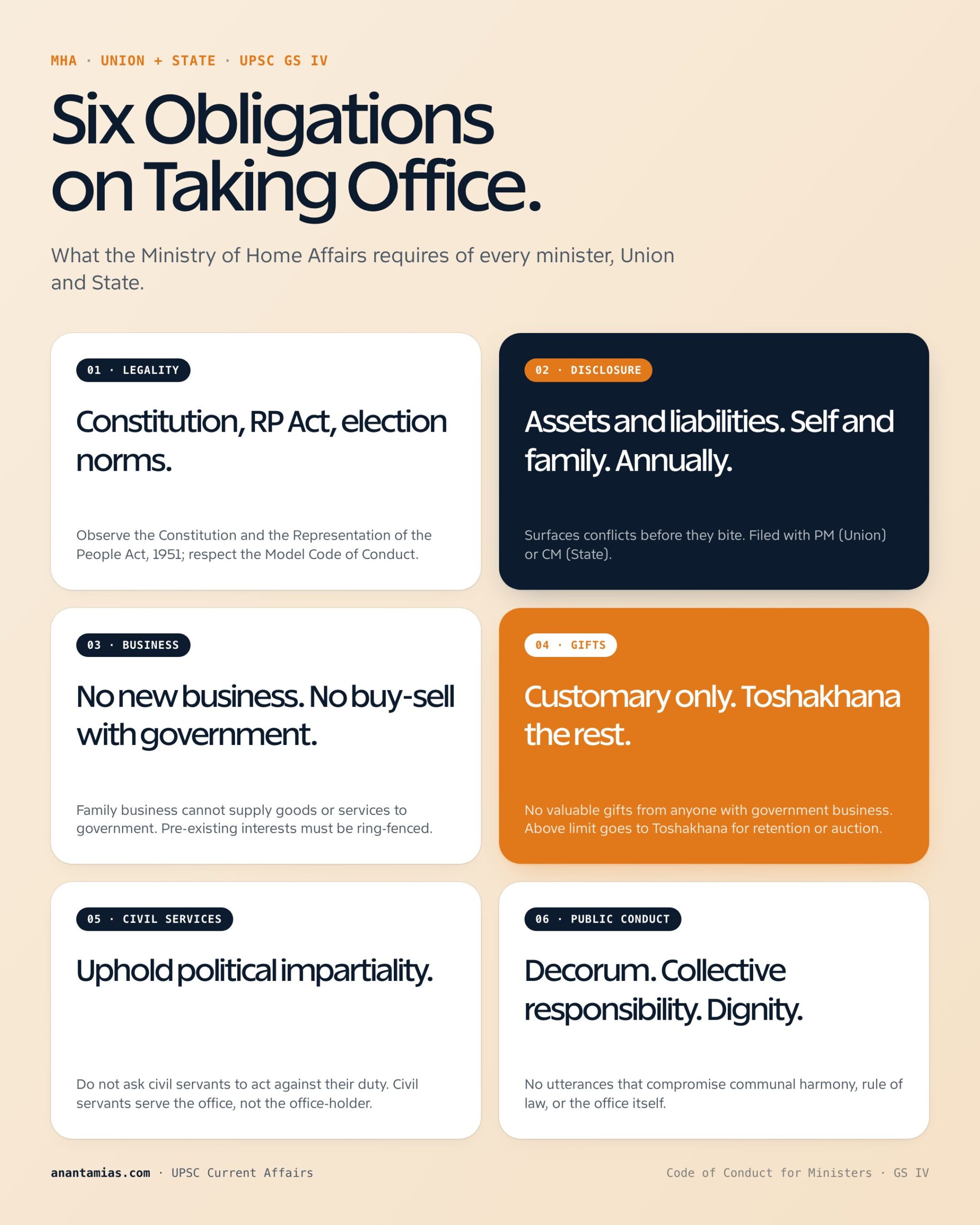
The Code requires ministers to observe a series of positive obligations and negative prohibitions.
Constitutional and legal compliance
- Observe the provisions of the Constitution, the Representation of the People Act, 1951 and other laws in force.
- Uphold the secret ballot, abstain from electoral malpractice and respect the model code of conduct during elections.
Asset and liability disclosure
- Disclose to the Prime Minister (Union ministers) or the Chief Minister (State ministers) details of the assets and liabilities, and of the business interests, of self and family members on assuming office.
- Furnish the declaration of assets and liabilities of the previous year to the PM or CM annually.
- This declaration is meant to surface conflicts before they bite — and to provide a baseline against which subsequent acquisitions can be checked.
Restrictions on private business
- Refrain from starting or joining any business once in office.
- Refrain family members from starting or joining any business that supplies goods or services to the government.
- Refrain from buying or selling any movable or immovable property to or from the government.
The logic: a minister who has business relationships with the state cannot make decisions affecting that state without conflict.
Gifts and hospitality
- Refrain from accepting valuable gifts, hospitality or entertainment from any individual, firm or company that has business with the government, except in narrow customary contexts.
- Customary modest gifts (within prescribed value limits) may be accepted but must be reported and may be deposited with the Toshakhana for retention or auction.
Relationship with civil services
- Uphold the political impartiality of the civil services.
- Refrain from asking civil servants to act in a way that would conflict with the duties and responsibilities of civil servants.
- Recognise that civil servants serve the office, not the office-holder, and that political loyalty is not a legitimate criterion for civil-service deployment.
Public conduct
- Maintain decorum in public utterance.
- Refrain from criticising colleagues publicly in a way that undermines collective responsibility.
- Avoid utterances that compromise the dignity of office, communal harmony or the rule of law.
| Theme | Specific obligation |
|---|---|
| Legality | Observe Constitution, RP Act, other laws |
| Disclosure | Assets and liabilities of self and family, on entry and annually |
| Business | No new business; family business not to deal with government; no buy/sell with government |
| Gifts | No valuable gifts; customary modest gifts only with disclosure |
| Civil service | Uphold political impartiality; do not ask civil servants to act against their duty |
| Public conduct | Decorum, collective responsibility, dignity of office |
Where the Code falls short
The Code's critics — including the 2nd ARC, the Veerappa Moily Committee, and contemporary observers — point to several structural weaknesses.
- Non-statutory nature. The Code is administrative, not legislative. Violations cannot be challenged in court directly; political accountability is the only enforcement mechanism.
- No independent enforcement body. Compliance is monitored by the political executive itself — the PM or CM, who may have personal political reasons not to act on a violation by a colleague.
- Asset disclosures often confidential. Public access to ministerial asset declarations is limited; without public scrutiny, the deterrent effect is weak.
- Family-business loopholes. "Family" has not been comprehensively defined; spouses, children and others can hold interests through complex structures.
- Gifts: enforcement is uneven. Toshakhana records have, in past cases, been incomplete or contested.
- Civil-service interference: hard to police. Asking a civil servant to do something improper rarely leaves a paper trail; the civil servant's word against the minister's is often the only evidence.
- Communal and divisive utterances. The Code's provisions on public conduct are largely unenforced when violated by senior politicians.
Reform proposals: improving probity in governance
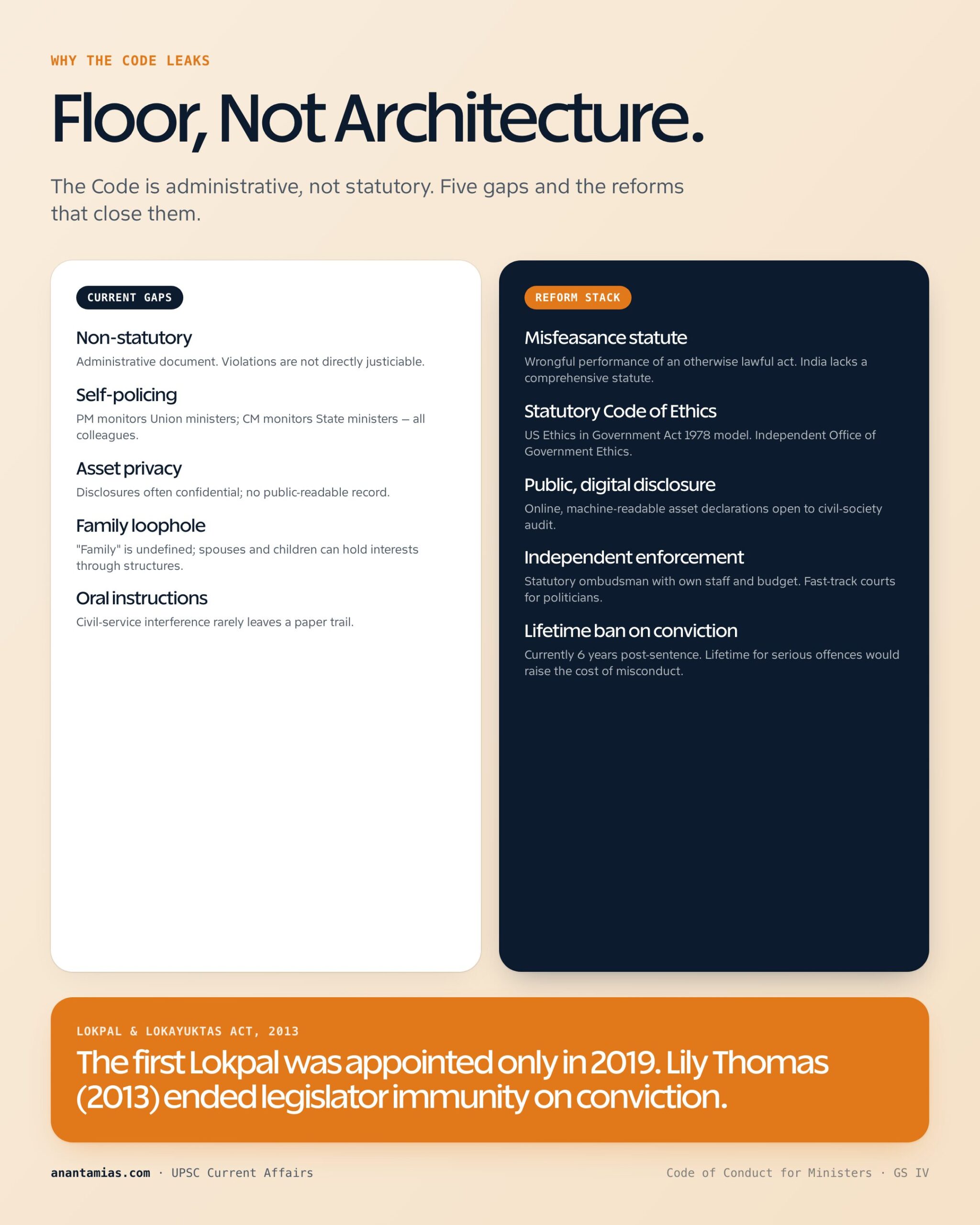
The 2nd ARC and other commentators have proposed a range of reforms.
Misfeasance in public office
Legislation to check misfeasance in public office — the wrongful performance of an otherwise lawful act. If a public servant abuses office by act of omission or commission, and the consequence is injury to an individual or loss of public property, an action may be maintained against the public servant. India does not yet have a comprehensive misfeasance statute; the case law has developed in piecemeal fashion through tort suits and constitutional remedies.
Statutory Code of Ethics in government
Modelled on the Ethics in Government Act of the United States (1978), an Indian statutory code would put ministerial obligations on legislative footing, create independent monitoring (an Office of Government Ethics), and make violations directly justiciable.
Strengthened criminal justice system
Faster prosecution, dedicated benches for cases against ministers, time-bound proceedings. Many cases against politicians take decades to conclude; the delay is itself a form of impunity.
Independent enforcement
A statutory ombudsman with independent staff and a guaranteed budget would reduce the dependence of enforcement on the political executive itself.
Asset disclosure: public and digital
Ministerial asset disclosures should be publicly accessible online, machine-readable, and subject to civil-society audit. Several states have moved part-way; the Centre has been slower.
Lifetime ban on conviction
Disqualification on conviction is currently for six years post-sentence. A lifetime ban for serious offences would substantially raise the cost of misconduct.
Fast-track courts for politicians
The Supreme Court has directed but not enforced strict deadlines for trials of politicians. Effective implementation would shorten the impunity window.
Two Indian case studies
Case study 1 — the Lokpal and Lokayuktas Act, 2013
The Anna Hazare-led India Against Corruption movement of 2011–13 produced the Lokpal and Lokayuktas Act, an institutional response to the failure of existing codes to catch ministerial misconduct. The Act creates a Lokpal at the Centre and Lokayuktas in States to investigate complaints of corruption against public functionaries, including the Prime Minister (with restrictions). The Act's slow operationalisation — the first Lokpal was appointed only in 2019 — illustrates the soft-state pattern even in reform implementation.
Case study 2 — disqualification of legislators on conviction
The Supreme Court's Lily Thomas v. Union of India (2013) judgement struck down Section 8(4) of the Representation of the People Act, which had allowed convicted legislators to continue in office during appeal. The judgement substantially strengthened the link between criminal conviction and loss of office. Subsequent litigation (Lok Prahari and others) has pushed for fuller disclosure and more rapid trials. The cumulative effect is a slow tightening of the probity infrastructure for elected office-holders.
Civil services application
The Ministers' Code intersects with the working life of senior civil servants in several ways.
- Recording oral instructions. When a minister gives oral instructions of dubious propriety, the civil servant's protection is the recorded note. Conscientious officers convert oral instructions into recorded form, sometimes with a note that records the substance and origin.
- Dissent on file. Where the minister insists on a decision the civil servant believes to be wrong, recording dissent is both protective and substantive.
- Refusing improper requests. The civil servant who follows an improper minister's instruction is herself culpable. Refusal — backed by recorded reasoning — is the proper response.
- Cooperation with vigilance. When investigations into ministerial conduct begin, the civil servant's cooperation, with proper records, is a public-interest duty.
UPSC past-year question references
- 2014 GS IV: "Public servants are likely to confront with the issues of 'Conflict of Interest', 'Code of Conduct vs Code of Ethics', 'Discretion vs Accountability'."
- 2017 GS IV: case study on improper instructions from political superiors.
- 2018 GS IV: discussion of probity in public administration.
- 2020 GS IV: reform of accountability mechanisms for political office-holders.
Mains answer hook
The Code of Conduct for Ministers, issued by the Ministry of Home Affairs and applicable to Union and State ministers, sets out the obligations of ministerial office: legal compliance, asset and liability disclosure, restrictions on private business, gift acceptance limits, respect for the political impartiality of civil services, and dignified public conduct. Its weaknesses are equally well known — non-statutory, dependent on political enforcement, vulnerable to family-business loopholes and unrecorded oral instructions to civil servants. Reform proposals — misfeasance legislation, statutory Code of Ethics modelled on the US Ethics in Government Act, strengthened criminal justice, independent enforcement, public digital asset disclosure, lifetime ban on conviction, fast-track courts for politicians — together describe a probity-in-governance infrastructure that India is slowly assembling. The Code is the floor; the reforms are the architecture above it.
Prelims pointers
- Code of Conduct for Ministers — issued by Home Ministry; applies to Union and State.
- Constitution Article 75 (Council of Ministers, Union) and Article 164 (Council of Ministers, State).
- Lokpal and Lokayuktas Act, 2013 — first Lokpal appointed 2019.
- Lily Thomas v. Union of India (2013) — disqualification on conviction without appeal protection.
- Ethics in Government Act, 1978 — US comparator.
- Misfeasance in public office — wrongful performance of an otherwise lawful act.
- Toshakhana — repository of gifts received by ministers.
FAQ
Is the Code of Conduct for Ministers a law?
No. It is an administrative document issued by the Ministry of Home Affairs. It does not have the force of statute, though violations may attract political consequences and (where they coincide with statutory offences) criminal proceedings.
Who enforces the Code?
Primarily the Prime Minister (for Union ministers) and Chief Ministers (for State ministers). This has been criticised for being insufficiently independent.
Can a citizen file a case for Code violation?
Not directly under the Code. Where the violation also constitutes a statutory offence (under the Prevention of Corruption Act, IPC, etc.), prosecution may be initiated through prescribed procedures.
What is misfeasance in public office?
The wrongful performance of an otherwise lawful act by a public officeholder, causing injury to an individual or loss of public property. India does not have a comprehensive misfeasance statute; remedies operate through tort and constitutional litigation.
What can a civil servant do when given improper oral instructions by a minister?
Convert oral to written by recording on file with a request for confirmation; record dissent if the instruction persists; escalate through proper channels; refuse if the instruction is plainly illegal; cooperate with vigilance authorities if asked.
The Code of Conduct for Ministers, in its present form, is necessary but not sufficient. Its real value will come when reform proposals — statutory backing, independent enforcement, public asset disclosure, and the rest — are implemented. The conversation is not whether but when. The civil servant who knows the Code well is the better-prepared participant in that conversation.