Comparative Politics: UK, US, China, France & Switzerland
A PSIR-focused comparison of political systems in UK, US, China, France, and Switzerland with answer frameworks for 20-mark questions.
UPSC has asked at least one comparative politics question in PSIR Paper I every single year since 2013. The 2023 paper asked you to compare the committee systems of the US Congress and the British Parliament. The 2019 paper wanted a comparison of judicial review in the US and India. If you cannot write a structured comparative answer in 15 minutes, you are leaving easy marks on the table.
Here is what I have seen in 15+ years of teaching: students describe Country A, then Country B, and call it a comparison. That is not comparison. That is two separate essays stapled together. UPSC rewards analytical frameworks, not sequential descriptions.
This piece covers the five systems PSIR demands you know, and more importantly, shows you how to structure answers that actually score.
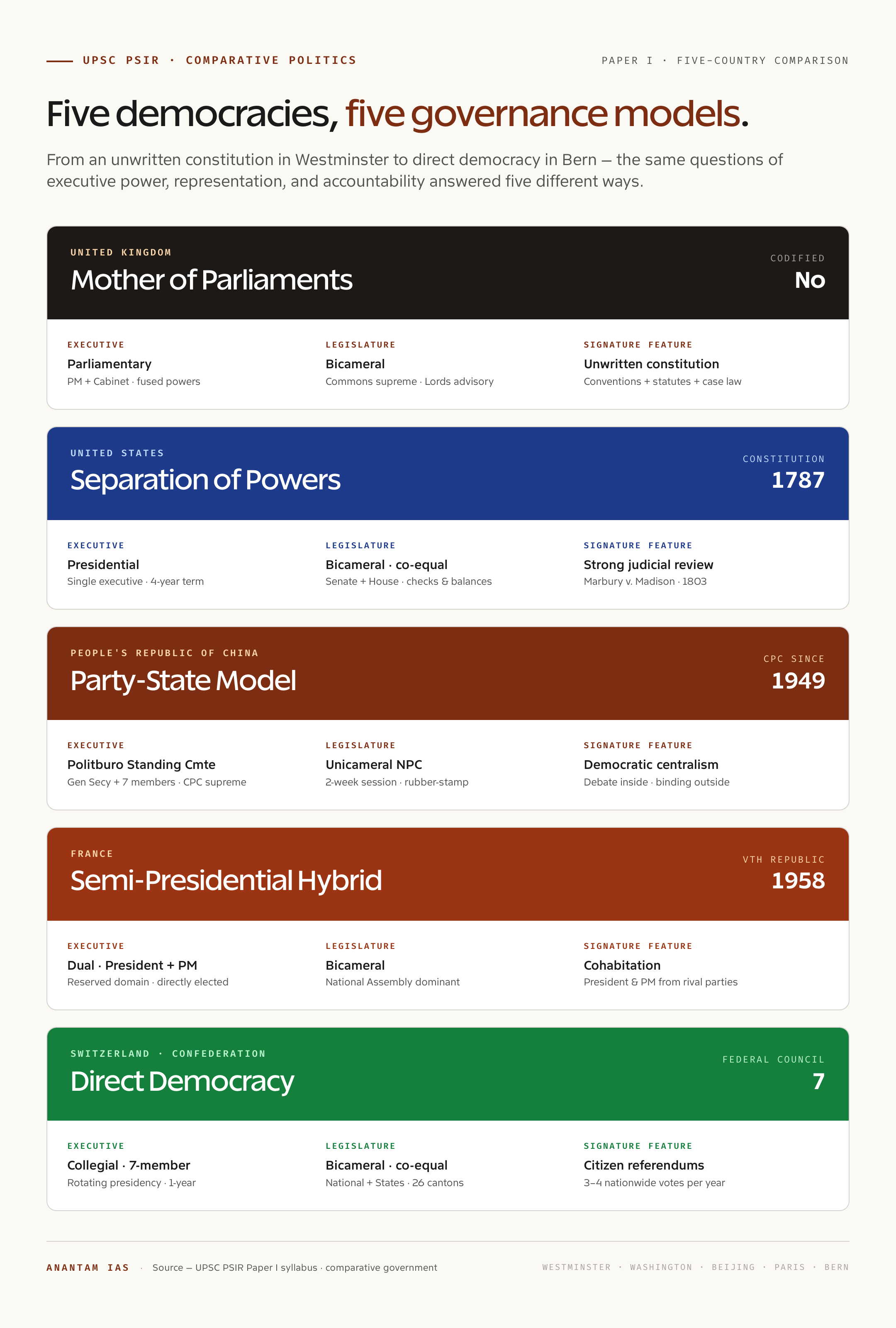
United Kingdom: The Mother of Parliaments
The UK operates a parliamentary system with an unwritten constitution — a fact that confuses students who assume every democracy needs a single written document. The UK constitution is a collection of statutes (Parliament Acts 1911 and 1949, Human Rights Act 1998), conventions, judicial decisions, and authoritative works (Dicey, Bagehot).
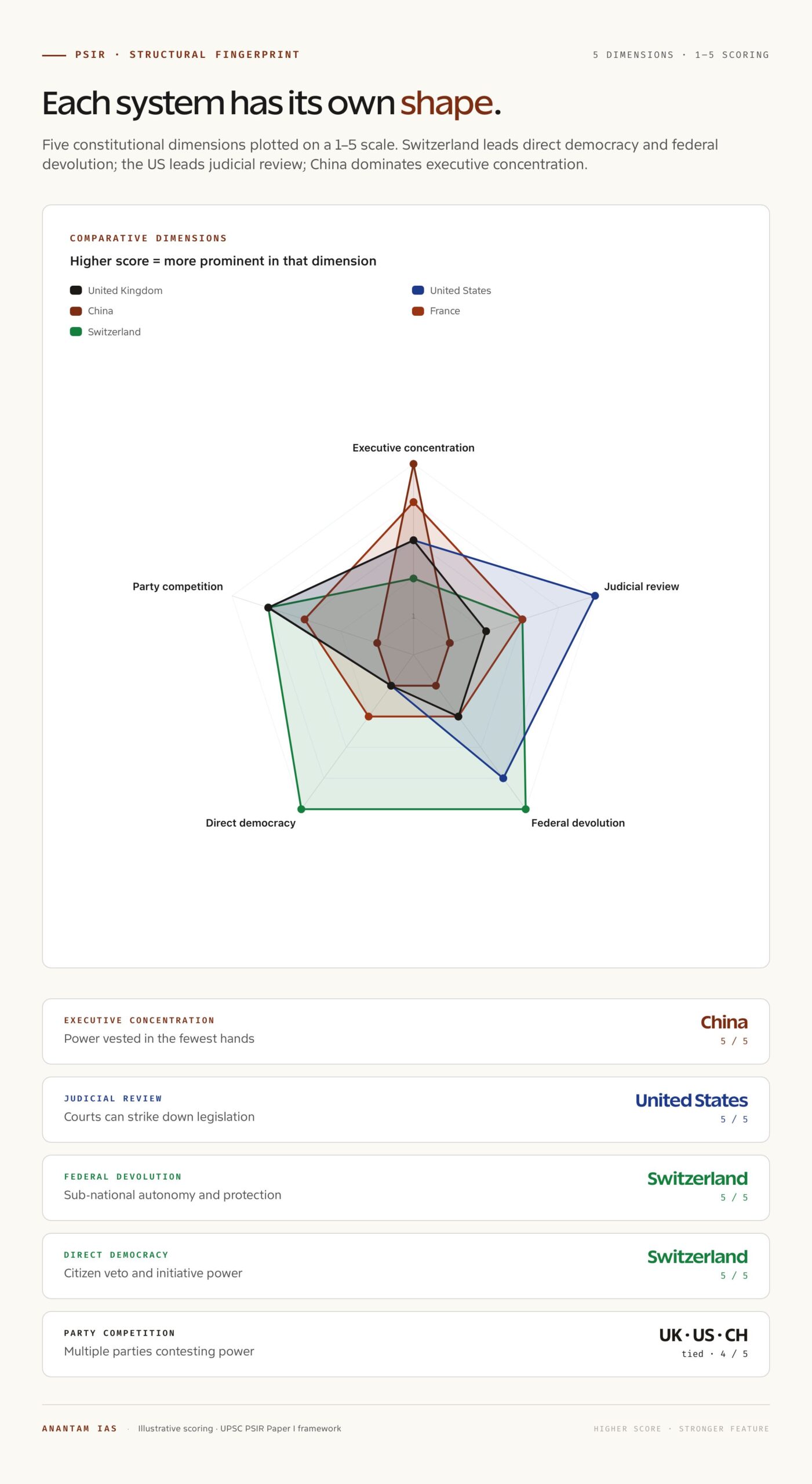
Parliamentary sovereignty remains the foundational doctrine. Parliament can make or unmake any law, and no body can override or set aside its legislation. The Supreme Court (established 2009, replacing the Law Lords) exercises limited judicial review — it can declare executive action unlawful but cannot strike down Acts of Parliament. Compare this with the US Supreme Court, which routinely invalidates federal legislation.
Cabinet government under the Westminster model means the Prime Minister is first among equals, drawing authority from commanding a majority in the House of Commons. The PM is not directly elected by the people. The fusion of powers between executive and legislature is the defining structural feature — the exact opposite of the American separation.
Brexit (2016-2020) exposed every tension in the UK system. The referendum was advisory, but Parliament treated it as binding. The Supreme Court's Miller judgments (2017, 2019) asserted parliamentary sovereignty against executive prerogative. Boris Johnson's prorogation was ruled unlawful. Brexit showed that an unwritten constitution bends but does not break — conventions held, courts intervened, and Parliament ultimately decided.
Common student mistake: Writing that the UK has "no constitution." Wrong. It has no single codified constitution. The distinction matters. UPSC 2017 PSIR Paper I specifically tested this nuance.
United States: Separation of Powers in Action
The US Constitution (1787) is the oldest written constitution still in operation. Its genius and its gridlock both flow from the same source: separation of powers with checks and balances.
The President, Congress, and Supreme Court each hold independent authority. The President cannot dissolve Congress. Congress cannot remove the President except through impeachment. The Supreme Court, through judicial review established in Marbury v. Madison (1803), can invalidate acts of both other branches. Chief Justice Marshall's assertion that "it is emphatically the province and duty of the judicial department to say what the law is" remains the most consequential sentence in American constitutional history.
Federalism in the US is dual in theory but cooperative in practice. The Tenth Amendment reserves powers to states, but the commerce clause (Article I, Section 8) and the Fourteenth Amendment have massively expanded federal authority since the New Deal era. The federal government spends over $6 trillion annually, dwarfing state budgets.
The Electoral College is the most misunderstood institution. Presidents are not elected by popular vote but by 538 electors. This has produced five presidents who lost the popular vote (most recently Trump in 2016). The system overrepresents small states and makes swing states disproportionately important. Reform efforts consistently fail because small states and the Republican Party benefit from the current arrangement.
The US system produces divided government frequently — the President from one party, one or both chambers of Congress from another. This is structurally impossible in the UK. The policy implications are enormous: the US passed major healthcare reform (ACA 2010) only when Democrats controlled both chambers and the presidency simultaneously.
Common student mistake: Conflating "checks and balances" with "separation of powers." They are related but distinct concepts. Separation is about institutional independence. Checks are about institutional interdependence. UPSC wants you to show you understand the difference.
China: The Party-State Model
China is a one-party state governed by the Communist Party of China (CPC), not a one-party dominant system (like Japan's LDP era or India's Congress dominance pre-1977). The distinction is structural: no other party can legally compete for power.
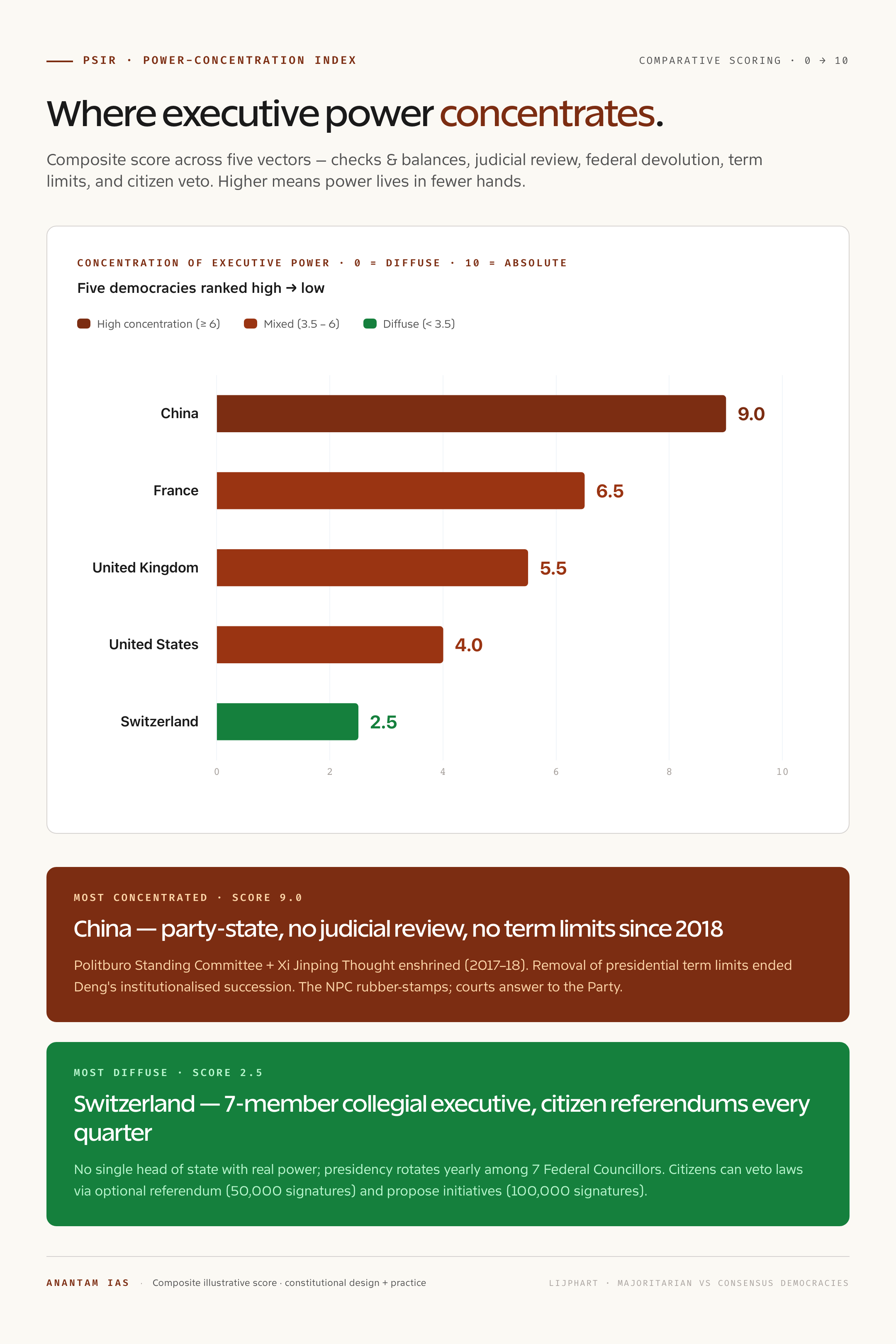
Democratic centralism is the organizing principle. Decisions are debated within the Party, but once made, they are binding on all members. Dissent after decision is not tolerated. The National People's Congress (NPC) is constitutionally the highest organ of state power, but in practice it rubber-stamps CPC decisions. The NPC meets for roughly two weeks annually. The real power sits in the Politburo Standing Committee (currently 7 members) and ultimately in the General Secretary.
Xi Jinping Thought on Socialism with Chinese Characteristics for a New Era was enshrined in the CPC constitution in 2017 and the state constitution in 2018. The removal of presidential term limits the same year signaled a fundamental shift from the collective leadership model Deng Xiaoping had established. Xi's consolidation of power reversed three decades of institutionalized succession.
The Chinese system delivers rapid policy implementation — the high-speed rail network, poverty alleviation targeting 100 million people, zero-COVID lockdowns — with a speed no democratic system can match. The tradeoff is zero accountability and no peaceful mechanism for leadership change when the system fails.
For PSIR purposes, the critical analytical framework is regime type versus governance outcome. UPSC 2020 asked about the Chinese model of development. The answer is not about praising or condemning China but about analyzing the structural relationship between authoritarian governance and economic performance, referencing Amartya Sen's capability approach as a counterpoint.
France: The Semi-Presidential Hybrid
The Fifth Republic (established 1958 by de Gaulle) created a semi-presidential system — a directly elected President coexists with a Prime Minister responsible to the National Assembly. This is neither purely presidential (like the US) nor purely parliamentary (like the UK). Maurice Duverger coined the term in 1980.
The President handles foreign policy and defense (the "reserved domain"), appoints the Prime Minister, can dissolve the National Assembly, and holds emergency powers under Article 16. The Prime Minister manages domestic policy and commands a parliamentary majority.
Cohabitation occurs when the President and Prime Minister come from opposing parties. This happened three times (1986-88, 1993-95, 1997-2002) before the 2000 constitutional reform aligned presidential and legislative terms to five years, making cohabitation much less likely. During cohabitation, real power shifts to the PM on domestic matters, and France temporarily functions as a parliamentary system.
The Yellow Vest movement (2018-2019) exposed the Fifth Republic's centralization problem. Macron's top-down fuel tax increase triggered nationwide protests because France lacks the federal or devolved structures that could absorb regional discontent. The movement forced Macron to launch the "Grand Debate" — an unprecedented exercise in direct consultation. Students should connect this to Tocqueville's warnings about centralization in French democracy.
Common student mistake: Calling France a "presidential system." It is semi-presidential. This is not a minor taxonomic quibble. The structural difference (PM accountable to legislature) changes the entire power dynamic. The 2022 elections, where Macron lost his parliamentary majority, showed how semi-presidentialism constrains even a sitting president.
Switzerland: Direct Democracy and Collegial Executive
Switzerland is the outlier UPSC loves to ask about because it defies every conventional category. The Federal Council (Bundesrat) is a seven-member collegial executive. There is no single head of government. The presidency rotates annually among the seven members. The Federal Council operates by consensus, and all major parties are represented through the magic formula (Zauberformel) — an informal power-sharing arrangement since 1959.
Direct democracy is not symbolic in Switzerland. Citizens vote on federal referendums 3-4 times per year. There are two main instruments: the mandatory referendum (constitutional amendments automatically go to a vote) and the popular initiative (100,000 signatures can force a vote on any constitutional change). The optional referendum allows 50,000 signatures to challenge any law passed by Parliament.
In 2009, Swiss voters banned minaret construction through a popular initiative, overriding elite consensus and international human rights norms. In 2014, they narrowly approved immigration quotas contradicting the EU's free movement principle. Direct democracy produces outcomes that representative systems would filter out. This is the core tension students must discuss: popular sovereignty versus liberal constitutionalism.
Swiss federalism is among the most decentralized in the world. The 26 cantons retain enormous autonomy over taxation, education, policing, and healthcare. Linguistic and religious diversity (German, French, Italian, Romansh; Catholic and Protestant) is managed through this radical decentralization rather than through majority rule. Compare this with India's cooperative and competitive federalism model.
The Comparison Framework: How to Structure 20-Mark Answers
Stop writing "Country A does X. Country B does Y." Instead, use thematic comparison.
Structure for a 20-mark comparative question:
- Introduction (2-3 lines): State the basis of comparison and your analytical framework
- Theme 1 (e.g., Executive structure): Discuss all relevant countries together
- Theme 2 (e.g., Legislative power): Same approach
- Theme 3 (e.g., Judicial independence): Same approach
- Conclusion: Offer a synthesizing observation, ideally connecting to a broader PSIR concept (legitimacy, accountability, representation)
Each theme should have direct, point-by-point comparison, not sequential description.
Example: If asked to compare the UK and US executives, do NOT write 200 words on the PM and then 200 words on the President. Instead, compare them on selection method, removal mechanism, relationship with legislature, and policy-making power within the same paragraphs.
Common student mistake: Writing comparative answers as two separate essays. UPSC 2018 PSIR Paper I asked students to compare judicial activism in India and the US. Students who wrote about India for two pages and the US for two pages scored 8-10/20. Students who compared thematically scored 14-16/20. The structure determines the score.
Five Countries Compared
| Feature | UK | US | China | France | Switzerland |
|---|---|---|---|---|---|
| Executive Type | Parliamentary (PM + Cabinet) | Presidential (single executive) | Party-state (General Secretary + Politburo SC) | Semi-presidential (President + PM) | Collegial (7-member Federal Council) |
| Legislature | Bicameral (Commons supreme, Lords advisory) | Bicameral (co-equal Senate and House) | Unicameral (NPC, rubber-stamp) | Bicameral (National Assembly dominant) | Bicameral (co-equal National Council + Council of States) |
| Judiciary | Limited judicial review, no constitutional strike-down | Strong judicial review (Marbury v. Madison) | No independent judiciary, Party supervision | Constitutional Council (post-2008: QPC allows citizen challenges) | No constitutional review of federal laws by courts |
| Party System | Two-party dominant (Conservative, Labour) | Two-party (Republican, Democrat) | One-party (CPC monopoly) | Multi-party with dominant blocs | Multi-party with consensus formula |
| Unique Feature | Unwritten constitution | Separation of powers + federalism | Democratic centralism, party supremacy | Cohabitation possibility | Direct democracy (referendums 3-4x/year) |
Connecting Comparative Politics to PSIR Themes
Do not study these five countries in isolation. Connect them to PSIR's recurring themes:
Legitimacy: The UK derives legitimacy from tradition and convention. The US from a written constitution. China from economic performance (output legitimacy). Switzerland from direct citizen participation. France from republican ideology. When UPSC asks about legitimacy, these are your examples.
Accountability: Parliamentary systems (UK) offer stronger day-to-day accountability through Question Hour and vote of confidence. Presidential systems (US) offer fixed-term stability but weaker ongoing accountability. China offers no formal accountability mechanism. Switzerland's referendum system creates the strongest citizen-level accountability in the world.
Representation: First-past-the-post (UK, US) produces majoritarian outcomes. Proportional representation (Switzerland) produces consensus outcomes. China's NPC representation is controlled by the Party. France's two-round system balances proportionality and governability. Connect these to debates about decolonization and post-colonial state design.
These connections are what turn a 12/20 answer into a 16/20 answer. UPSC rewards students who demonstrate that comparative politics is not about memorizing country profiles but about understanding analytical categories.
Frequently Asked Questions
Is the UK constitution really u0022unwrittenu0022?
No. The more accurate term is "uncodified." Major constitutional principles exist in written statutes (Magna Carta 1215, Bill of Rights 1689, Parliament Acts 1911/1949, Human Rights Act 1998). What the UK lacks is a single consolidated document labeled "The Constitution." UPSC has tested this distinction. Use "uncodified" in your answers to demonstrate precision.
How does cohabitation work in France, and is it still possible?
Cohabitation occurs when the President and PM belong to different parties. It happened three times before the 2000 reform aligned presidential and legislative election cycles. While theoretically still possible (if the President's party loses mid-term legislative elections after a dissolution), the aligned five-year terms make it unlikely. The 2024 elections, where Macron dissolved the Assembly and lost his majority, came close to a new cohabitation scenario.
Can the Chinese NPC actually check the CPC’s power?
In theory, Article 57 of China's constitution designates the NPC as the "highest organ of state power." In practice, the NPC has never rejected a major piece of legislation. Its standing committee does some legislative work between sessions, but all key decisions originate in the CPC Politburo. For PSIR answers, frame this as a gap between constitutional text and political reality — a theme that recurs across authoritarian systems.
Why does UPSC focus on Switzerland when it is a small country?
Switzerland is the world's most developed model of direct democracy, consensus government, and multilingual federalism. These are all live debates in Indian politics (referendums, coalition governance, linguistic states). UPSC uses Switzerland as a conceptual contrast to majoritarian democracies. When writing about Switzerland, always connect back to Indian implications.
What is the best way to study comparative politics for PSIR?
Study thematically, not country-by-country. Create comparison matrices on executives, legislatures, judiciaries, party systems, and federalism. Practice writing answers where you discuss all relevant countries within each theme. Read Heywood's Politics (Chapter 14-17) and Hague & Harrop's Comparative Government and Politics for frameworks. For current examples, follow constitutional developments in all five countries.
How do I use the Electoral College in PSIR answers?
The Electoral College appears in questions about democratic representation, federal design, and the gap between popular mandate and institutional outcome. The 2016 election (Clinton won 3 million more votes but lost) is your go-to example. Connect it to broader debates about the quality of democracy in established democracies — a theme UPSC has explored in questions referencing the Cold War era democratic transitions.
What is the difference between one-party and one-party dominant systems?
A one-party system (China) legally prohibits competitive multi-party elections. A one-party dominant system (Japan's LDP 1955-2009, India's Congress 1947-1977) allows competition but one party consistently wins. The distinction is about structural prohibition versus electoral dominance. UPSC 2016 PSIR Paper I tested exactly this distinction. Get it wrong, and you lose 3-4 marks on definition alone.
How should I reference thinkers in comparative politics answers?
Every paragraph should not have a thinker, but your answer must show theoretical grounding. For the UK, cite Bagehot (efficient vs dignified parts) and Dicey (rule of law, parliamentary sovereignty). For the US, cite Madison (Federalist No. 51 on separation), Tocqueville (Democracy in America). For China, cite Huntington (political order) and Fukuyama (state capacity). For France, Duverger (semi-presidentialism). For Switzerland, Lijphart (consensus democracy). Two to three well-placed references per answer is the sweet spot.