Compassionate Appointment and Married Daughters: Equality, Family Status and Article 14 (UPSC Polity)
In Kulsum Nisha v. State of U.P. (June 2026), the Supreme Court held that marital status cannot be a ground to deny a dependent daughter a compassionate benefit. Here is the full picture — what compassionate appointment is, why it is an exception to the Article 14 and 16 equality rules, and why excluding married daughters fails the equality test — explained for UPSC GS2.
In June 2026, the Supreme Court took a single, very human story and turned it into a clear point of constitutional law. A woman in Uttar Pradesh had run a ration shop under the Public Distribution System. When she died, her married daughter — who still lived in the same village, had cared for her mother, and was supporting four sisters including one who is visually impaired — applied to take over the licence under the dependent quota. The authorities said no, on one ground only: she was married, and a married daughter, in their reading, was no longer part of the family. In Kulsum Nisha v. State of U.P., a Bench of Justices P.S. Narasimha and Alok Aradhe set that refusal aside and held that marital status, on its own, cannot be used to deny a welfare benefit to an otherwise eligible daughter. Marriage, the Court said, neither breaks the bond between a daughter and her parents nor proves she has stopped depending on them.
The case looks small — one ration shop in one village. But it sits on top of a much larger debate that runs through Indian public employment, and that is what makes it a near-perfect GS2 topic. Compassionate appointment is one of the few legally sanctioned exceptions to the constitutional promise of equality in public jobs. So every rule about who counts as “family” forces a collision between two values an aspirant has to hold at once — welfare for a grieving, suddenly impoverished household on one side, and equal treatment regardless of sex and marital status on the other. The married-daughter question is where that collision has been sharpest, and the courts have now answered it firmly in favour of equality.
What Compassionate Appointment Is and Why It Bends the Equality Rule
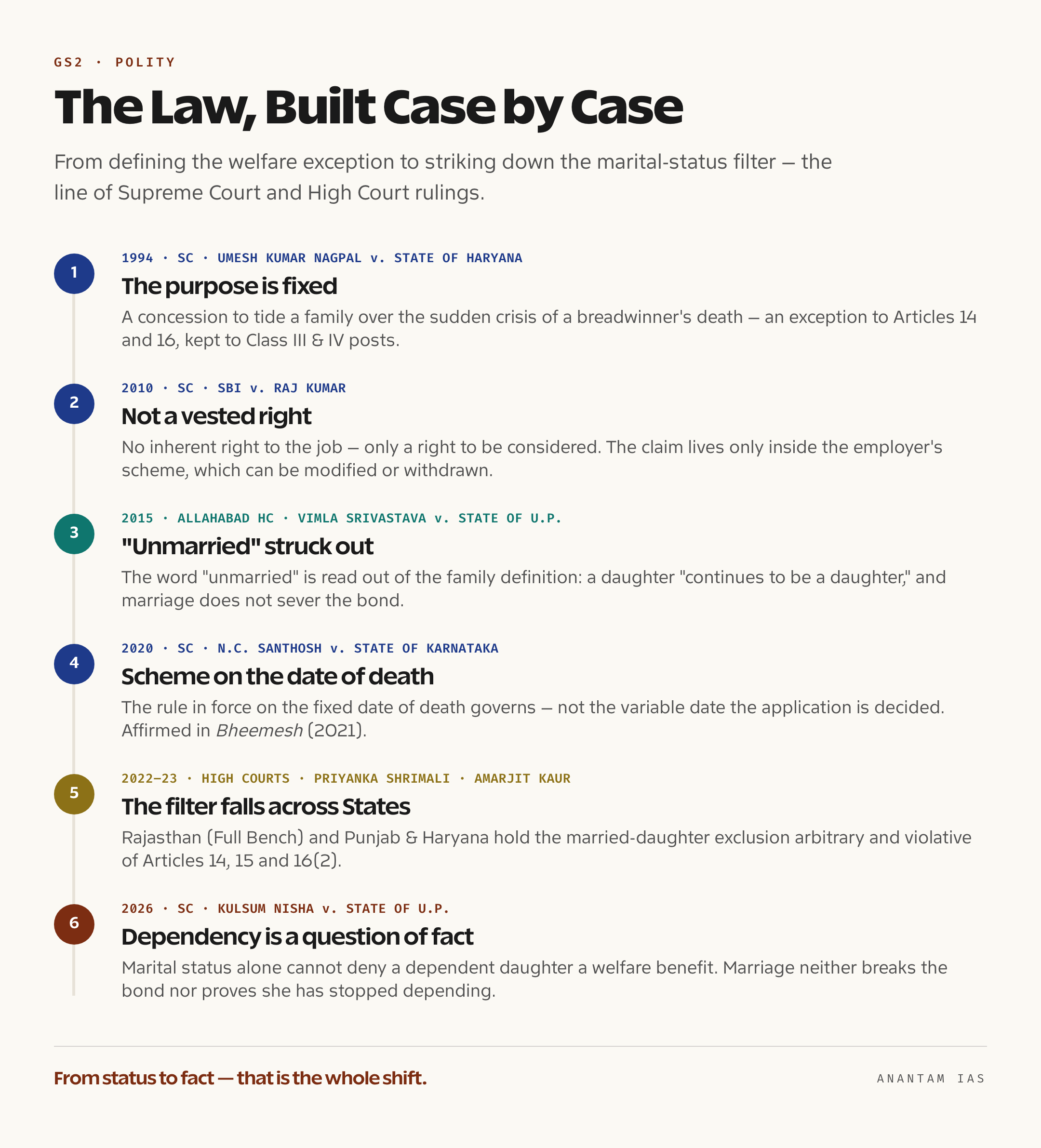
Start with the idea, because the idea is the whole exam answer in miniature. Compassionate appointment is a job given by the State, or a public-sector employer, to a dependent of an employee who dies while still in service — or who is medically boarded out, made unfit to work, before retirement. It is not a reward, not a pension, and not a normal recruitment. Its single purpose is to help a family that has just lost its breadwinner get over the sudden financial crisis that death creates, so the household does not slide into destitution while it finds its feet. The Supreme Court fixed that purpose early, in Umesh Kumar Nagpal v. State of Haryana in 1994, and has repeated it ever since: the scheme exists “to enable the family to tide over the sudden crisis,” not to provide jobs as a matter of inheritance.
Now see why that’s constitutionally awkward. Articles 14 and 16 of the Constitution together guarantee equality before the law and equal opportunity in public employment — which, in plain terms, means government jobs are supposed to go through open, merit-based recruitment where everyone gets a fair chance to compete. A job handed to one family member without any open competition, simply because their relative died in service, cuts straight across that promise. So the courts treat compassionate appointment as an exception to Articles 14 and 16 — a narrow, carefully fenced concession that’s allowed only because the goal (rescuing a family from sudden penury) is itself a legitimate, humane one. Because it is an exception, it has to stay small. Umesh Kumar Nagpal limited it to lower posts, Class III and IV roles, and barred its use for higher Class I and II positions, precisely so the exception didn’t swallow the merit rule.
And because it’s a concession rather than a right, a string of judgments has hedged it with conditions. In State Bank of India v. Raj Kumar in 2010, the Court held there is “no inherent right” to compassionate appointment at all — the claim exists only inside whatever scheme the employer has framed, and an employer can modify or even withdraw that scheme. The right under Article 16, the Court explained, is a right to be considered, not a right to be appointed. The benefit also can’t be claimed years later once the crisis has passed, because the whole point is immediate relief; a long delay is itself proof the family survived without it. At the same time the Court has refused to read the concession meanly. In Govind Prakash Verma v. LIC in 2005, it held that a family pension or terminal benefits like provident fund and gratuity cannot, by themselves, be a reason to reject the appointment, since those are separate dues the family is owed anyway. Welfare, fenced but real — that’s the balance the whole doctrine is trying to strike.
The Rules of the Game: Scheme on the Date of Death, and the “Dependant” Question
Two technical rules decide most compassionate-appointment cases, and both reward precision in an answer. The first is which scheme applies, because rules change over the years between a death and the day an application is finally decided. The Supreme Court resolved a long-running conflict on this point in 2021, in Secretary, Department of Education v. Bheemesh, and again through N.C. Santhosh v. State of Karnataka in 2020: the scheme in force on the date of the employee’s death governs the claim — not the scheme in force on the date the application is considered. The logic is clean. The death is the fixed, certain event that creates the crisis; the date of consideration depends on how fast or slow officials move, which is variable and outside the family’s control. A rule that produced different results depending on bureaucratic speed, the Court said, would be no rule at all. The flip side is a duty on the State: in Malaya Nanda Sethy v. State of Orissa in 2022, the Court directed that these applications be decided promptly, and as a norm within six months, so a deserving family is not kept waiting until the crisis — and the eligibility — has lapsed.
The second rule is the one the married-daughter cases turn on: who is a “dependant,” or a member of the “family.” Every compassionate-appointment scheme carries a definition of “family” — typically the spouse, sons and daughters of the deceased — and that definition is the gate through which an applicant must pass. For decades many State rules quietly narrowed that gate for women by inserting a single word: “unmarried.” A son stayed “family” whether married or not. A daughter counted as “family” only while unmarried; the day she married, the rule treated her as having joined another household and left her parents’ family behind. That word — “unmarried,” sitting in front of “daughter” and nowhere near “son” — is the whole battleground.
The courts have steadily pulled that gate open. The Allahabad High Court, in Vimla Srivastava v. State of U.P. in 2015, struck the word “unmarried” out of the family definition in Uttar Pradesh’s dying-in-harness rules, holding that a daughter “continues to be a daughter” and that marriage does not sever the relationship in fact or in law. A Full Bench of the Rajasthan High Court did the same in Priyanka Shrimali v. State of Rajasthan in 2022, declaring that “marriage by itself cannot be a disqualification” and reading the exclusion as a violation of Articles 14, 15 and 16(2). The Punjab and Haryana High Court followed in State of Punjab v. Amarjit Kaur in 2023, calling the shutting-out of a married daughter “apparently arbitrary.” The thread running through all of them is a shift the Supreme Court has now endorsed: stop asking about status (is she married?) and start asking about fact (was she actually dependent on the deceased?).
Why Excluding Married Daughters Fails the Article 14 Test
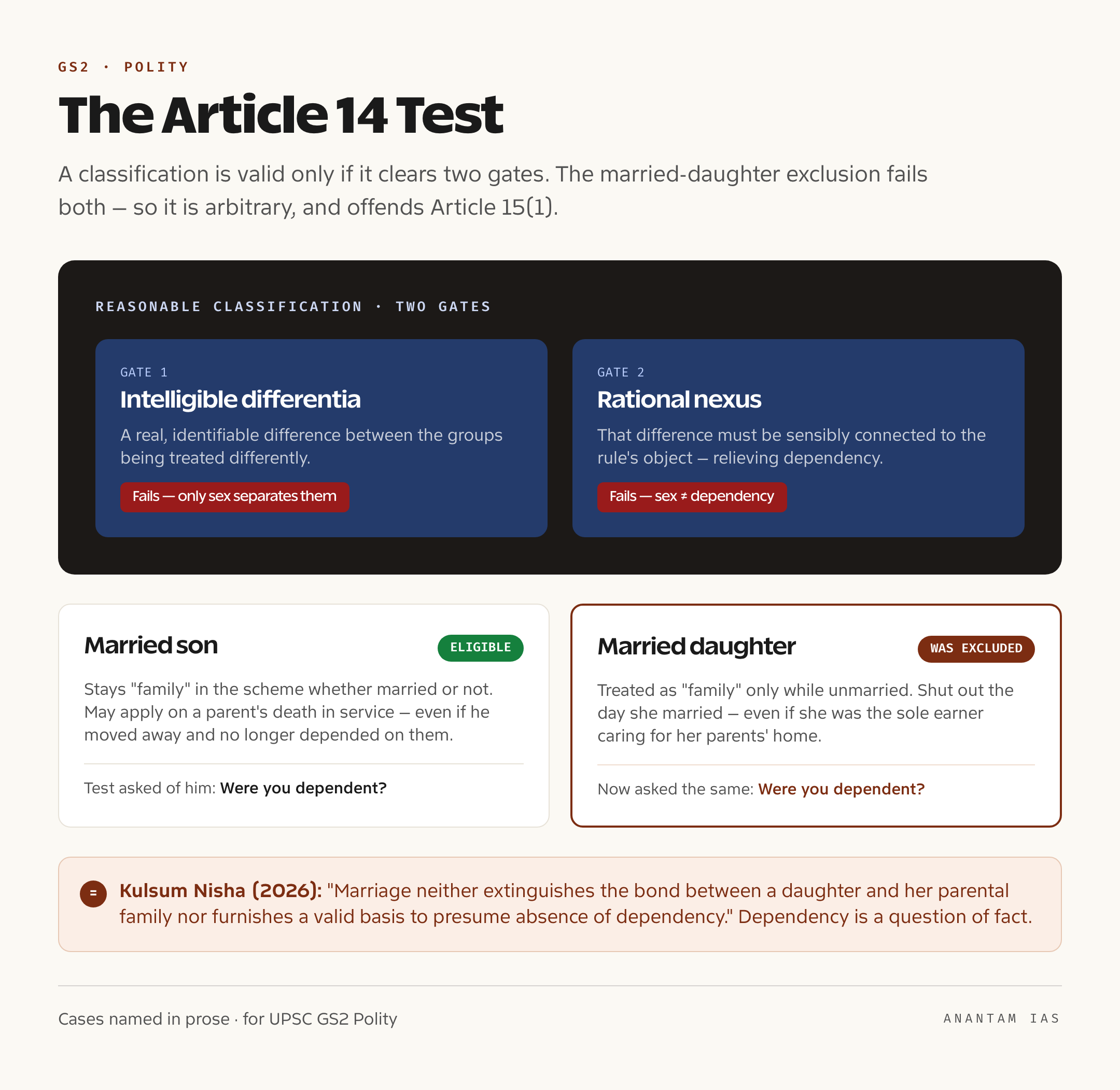
The constitutional heart of the issue is the equality clause, and it pays to know exactly how the argument runs. Article 14 does not forbid all classification — the State is allowed to treat different groups differently. But any classification has to clear a two-part test the Supreme Court has used for decades: it must rest on an “intelligible differentia” (a real, identifiable difference between the groups), and that difference must have a “rational nexus” — a sensible connection — to the object the rule is trying to achieve. A classification that fails either limb is arbitrary, and arbitrariness is the enemy of Article 14.
Apply that test to the married-daughter exclusion and it collapses. The object of a compassionate scheme is to relieve the financial distress of those who depended on the deceased. If a married son is still treated as part of the family and allowed to apply, then sex is the only thing separating him from a married daughter who is shut out — and sex has no rational connection to whether someone depended on a dead parent. A married daughter can be the sole earner in her parents’ home; a married son can have moved away and cut all ties. The rule sorts people by a feature (the daughter’s marriage) that simply doesn’t track the thing the scheme cares about (dependency). And it doesn’t sort married sons the same way. So the classification has no intelligible differentia tied to the object, no rational nexus, and it discriminates on the ground of sex — which Article 15(1) prohibits outright. As the Supreme Court put it in Kulsum Nisha, “marriage neither extinguishes the bond between a daughter and her parental family nor furnishes a valid basis to presume absence of dependency,” and dependency “is a question of fact” that “cannot be conclusively determined by reference to marital status alone.”
There’s a deeper point the Court keeps returning to, and it lifts an answer from technical to thoughtful. The exclusion isn’t a neutral accident of drafting; it encodes a stereotype — the old assumption that a daughter is paraya dhan, that she belongs to her husband’s family the moment she marries and ceases to be her parents’ concern. Constitutional courts have increasingly treated reliance on that kind of sex stereotype as itself a form of discrimination, not just a side effect of one. The same reasoning that gave daughters an equal share in ancestral property under the amended Hindu Succession Act, and that the Court used to open up roles like permanent commissions for women officers, runs through here: a woman’s legal identity and entitlements don’t dissolve into her husband’s on marriage. So striking down “unmarried” is not the courts inventing a new welfare benefit. It is the courts refusing to let a welfare benefit be rationed by a prejudice the Constitution already outlaws.
Where the Limits Still Bite: Welfare Without Turning It Into a Right
It would be a mistake to read these rulings as throwing the gates wide open, and the strongest answers acknowledge the limits. Winning the equality argument gets a married daughter to the door — it gets her the right to be considered on the same terms as a married son. It does not hand her the job. Everything the older doctrine built still applies to her exactly as it applies to everyone else. She must still actually have been a dependant of the deceased, which is now a question of fact for the authorities to verify, not a box ticked by status. She must still apply within a reasonable time, while the crisis is live. She must still satisfy the financial-need and other eligibility conditions in the scheme, and a post must be available. The Court has been careful to frame its intervention as removing an unconstitutional filter, not creating a guaranteed outcome.
This is the genuine tension the topic is built on, and a balanced answer names both sides. Push welfare too far and compassionate appointment stops being a narrow exception and becomes a hereditary right to a government job — which would hollow out the Article 16 promise of open recruitment for everyone else queuing for the same posts. Police it too harshly, with arbitrary cut-offs like “unmarried daughters only,” and you betray the very families the scheme exists to protect, along lines of sex the Constitution forbids. The courts’ answer has been to keep the exception small and conditional — capped at lower posts, tied to genuine and timely need, dependent on the scheme being in force — while insisting that within those limits it be administered without sex discrimination. Welfare and equality aren’t traded off here so much as reconciled: the benefit stays narrow, but the narrow benefit is offered fairly.
What’s left to watch is implementation, which is where rights of this kind usually leak away. A central judgment binds, but dozens of State and public-sector schemes still carry the word “unmarried,” or the older habit of treating a daughter’s marriage as the end of her membership in her birth family, until each is amended or read down. Officials at the counter — the ones who actually rejected Kulsum Nisha — decide most cases long before any court sees them. So the live question for governance is whether States will proactively rewrite their dying-in-harness and dependent-quota rules to match the Constitution, or whether each married daughter will have to litigate her way to a result the law already guarantees her. That gap, between a clear principle at the top and patchy practice at the bottom, is exactly the kind of point examiners reward.
For Your Mains Answer
This is a high-value topic for GS Paper 2, which covers the Constitution, fundamental rights, the role of the judiciary, and issues relating to women and vulnerable sections. It maps directly onto questions about Articles 14, 15 and 16, the test of reasonable classification, judicial review of discriminatory rules, and gender justice in public policy. It also offers a sharp, current example for the Essay paper and for the GS1 society syllabus on the persistence of gender stereotypes. The skill examiners reward is the one this article uses: state the welfare purpose, then show precisely how the equality test is applied to a specific rule, and close by reconciling the two values rather than picking one.
How to Build the Answer
Open with what compassionate appointment is and why it is an exception to Articles 14 and 16 — that framing earns marks immediately. Then move in a chain: the purpose (tide over sudden crisis, per Umesh Kumar Nagpal) → it is a concession, not a vested right (SBI v. Raj Kumar) → the governing rules (scheme on the date of death; decide within six months) → the “dependant” definition and the “unmarried daughter” filter → the Article 14 two-part test applied to that filter → why it fails (sex has no nexus to dependency; it encodes a stereotype Article 15 forbids) → the limits that remain → a balanced conclusion. That arc fits both a rights question and a gender-justice question.
Common Mistakes to Avoid
Don’t describe compassionate appointment as a “right” — it is a concession and an exception, and saying so is half the marks. Don’t say the courts have guaranteed married daughters the job; they have guaranteed equal consideration, with dependency and the other conditions still to be met. Don’t forget Article 15(1): the exclusion is sex discrimination, not merely irrational classification. And don’t treat it as purely a women’s-rights story — anchor it in the Article 14 reasonable-classification test, because that legal machinery is what an examiner is checking you can operate.
A Compact Answer Spine
Compassionate appointment = a job for a dependant of an employee dying in harness, to tide the family over a sudden crisis → an exception to Articles 14 and 16 (open, merit-based recruitment), so kept narrow (Class III/IV; Umesh Kumar Nagpal, 1994) → a concession, not a vested right; only a right to be considered (SBI v. Raj Kumar, 2010) → scheme on the date of death governs (N.C. Santhosh; Bheemesh) → many State rules excluded “married daughters” while keeping married sons → that fails the Article 14 test (no intelligible differentia tied to dependency, no rational nexus) and offends Article 15(1) → struck down in Vimla Srivastava (2015), Priyanka Shrimali (2022), Amarjit Kaur (2023), affirmed in Kulsum Nisha (2026): dependency is a question of fact, not marital status → limits remain (genuine, timely need; scheme in force) → verdict: equality without converting welfare into a hereditary right.
Diagram or Flowchart Idea
Draw the Article 14 test as a two-gate flow: “Intelligible differentia?” → “Rational nexus to the object (relieving dependency)?” with the married-daughter rule failing both gates and dropping into a box marked “arbitrary + Art. 15(1) sex discrimination → struck down.” Beside it, a small two-column “married son (eligible) vs married daughter (excluded)” contrast makes the irrationality visible at a glance.
A Balanced-Conclusion Line
A line that lands the marks: “Compassionate appointment must stay a narrow exception to the equality of public employment — but a narrow exception is no licence for a narrow prejudice, and a rule that lets a married son apply while shutting out a married daughter fails the very equality it claims to serve.”
How to Use Data Without Cramming
You don’t need statistics here; you need four or five case anchors used precisely: Umesh Kumar Nagpal (1994) for the purpose, SBI v. Raj Kumar (2010) for “not a vested right,” N.C. Santhosh (2020) for the date-of-death rule, and Kulsum Nisha (2026) for the married-daughter holding. Attribute each one plainly — “as the Supreme Court held in Kulsum Nisha” — and let the two-part Article 14 test, not a list of numbers, carry the analytical weight.
FAQ
What is compassionate appointment, and how is it different from a normal government job? It is a job offered by the State or a public-sector employer to a dependent of an employee who dies while in service, or is medically retired, so the bereaved family can survive the sudden loss of its breadwinner. Unlike a normal post, it is given without open competition, which is why the Supreme Court treats it as a narrow exception to the equality and open-recruitment guarantees of Articles 14 and 16 — a humanitarian concession, not a right, and not a form of inheritance.
Did the Supreme Court rule that married daughters are eligible for compassionate appointment? Yes, in substance. In Kulsum Nisha v. State of U.P. (June 2026), a Bench of Justices P.S. Narasimha and Alok Aradhe held that marital status alone cannot be used to deny a dependent daughter a compassionate benefit, because that exclusion violates Articles 14 and 15. The case concerned a fair-price-shop licence under the dependent quota, but the reasoning applies across compassionate-benefit schemes, and it follows High Court rulings that struck “unmarried” out of family definitions in U.P., Rajasthan and Punjab.
Why does excluding married daughters violate Article 14? Article 14 allows classification only if it rests on a real difference (an intelligible differentia) that is rationally connected to the rule’s purpose. A compassionate scheme exists to relieve dependants. If a married son can still apply, excluding a married daughter sorts people by sex — which has no connection to whether someone actually depended on the deceased — so the classification is arbitrary. It also discriminates on the ground of sex, which Article 15(1) forbids, and rests on the stereotype that a daughter stops being family once she marries.
Does this mean a married daughter is now guaranteed the job? No. The rulings remove an unconstitutional filter; they don’t create a guaranteed outcome. A married daughter now has the right to be considered on the same footing as a married son, but she must still prove she was genuinely dependent on the deceased (now a question of fact, not status), apply while the crisis is live, satisfy the scheme’s eligibility conditions, and have a post available. Compassionate appointment remains a concession, not a vested right.
Practice Questions
Prelims MCQs
- With reference to compassionate appointment in India, which statement is most accurate?
(a) It is a fundamental right guaranteed under Article 16
(b) It is a narrow exception to the equality and open-recruitment norms of Articles 14 and 16, given to a dependant of an employee dying in harness
(c) It is a form of inheritance of a government post
(d) It is available only to the spouse of the deceased
Answer: (b) The Supreme Court treats it as a concession to tide a family over a sudden crisis, an exception to the merit-based recruitment guaranteed by Articles 14 and 16, not a right or an inheritance. - In which case did the Supreme Court hold that there is “no inherent right” to compassionate appointment and that the claim exists only within the employer’s scheme?
(a) Umesh Kumar Nagpal v. State of Haryana
(b) Govind Prakash Verma v. LIC
(c) State Bank of India v. Raj Kumar
(d) Kulsum Nisha v. State of U.P.
Answer: (c) SBI v. Raj Kumar (2010) held the right under Article 16 is only a right to be considered, and the employer may modify or withdraw the scheme. - According to settled Supreme Court law, which scheme governs a claim for compassionate appointment?
(a) The scheme in force on the date the application is finally considered
(b) The scheme in force on the date of the employee’s death
(c) Whichever scheme is more favourable to the applicant
(d) The scheme in force on the date the post falls vacant
Answer: (b) In N.C. Santhosh and Bheemesh, the Court held the scheme on the date of death governs, because death is a fixed event while the date of consideration is variable. - The exclusion of married daughters from the definition of “family” in many compassionate-appointment rules has been struck down mainly because it violates which articles?
(a) Articles 19 and 21
(b) Articles 14 and 15
(c) Articles 25 and 26
(d) Articles 32 and 226
Answer: (b) Courts held it fails the Article 14 reasonable-classification test and amounts to sex discrimination under Article 15(1), as in Vimla Srivastava, Priyanka Shrimali and Kulsum Nisha. - The “test of reasonable classification” under Article 14 requires that a classification
(a) treats every person identically in all circumstances
(b) rests on an intelligible differentia having a rational nexus to the object sought to be achieved
(c) is approved by Parliament before it takes effect
(d) applies only to economic legislation
Answer: (b) A valid classification needs a real distinguishing feature (intelligible differentia) and a sensible connection (rational nexus) to the rule’s purpose; the married-daughter exclusion fails both.
Mains Practice Questions
- “Compassionate appointment is an exception to the equality of opportunity in public employment, not a right.” Examine this statement with reference to the relevant constitutional articles and Supreme Court jurisprudence. (15 marks, 250 words)
- Excluding married daughters from compassionate benefits while retaining married sons fails the test of reasonable classification under Article 14. Critically analyse, using recent judicial pronouncements. (15 marks, 250 words)
- Discuss how the judiciary has balanced the welfare objective of compassionate appointment against the constitutional guarantee of equality in public employment. (15 marks, 250 words)
- “Dependency is a question of fact and cannot be determined by marital status alone.” In light of this principle, evaluate the shift from status-based to fact-based assessment in compassionate-appointment schemes. (10 marks, 150 words)
- Discriminatory rules often survive in administrative practice long after they are held unconstitutional. With reference to the exclusion of married daughters, discuss the gap between judicial principle and implementation, and suggest reforms. (15 marks, 250 words)