Conservation Agriculture: Pillars, Benefits and Way Forward (UPSC Economy)
Conservation agriculture rests on minimum tillage, residue retention and crop rotation. Learn principles, benefits, challenges and India's 2024-26 roadmap for UPSC.
Conservation Agriculture (CA) is a farming system advocated by the Food and Agriculture Organization (FAO) as an alternative to conventional, plough-based production. It rests on three interlinked pillars — minimum mechanical soil disturbance, permanent organic soil cover, and species diversification through crop rotation/intercropping. By cutting tillage costs, recycling crop residues, and protecting soil organic matter, CA promises a triple win: higher net returns, lower input use, and reduced greenhouse-gas emissions. For UPSC GS-III, CA cuts across agriculture, climate change, soil health, food security, and water conservation, making it one of the highest-leverage topics in the syllabus.
What Is Conservation Agriculture
CA is not a single technique but an integrated production paradigm. It departs from the conventional mindset that "good farming = clean tilled fields" and instead works with, not against, ecological processes — biological tillage by roots and earthworms, mulch from previous crop residues, and nutrient cycling through diverse rotations.
The Three FAO Pillars
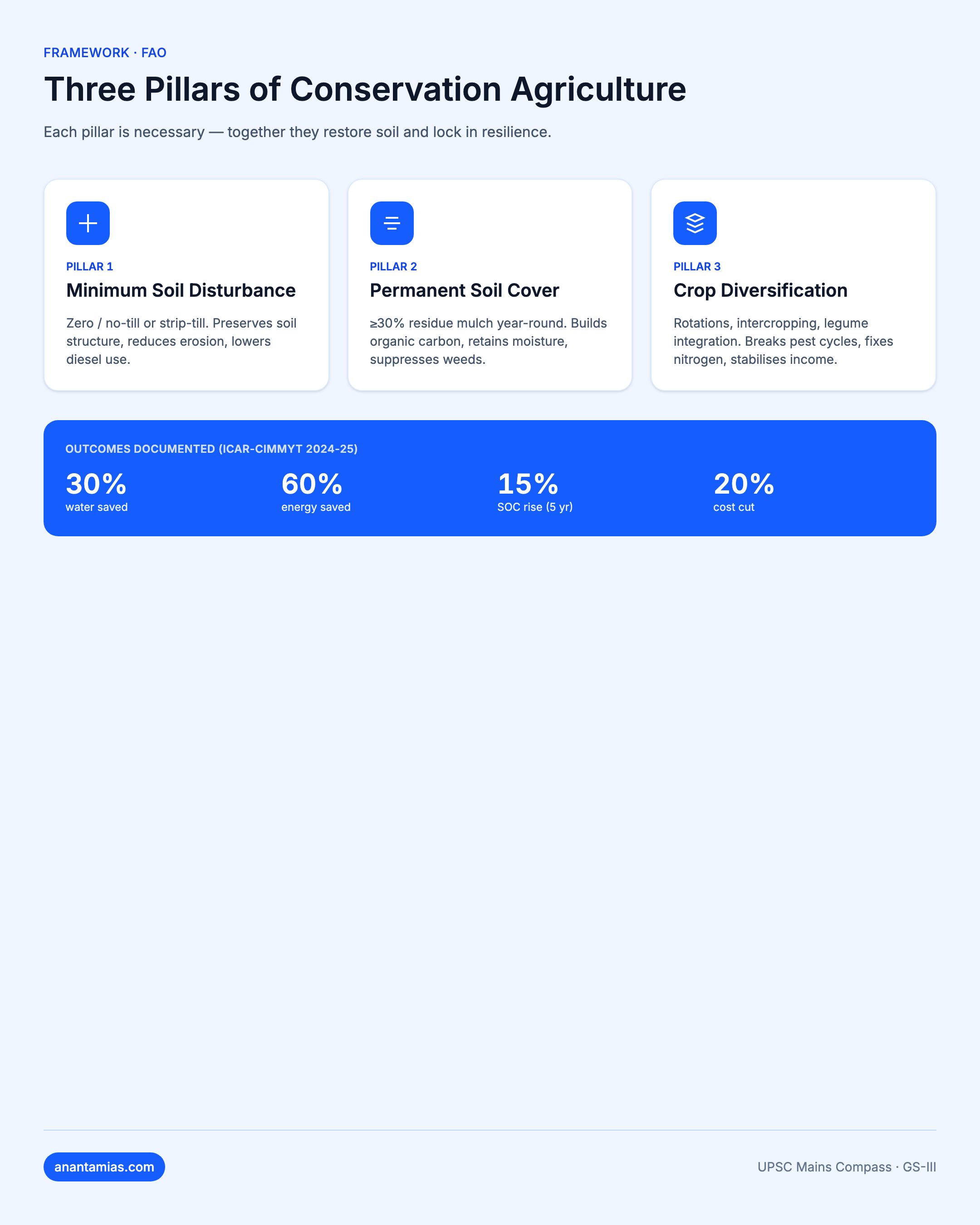
- Minimum mechanical soil disturbance — direct seeding into untilled soil; no ploughing, harrowing, or puddling beyond that needed for sowing. Practices include zero tillage (ZT), reduced tillage, ridge tillage, and direct-seeded rice (DSR).
- Permanent organic soil cover — at least 30 percent of the soil surface kept covered by crop residues, cover crops, or live mulch. This protects soil from erosion, moderates temperature and conserves moisture.
- Crop diversification — sequential and associated cropping (rotations and intercrops) involving at least three different crops over time to break pest cycles, fix nitrogen, and stabilise income.
Conventional vs Conservation Agriculture: Side-by-Side
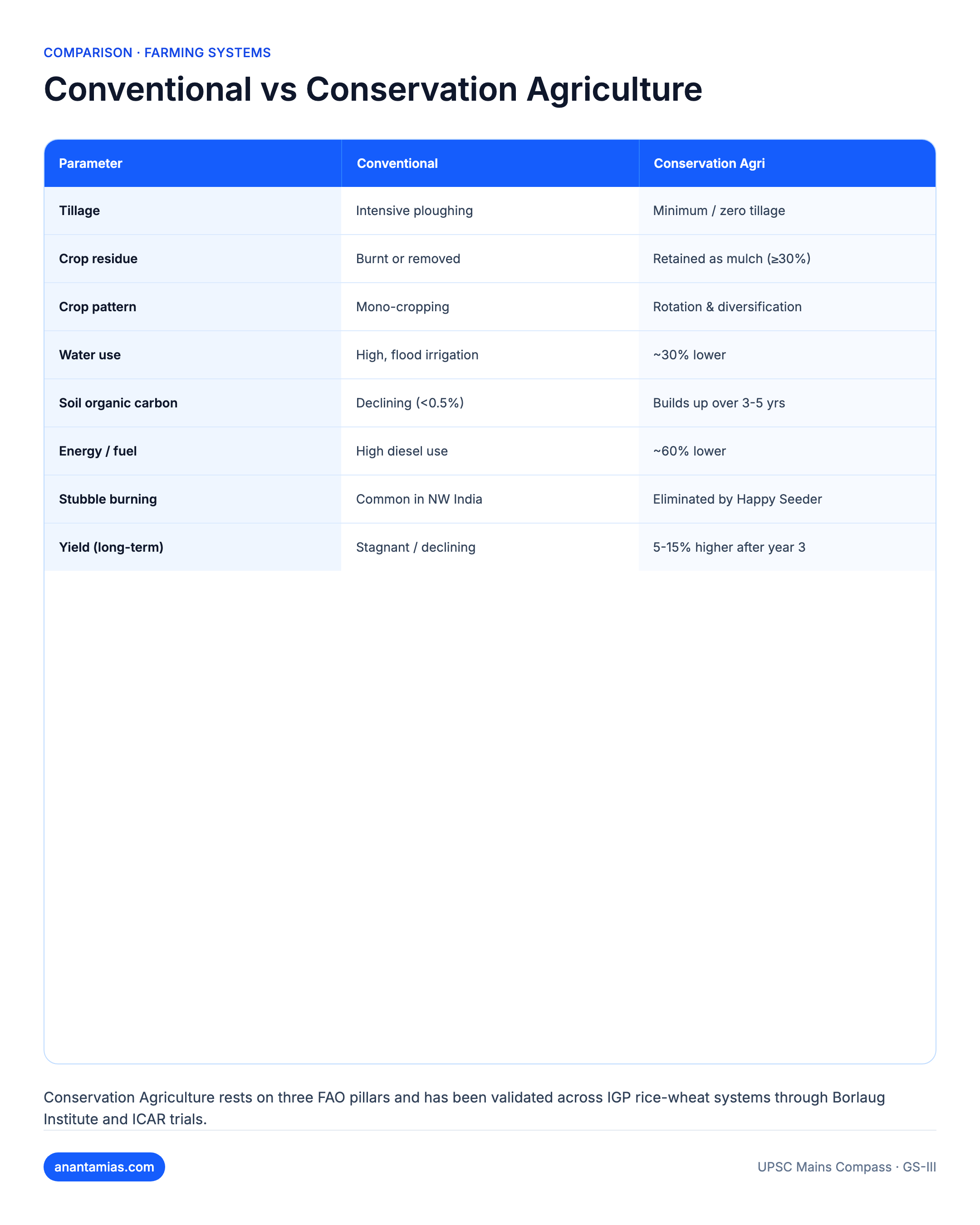
| Feature | Conventional Agriculture | Conservation Agriculture |
|---|---|---|
| Underlying philosophy | Dominate nature using science and machines | Minimum interference with natural processes |
| Tillage | Excessive mechanical tillage, soil inversion | Zero/reduced (biological) tillage |
| Residues | Burnt or incorporated by ploughing | Retained on the surface as mulch |
| Organic matter source | Ex-situ FYM and compost brought in from outside | In-situ organics, decomposing residues, cover crops |
| Manuring | Green manuring (sown specifically) | Brown manuring (residues from previous crop) |
| Machinery use | Free wheeling — heavy tractor traffic everywhere | Controlled traffic — fixed wheel paths |
| Management lens | Single crop focus | Whole cropping-system focus |
| Cropping pattern | Sole cropping | Intercropping, relay cropping, rotation |
| Field surface | Uneven, water runs off | Precision laser land levelling for water efficiency |
| Soil disturbance | High — leads to erosion and SOC loss | Low — builds soil organic carbon |
Why India Needs Conservation Agriculture
Soil Degradation Crisis
India loses an estimated 5.3 billion tonnes of soil annually to erosion, according to ICAR's National Bureau of Soil Survey and Land Use Planning. Almost 30 percent of India's geographical area is degraded — through water erosion, wind erosion, salinity, and nutrient depletion. Conventional ploughing accelerates this loss, while CA's continuous mulch cover sharply reduces splash and sheet erosion.
Stagnant Soil Organic Carbon
Indian soils typically contain 0.3-0.5 percent organic carbon, far below the 1.5-2 percent considered healthy. CA, by retaining residues and minimising disturbance, can raise SOC by 0.1-0.3 percent over a decade, with significant gains in water-holding capacity and microbial activity.
Stubble Burning and Air Pollution
Each kharif season, an estimated 20-25 million tonnes of paddy straw is burnt in Punjab, Haryana, and western UP. Happy Seeders, Super Seeders, and SMS-fitted combine harvesters — all CA tools — let farmers sow wheat directly into standing residue, eliminating the need to burn.
Groundwater Depletion
Punjab's groundwater table is falling by 30-50 cm per year in many districts. Direct-seeded rice (DSR) under CA can save 15-30 percent of irrigation water compared to puddled transplanted rice.
Climate Mitigation and Adaptation
CA supports India's Nationally Determined Contributions (NDCs) by sequestering carbon in soils, cutting fuel use, and reducing methane from puddled rice fields. It also builds resilience to erratic monsoons, heat waves, and droughts.
Benefits of Conservation Agriculture
Economic Benefits
- Cost savings of 15-20 percent on diesel, machinery operations, and labour because of fewer tillage passes.
- Faster sowing window — wheat after paddy can be sown 7-10 days earlier with Happy Seeder, reducing terminal heat damage.
- Higher net returns over a 3-5 year horizon as soil health improves.
Agronomic Benefits
- Increase in soil organic matter content; better soil structure; deeper rooting zones.
- In-situ moisture conservation — mulch cuts evaporation by 25-40 percent.
- Improved fertiliser-use efficiency through better nutrient retention.
Environmental and Social Benefits
- Reduced soil erosion and improved water and air quality.
- Carbon sequestration of an estimated 0.5-1 tonne CO2 equivalent per hectare per year.
- Higher on-farm biodiversity — earthworms, beneficial insects, and microbial diversity.
- Less drudgery and exposure to pesticides for women and labourers who handle weeding.
Challenges in Adopting CA in India
- Sowing and input application difficulties: Conventional seed drills and fertiliser spreaders cannot work through heavy residue cover; specialised CA machinery is still scarce and costly.
- Pest and weed pressure: Surface residues can harbour insects and pathogens; weeds cannot be smothered by ploughing, forcing reliance on herbicides like glyphosate, which raises ecological concerns.
- Initial yield lag: First 2-3 years can show flat or marginally lower yields before soil biology rebuilds — many farmers cannot afford the transition risk.
- Knowledge gap: CA needs whole-system thinking; agricultural extension officers and KVKs are still oriented to conventional package-of-practices.
- Tenure insecurity: Tenant farmers see no benefit in long-term soil-building investments when leases are informal and short.
- Subsidy distortions: Free electricity for pumps and a strong MSP for paddy and wheat discourage diversification away from the rice-wheat treadmill that CA seeks to break.
Recent Developments (2024-26)
- Union Budget 2025-26 announced a National Mission on High-Yielding Seeds and a National Mission on Natural Farming, both of which complement CA practices like cover cropping and minimum tillage.
- Per Drop More Crop component of PMKSY continues to support micro-irrigation and laser land levelling, with cumulative coverage above 90 lakh hectares by 2025.
- Sub-Mission on Agricultural Mechanization (SMAM) subsidises Happy Seeders, Super Seeders, and Mulchers in NCR-adjoining states, with allocations of Rs 600 crore in 2024-25 specifically for crop residue management.
- Digital Agriculture Mission (2024) is rolling out AgriStack and a Farmer Registry which will enable targeted CA advisories through mobile-based extension.
- NITI Aayog Working Paper on Natural Farming (2024) flags overlap with CA and recommends scaling both under a unified umbrella.
- Climate finance: India's draft Carbon Credit Trading Scheme (CCTS) 2024 explicitly contemplates agriculture-based carbon credits, opening monetisation routes for CA-adopting farmers.
CA, Natural Farming, and Organic Farming: Sorting the Confusion
| Feature | Conservation Agriculture | Natural Farming | Organic Farming |
|---|---|---|---|
| Tillage | Minimum or zero | Minimum | Generally tilled |
| Synthetic inputs | Allowed but reduced | Avoided | Prohibited |
| Soil cover | Mandatory | Encouraged | Optional |
| Crop diversity | Mandatory rotations | Polycultures | Optional |
| Certification | None — practice based | None — voluntary | Third-party (NPOP, PGS) |
| Indian flagship | NMSA, SMAM | National Mission on Natural Farming (2025) | PKVY, MOVCDNER |
Way Forward: Scaling CA in India
- Awareness and demonstration: Strengthen Krishi Vigyan Kendras (KVKs) and ATMA to run on-farm demonstrations; partner with FPOs and women's SHGs.
- CA-specific machinery ecosystem: Custom Hiring Centres (CHCs) for Happy Seeders, Super Seeders, mulchers, and DSR drills, especially in north-west India.
- Integrated weed management combining chemical (selective herbicides), cultural (cover crops, narrow row spacing), and mechanical (inter-row cultivators) options to avoid herbicide over-reliance.
- Soil health card linkage: Tie CA practices to Soil Health Card 2.0 advisories so farmers see measurable SOC and nutrient gains.
- Policy alignment: Reform MSP and free electricity to remove perverse incentives; reward SOC build-up through carbon credits.
- Climate finance: Channel Green Climate Fund and CCTS receipts to early adopters to compensate for the transition risk.
- Curriculum reform: Embed CA principles in agricultural universities and KVK training so the next cohort of extension officers is CA-fluent.
International Comparisons
- Argentina, Brazil, USA, Canada, Australia lead in CA, with adoption ranging from 45-75 percent of cropped area, supported by no-till seeders, cover-crop rotations and herbicide-tolerant varieties.
- South Asia is catching up, with Haryana and Punjab alone hosting around 3-4 million hectares under zero-till wheat after rice — one of the world's largest CA footprints by absolute area.
- India's CA challenge is not technical but institutional — fragmented holdings, tenant insecurity, and policy distortions slow what is otherwise globally proven.
UPSC Relevance
GS-III Mapping
- Major crops, cropping patterns, irrigation systems, e-technology in farming.
- Issues related to direct and indirect farm subsidies and minimum support prices.
- Conservation, environmental pollution, and degradation — soil erosion, residue burning.
- Climate change — adaptation, mitigation, NDCs.
Prelims Pointers
- CA pillars (FAO): minimum soil disturbance, permanent soil cover, crop diversification.
- Happy Seeder, Super Seeder, SMS combine attachment are CA implements.
- Direct-Seeded Rice (DSR) saves 15-30 percent water versus puddled transplanted rice.
- National Mission for Sustainable Agriculture (NMSA) is the flagship for climate-resilient and CA practices.
- Soil Organic Carbon (SOC) target under healthy soil: >0.75 percent.
Mains Hooks
- "Conservation agriculture is a triple win for soil, water and climate. Examine its prospects and constraints in India." (GS-III)
- "Stubble burning persists despite multiple interventions. How can a Conservation Agriculture framework offer a structural solution?"
- "Compare and contrast Conservation Agriculture and Natural Farming as pathways to sustainable Indian agriculture."
Conservation Agriculture is the most cost-effective climate-smart farming option available to India today. The technology is proven, the machinery exists, and global precedent is strong. What remains is the institutional architecture — extension, machinery access, residue markets, and the realignment of MSP and subsidies — to make CA the default rather than an exception. For UPSC, master the three pillars, the implements, and the policy ecosystem and you can answer cross-cutting questions on agriculture, climate, and soil health with confidence.
Quick Reference: CA Implements and Their Functions
| Implement | Primary Function | CA Pillar Supported |
|---|---|---|
| Happy Seeder | Sows wheat into standing paddy stubble without burning | Minimum tillage + soil cover |
| Super Seeder | Cuts, mulches, and sows in one pass | Minimum tillage + soil cover |
| Mulcher | Cuts and spreads residue on field surface | Soil cover |
| Zero-Till Drill | Direct seeding into untilled soil | Minimum tillage |
| DSR Drill | Direct sowing of paddy without puddling | Minimum tillage + water saving |
| Rotavator (limited use) | Shallow tillage where needed | Minimal disturbance |
| Laser Land Leveller | Precision levelling for uniform irrigation | Soil cover, water efficiency |
| Cover Crop Drill | Sows cover crops into standing crops | Crop diversification + soil cover |
Common Misconceptions
- "Zero tillage means lower yields" — In reality, yields stabilise after 2-3 transition years and improve thereafter as soil health rebuilds.
- "CA needs herbicides forever" — Integrated weed management with cover crops, narrow row spacing, and rotations reduces herbicide reliance over time.
- "CA is only for big farmers" — Custom Hiring Centres make CA implements accessible even to marginal farmers.
- "CA is the same as organic" — CA permits judicious synthetic input use; organic prohibits them. They are complementary, not identical.
CA is therefore neither a silver bullet nor a niche technique — it is a scientifically validated, climate-smart paradigm that India must mainstream over the next decade if it is to feed 1.5 billion people sustainably while honouring its NDC commitments.