Cooperative Movement in India: History & Reforms
Study notes on the cooperative movement in India — history, Amul, NAFED, IFFCO, cooperative reforms, 97th Amendment, and UPSC notes.
Cooperative Movement in India: History & Reforms
The cooperative movement in India has a history spanning over a century — from the Cooperative Credit Societies Act of 1904 to the creation of a dedicated Ministry of Cooperation in 2021. Cooperatives like Amul, IFFCO, and NAFED have demonstrated that collective action can transform rural economies. Yet the sector also faces deep-rooted challenges — political interference, poor governance, and financial mismanagement. For UPSC, cooperatives connect Economy, Polity (constitutional provisions), and Governance themes.
What Are Cooperatives?
A cooperative is a voluntary association of people who come together to meet common economic, social, and cultural needs through a jointly owned and democratically controlled enterprise. The International Cooperative Alliance (ICA) defines cooperatives based on seven principles:
- Voluntary and open membership
- Democratic member control (one member, one vote)
- Member economic participation
- Autonomy and independence
- Education, training, and information
- Cooperation among cooperatives
- Concern for community
In India, cooperatives operate across sectors — agriculture, dairy, credit, housing, consumer goods, sugar, fisheries, and handlooms.
History of Cooperatives in India
Colonial Period
- 1904: Cooperative Credit Societies Act — first legislation; established agricultural credit cooperatives to free farmers from moneylenders
- 1912: Cooperative Societies Act — expanded scope to non-credit cooperatives
- 1919: Cooperation became a provincial subject under the Montagu-Chelmsford Reforms
- Maclagan Committee (1914): Recommended a three-tier cooperative credit structure (primary, district, state)
Post-Independence Growth
- All India Rural Credit Survey Committee (Gorewala Committee, 1954): Recommended state partnership in cooperatives — the “cooperation should be state-sponsored” approach
- Vaikunth Mehta National Institute of Cooperative Management established
- National Cooperative Development Corporation (NCDC, 1963): Planning, promoting, and financing cooperative programmes
- Cooperatives grew rapidly in dairy (Amul), sugar (Maharashtra), credit (PACS), and fertiliser (IFFCO) sectors
Recent Reforms
- 97th Constitutional Amendment (2011): Gave constitutional status to cooperatives
- Multi-State Cooperative Societies Act, 2002: Governs cooperatives operating in multiple states
- Ministry of Cooperation (2021): New dedicated ministry created — first ever
Constitutional Framework
97th Amendment (2011)
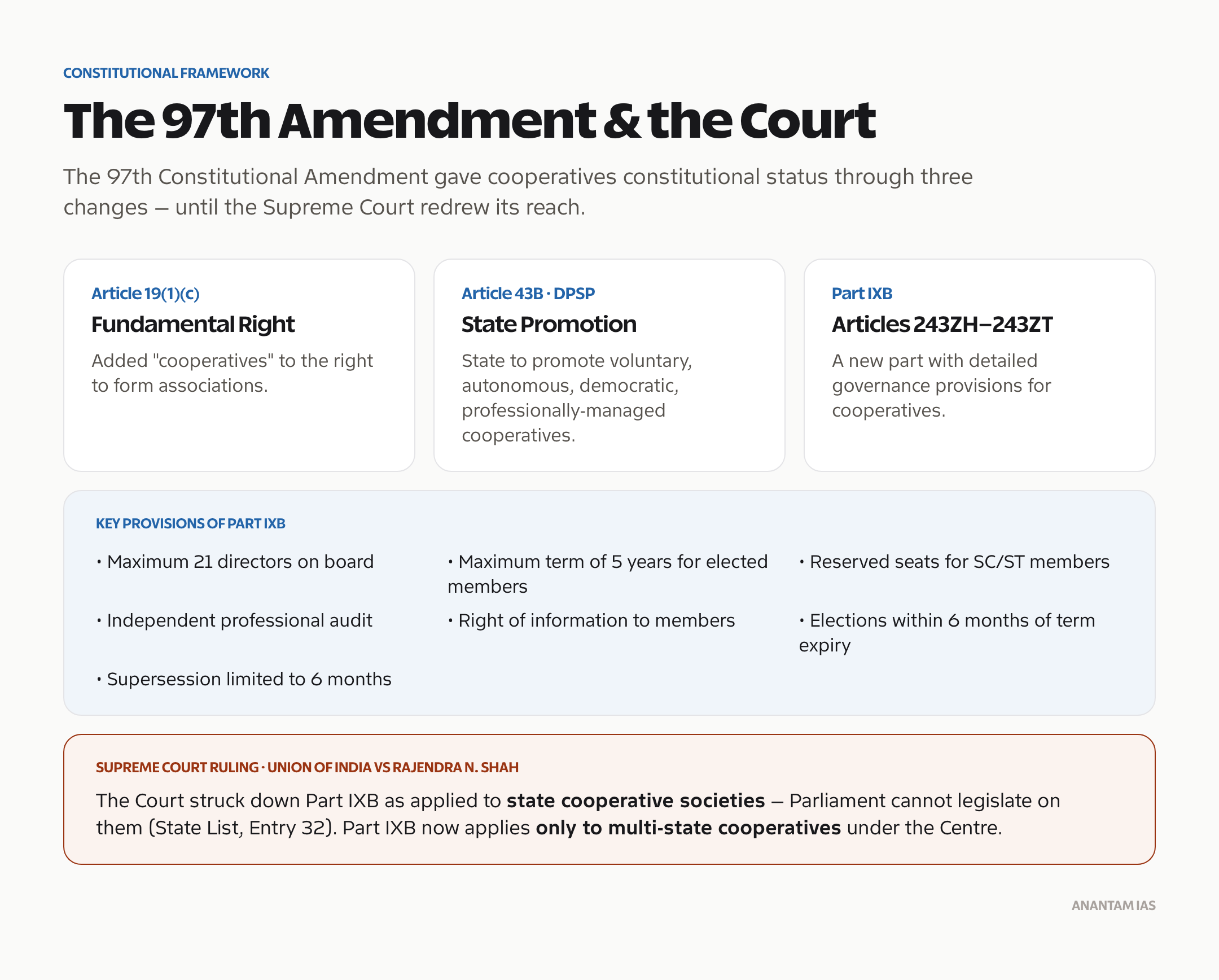
This amendment made three significant changes:
- Article 19(1)(c): Added “cooperatives” to the fundamental right to form associations
- Article 43B (DPSP): State shall promote voluntary formation, autonomous functioning, democratic control, and professional management of cooperatives
- Part IXB (Articles 243ZH–243ZT): Added a new part with detailed provisions for cooperatives
Key provisions of Part IXB:
- Maximum 21 directors on cooperative board
- Maximum term of 5 years for elected members
- Reserved seats for SC/ST members
- Independent professional audit
- Right of information to members
- Regular elections within 6 months of term expiry
- Supersession limited to 6 months
Supreme Court Ruling (2021)
The Supreme Court in Union of India vs Rajendra N. Shah struck down Part IXB as it applied to state cooperative societies — ruling that Parliament couldn’t legislate on state cooperatives (which fall under State List, Entry 32). Part IXB now applies only to multi-state cooperatives under the Central government’s purview.
Major Cooperatives in India
Amul (Gujarat Cooperative Milk Marketing Federation)
The most successful cooperative model in India — and arguably the world. Amul was founded in 1946 in Anand, Gujarat, under the leadership of Tribhuvandas Patel and later guided by Dr Verghese Kurien (the “Milkman of India”).
The Amul model:
- Village-level dairy cooperative societies (primary tier)
- District-level milk unions (processing and procurement)
- State-level federation (GCMMF — marketing and branding)
- Farmers own the entire supply chain — from production to retail
- Over 36 lakh milk producer members across Gujarat
Amul inspired Operation Flood (1970–96) — the National Dairy Development Board (NDDB) replicated the cooperative model nationwide, making India the world’s largest milk producer.
IFFCO (Indian Farmers Fertiliser Cooperative)
The world’s largest cooperative, IFFCO was established in 1967. It manufactures and distributes fertilisers to farmers through a cooperative network. IFFCO operates large fertiliser plants and has diversified into general insurance and rural telephony.
NAFED (National Agricultural Cooperative Marketing Federation)
Established in 1958, NAFED is the apex cooperative for agricultural marketing. It procures pulses, oilseeds, and other commodities under the Price Stabilisation Fund and government procurement operations. NAFED operates across marketing, processing, and distribution of agricultural produce.
Other Important Cooperatives
| Cooperative | Sector | Significance |
|---|---|---|
| Amul/GCMMF | Dairy | India’s largest food brand; Operation Flood model |
| IFFCO | Fertiliser | World’s largest cooperative |
| NAFED | Agricultural marketing | Apex body for agri-marketing |
| KRIBHCO | Fertiliser | Second-largest fertiliser cooperative |
| Indian Coffee House | Workers’ cooperative | Chain of cooperative restaurants |
| PACS (1 lakh+) | Rural credit | Grassroots credit to farmers |
| Sugar cooperatives (Maharashtra) | Sugar processing | Significant political and economic role |
| Lijjat Papad | Women’s cooperative | Successful self-employed women’s model |
Cooperative Credit Structure
India’s cooperative credit system has two parallel structures:
Short-Term Credit (Three-tier)
- State Cooperative Banks (SCBs): Apex level — channel RBI/NABARD funds
- District Central Cooperative Banks (DCCBs): Intermediate level
- Primary Agricultural Credit Societies (PACS): Village level — provide crop loans
Over 1 lakh PACS form the grassroots of India’s rural credit infrastructure, serving millions of small and marginal farmers.
Long-Term Credit (Two-tier)
- State Cooperative Agriculture and Rural Development Banks (SCARDBs)
- Primary Cooperative Agriculture and Rural Development Banks (PCARDBs)
These provide long-term investment credit for land development, minor irrigation, and farm mechanisation.
Challenges in Cooperative Credit
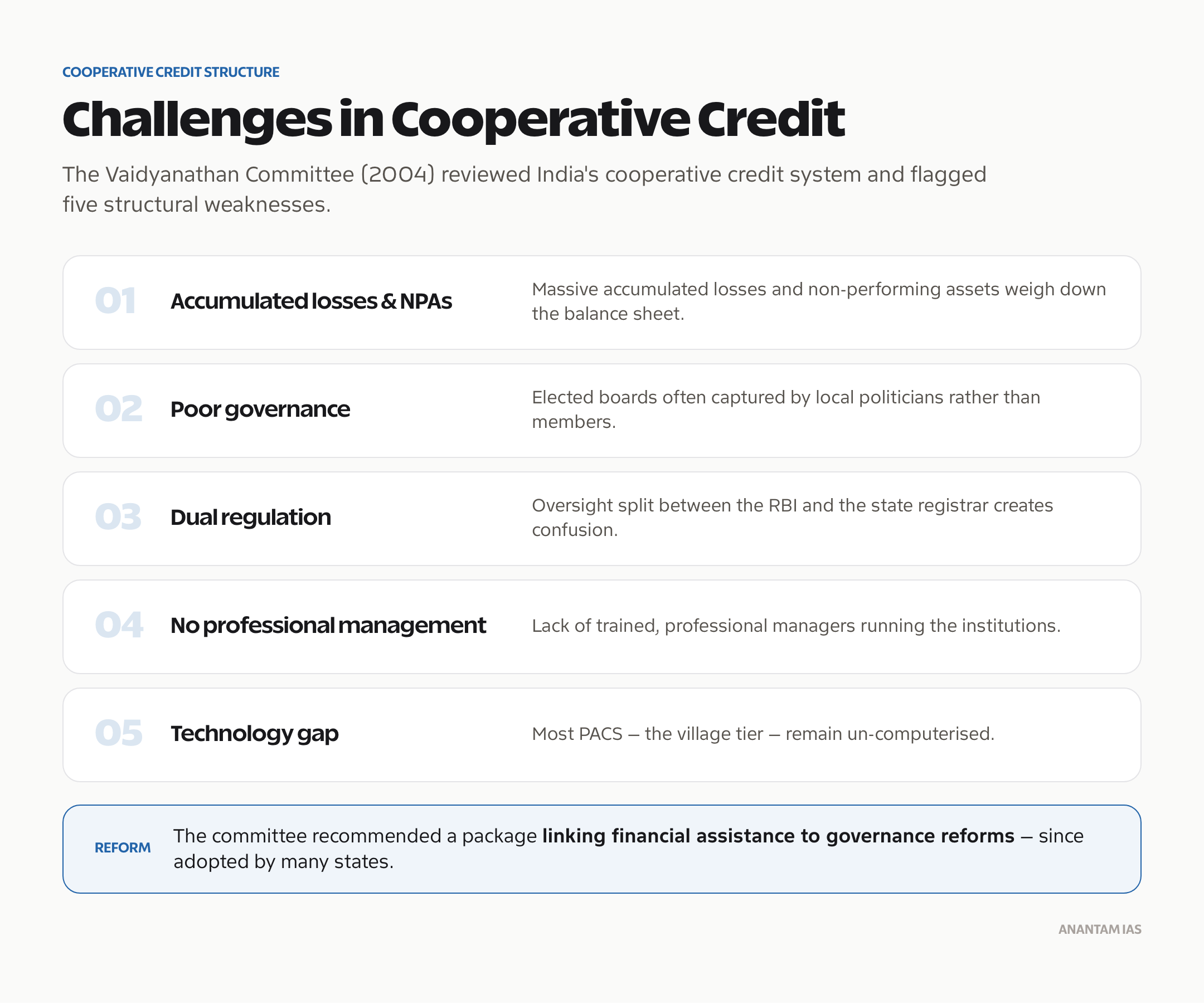
The Vaidyanathan Committee (2004) reviewed cooperative credit and found:
- Massive accumulated losses and NPAs
- Poor governance — elected boards often captured by local politicians
- Dual regulation (RBI + state registrar) creates confusion
- Lack of professional management
- Technology gap — most PACS not computerised
The committee recommended a reform package linking financial assistance to governance reforms — adopted by many states.
Banking System in India: Types & Structure
Ministry of Cooperation
The Ministry of Cooperation was created in July 2021 as a separate ministry — the first dedicated central ministry for cooperatives. Earlier, cooperatives fell under the Ministry of Agriculture.
Objectives
- Strengthen the cooperative movement at grassroots level
- Streamline governance and ensure transparency
- Promote computerisation of PACS
- Support formation of new cooperatives — especially multi-purpose ones
- Implement cooperative-related central schemes
Key Initiatives
- Computerisation of PACS: Target to computerise all 63,000+ viable PACS
- Formation of multi-purpose PACS: Enabling PACS to function as dairy cooperatives, FPOs, LPG distributors, and Jan Aushadhi Kendras
- National Cooperative Database: Comprehensive digitised record of all cooperatives
- Model Bye-Laws: Standardised governance framework for PACS
Challenges in India’s Cooperative Sector
Political Interference
Cooperative boards are often dominated by political figures who use them for patronage. Elections are delayed or manipulated. Professional management is sidelined. This is especially visible in sugar cooperatives (Maharashtra) and credit cooperatives.
Governance Deficit
Lack of democratic functioning — general body meetings not held regularly, audit delays, financial irregularities. The PMC Bank crisis (2019) exposed governance failures in urban cooperative banking.
Financial Weakness
Many cooperatives are financially unviable — accumulated losses, high NPAs in credit cooperatives, and dependence on government support. Only about 30% of PACS are truly functional.
Regulatory Issues
Dual regulation — cooperatives registered under state acts are regulated by both the Registrar of Cooperative Societies (state) and the RBI (for banking operations). This creates jurisdictional confusion and accountability gaps. The Banking Regulation (Amendment) Act, 2020 strengthened RBI oversight of cooperative banks.
| Challenge | Impact | Reform |
|---|---|---|
| Political interference | Poor governance, corruption | 97th Amendment provisions, model bye-laws |
| Financial weakness | NPAs, losses, closure | Vaidyanathan Committee reforms, NABARD support |
| Dual regulation | Confusion, gaps in oversight | Banking Regulation Amendment 2020 |
| Technology gap | Inefficiency, leakages | PACS computerisation programme |
| Low member participation | Democratic deficit | Awareness campaigns, training |
Land Reforms in India: History & Impact
Frequently Asked Questions
What is a cooperative society?
A cooperative society is a voluntary association of people who unite to meet common economic needs through a jointly owned, democratically controlled enterprise. Members contribute capital and share profits proportionally. In India, cooperatives operate in agriculture, dairy, credit, housing, consumer goods, and other sectors. They are registered under state cooperative laws or the Multi-State Cooperative Societies Act.
What is the 97th Constitutional Amendment?
The 97th Amendment (2011) gave constitutional recognition to cooperatives by adding Part IXB to the Constitution. It guaranteed the right to form cooperatives under Article 19(1)(c), added a DPSP (Article 43B) for promoting cooperatives, and set governance standards including term limits, regular elections, and professional audit. However, the Supreme Court (2021) restricted Part IXB to only multi-state cooperatives.
What is the Amul model of cooperatives?
The Amul model is a three-tier dairy cooperative structure: village-level societies (milk collection), district unions (processing), and state federation (marketing). Farmers own the entire chain and receive fair prices. Dr Verghese Kurien scaled this model nationally through Operation Flood, making India the world’s largest milk producer. The model is considered the gold standard for cooperative success.
Why was the Ministry of Cooperation created?
The Ministry of Cooperation was created in 2021 to provide dedicated central support for the cooperative sector, which had been handled by a division within the Agriculture Ministry. The new ministry aims to strengthen PACS, computerise cooperatives, promote multi-purpose societies, and improve governance. It signals the government’s intent to use cooperatives as vehicles for rural development and financial inclusion.