CSAT Cut-off Trends 2011–2026: Year-wise Analysis
CSAT cutoff trends from 2011 to 2026: year-wise pass rates, three eras of difficulty, the 2023 watershed, and what the 2026 paper means for the next cycle.
CSAT is a qualifying paper requiring 33% (66 out of 200 marks) to pass, but the real story is in how many candidates actually clear it each year. Between 2011 and 2025, CSAT difficulty has varied dramatically, reshaping the preliminary examination from a formality into a genuine filter. This analysis tracks 15 years of CSAT performance and identifies three distinct eras.
The 33% Qualifying Rule
Unlike GS Paper I where cut-offs vary by category (UR, OBC, SC, ST, EWS, PwBD), CSAT has a uniform qualifying bar: 66 marks for all categories. Failing CSAT results in your GS Paper I sheet not being evaluated — regardless of how well you scored in GS-I.
The Three Eras of CSAT
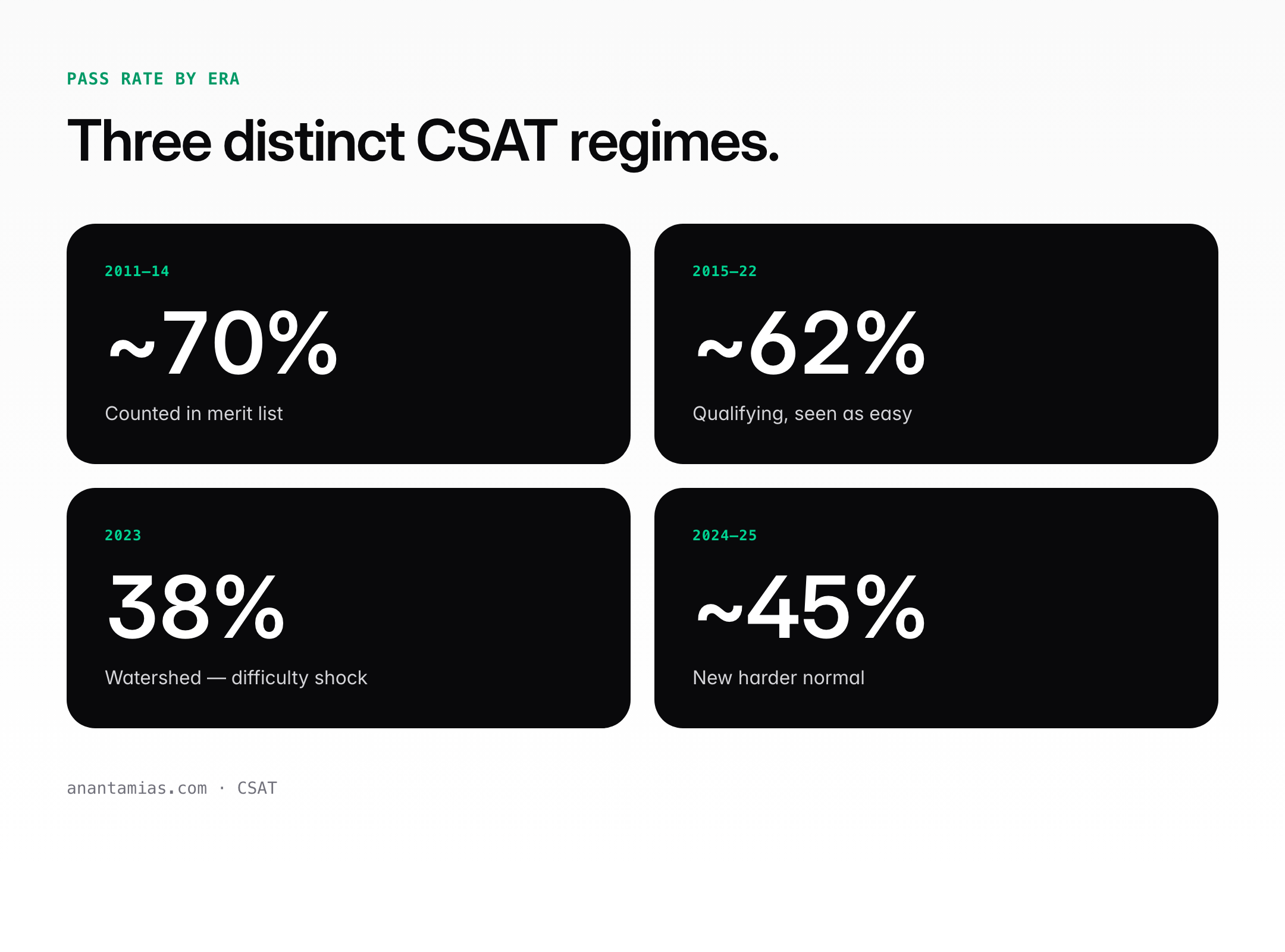
- Era 1 (2011–2014): CSAT counted in the merit list. Qualifying + ranking tool.
- Era 2 (2015–2022): CSAT made qualifying only (33%). Seen as easy.
- Era 3 (2023–present): CSAT made qualifying but genuinely tough.
Year-Wise CSAT Pass Rates (Estimates)
| Year | Approx. Pass Rate | Difficulty Level |
|---|---|---|
| 2011 | 75%+ | Easy |
| 2012 | 70%+ | Easy |
| 2013 | 72% | Easy–Moderate |
| 2014 | 65% | Moderate |
| 2015 | 68% | Moderate |
| 2016 | 72% | Moderate |
| 2017 | 62% | Moderate–Hard |
| 2018 | 55% | Hard |
| 2019 | 60% | Moderate–Hard |
| 2020 | 58% | Moderate–Hard |
| 2021 | 65% | Moderate |
| 2022 | 60% | Moderate |
| 2023 | 38% | Very Hard |
| 2024 | 48% | Hard |
| 2025 | 52% (est.) | Hard |
| 2026 | 62–72% (forecast) | Moderate–Hard |
Note: Exact pass rates are not published by UPSC. These are estimates derived from cut-off trends and candidate self-reports analyzed by test prep platforms.
Era 1: CSAT in Merit (2011–2014)
When CSAT was introduced in 2011, both Paper I and Paper II counted equally for 200 marks each. Engineers and commerce students benefited massively from CSAT’s quant and reasoning focus, shifting Prelims demographics. The 2014 protests by humanities students eventually forced UPSC to make CSAT qualifying from 2015.
Era 2: The Comfortable Years (2015–2022)
With CSAT made qualifying at 33%, most aspirants treated it as a formality. Average candidates scored 100 to 130 easily. Coaching institutes reduced CSAT syllabus coverage. The paper became an afterthought.
Era 3: The Difficulty Shock (2023–Present)
CSAT 2023 was a tectonic shift. Key changes:
- Reading comprehension passages grew from 300–400 words to 500–700 words.
- Inference-based questions replaced direct recall.
- Quantitative aptitude shifted from arithmetic to mixed arithmetic-algebra.
- Negative marking at 1/3 made guessing expensive.
Only about 38% cleared CSAT 2023, the lowest ever. Many candidates who scored 140+ in GS-I failed Prelims purely due to CSAT.
GS-I Cut-Offs (For Context)
| Year | UR | OBC | SC | ST | EWS |
|---|---|---|---|---|---|
| 2020 | 92.51 | 89.12 | 74.84 | 68.71 | 77.55 |
| 2021 | 87.54 | 84.85 | 75.41 | 70.71 | 80.14 |
| 2022 | 88.22 | 87.54 | 74.08 | 69.35 | 82.83 |
| 2023 | 75.41 | 74.75 | 59.25 | 47.82 | 68.02 |
| 2024 | 87.98 | 87.54 | 79.03 | 74.23 | 85.92 |
Note the sharp drop in 2023 GS-I cut-offs — not because GS-I was easier, but because fewer candidates cleared CSAT, leaving UPSC with a smaller pool to rank.
What 2027 Aspirants Should Expect
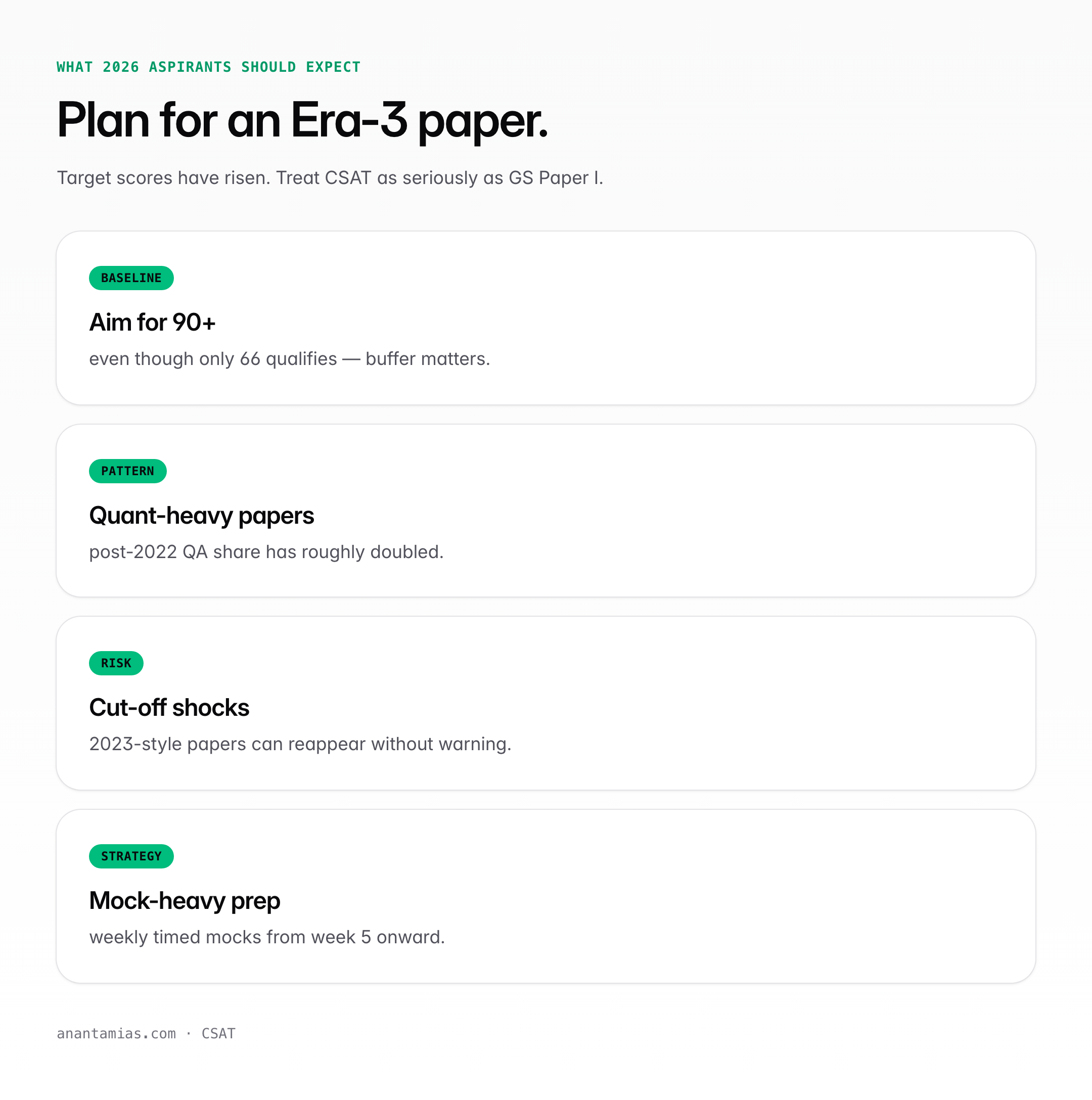
- CSAT stays in the 2023–2026 difficulty band. The 24 May 2026 paper came in moderate-to-tough — harder than 2024 and 2025, still short of 2023.
- Reading comprehension keeps the largest share: 28 of 80 questions in 2026.
- Quantitative aptitude ran to 26 questions in 2026, above the 22–24 band of the preceding years, and leaned on number-theory tricks rather than long calculation.
- Qualifying cut-off remains 66/200, but the real target should be 90+.
- Decision making came back in 2026 after years away — only two questions, in situational-judgment style. Plan for it instead of assuming it is gone.
Target Score Strategy
| Target | Strategy | Outcome |
|---|---|---|
| 66–80 | Scrape through | Risky — one bad RC set and you fail |
| 80–100 | Safe qualifier | Reasonable buffer |
| 100–130 | Strong qualifier | Comfortable margin |
| 130+ | Overkill | Time better spent on GS-I |
Optimal target: 95 to 110 marks. This provides a 30-point safety buffer while not over-consuming preparation time.

Cracking the CSAT Paper II 2027 — Arihant
- 633 pages, one manual across comprehension, reasoning, maths and DI
- Built to the post-2023 difficulty, with solved PYQs
- Chapter tests that mirror the 80-question paper
Common Myths About CSAT Cut-Off
- Myth: ‘CSAT has a relative cut-off.’ Fact: Only 33% absolute.
- Myth: ‘My caste gets a lower CSAT cut-off.’ Fact: 33% applies to all.
- Myth: ‘CSAT score matters in final merit.’ Fact: Not since 2015.
- Myth: ‘CSAT difficulty alternates year to year.’ Fact: Trend since 2023 has been consistently hard.
Key Takeaway
CSAT cut-off has never moved from 66/200 since 2015, but the difficulty of scoring those 66 marks has risen sharply. Plan for 90 to 110 marks. Solve all 15 previous year papers. Never assume CSAT will be easy.
Frequently Asked Questions
What is the CSAT qualifying cut-off?
33%, or 66 marks out of 200. This is uniform across all categories (UR, OBC, SC, ST, EWS, PwBD). Scoring below this disqualifies you from Prelims regardless of GS-I performance.
Does CSAT score count in final merit?
No, not since 2015. CSAT is purely qualifying. Only GS Paper I marks count for Prelims ranking, and only Mains + Interview count for final merit.
Why did the CSAT pass rate drop in 2023?
UPSC significantly raised CSAT difficulty in 2023: longer RC passages, inference-based questions, and harder quant. Only about 38% of appearing candidates cleared, the lowest rate in CSAT’s history.
Is the CSAT cut-off the same for reserved categories?
Yes. The 33% qualifying rule applies uniformly. Reservation benefits apply only to GS Paper I cut-offs, not CSAT.
What score should I target in CSAT?
Aim for 95 to 110 out of 200. This provides a healthy 30-point buffer above the 66 qualifying mark and protects against one bad section or unexpected difficulty spikes.
Will CSAT become easier in 2027?
Unlikely. The 24 May 2026 paper was moderate-to-tough, harder than 2024 and 2025, and reading comprehension again took 28 of 80 questions. UPSC has shown no signal of easing CSAT. Prepare for the 2023–2026 band, not for a return to the pre-2023 years.