Data Interpretation in CSAT: Tables, Charts & Graphs
Complete guide to CSAT Data Interpretation covering tables, bar charts, pie charts, caselets, approximation tricks, and fraction-percentage equivalents.
Data Interpretation (DI) in CSAT tests your ability to read tables, bar charts, line graphs, pie charts, and caselets, then perform quick calculations on the data. DI typically contributes 5 to 8 questions in CSAT (roughly 12 to 20 marks), but these are often the fastest-to-solve questions in the entire paper if your basics are strong.
Types of DI Questions in CSAT
- Tables: Raw data arranged in rows and columns.
- Bar charts: Vertical or horizontal bars comparing categories.
- Line graphs: Trends over time.
- Pie charts: Percentage distribution of a whole.
- Caselets: Paragraph-form data with 2 to 3 sub-questions.
- Mixed charts: A bar graph plus a line graph in one figure.
- Data sufficiency: Do the given statements answer the question?
Core Skills You Must Master
- Percentage calculations without pen and paper.
- Ratio and proportion manipulation.
- Approximation techniques (rounding to 2 significant figures).
- Averages, weighted averages, and percentage changes.
- Reading axis labels carefully (units matter: lakh vs crore).
The 4-Step DI Approach
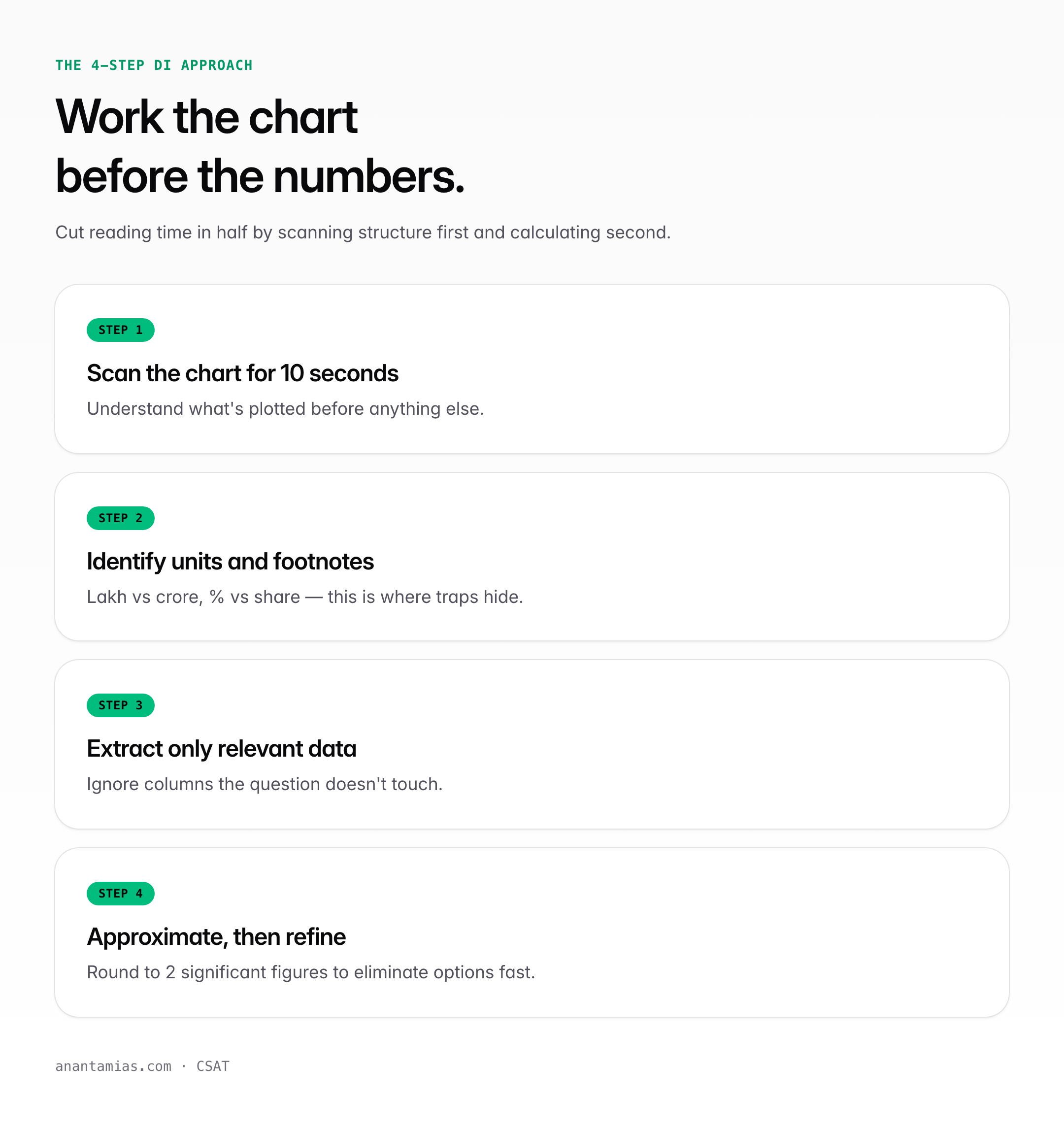
- Scan the chart/table for 10 seconds to understand what is plotted.
- Identify units and any footnotes (often tested).
- Extract only the relevant data for the question asked.
- Approximate first, calculate only if options are close.
Approximation Tricks That Save Time
| Situation | Trick | Example |
|---|---|---|
| % change ≤ 10% | Subtract from 100 | 108 → 100 + 8% |
| Large division | Round numerator & denominator | 4872 / 612 ≈ 4900/600 = 8.17 |
| Multiplication | Break into factors | 18 × 25 = 18 × 100/4 = 450 |
| Percentage of | Use fraction equivalents | 12.5% = 1/8, 16.66% = 1/6 |
| Close options | Calculate to 3 significant figures | — |
Common Fraction-Percentage Equivalents
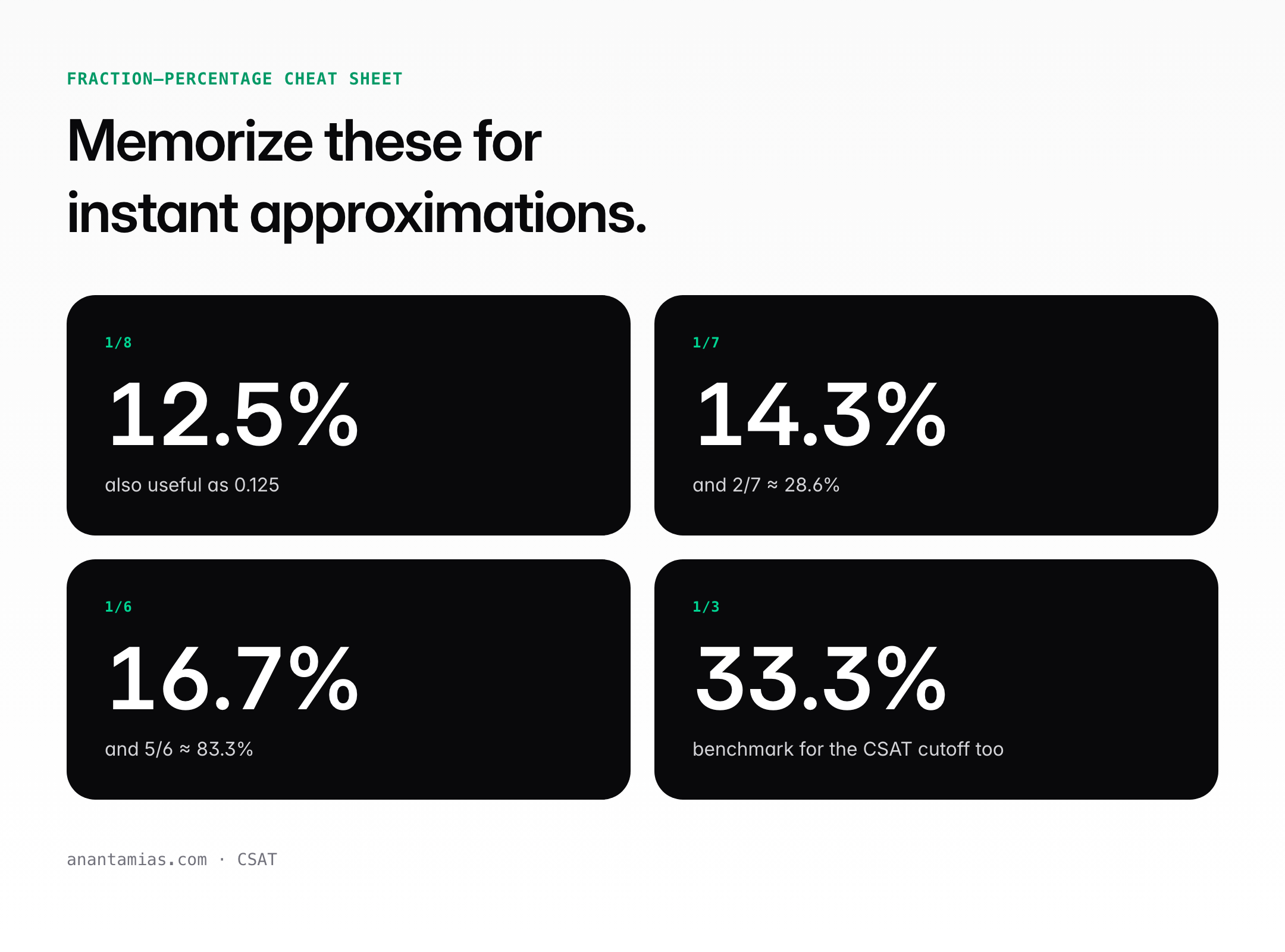
| Fraction | Percentage | Fraction | Percentage |
|---|---|---|---|
| 1/2 | 50% | 1/7 | 14.28% |
| 1/3 | 33.33% | 1/8 | 12.5% |
| 1/4 | 25% | 1/9 | 11.11% |
| 1/5 | 20% | 1/10 | 10% |
| 1/6 | 16.66% | 1/11 | 9.09% |
Memorize these. They shave 20+ seconds off most percentage calculations.
Sample DI Caselet
A company sold 2,400 units in 2023 and 3,000 units in 2024. The revenue in 2023 was Rs 48 lakh, and in 2024 it rose to Rs 66 lakh. Find the percentage increase in average price per unit from 2023 to 2024.
Solution:
- 2023 price per unit = 48,00,000 / 2,400 = Rs 2,000.
- 2024 price per unit = 66,00,000 / 3,000 = Rs 2,200.
- Increase = (2,200 – 2,000) / 2,000 × 100 = 10%.
Data Sufficiency Basics
You are given a question and two statements (I and II). Decide which statement alone or together answers the question. Options are typically:
- (a) Statement I alone is sufficient.
- (b) Statement II alone is sufficient.
- (c) Both statements together are needed.
- (d) Neither statement is sufficient.
Never solve — only check sufficiency. This is where most aspirants waste 60 seconds.
Common Mistakes in DI
- Misreading axis labels (thousand vs lakh).
- Confusing ‘increase by 20%’ with ‘increase to 20%’.
- Ignoring footnotes (often contain exclusions).
- Assuming linear trends in line graphs.
- Over-calculating when approximation suffices.
Practice Routine

Quantitative Aptitude — R.S. Aggarwal (Revised 2026–27)
- The standard drill book for arithmetic and data interpretation
- Graded exercises from basics to exam level
- Far more questions than a CSAT candidate needs
- Solve 5 DI sets per week, each with 3 to 5 questions.
- Maintain an error log categorized by type of mistake.
- Time each set — target 4 minutes for 5 questions.
- Revise fraction-percentage table weekly until automatic.
Conclusion
DI is the most scoring section in CSAT if you train your approximation reflexes. A student who masters DI can lock in 15+ marks in under 8 minutes, buying crucial time for RC and reasoning.
Frequently Asked Questions
How many DI questions come in CSAT?
Typically 5 to 8 questions, contributing 12 to 20 marks. Though fewer in number, DI is high-accuracy territory for well-prepared candidates.
Do I need to memorize formulas for DI?
Very few. You need percentage, ratio, average, and percentage change. Memorize the fraction-percentage table (1/2 through 1/12) to speed up mental math.
What is the best book for CSAT DI?
RS Aggarwal’s Quantitative Aptitude (DI chapters) and Arun Sharma’s Data Interpretation are standards. Supplement with CSAT previous year papers from 2011 to 2025.
How is CSAT DI different from CAT/Bank exam DI?
CSAT DI is easier in calculations but trickier in interpretation. UPSC emphasizes reading the chart correctly over complex arithmetic. Bank and CAT DI focus more on calculation speed.
How much time should I allot per DI question?
Target 45 to 60 seconds per question. A 5-question caselet should be finished in 4 to 5 minutes, including the 30 seconds spent reading the chart.