CSAT Paper II: Complete Guide to Syllabus, Pattern & Cutoff
A complete guide to UPSC CSAT Paper II covering syllabus, exam pattern, difficulty trends from 2011 to 2025, and how to clear the 33% qualifying cutoff.
CSAT (Civil Services Aptitude Test) is Paper II of the UPSC Civil Services Preliminary Examination. Introduced in 2011 to replace the optional-subject-based Paper II, CSAT is a 200-mark qualifying paper where you must score at least 33% (66 marks) to have your General Studies Paper I evaluated. It is the single biggest reason thousands of candidates fail Prelims every year, despite scoring well in GS-I.
What is CSAT?
CSAT tests comprehension, interpersonal and communication skills, logical reasoning, analytical ability, decision-making, problem-solving, basic numeracy (Class X level), and data interpretation. The paper is set bilingually (English and Hindi) and consists of 80 multiple-choice questions carrying 2.5 marks each, for a total of 200 marks. The test duration is 2 hours.
CSAT Exam Pattern at a Glance
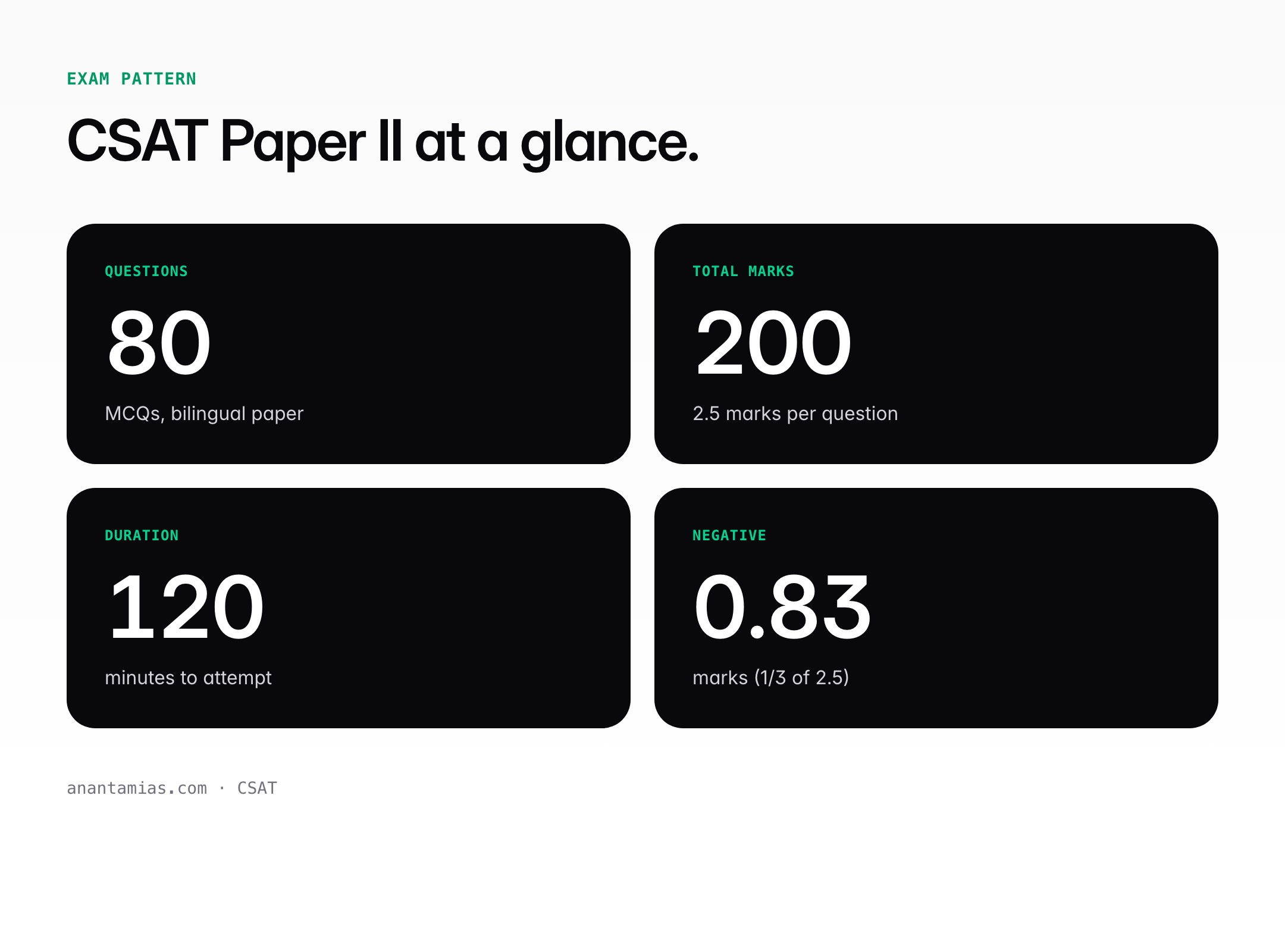
| Parameter | Details |
|---|---|
| Total Questions | 80 |
| Total Marks | 200 |
| Marks per Question | 2.5 |
| Negative Marking | 1/3rd (0.83 marks) |
| Duration | 2 hours (120 minutes) |
| Qualifying Marks | 66 out of 200 (33%) |
| Medium | English and Hindi |
Complete CSAT Syllabus
UPSC’s official notification lists seven areas that CSAT can test. In practice, the paper is dominated by three: Reading Comprehension, Logical Reasoning, and Basic Numeracy & Data Interpretation.
- Comprehension: Usually 25 to 30 passage-based questions.
- Interpersonal skills including communication skills.
- Logical reasoning and analytical ability.
- Decision-making and problem-solving.
- General mental ability.
- Basic numeracy (numbers and their relations, orders of magnitude, etc., Class X level).
- Data interpretation (charts, graphs, tables, data sufficiency, etc., Class X level).
Section-wise Weightage (2023–2025 Trends)
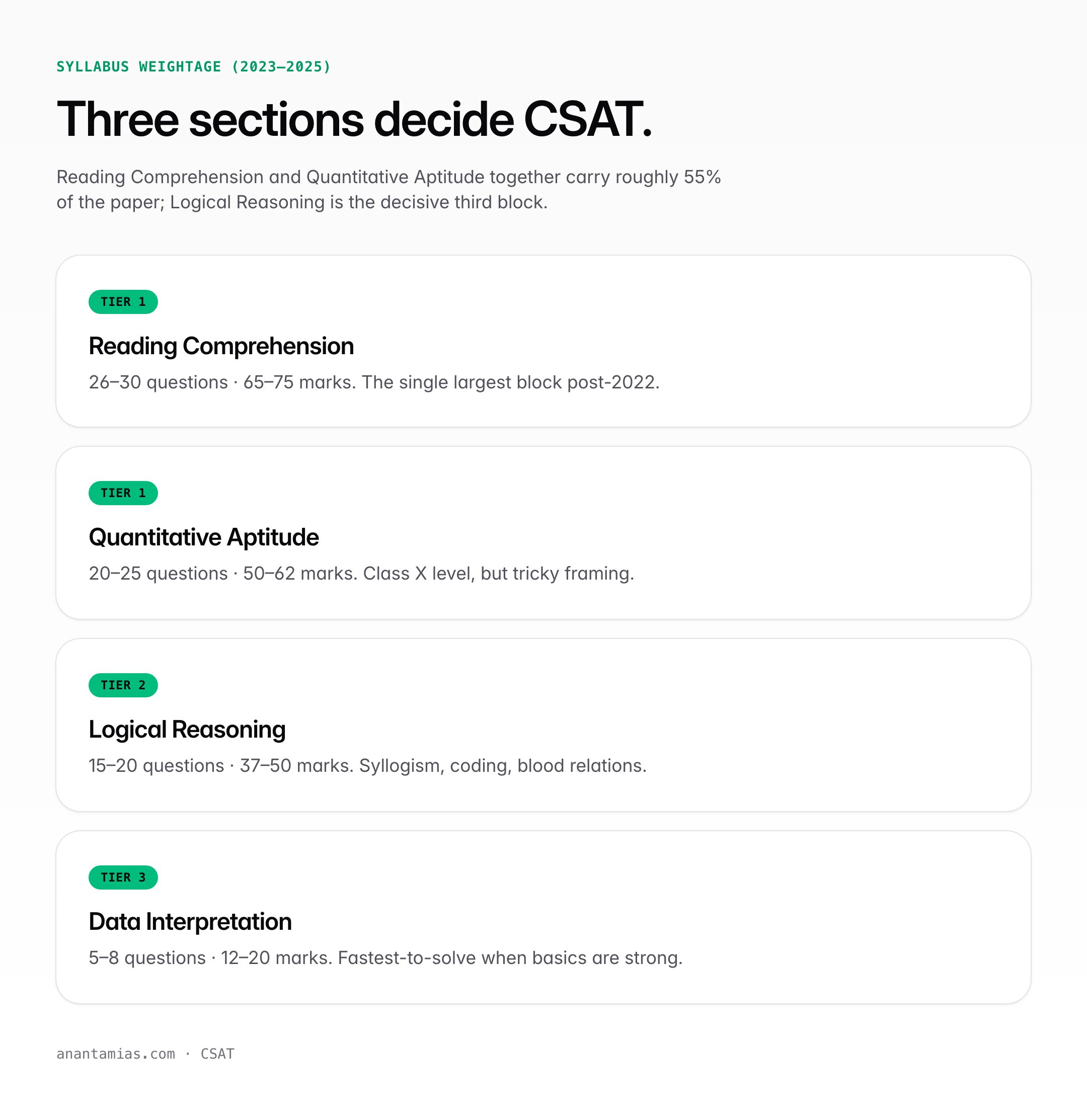
| Section | Avg Questions | Marks |
|---|---|---|
| Reading Comprehension | 26–30 | 65–75 |
| Quantitative Aptitude | 20–25 | 50–62 |
| Logical Reasoning | 15–20 | 37–50 |
| Data Interpretation | 5–8 | 12–20 |
| Decision Making | 0–3 | 0–7 |
CSAT Cut-off: The 33% Rule
Unlike GS Paper I, CSAT is qualifying in nature. You need exactly 66 marks out of 200. However, since 2023 UPSC has made the paper significantly harder, pushing failure rates above 60% in some years. In 2023, only about 38% of those who wrote Prelims cleared CSAT. In 2024 the paper swung slightly easier but still eliminated close to half of all candidates.
Why CSAT Became a Problem (Post-2022)
Before 2022, CSAT was considered a formality by engineering and commerce graduates. After 2023, humanities and arts students began failing in large numbers because:
- Passages became longer (500–700 words) and more philosophical.
- Questions started testing inference rather than literal recall.
- Quantitative questions moved from Class X to early-college difficulty.
- Time pressure increased: 80 questions in 120 minutes = 90 seconds per question.
How to Interpret the Qualifying Threshold
Do not aim for just 66. Aim for 90+. Negative marking (1/3rd) means 10 wrong guesses cost you 8.3 marks. Target roughly 45–50 correct attempts with 85% accuracy, which gives a safe buffer of ~95 marks.
Books and Resources

Cracking the CSAT Paper II 2027 — Arihant
- 633 pages, one manual across comprehension, reasoning, maths and DI
- Built to the post-2023 difficulty, with solved PYQs
- Chapter tests that mirror the 80-question paper

Quantitative Aptitude — R.S. Aggarwal (Revised 2026–27)
- The standard drill book for arithmetic and data interpretation
- Graded exercises from basics to exam level
- Far more questions than a CSAT candidate needs
- CSAT Paper II Manual by TMH (McGraw Hill) — comprehensive.
- Analytical Reasoning by MK Pandey — logical reasoning.
- Quantitative Aptitude by RS Aggarwal — arithmetic foundation.
- CSAT Previous Year Papers (2011–2025) — non-negotiable.
- Disha/Arihant CSAT Practice Sets for mock tests.
Final Takeaway
CSAT is no longer a paper you can take lightly. Treat it with the same seriousness as GS-I. Solve at least 30 previous year papers, take 15 full-length mocks, and dedicate a minimum of 90 minutes daily during the last 60 days before Prelims.
Frequently Asked Questions
Watch on YouTube
Related video from the Anantam IAS YouTube channel.
Is CSAT qualifying in nature?
Yes. You must score at least 33% (66 out of 200 marks) in CSAT Paper II. If you fail, your GS Paper I answer sheet will not be evaluated, regardless of how well you score in it.
How many questions are there in CSAT?
CSAT has 80 multiple-choice questions. Each question carries 2.5 marks, for a total of 200 marks. There is a negative marking of one-third (0.83 marks) for every incorrect answer.
What is the duration of CSAT Paper II?
The duration is 2 hours (120 minutes). This gives you approximately 90 seconds per question, which makes time management one of the biggest challenges of the paper.
How difficult is CSAT after 2023?
CSAT 2023 was widely considered the toughest ever, with only 38% candidates clearing it. 2024 and 2025 papers remained challenging. Passages are longer, quantitative questions harder, and inference-based questions have increased significantly.
Can I skip CSAT preparation if I am from a math background?
No. Engineering and commerce graduates used to clear CSAT easily until 2022, but recent papers emphasize reading comprehension and logical reasoning equally. Even a strong quant background will not save you if your RC speed is poor.
How many mocks should I take for CSAT?
A minimum of 15 full-length CSAT mocks under timed conditions, plus 30 previous year papers solved section-wise. Review every wrong answer and categorize mistakes into conceptual, silly, or time-pressure errors.