Daily Digest
UPSC · Civil Services Examination
Current Affairs · Sunday, 10 August 2025
Current affairs curated and edited by Anantam IAS faculty — pulled from The Hindu, PIB, IDSA, Foreign Affairs and the ministries. Read, annotate, revise.
Old Rajinder Nagar · Delhi 110005 · anantamias.com
NITI Aayog Pulses Vision: Doubling Output to 51.57 MT by 2047
Introduction
On 10 August 2025, NITI Aayog released a vision paper outlining a long-term roadmap for India’s pulses economy, setting an ambitious target of 51.57 million tonnes (MT) of domestic pulses output by 2047 — roughly double the current production of about 26 MT recorded in 2024–25 (NITI Aayog, Aug 2025). The document, titled along the lines of “Pulses Self-Sufficiency: A Vision for Viksit Bharat 2047,” frames pulses not merely as an agricultural commodity but as a strategic input for nutritional security, soil health, farmer income, and foreign-exchange savings. It comes against the backdrop of India remaining the world’s largest producer, consumer, and importer of pulses simultaneously — an anomaly that successive governments have tried to fix through the National Food Security Mission (NFSM)-Pulses, dedicated Minimum Support Price (MSP) regimes for tur, urad, moong, gram and masur, and import-substitution drives.
The vision paper has triggered a fresh policy conversation on whether India can finally close its protein deficit, reduce dependence on imports from Canada, Myanmar, Mozambique, Australia, and Tanzania, and integrate pulses more deeply into the Public Distribution System (PDS). For UPSC aspirants, this overlaps with GS-III (Agriculture, Food Security), GS-II (Government Schemes), and the Indian Economy paper. This article unpacks the targets, the structural story of India’s pulses economy, the institutional architecture (NFSM, MSP, IIPR, PSF), the bottlenecks in productivity and procurement, and the implications for Atmanirbhar Bharat in agriculture.
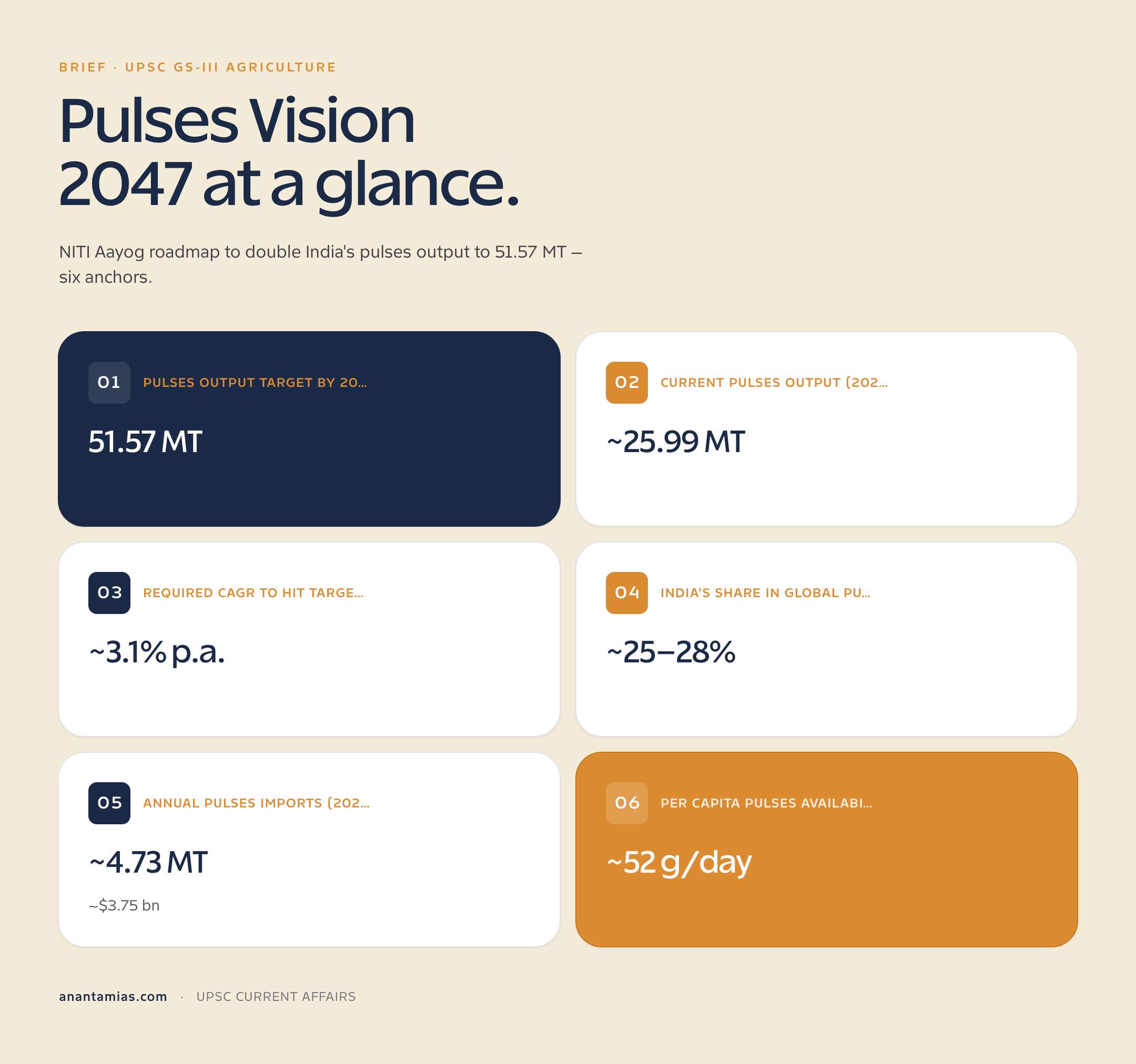
Quick Facts at a Glance
| Indicator | Value | Source |
|---|---|---|
| Pulses output target by 2047 | 51.57 MT | NITI Aayog Vision Paper, Aug 2025 |
| Current pulses output (2024–25, 3rd advance estimate) | ~25.99 MT | Ministry of Agriculture & Farmers Welfare, 2025 |
| Required CAGR to hit target | ~3.1% p.a. | NITI Aayog, Aug 2025 |
| India’s share in global pulses production | ~25–28% | FAO & PIB, 2024 |
| Annual pulses imports (2023–24) | ~4.73 MT, ~$3.75 bn | DGCI&S / DGFT, 2024 |
| Per capita pulses availability | ~52 g/day | NSO Household Consumption Survey, 2023–24 |
| ICMR-NIN recommended intake | ~85 g/day (adult) | ICMR-NIN Dietary Guidelines, 2024 |
| Lead research institute | ICAR-IIPR, Kanpur | ICAR, 2024 |
Background and Historical Context
India’s pulses story is paradoxical. The country produces nearly a quarter of global output yet consistently runs a domestic shortfall. Until the early 2000s, pulses output stagnated around 13–15 MT, while population and per-capita demand kept climbing. The sharp price spike of tur dal in 2015–16 — when retail prices crossed Rs 200 per kg in several metros — became a political inflection point. The Arvind Subramanian Committee on Pulses (2016) recommended raising MSP, building a strategic buffer stock, lifting export bans selectively, and incentivising farmers to shift acreage from water-intensive paddy and sugarcane to pulses. The committee’s report set the template for the Pradhan Mantri Annadata Aay SanraksHan Abhiyan (PM-AASHA) in 2018 and the deepening of NFSM-Pulses across 638 districts.
Production responded. From 16.32 MT in 2015–16 output climbed past 27 MT in 2021–22 — a record (Ministry of Agriculture, 2022). But the growth plateaued thereafter due to erratic monsoons, pest attacks on tur and urad, and a structural shift of acreage back to cereals and oilseeds. By 2023–24, output dipped to 24.5 MT, forcing India to lift import duties on yellow peas and tur, sign duty-free arrangements with Mozambique and Malawi, and extend free-import windows till 2025. The NITI Aayog vision paper reads this trajectory and concludes that incremental tweaking will not get India to self-sufficiency — a structural overhaul of seeds, irrigation, MSP coverage, and post-harvest infrastructure is required, anchored in a clear 2047 target.
Key Pillars of the Pulses 2047 Vision
Yield revolution through seed and science
The vision paper’s first pillar is a productivity leap. India’s pulses yield is around 892 kg/hectare — well below the global average of 1,100 kg/ha and less than half of Canada’s 1,950 kg/ha for chickpea. NITI Aayog proposes scaling up Seed Hubs under ICAR-IIPR, Kanpur, expanding the Seed Replacement Rate (SRR) from the current 35–40% to over 60%, and accelerating release of climate-resilient varieties such as IPA-203 (chickpea), IPM 2-14 (mungbean), and short-duration arhar like Pusa Arhar 16. The paper also flags genome-edited pulses — following the 2024 release of two genome-edited rice varieties by ICAR — as a frontier opportunity for biotic-stress tolerance (NITI Aayog, 2025).
MSP-led procurement and price stability
The second pillar deepens price assurance. The Cabinet Committee on Economic Affairs (CCEA) raised the MSP for tur to Rs 8,000/quintal, urad to Rs 7,800/quintal, and moong to Rs 8,768/quintal for the 2025–26 kharif marketing season (PIB, 2025). NITI Aayog argues that MSP is necessary but insufficient — actual procurement of pulses at MSP has historically covered less than 15% of marketed surplus, leaving most farmers exposed to spot prices. The paper recommends guaranteed 25% procurement through NAFED and NCCF, expansion of Price Support Scheme (PSS), and a transparent Pulses Buffer Stock of 4–6 MT to smooth retail prices and protect kharif arrivals from crash.
PDS, nutrition, and demand-side levers
The third pillar links pulses to protein security. With per-capita pulses availability at roughly 52 g/day against the ICMR-NIN recommended 85 g/day, the vision paper proposes mainstreaming pulses in the Pradhan Mantri Garib Kalyan Anna Yojana (PMGKAY), the PM POSHAN (mid-day meal) scheme, and Anganwadi Take-Home Rations. A standing 1 kg/month per household pulses entitlement under PDS — currently piloted in select states — would create a guaranteed offtake floor and allow forward contracts with Farmer Producer Organisations (FPOs). NITI Aayog estimates this single measure could absorb 5–6 MT of incremental output annually by 2047, anchoring the supply-side push with a clear demand signal.
Significance for UPSC
- GS-III Agriculture: Direct relevance to cropping pattern, MSP regime, irrigation, technology missions, and farm income (PM-KISAN linkage).
- GS-III Food Security: Connects to PDS, NFSA 2013, nutrition security, ICMR-NIN guidelines, and the protein deficit debate.
- GS-II Governance: NITI Aayog’s role as policy think-tank, Cooperative Federalism, NFSM as Centrally Sponsored Scheme.
- GS-III Economy: Import dependence, current-account effect of $3.75 bn pulses imports, exchange-rate transmission to retail inflation.
- GS-III Environment: Pulses as nitrogen-fixing crops — soil health, sustainable agriculture, climate-resilient cropping under Mission for Sustainable Agriculture.
- Essay paper: “Self-reliance in agriculture is the foundation of strategic autonomy” — pulses as a perfect case study.
Detailed Analysis: The Structural Economics of India’s Pulses Trade
India’s pulses deficit has long been a function of three structural mismatches. First, acreage is rainfed and marginal — over 87% of pulses area is unirrigated (Agricultural Statistics at a Glance, 2024), concentrated in dryland tracts of Madhya Pradesh, Rajasthan, Maharashtra, Karnataka, and Uttar Pradesh. Second, MSP transmission is weak: even when announced MSP exceeds Rs 7,000/quintal, mandi arrivals during peak harvest often clear at 10–15% below MSP, especially for tur and urad in October–November. Third, imports cushion the deficit but distort domestic price signals. India relies on yellow peas from Canada and Russia, tur from Mozambique, Malawi, and Myanmar, and urad from Myanmar. When import windows open, mandi prices crash; when they shut, retail spikes — a cycle that depresses long-term acreage decisions.
State-wise, the pulses map is concentrated. The table below shows the production share of the top five states based on the third advance estimate for 2024–25 — a useful reference for prelims:
| State | Pulses Output (2024–25, MT) | Share of National Output |
|---|---|---|
| Madhya Pradesh | 6.10 | ~23% |
| Rajasthan | 4.55 | ~17% |
| Maharashtra | 3.40 | ~13% |
| Uttar Pradesh | 2.90 | ~11% |
| Karnataka | 1.95 | ~7.5% |
| Rest of India | 7.09 | ~28.5% |
The vision paper’s pathway to 51.57 MT rests on a productivity-plus-acreage strategy. Productivity is expected to rise from the current 892 kg/ha to roughly 1,400 kg/ha by 2047, while net sown area under pulses expands modestly from 29.1 million hectares to about 36 million hectares. Critically, NITI Aayog flags rice-fallow areas in eastern India — Bihar, West Bengal, Jharkhand, Odisha, and Assam — covering nearly 11.7 million hectares as the single largest untapped frontier. With short-duration moong, urad, and lentil varieties and minimal irrigation support, even a 30% conversion of rice fallows could add 4–5 MT annually. Linking this to PM Kisan Maan-Dhan Yojana and FPO-led collectivisation would protect smallholder margins.
The trade dimension matters equally. India’s pulses imports averaged $2.8–3.8 billion annually over 2020–24 (DGCI&S, 2024). At the 2047 self-sufficiency target, this saves the equivalent of roughly 0.1–0.2% of GDP in foreign exchange — modest in macro terms, but politically and strategically significant given that pulses imports are concentrated in a handful of geographies vulnerable to climate disruption (Canada wildfires) and geopolitical risk (Myanmar’s internal conflict). Self-sufficiency thus becomes a hedge against both climate volatility and supply-chain weaponisation.
Challenges and Criticisms
The 2047 target has drawn measured scepticism. The Indian Council for Research on International Economic Relations (ICRIER), in a working paper by Ashok Gulati and co-authors (2024), argues that India has historically under-invested in pulses R&D — barely 0.5% of total agricultural research outlay goes to pulses despite their share of more than 20% of cropped area in many states. Without a step-change in research funding for IIPR, climate-tolerant varieties, and seed multiplication infrastructure, productivity targets risk slipping. ICRIER also flags that MSP procurement of pulses has averaged below 15% of marketed surplus, far short of the 25% the vision paper proposes — an operational gap that NAFED and NCCF have not yet closed even with strong fiscal backing.
A second critique concerns water and ecology. While pulses are rainfed and water-efficient, expansion into rice fallows requires lifecycle protective irrigation at flowering — typically two assured irrigations. The Jal Shakti Abhiyan and PM Krishi Sinchayee Yojana (PMKSY) have not yet meaningfully reached eastern rice-fallow tracts. There is also the political-economy concern: lifting import duties to manage retail prices repeatedly undercuts domestic farmers, and the Standing Committee on Agriculture (2024) in its 38th report criticised the “stop-go” import policy as the single biggest disincentive for pulses acreage expansion. Without policy stability — predictable tariffs, transparent buffer stock operations, and time-bound procurement — even a well-designed vision paper risks remaining a glossy aspiration.
Prelims Pointers
- NITI Aayog vision paper (Aug 2025) targets 51.57 MT pulses by 2047.
- India’s pulses output (2024–25, 3rd advance estimate): ~25.99 MT.
- Top pulses-producing state: Madhya Pradesh (~23% share).
- Lead research institute: ICAR–Indian Institute of Pulses Research (IIPR), Kanpur.
- Tur MSP for kharif 2025–26: Rs 8,000/quintal; moong: Rs 8,768/quintal; urad: Rs 7,800/quintal.
- NFSM-Pulses operates across 638 districts.
- Per-capita pulses availability: ~52 g/day vs ICMR-NIN recommended 85 g/day.
- Major pulses imports: yellow peas (Canada/Russia), tur (Mozambique/Malawi/Myanmar), urad (Myanmar).
- PM-AASHA launched in 2018; includes Price Support Scheme (PSS), Price Deficiency Payment Scheme (PDPS), and Pilot Private Procurement & Stockist Scheme (PPPS).
- Procurement agencies for pulses: NAFED and NCCF.
- Pulses are nitrogen-fixing legumes — Rhizobium symbiosis enriches soil nitrogen.
- India is simultaneously the world’s largest producer, consumer, and importer of pulses.
Mains Practice Questions
- “India remains the world’s largest producer, consumer, and importer of pulses simultaneously.” Examine the structural reasons for this paradox and evaluate the NITI Aayog 2047 vision as a corrective. (15 marks, 250 words)
- Discuss the role of MSP, buffer stock, and import policy in stabilising pulses prices in India. To what extent has PM-AASHA delivered on its objectives? (10 marks, 150 words)
- “Self-sufficiency in pulses is as much a strategic question as an agricultural one.” Critically analyse in the context of recent geopolitical and climate disruptions in pulses-exporting countries. (15 marks, 250 words)
- Evaluate the potential of rice-fallow areas in eastern India for boosting pulses production. What policy and institutional support is required to unlock this frontier? (10 marks, 150 words)
- Examine the linkages between protein deficiency, the Public Distribution System, and pulses self-sufficiency. Should pulses be made a guaranteed entitlement under the National Food Security Act? (15 marks, 250 words)
Conclusion
The NITI Aayog Pulses 2047 vision is the most ambitious institutional articulation of pulses self-sufficiency since the Subramanian Committee of 2016. By doubling output to 51.57 MT, the document does not merely propose a production target — it implicitly proposes a reorientation of cropping policy, procurement architecture, research priorities, and trade policy around pulses as a strategic crop. The convergence with the Atmanirbhar Bharat framing is deliberate: pulses sit at the intersection of farm income, dietary protein, soil health, and foreign-exchange savings, making them a uniquely high-leverage commodity for policy intervention.
Whether the target is met will depend less on tonnage arithmetic and more on the political economy of follow-through. Predictable MSP procurement, sustained R&D funding for IIPR and the National Agricultural Research System, climate-resilient seed multiplication, irrigation in rice-fallow tracts, and a stable tariff regime that does not crush farm-gate prices each time retail inflation flares — these are the binding constraints. For the UPSC aspirant, the vision paper is a textbook case of how India’s agricultural challenges are systemic: production targets, market structure, nutrition policy, and trade strategy must move together. Done well, pulses self-sufficiency by 2047 could become one of the quieter but more consequential planks of Viksit Bharat, lifting smallholder incomes, anchoring food inflation, and freeing scarce foreign exchange for higher-value imports.
Frequently Asked Questions
What is the pulses production target set by NITI Aayog for 2047?
NITI Aayog’s vision paper released around 10 August 2025 sets a target of 51.57 million tonnes of pulses output by 2047 — roughly double the current production of about 26 MT — to achieve domestic self-sufficiency and reduce import dependence.
Why is India still importing pulses despite being the world’s largest producer?
India’s pulses output of ~26 MT falls short of domestic demand of nearly 30 MT. Low yields (892 kg/ha vs Canada’s 1,950 kg/ha for chickpea), unirrigated acreage, and erratic monsoons leave a structural gap of 3–5 MT that is filled through imports from Canada, Myanmar, Mozambique, and Australia.
What is NFSM-Pulses?
The National Food Security Mission–Pulses is a Centrally Sponsored Scheme that operates in 638 districts across major pulses-growing states. It funds seed minikits, certified seed distribution, integrated pest management, machinery, and demonstrations to raise productivity and area under tur, gram, urad, moong, and lentil.
Which is the largest pulses-producing state in India?
Madhya Pradesh is the largest, contributing about 23% of national output (roughly 6 MT in 2024–25), followed by Rajasthan, Maharashtra, Uttar Pradesh, and Karnataka. These five states together account for over 70% of India’s pulses production.
What is the role of IIPR Kanpur?
The Indian Institute of Pulses Research (IIPR), Kanpur, is the apex ICAR institute for pulses R&D. It develops climate-resilient varieties (e.g., IPA-203 chickpea, IPM 2-14 mungbean, Pusa Arhar 16), runs Seed Hubs, and coordinates the All-India Coordinated Research Project on pulses.
How does MSP work for pulses?
The CCEA announces Minimum Support Prices for tur, urad, moong, gram, and lentil before each season. NAFED and NCCF procure at MSP under the Price Support Scheme of PM-AASHA. For kharif 2025–26, tur MSP is Rs 8,000/quintal, urad Rs 7,800, and moong Rs 8,768. However, actual procurement covers only 10–15% of marketed surplus.
Why are pulses important for soil health?
Pulses are leguminous crops that host Rhizobium bacteria in root nodules, fixing atmospheric nitrogen into a plant-available form. This enriches soil nitrogen, reduces need for synthetic fertilisers, and improves yields of subsequent cereal crops in rotation — a key reason pulses are central to sustainable agriculture and crop diversification.
What is the rice-fallow opportunity for pulses?
Roughly 11.7 million hectares of land in eastern India — Bihar, West Bengal, Jharkhand, Odisha, and Assam — lie fallow after the kharif rice harvest. Short-duration pulses like moong, urad, and lentil can be sown in this rabi window with residual soil moisture, potentially adding 4–5 MT of pulses annually with minimal irrigation support.
Source: https://anantamias.com/current-affairs/niti-aayog-pulses-self-sufficiency-2047/