Daily Digest
UPSC · Civil Services Examination
Current Affairs · Saturday, 11 October 2025
Current affairs curated and edited by Anantam IAS faculty — pulled from The Hindu, PIB, IDSA, Foreign Affairs and the ministries. Read, annotate, revise.
Old Rajinder Nagar · Delhi 110005 · anantamias.com
Microfinance

Context:
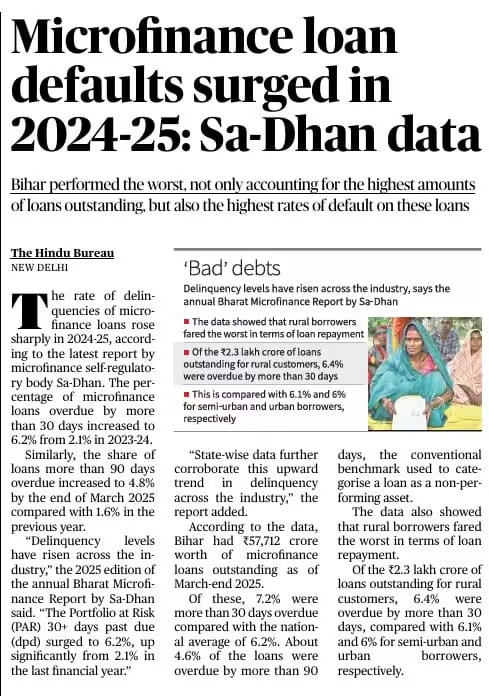
The Bharat Microfinance Report 2025 released by Sa-Dhan, a self-regulatory body for the microfinance industry, revealed a sharp rise in loan defaults across India during the financial year 2024–25. This indicates growing stress in rural credit markets and weakening repayment capacity among low-income borrowers.
UPSC Relevance:
Microfinance and it’s role in economy
UPSC PYQ:
Q. Microfinance is the provision of financial services to people of low-income groups. This includes both the consumers and the self-employed. The service/ services rendered under microfinance is/are (2011)
- Credit facilities
- Savings facilities
- Insurance facilities
- Fund Transfer facilities
Select the correct answer using the codes given below the lists:
(a) 1 only
(b) 1 and 4 only
(c) 2 and 3 only
(d) 1, 2, 3 and 4
Microfinance:
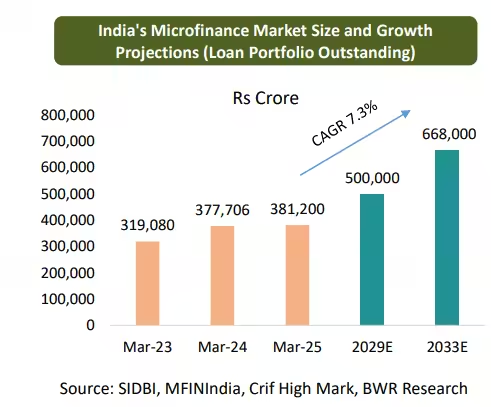
Microfinance refers to the financial services provided to low-income individuals or groups who are typically excluded from traditional banking. Microfinance aims to improve financial services access for marginalized groups, especially women and the rural poor, to promote self-sufficiency.
- MFI is defined as a non-deposit taking NBFC that fulfils the following conditions:
- Minimum Net Owned Funds of Rs.5 crore. (For NBFC-MFIs registered in the Northeastern Region of the country, the minimum NOF requirement shall stand at Rs. 2 crore).
- At least 75% of its loans should be microfinance loans.

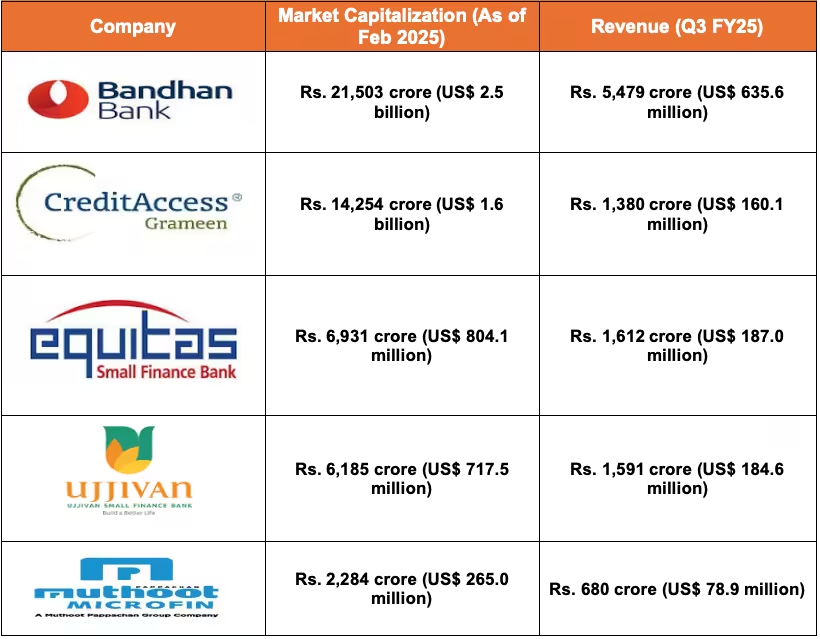
Top micro finance institutions in India:
Loans disbursed to SHGs: The number of SHGs that availed loans during the year 2023-24 increased to 54.28 lakh from 42.96 lakh in the previous year, reflecting a growth of around 28%. Correspondingly, the amount of loans disbursed in absolute terms also increased by 44% from ₹1,45,200.23 crore (2022- 23) to ₹2,09,285.87 crore (2023-24) on Y-o-Y basis. The proportion of loans disbursed to all-women SHGs also increased steadily, albeit marginally during 2023-24.
Microfinance and Financial Inclusion
Low-income people are neglected by their financial systems because they are considered uneconomical to serve or too difficult to reach. According to the World Bank’s Global Findex, 1.7 billion adults globally are financially excluded, living without formal credit or savings.
Role of microfinance in empowering small businesses:
- Workforce development and economic empowerment: Microfinance has played a critical role, giving MSMEs the capital needed for expansion and employment, generating new job opportunities, especially in less developed regions.
- Women entrepreneurs: Women owned MSMEs are mainly funded by micro-finance institutions. Loans availed by women in India grew by 19% in FY23, outpacing the overall loan growth of 17%. Extending micro credit to women entrepreneurs in MSMEs has increased their economic power, thereby fostering empowerment. Through inclusiveness and by providing a way for women entrepreneurs to realise their business ambitions, 2.20 crore women-owned MSMEs have been registered by Udyam Registration Portal (URP) and Udyam Assist Platform (UAP).
- Establishing creditworthiness: microfinance institutions solves these issues by providing tailored loans without mandatory collateral requirements based on each borrower’s unique circumstances and repayment ability.
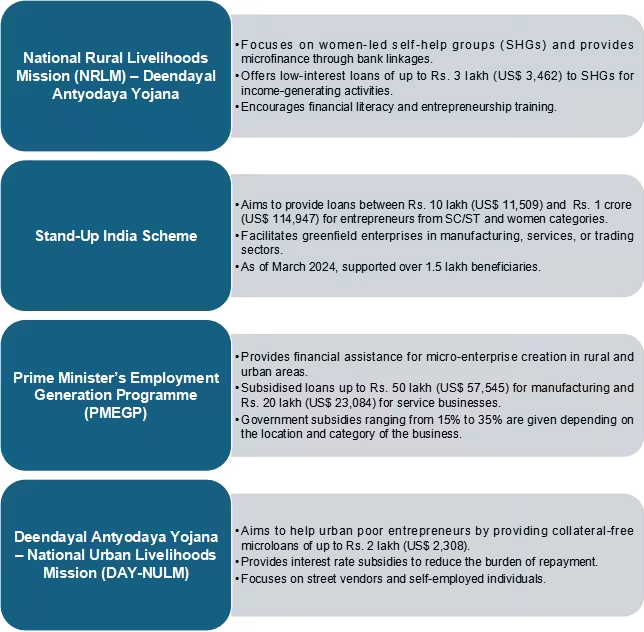
Government schemes:
- The Pradhan Mantri MUDRA Yojana (PMMY)
- It was launched in 2015 to provide small businesses access to capital through three categories of collateral-free loans.
New Emerging Issues:
- Delinquency Spike:
- The proportion of microfinance loans overdue by more than 30 days rose to 6.2% in March 2025, up from 2.1% in 2023–24.
- Loans overdue by more than 90 days also increased to 4.8%, from 1.6% the previous year.
- Geographical Pattern:
- Bihar recorded the worst performance, with both the highest volume of loans outstanding and highest rate of defaults — around 6.2% overdue beyond 30 days.
- Borrower Segment:
- Of the ₹2.3 lakh crore in outstanding loans:
- 6.4% of rural borrowers’ loans were overdue >30 days.
- 6.1% for semi-urban borrowers.
- 6% for urban borrowers.
- Of the ₹2.3 lakh crore in outstanding loans:
key issues:
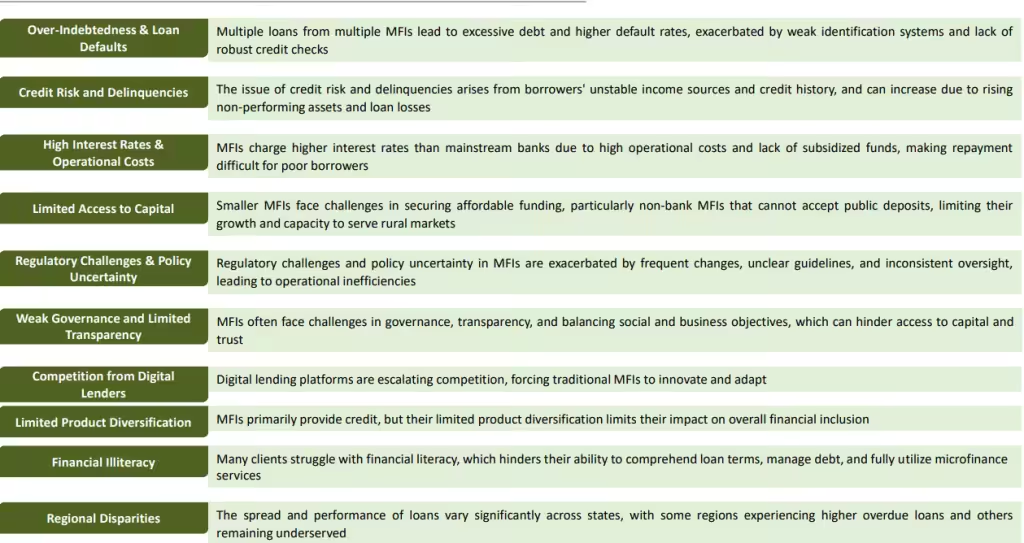
Microfinance has undeniably transformed India by empowering business owners and encouraging entrepreneurial spirit. Addressing vital issues, such as restricted finances, intense repayment demands, and gender or cultural hindrances, micro-lenders and administration projects are making significant strides. These efforts are propelling economic advancement and social empowerment.
Source: https://anantamias.com/current-affairs/microfinance/
Revision of base year of Index of Industrial production
Context:
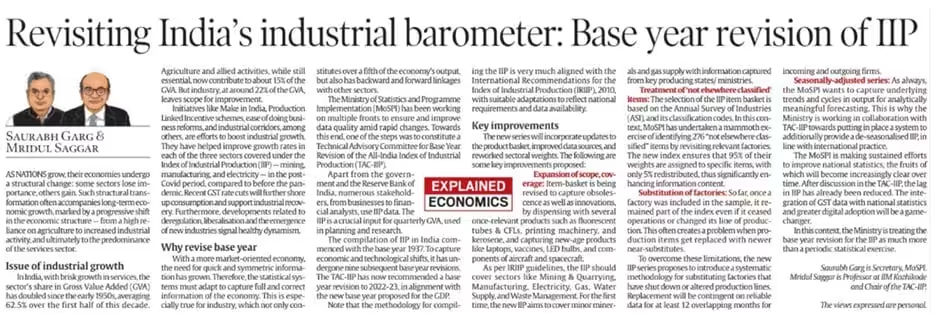
The Government of India has constituted a committee to revise the base year for the Index of Industrial Production in order to make it updated in accordance with the market trend.
UPSC Relevance:
PYQ:
Q. With reference to Index of Eight Core Industries (ECI), consider the following statements:
- The Eight Core Industries comprise 60 percent of the weight of items included in the Index of Industrial Production (IIP).
- It is prepared by the Central Statistical Office, Ministry of Statistics and Program Implementation.
- Electricity generation is given the highest weightage in the ECI.
How many of the above statements is/are correct?
(a) Only one
(b) Only two
(c) All three
(d) None
Why is the base year being revised?
- With a more market-oriented economy, the need for quick and symmetric information has grown.
- Therefore, the statistical system must adapt to capture full and correct information of the economy.
Key Improvements:
- Expansion of scope, coverage: Revision of item-basket to capture obsolescence as well as innovations, by dispensing with several once-relevant products.
- Inclusion of ‘not elsewhere classified’ items by assigning relevant weightage to them.
- Substitution of factories by introducing a systematic methodology for substituting factories that have shut down or altered production lines.
- Seasonally – adjusted series to put in place a system to additionally provide a de-seasonalized index, in line with the international practice.
About the Index of Industrial Production (IIP):
- The Index of Industrial Production (IIP) is a key statistical tool used to measure the short-term changes in the volume of production in Indian industries.
- It provides insight into the growth or contraction of industrial activity over a given period, making it a crucial economic performance indicator.
- The IIP is published by the Central Statistics Office (CSO), which is part of the Ministry of Statistics and Programmer Implementation (MoSPI).
- The current base year for the index is 2011–12. This base year was adopted to reflect modern industrial structure and production patterns, following periodic revisions from earlier base years such as 1937, 1946, 1951, 1956, and so on.
- Sectoral Composition of IIP (Weight-wise):
- Manufacturing: 77.63% of total weight (809 items)
- Mining: 14.37% (29 items)
- Electricity: 7.99% (1 item)
Source: https://anantamias.com/current-affairs/revision-of-base-year-of-index-of-industrial-production/