112 Emergency Number: How India Built a Single Helpline for All Emergencies
Why in News?
An Indian Express Explained piece revisits how India consolidated a maze of separate emergency helplines into a single, pan-India number, 112, running on the Emergency Response Support System (ERSS). The number is now the common front door for police, fire and ambulance help across states and Union Territories.
The story matters for governance and internal-security study because 112 is a textbook case of citizen-centric digital service delivery: one number, one app and one back-end dispatch system replacing the fragmented 100/101/108 setup that many citizens struggled to remember in a crisis.
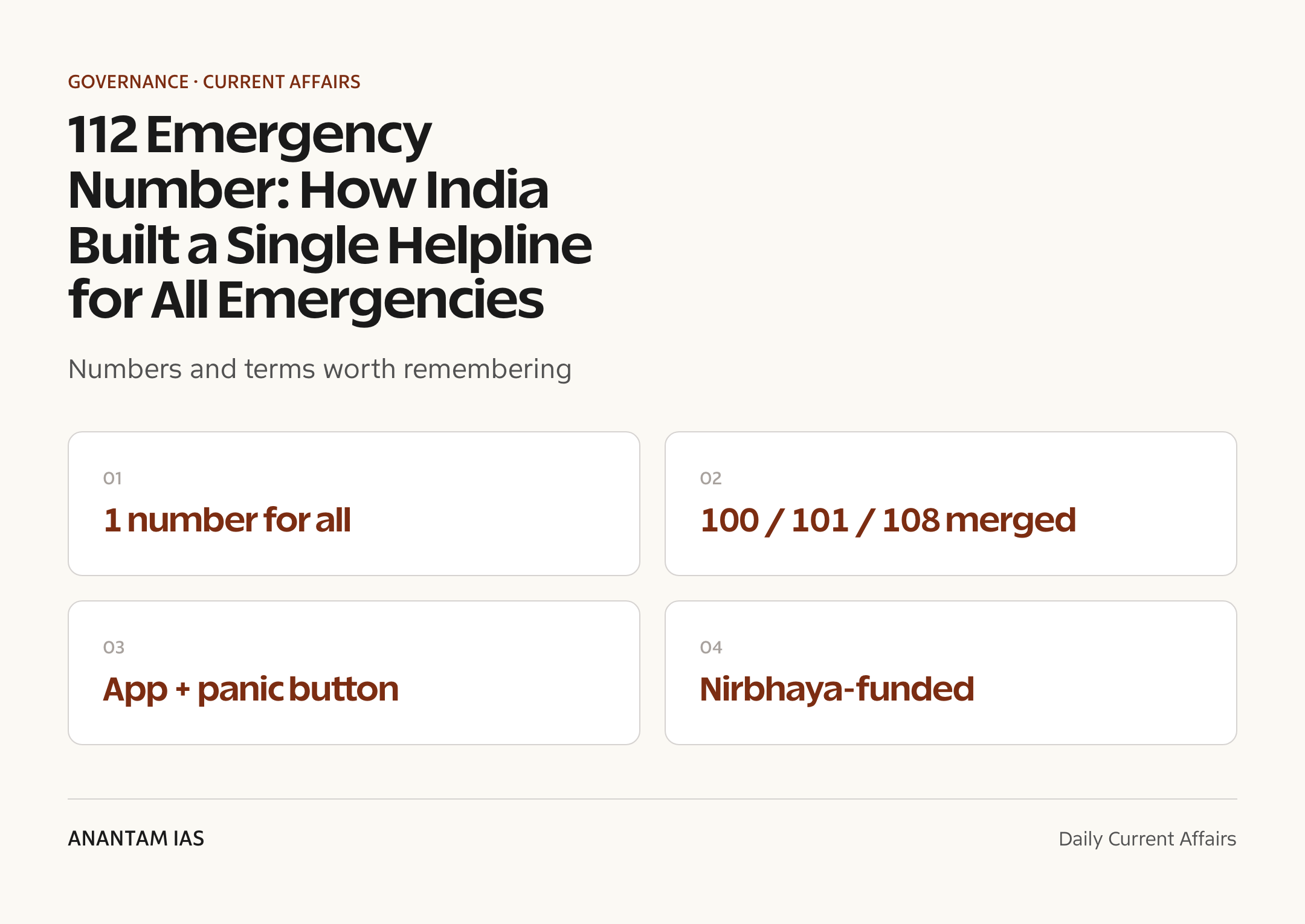
- 112 functions as the all-in-one emergency number, integrating the older 100 (police), 101 (fire) and 102/108 (ambulance) lines.
- The back-end ERSS was rolled out by the Ministry of Home Affairs (MHA) and funded under the Nirbhaya Fund, tying it directly to the women’s-safety mandate.
- Citizens can reach help by dialling 112, using the 112 India app, or pressing the panic button on a phone — a multi-channel design for emergencies.
The development matters in the context of:
- India earlier ran a confusing patchwork of toll-free numbers — one each for police, fire, ambulance, women and children — which slowed response during real emergencies.
- Globally, single emergency numbers like 112 (Europe) and 911 (US) had already proved that one memorable number saves critical seconds.
- Post-2012, the push for a unified system became inseparable from the women’s-safety agenda and the Nirbhaya Fund corpus.
UPSC Relevance
Prelims Relevance
- 112 is India’s single pan-India emergency number, modelled on the international 112 standard used across the European Union.
- The supporting back-end is the Emergency Response Support System (ERSS), rolled out nationally by the Ministry of Home Affairs (MHA) from 2019.
- 112 integrates earlier numbers: 100 (police), 101 (fire and rescue), 102/108 (ambulance) and women/child lines such as 1090 and 1098.
- ERSS was funded under the Nirbhaya Fund, the women’s-safety corpus announced in 2013 after the 2012 Delhi case.
- Citizens can raise an alert by voice call, by the 112 India app, by SMS, or via the app’s SHOUT feature that alerts nearby volunteers for women in distress.
- Indian smartphones and feature phones were mandated by the Department of Telecommunications (DoT) to carry a panic button — long-pressing key 5 or 9 on feature phones, or the power button on smartphones.
- Himachal Pradesh and Nagaland were among the first states to operationalise the 112 ERSS service.
- ERSS uses a Computer-Aided Dispatch (CAD) platform with GIS mapping to locate callers and route the nearest responder.
Mains Relevance
GS Paper 2
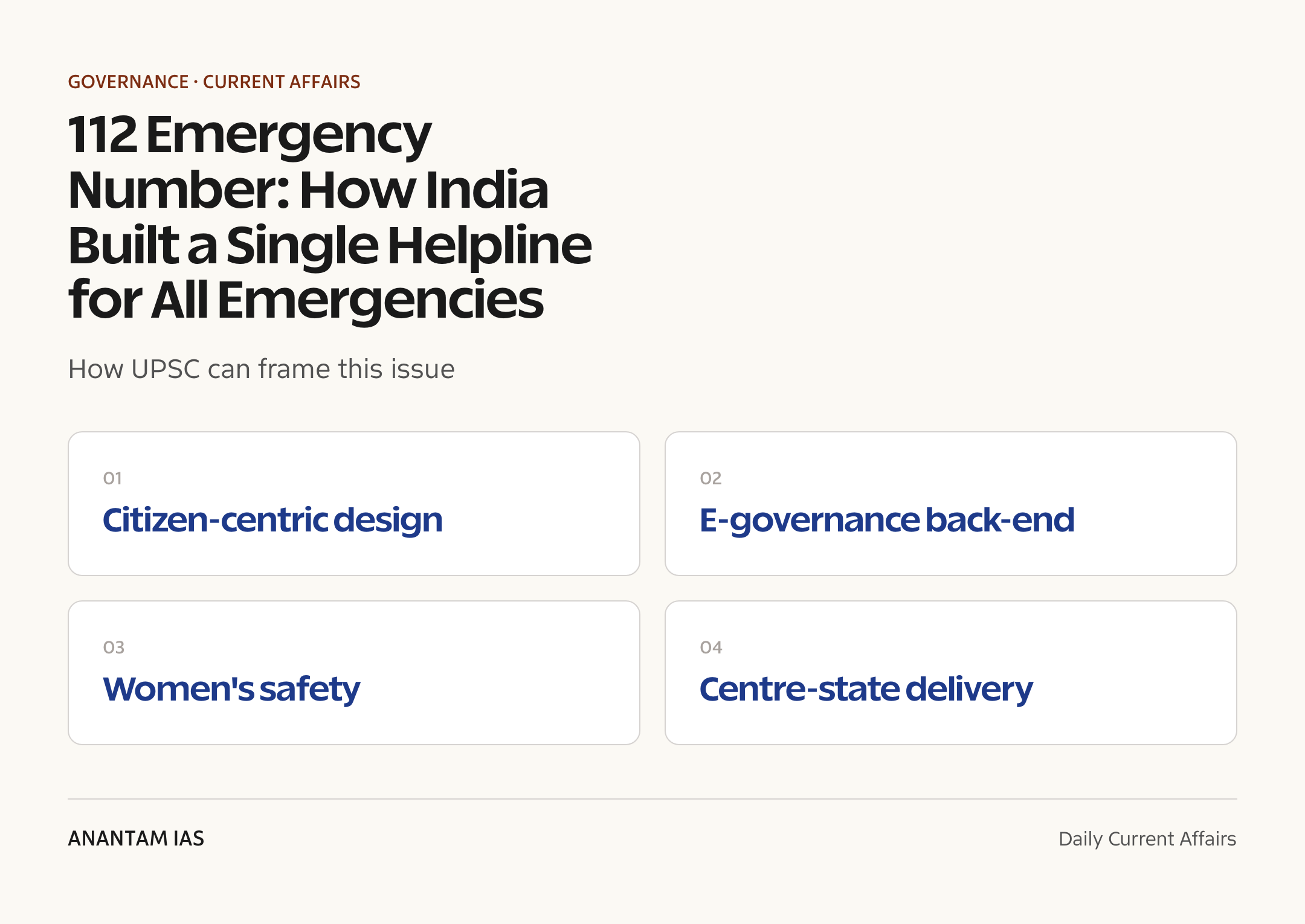
- Discuss how a single emergency number such as 112 illustrates citizen-centric, technology-enabled service delivery and reduces the citizen’s cognitive load during crises.
- Examine the federal coordination challenge: emergency response is a State subject, yet 112 needs uniform standards, centre-funded infrastructure and inter-state interoperability.
Essay
- Technology as an enabler of dignity and safety: how a memorable helpline can be a quiet act of governance.
- Citizen-centric governance — designing public services around the user, not the department.
Background and Context
What 112 and ERSS actually are
One number, one app, one back-end dispatch brain.
- 112 is the single emergency number a citizen dials for any emergency — crime, fire, medical or distress — regardless of the state.
- The Emergency Response Support System (ERSS) is the technology back-end that receives the call, identifies the caller’s location and dispatches the nearest responder.
- It mirrors the international model: 112 is the standard emergency number across the European Union and works on most GSM networks worldwide.
- The aim is simple — replace a list of numbers a panicked citizen cannot recall with one number a child can remember.
The journey from fragmented numbers
From a confusing menu of helplines to a single front door.
- For decades India ran separate lines — 100 for police, 101 for fire, 102/108 for ambulance, plus women and child helplines like 1090 and 1098.
- In a real emergency, citizens often forgot which number applied, or wasted minutes calling the wrong service.
- Under ERSS, these legacy numbers are integrated into 112, so a single call can be triaged and routed to police, fire or ambulance as needed.
- The older numbers were not switched off overnight; 112 was layered on top so existing dialling habits still connect to help.
Technology and features
Voice, app, panic button and location-aware dispatch.
- Citizens can reach 112 by voice call, SMS, email, the 112 India app, or the state ERSS web portal.
- The app’s SHOUT feature lets a woman in distress alert registered volunteers nearby, in addition to the police control room.
- ERSS runs on a Computer-Aided Dispatch (CAD) platform that maps the caller on GIS and pushes the alert to the closest patrol vehicle or responder.
- A nationwide panic button mandate from the Department of Telecommunications (DoT) requires phones to trigger an emergency call — long-pressing 5 or 9 on feature phones, and the power button on smartphones — with location sharing built in.
Funding and governance
Centre seeds it, states run it, Nirbhaya Fund pays for it.
- ERSS was conceived and pushed by the Ministry of Home Affairs (MHA) as a flagship of the women’s-safety and emergency-response agenda.
- It is financed under the Nirbhaya Fund, the dedicated corpus announced in 2013 (around Rs 1,000 crore initially) for projects protecting women.
- Public safety and policing are State subjects, so states and UTs operate their own ERSS control rooms while following common 112 standards.
- Himachal Pradesh and Nagaland were among the first to operationalise the service, with national rollout proceeding from 2019.
Significance and the gaps that remain
A strong model still uneven on the ground.
- 112 embodies citizen-centric digital governance: it is designed around the user’s panic, not the department’s silos.
- It strengthens the women’s-safety architecture by linking the 112 India app, SHOUT and the smartphone panic button into one response chain.
- Response quality still varies by state — control-room staffing, vehicle availability and rural network coverage shape whether the call actually converts into timely help.
- Awareness is uneven; many citizens still dial 100 out of habit, and the system depends on accurate caller-location data that weaker networks cannot always provide.
Way Forward
Close the last-mile response gap
- Invest in control-room staffing, GPS-tracked response vehicles and guaranteed dispatch times so a 112 call reliably reaches a responder.
- Tie ERSS performance to published response-time data, audited per district, to expose weak links.
Deepen integration and awareness
- Run sustained public campaigns so 112 becomes as instinctive as the old 100, especially in rural and non-Hindi regions.
- Fully fold remaining standalone helplines and disaster lines into 112 to end residual fragmentation.
Strengthen women's-safety features and privacy
- Expand the SHOUT volunteer network and verify volunteers to keep the distress-alert chain trustworthy.
- Pair location tracking with clear data-protection safeguards so safety tools do not become surveillance tools.
Conclusion
India’s 112 is a quiet but instructive example of governance done right — taking a confusing menu of helplines and collapsing it into one number a frightened citizen can recall. Built on the ERSS back-end, funded by the Nirbhaya Fund and driven by the MHA, it shows how technology, financing and federal coordination can combine to deliver a citizen-centric service.
The remaining work is less about the design and more about delivery: consistent response times, full state coverage, reliable caller-location data and genuine public awareness. As the Indian Express account underlines, a single number is only as good as the responder it summons — the next phase is making sure every 112 call ends in timely, accountable help.
UPSC Practice Questions
Prelims MCQ 1
With reference to the Emergency Response Support System (ERSS), consider the following statements:
- 112 is the single pan-India emergency number that integrates earlier numbers such as 100, 101 and 108.
- ERSS is funded under the Nirbhaya Fund and was rolled out by the Ministry of Home Affairs.
- Police and public order are Union subjects, so ERSS control rooms are operated solely by the central government.
How many of the above statements are correct?
(a) Only one (b) Only two (c) All three (d) None
Answer: (b) Only two
Explanation:
Statements 1 and 2 are correct. Statement 3 is wrong: police and public order are State subjects, so states and UTs run their own ERSS control rooms under common 112 standards.
Prelims MCQ 2
The Nirbhaya Fund, which finances the Emergency Response Support System, is best described as:
(a) A statutory body created to investigate crimes against women (b) A dedicated corpus announced in 2013 to support initiatives for women’s safety and dignity (c) A scheme that provides direct cash transfers to survivors of violence (d) A constitutional fund managed by the Election Commission
Answer: (b) A dedicated corpus announced in 2013 to support initiatives for women's safety and dignity
Explanation:
The Nirbhaya Fund was announced in 2013 (around Rs 1,000 crore initially) to fund women’s-safety initiatives, including ERSS/112 and Safe City projects; it is not a statutory or constitutional body and does not run direct cash transfers.
UPSC Mains Questions
- A single emergency number is as much a governance reform as a technology project. Discuss this in the context of India’s 112 and the Emergency Response Support System.
- Examine how the 112 ERSS strengthens India’s women’s-safety architecture, and identify the last-mile gaps that limit its effectiveness.
Source: Indian Express.
Frequently Asked Questions
What is 112 in India?
112 is India’s single, pan-India emergency number. A citizen dials 112 for any emergency — police, fire, ambulance or distress — and the call is routed to the right service through the Emergency Response Support System (ERSS).
What is the Emergency Response Support System (ERSS)?
ERSS is the technology back-end behind 112. It receives the call, locates the caller using GIS mapping on a Computer-Aided Dispatch platform, and sends the nearest responder. It was rolled out by the Ministry of Home Affairs from 2019.
Which older numbers does 112 replace?
112 integrates the earlier 100 (police), 101 (fire and rescue), 102/108 (ambulance), and women/child helplines such as 1090 and 1098, so one number now covers them all.
How is 112 funded?
ERSS is financed under the Nirbhaya Fund, the women’s-safety corpus announced in 2013, which links 112 directly to the women’s-safety agenda alongside projects like Safe City.
How can I use 112 besides dialling?
You can reach 112 by voice call, SMS, email, the 112 India app, or the panic button on your phone — long-pressing key 5 or 9 on feature phones, or the power button on smartphones. The app’s SHOUT feature alerts nearby volunteers for women in distress.
Who runs the 112 control rooms?
Because police and public order are State subjects, individual states and Union Territories operate their own ERSS control rooms while following common 112 standards set centrally by the MHA.