Daily Digest
UPSC · Civil Services Examination
Current Affairs · Saturday, 13 December 2025
Current affairs curated and edited by Anantam IAS faculty — pulled from The Hindu, PIB, IDSA, Foreign Affairs and the ministries. Read, annotate, revise.
Old Rajinder Nagar · Delhi 110005 · anantamias.com
IndiaAI Mission Crosses 38,000 GPUs, Targets a Sovereign LLM
Why in News?
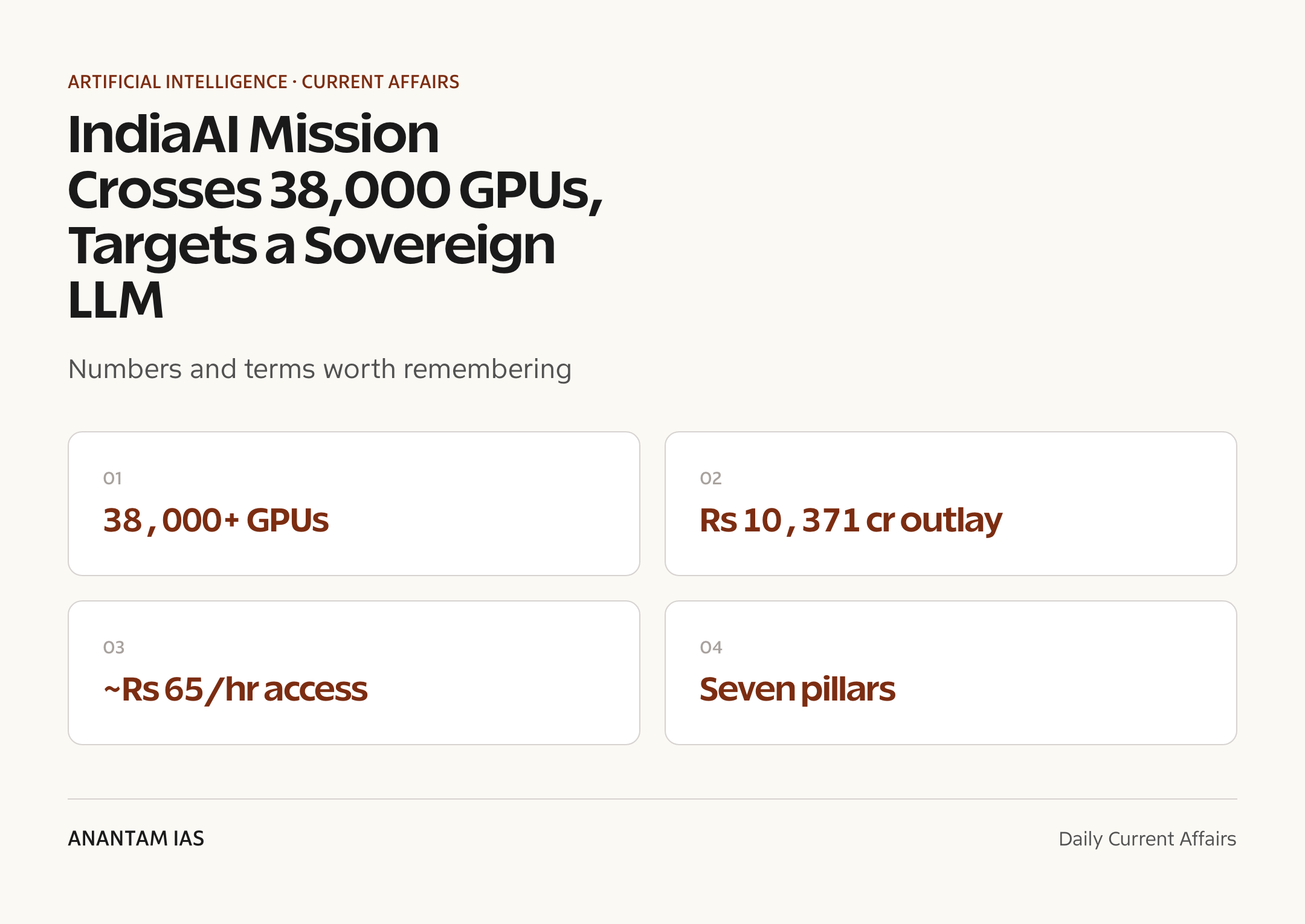
By late 2025 the IndiaAI Mission‘s shared Common Compute facility had crossed 38,000 GPUs, making large-scale AI training power available to Indian startups, researchers and academia at heavily subsidised rates — around Rs 65 per hour. The Mission, run by the Ministry of Electronics and IT (MeitY) through its IndiaAI Independent Business Division, is the country’s flagship push for AI self-reliance.
The headline goal is a sovereign Indian LLM — a homegrown large language model trained on India-specific data and the country’s many languages, rather than depending on foreign foundation models. Several Indian firms have been selected under the Mission’s Foundation Model pillar to build these indigenous models.
- Common Compute pool crossed 38,000 GPUs by late 2025, up from about 34,000 GPUs in mid-2025, built with empanelled industry partners.
- GPU access is subsidised for startups, researchers and academia at roughly Rs 65 per hour after government support on the commercial rate.
- Approved in 2024 with an outlay of Rs 10,371.92 crore (over Rs 10,300 crore) spread across the Mission’s pillars.
- Sarvam AI was selected to build India’s sovereign LLM ecosystem with an open-source 120-billion-parameter model; Soket AI, Gnani AI and Gan AI were later picked to build further indigenous foundation models.
- The AIKosh platform hosts datasets and AI models — over 3,000 datasets and hundreds of models — as shared public infrastructure for builders.
- IndiaAI FutureSkills has supported more than 13,500 scholars, with the AI talent pool targeted to reach about 1.25 million professionals.
The development matters in the context of:
- Compute power, data and talent are the three scarce inputs for frontier AI — and India had little sovereign capacity in any of them before this Mission.
- A national LLM trained on Indian languages and contexts is framed as both a strategic-autonomy and a digital-public-goods question, not just a commercial one.

UPSC Relevance
Prelims Relevance
- IndiaAI Mission — approved 2024, outlay Rs 10,371.92 crore, implemented by IndiaAI (an Independent Business Division under MeitY)
- Seven pillars — Common Compute, Foundation Models, AIKosh datasets, application development, FutureSkills, startup financing and Safe and Trusted AI
- Common Compute — shared GPU pool that crossed 38,000 GPUs; subsidised access (~Rs 65/hour)
- AIKosh — national platform of datasets and AI models for developers
- Sarvam AI — selected to build the sovereign LLM ecosystem (open-source 120-billion-parameter model)
- BharatGen — government-funded multimodal LLM supporting Indian languages; Bhashini — language-translation platform
- A GPU (Graphics Processing Unit) is the hardware that does the parallel maths AI models need for training and inference
- Difference between training a model and running inference on it
- Foundation model and large language model (LLM) — meaning of ‘parameters’
Mains Relevance
GS Paper 3
- Building sovereign AI capability — compute, data and talent as strategic infrastructure for self-reliance.
- Public investment in shared GPU infrastructure as a way to democratise access and lower the entry barrier for startups and researchers.
- Indigenous foundation models trained on Indian languages and data, and what ‘sovereign LLM’ means for technology security.
GS Paper 2
- AI governance — the Safe and Trusted AI pillar, responsible-use frameworks and the state’s role in steering an emerging technology.
- Digital public infrastructure and equitable access to technology as a development and welfare question.
Essay
- Technology should not be left in the hands of a few — democratising the tools of the AI age.
- Self-reliance in the age of artificial intelligence: who controls the compute controls the future.
Background and Context
What the IndiaAI Mission is
The Mission is India’s umbrella programme to build a full AI ecosystem rather than a single product.
- Approved in 2024 with an outlay of Rs 10,371.92 crore, it is implemented by IndiaAI, an Independent Business Division under MeitY.
- Its stated aim is to democratise AI access, foster technological self-reliance and ensure the ethical, responsible use of AI.
- It is built around seven pillars — Common Compute, Foundation Models, AIKosh datasets, application development, FutureSkills, startup financing and Safe and Trusted AI.
- The design treats compute, data and talent as shared public infrastructure that any Indian builder can tap, not just large firms.
- Union Minister Ashwini Vaishnaw has framed it around the idea that technology should reach a wide section of society, not a privileged few.
The compute pillar — crossing 38,000 GPUs
The most concrete achievement is a large, shared pool of AI compute power.
- A GPU is the specialised processor that performs the massive parallel calculations AI training and inference demand; frontier models need thousands of them.
- The Common Compute pool rose from about 18,400 empanelled GPUs to roughly 34,000 in mid-2025, then crossed 38,000 GPUs by late 2025.
- Capacity is built with empanelled industry partners — Indian data-centre and cloud firms such as Yotta, Sify, Netmagic, Cyfuture, Locuz, Ishan Infotech and Vensysco.
- Access is heavily subsidised — startups, researchers and academia pay around Rs 65 per hour after government support on the commercial rate.
- This shared model lowers the single biggest barrier to AI — the prohibitive cost of owning GPU clusters.
The push for a sovereign Indian LLM
The Foundation Models pillar funds Indian firms to build large models trained on Indian data.
- A foundation model is a large model trained on broad data that can be adapted to many tasks; a large language model (LLM) is the text-and-language version.
- Sarvam AI was selected to build India’s sovereign LLM ecosystem, developing an open-source 120-billion-parameter model for governance and public-service use.
- Three more firms were added — Soket AI (a 120-billion-parameter open-source model for India’s linguistic diversity), Gnani AI (a 14-billion-parameter voice model) and Gan AI (a 70-billion-parameter multilingual model).
- The goal is models trained on India-specific data and many Indian languages, reducing reliance on imported foreign models.
- Earlier efforts like BharatGen (a government-funded multimodal LLM) and Bhashini (language translation) feed the same ambition of language sovereignty.
Data and skills — AIKosh and FutureSkills
Models are only as good as the data and the people behind them, so two pillars target both.
- AIKosh is a national platform pooling datasets and AI models — over 3,000 datasets and hundreds of models — as open building blocks.
- Curated, high-quality Indian-language and domain datasets are essential to train models that work for Indian contexts.
- IndiaAI FutureSkills has supported more than 13,500 scholars across AI courses and labs.
- The Mission aims to grow India’s AI talent pool toward roughly 1.25 million professionals.
- Together these tackle the data and talent bottlenecks that compute alone cannot solve.
Applications and Safe and Trusted AI
Alongside infrastructure, the Mission funds real-world applications and a governance pillar.
- More than 30 India-specific AI applications have been approved across healthcare, agriculture and cybersecurity.
- A joint hackathon with the Indian Cyber Crime Coordination Centre (I4C) produced AI tools to classify cybercrime complaints on the national reporting portal.
- The Safe and Trusted AI pillar funds work on responsible-use frameworks, bias and safety standards.
- Startup financing support is meant to take indigenous AI from research into deployable products.
- This breadth is meant to make AI useful for India — solving local problems — not just technically impressive.
Why sovereignty matters here
The framing of ‘sovereign’ compute and models is strategic as much as commercial.
- Depending on foreign GPUs and foreign LLMs creates supply, cost and policy dependence on a handful of overseas firms and governments.
- Models trained abroad may under-represent Indian languages, contexts and values.
- Owning the compute, data and models stack is treated as a question of strategic autonomy, akin to energy or defence.
- Subsidised shared compute also addresses equity — letting small teams and universities build, not only big corporations.
- The Mission positions India to be a builder, not just a consumer, in the global AI economy.
Way Forward
Scale compute without dependence
- Keep expanding the Common Compute pool while moving toward domestic chip and data-centre capability.
- Keep access genuinely affordable so startups and universities — not only large firms — can train serious models.
Build models that work for India
- Fund the selected firms to deliver usable Indian-language foundation models, not just demonstrations.
- Strengthen AIKosh with high-quality, well-governed Indian-language and domain datasets.
Govern as you build
- Pair the build-out with a working Safe and Trusted AI framework covering bias, safety and accountability.
- Convert FutureSkills numbers into deep talent so India can both build and audit advanced AI.
Conclusion
Crossing 38,000 GPUs is a real milestone, but the IndiaAI Mission’s larger bet is structural: treat compute, data, talent and foundation models as shared national infrastructure rather than the property of a few firms. Subsidised access and government-funded indigenous models are meant to let any Indian team build serious AI.
The test now is delivery. Empanelled GPUs and selected firms must turn into deployable Indian-language models, a working safety framework and a deep talent base. If that happens, India shifts from consumer to builder in the AI economy; if the sovereign LLM and the governance scaffolding lag the hardware, the country risks owning the compute while still importing the intelligence.
UPSC Practice Questions
Prelims MCQ 1
With reference to the IndiaAI Mission, consider the following statements:
- It is implemented by IndiaAI, an Independent Business Division under the Ministry of Electronics and IT.
- Its Common Compute pillar provides a shared pool of GPUs for AI training and inference.
- AIKosh is the Mission’s pillar dedicated solely to subsidising GPU access.
How many of the above statements are correct?
(a) Only one (b) Only two (c) All three (d) None
Answer: (b) Only two
Explanation:
Statements 1 and 2 are correct. Statement 3 is wrong: AIKosh is the platform for datasets and AI models; subsidised GPU access falls under the Common Compute pillar.
Prelims MCQ 2
In the context of AI, what does the term ‘GPU’ most directly refer to?
(a) A government policy unit for AI regulation (b) A processor that performs the parallel computation needed to train and run AI models (c) A dataset repository for machine learning (d) A type of large language model
Answer: (b) A processor that performs the parallel computation needed to train and run AI models
Explanation:
A GPU (Graphics Processing Unit) does the massive parallel maths that AI training and inference require; clusters of thousands of GPUs underpin large foundation models.
UPSC Mains Questions
- Compute, data and talent are the strategic inputs of the AI age. Examine how the IndiaAI Mission seeks to build sovereign capability in each, and discuss why public investment in shared GPU infrastructure matters for an emerging economy.
- What does a ‘sovereign large language model’ mean for India, and why is it being pursued? Discuss the opportunities and the risks of building indigenous foundation models trained on Indian languages and data.
- Discuss the governance challenges of a state-led artificial-intelligence push. How should a Safe and Trusted AI framework balance innovation, safety and accountability?
Sources: PIB, Ministry of Electronics and IT (MeitY) and DD News.
Frequently Asked Questions
What is the IndiaAI Mission?
The IndiaAI Mission is India’s flagship national programme to build a complete artificial-intelligence ecosystem. Approved in 2024 with an outlay of over Rs 10,300 crore, it is implemented by IndiaAI, a division under the Ministry of Electronics and IT. It works across seven pillars including shared compute, indigenous foundation models, datasets, skilling, startup financing and responsible AI.
Why does crossing 38,000 GPUs matter?
GPUs are the specialised processors that train and run AI models, and they are expensive and scarce. By pooling more than 38,000 GPUs into a shared Common Compute facility and offering access at subsidised rates around Rs 65 an hour, the Mission removes the biggest barrier for Indian startups, researchers and universities, letting them train serious models without owning costly hardware.
What is a sovereign Indian LLM?
A sovereign Indian LLM is a large language model built and owned within India, trained on India-specific data and many Indian languages, rather than relying on foreign models. The aim is technology self-reliance and language sovereignty. Firms like Sarvam AI have been selected under the Mission to build such open-source models for governance and public-service use.
What is AIKosh?
AIKosh is the IndiaAI Mission’s national platform that pools datasets and AI models as shared building blocks for developers. It hosts thousands of datasets and hundreds of models, including Indian-language and domain-specific data. Good models depend on good data, so AIKosh tackles the data bottleneck that affordable compute alone cannot solve.
Which firms are building India’s foundation models?
Under the Foundation Models pillar, Sarvam AI was selected to build India’s sovereign LLM ecosystem with an open-source 120-billion-parameter model. Three more were later chosen: Soket AI for a large open-source model tuned to India’s languages, Gnani AI for a voice model, and Gan AI for a multilingual text-to-speech model. Earlier efforts include BharatGen and Bhashini.
How does the Mission address AI safety and skills?
Two pillars handle these. The Safe and Trusted AI pillar funds work on responsible-use frameworks, bias and safety standards. The FutureSkills pillar has supported more than 13,500 scholars and aims to grow India’s AI talent pool toward roughly 1.25 million professionals, so the country can both build and responsibly govern advanced AI systems.
Source: https://anantamias.com/current-affairs/indiaai-mission-compute-sovereign-llm-2025/
India Enters the Top 100 of the UN SDG Index
Why in News?
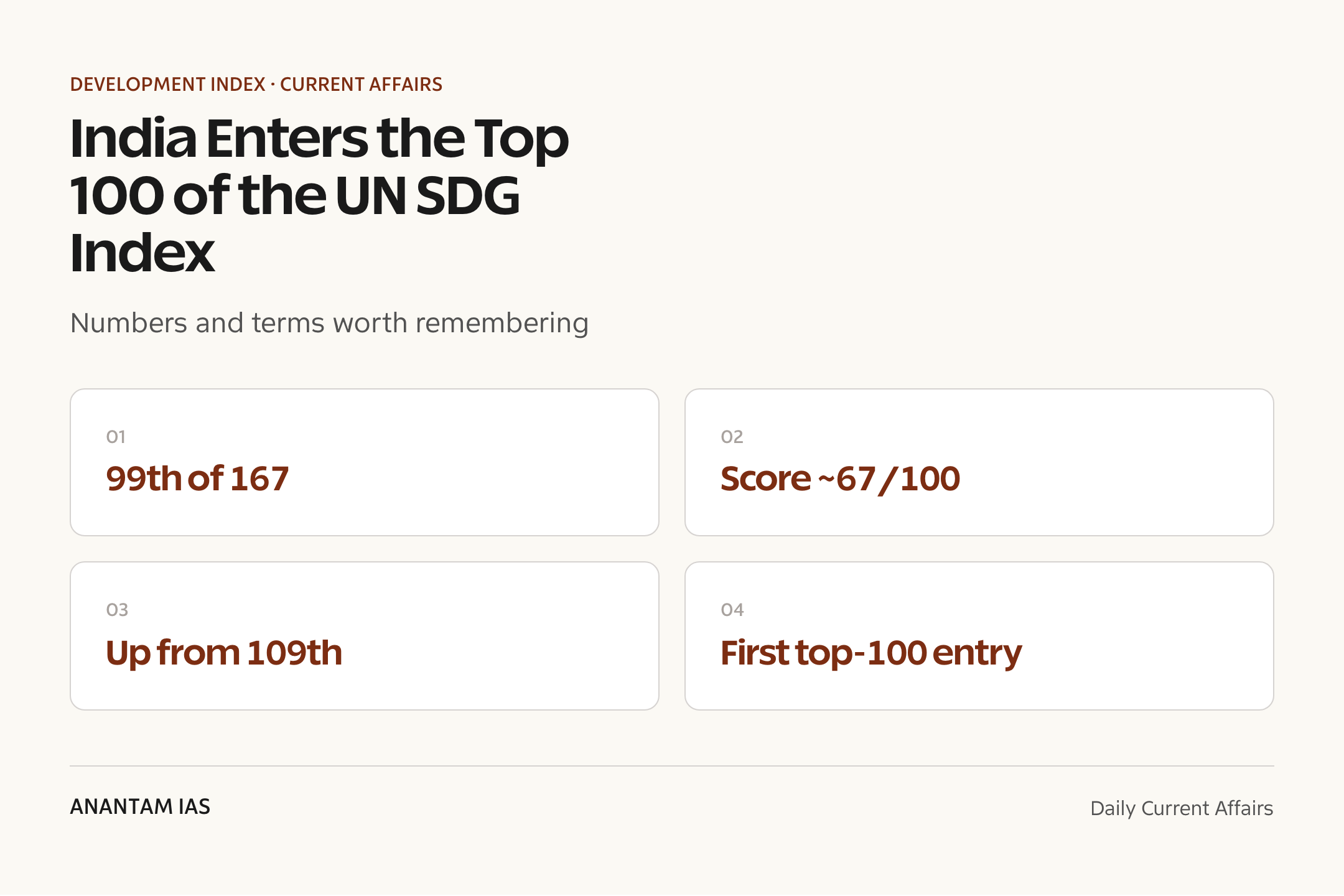
India broke into the top 100 of the global SDG Index for the first time, ranking 99th out of 167 countries on the Sustainable Development Report 2025, the annual benchmark published by the UN Sustainable Development Solutions Network (SDSN).
India scored about 67 on a 0-100 scale, climbing 10 places from 109th in 2024 on the strength of poverty reduction and clean-energy access, while still trailing on environment and biodiversity goals.
- Rank: 99th of 167; score ~67/100 — first-ever entry into the top 100.
- Trajectory: 116th (2017) to 112th (2023) to 109th (2024) to 99th (2025).
- Published in the Sustainable Development Report 2025, lead author economist Jeffrey Sachs.
- Tracks all 17 SDGs under the UN’s 2030 Agenda adopted in 2015.
- Globally only 17% of SDG targets are on track to be met by 2030.
- Top three: Finland, Sweden, Denmark; 19 of the top 20 are European.
The development matters in the context of:
- A staple reports-and-indices item that ties directly to the 2030 Agenda and India’s domestic SDG localisation under NITI Aayog.
- Useful for the GS2 governance angle on welfare delivery and the GS3 angle on the environment-development trade-off.

UPSC Relevance
Prelims Relevance
- Publisher: UN Sustainable Development Solutions Network (SDSN), not a UN treaty body.
- Sustainable Development Report (SDR) is the source publication; the SDG Index is its headline ranking.
- 17 SDGs and 169 targets under the 2030 Agenda for Sustainable Development (adopted September 2015).
- India’s 2025 rank 99th of 167, score ~67.
- Top performer Finland; 19 of top 20 are European countries.
- Neighbourhood: Bhutan 74th, Nepal 85th, Sri Lanka 93rd, Bangladesh 114th, Pakistan 140th; Maldives 53rd.
- The report also computes a Spillover Index measuring negative cross-border effects of rich-country consumption.
- Distinguish the SDG Index from NITI Aayog’s SDG India Index, the domestic state-level tracker.
- China 49th, USA 44th on the 2025 ranking.
Mains Relevance
GS Paper 2
- India’s progress on the SDGs as a measure of welfare-delivery and governance capacity.
- The gap between social-sector gains (poverty, energy, child health) and weaker performance on accountability and environment goals.
GS Paper 3
- The development-versus-environment trade-off visible in India’s lag on biodiversity and sustainable consumption (SDG 15).
GS Paper 1
- Society-level drivers behind India’s improvement, from energy access to declining child mortality.
Essay
- Growth that leaves no one behind: can India meet the 2030 promise?
- Prosperity and the planet need not be rivals.
Background and Context
What the SDG Index Measures
The index converts country performance across all 17 goals into a single comparable score.
- Compiled annually since 2016 in the Sustainable Development Report (SDR) by the SDSN and partners.
- Scores each country 0-100, where 100 means full achievement of every SDG target.
- Covers goals from no poverty (SDG 1) and zero hunger (SDG 2) to climate action (SDG 13) and strong institutions (SDG 16).
- A country’s score is read as the percentage of the way it has travelled toward the 2030 targets.
India's Climb to 99th
India added roughly ten places in a single year to cross the symbolic top-100 line.
- Up from 109th (2024) and 112th (2023), continuing a steady multi-year rise.
- Score of about 67 places India just behind Sri Lanka (93rd) in the region.
- Gains driven by wider electricity access (SDG 7), expanding mobile broadband (SDG 9), and falling child mortality (SDG 3).
- Welfare schemes on poverty, health, education and clean energy are credited as the main levers.
Where India Still Lags
The same report flags goals where India and most large economies are moving backward.
- Weak scores on biodiversity loss (SDG 15) and sustainable land use.
- Pressure on nitrogen management and rising obesity (SDG 2) noted as reversals since 2015.
- Mixed performance on SDG 16 measures such as press freedom and corruption perception.
- Environment and consumption goals remain the hardest globally, even for top-ranked nations.
The 2030 Agenda Behind the Number
The ranking sits on the UN framework every member state signed in 2015.
- The 2030 Agenda for Sustainable Development set 17 goals and 169 targets.
- It succeeded the Millennium Development Goals (MDGs), which ran 2000-2015.
- The SDGs are universal — binding on developed and developing countries alike.
- India tracks them domestically through NITI Aayog’s SDG India Index, a separate state and UT-level tool.
The Global and Regional Picture
The 2025 edition warns that the world is far off the 2030 pace.
- Only 17% of targets are projected to be achieved on time worldwide.
- Finland, Sweden and Denmark top the table; 19 of the top 20 are European.
- Regionally Maldives (53rd) and Bhutan (74th) lead among India’s neighbours.
- The report blames conflicts, structural vulnerabilities and limited fiscal space for the slowdown.
How to Read the Index Critically
The ranking is a useful signal but carries known limitations.
- It is a non-official, expert-network product, not a UN-mandated official statistic.
- Data gaps and lags mean some indicators rely on modelled or older figures.
- A high aggregate score can mask poor performance on a few critical goals.
- Cross-country comparison is sensitive to how missing indicators are handled.
Way Forward
Close the environment gap
- Pair welfare gains with stronger action on biodiversity, land use and nitrogen pollution.
- Mainstream SDG 13 and SDG 15 targets into state-level planning.
Strengthen data and localisation
- Improve real-time SDG data so India is judged on current rather than lagged figures.
- Deepen district and city-level tracking through NITI Aayog and the MoSPI framework.
Sustain the social-sector momentum on poverty, health and clean energy while financing the harder environment and institutional goals through a coherent, all-of-government SDG strategy.
Conclusion
Crossing into the top 100 is a genuine milestone: it confirms that India’s investments in energy access, health and poverty reduction are registering on a global scoreboard.
But a score of 67 with five years left to 2030 also marks how far the country, and the world, still has to travel — especially on the environment and accountability goals where progress has stalled or reversed.
UPSC Practice Questions
Prelims MCQ 1
With reference to the SDG Index in the Sustainable Development Report, consider the following statements:
- It is published annually by the UN Sustainable Development Solutions Network (SDSN).
- It scores countries on their progress across all 17 Sustainable Development Goals.
- It is the same as the SDG India Index released by NITI Aayog.
How many of the above statements are correct?
(a) Only one (b) Only two (c) All three (d) None
Answer: (b) Only two
Explanation:
Statements 1 and 2 are correct. Statement 3 is wrong — the SDSN’s SDG Index and NITI Aayog’s SDG India Index are two distinct rankings; the latter tracks Indian states and UTs.
Prelims MCQ 2
In the Sustainable Development Report 2025, India was ranked:
(a) 53rd of 167 (b) 85th of 167 (c) 99th of 167 (d) 114th of 167
Answer: (c) 99th of 167
Explanation:
India ranked 99th of 167 countries with a score of about 67, entering the top 100 for the first time, up from 109th in 2024.
UPSC Mains Questions
- India has crossed into the top 100 of the global SDG Index for the first time. Examine the factors behind this improvement and the goals where India continues to lag. (250 words)
- “Social-sector progress on the SDGs cannot substitute for action on environment and accountability goals.” Discuss in the context of India’s 2025 SDG Index performance. (250 words)
Sources: Sustainable Development Report 2025 (UN SDSN) and Drishti IAS / Outlook Business.
Frequently Asked Questions
What is the SDG Index?
The SDG Index is the headline ranking inside the annual Sustainable Development Report, published by the UN Sustainable Development Solutions Network (SDSN). It scores 167 countries from 0 to 100 on how far they have progressed across all 17 Sustainable Development Goals under the 2030 Agenda.
What rank did India get in 2025?
India ranked 99th out of 167 countries on the Sustainable Development Report 2025, with a score of about 67 on the 0-100 scale. This was India’s first-ever entry into the top 100, up ten places from 109th in 2024.
Who publishes the Sustainable Development Report?
It is published by the UN Sustainable Development Solutions Network (SDSN), with economist Jeffrey Sachs as lead author. The SDSN is an expert network, so the report is an independent benchmark rather than an official UN statistic.
Which goals does India perform well and poorly on?
India shows gains on electricity access (SDG 7), mobile broadband (SDG 9) and falling child mortality (SDG 3). It lags on environment and biodiversity goals such as biodiversity loss (SDG 15), nitrogen management and rising obesity, alongside mixed scores on institutional measures under SDG 16.
How does India compare with its neighbours?
Among regional neighbours, Maldives ranked 53rd, Bhutan 74th, Nepal 85th and Sri Lanka 93rd ahead of India at 99th, while Bangladesh (114th) and Pakistan (140th) ranked lower. Finland topped the global table, with 19 of the top 20 countries in Europe.
How is the SDG Index different from the SDG India Index?
The SDG Index ranks countries globally and is produced by the SDSN. The SDG India Index is a domestic tool released by NITI Aayog that ranks Indian states and union territories on the same goals. They are separate exercises measuring performance at different levels.
Source: https://anantamias.com/current-affairs/india-sdg-index-rank-99-top-100-2025/