Daily Digest
UPSC · Civil Services Examination
Current Affairs · Tuesday, 13 January 2026
Current affairs curated and edited by Anantam IAS faculty — pulled from The Hindu, PIB, IDSA, Foreign Affairs and the ministries. Read, annotate, revise.
Old Rajinder Nagar · Delhi 110005 · anantamias.com
Jharkhand PESA Rules 2026: Tribal Self-Governance After 25 Years
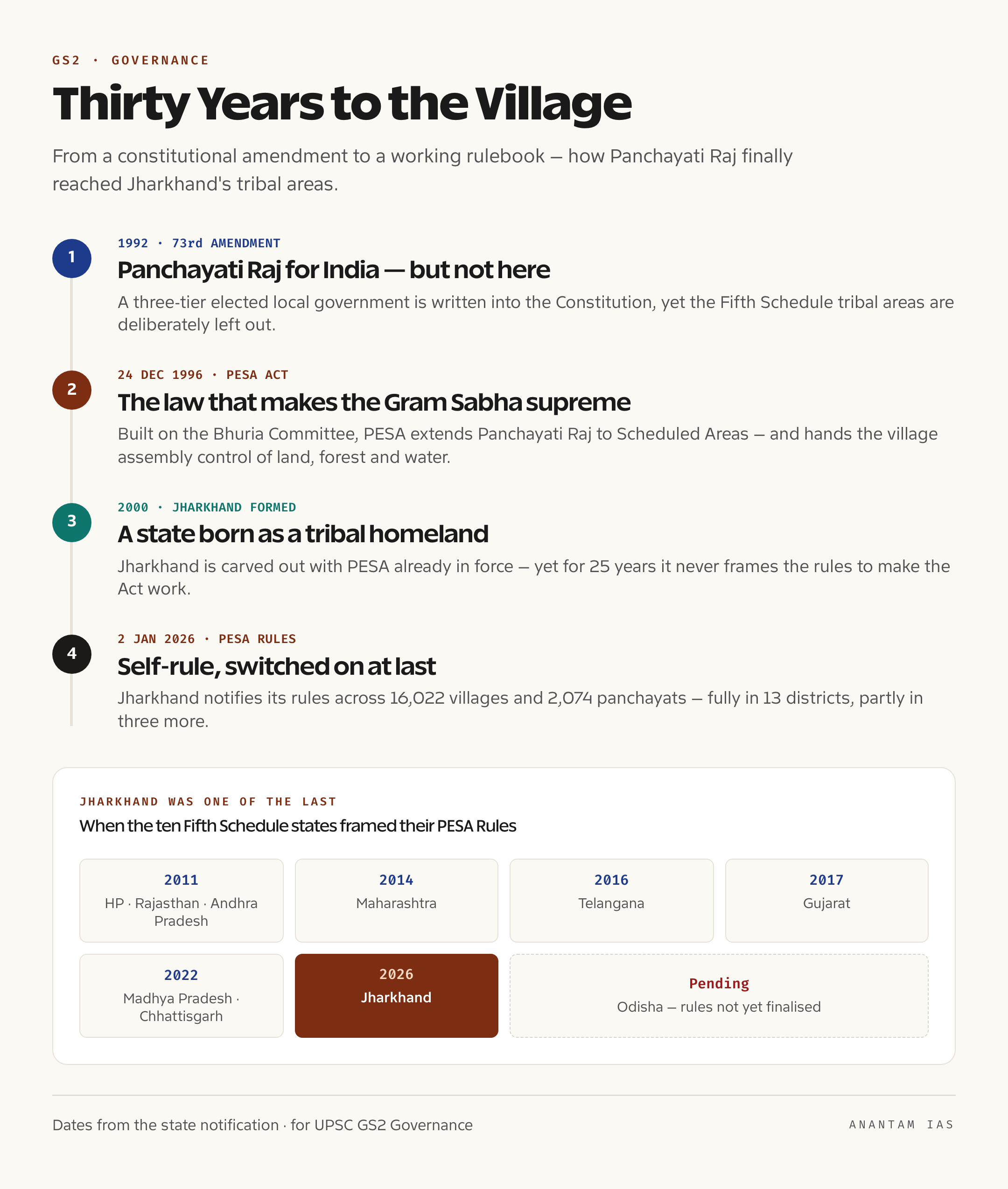
On 2 January 2026, Jharkhand’s Panchayati Raj department issued a notification that the state’s tribal heartland had waited a quarter of a century to read. With it, Jharkhand finally framed the rules to operate the Panchayats (Extension to Scheduled Areas) Act — PESA, the 1996 law that lets the village assembly, not the district office, govern tribal India. The cabinet had cleared the draft on 23 December 2025, and the notification a few days later switched the law on across 16,022 villages and 2,074 panchayats in the state’s Fifth Schedule areas. After almost 30 years on the central statute book and 25 years after Jharkhand itself was carved out in 2000, the Gram Sabha — the assembly of every adult voter in a village — was at last named the supreme authority over its own land, water and forest.
And that is why this is more than a piece of state-level paperwork. PESA is the boldest experiment in self-rule India has tried below the level of an elected council, built on a simple, radical idea: that in tribal areas the smallest unit of democracy should be the strongest. For a state where roughly a quarter of the population is tribal and where the fight over land, mines and forests is the fight over everything, putting that idea into working rules is a genuine turning point. It also sits at the centre of UPSC’s GS2 syllabus on devolution, the Fifth Schedule and the empowerment of vulnerable sections — and it rewards an aspirant who can explain not just what PESA says, but why it took Jharkhand so long to say it.
Why It’s in the News
Jharkhand notified its PESA Rules on 2 January 2026, becoming one of the last major Fifth Schedule states to operationalise a law Parliament passed back in 1996. The Fifth Schedule is the part of the Constitution that sets up a special administrative regime for “Scheduled Areas” — tribal-majority tracts where ordinary laws can be modified to protect Adivasi land and custom. PESA extends Panchayati Raj to exactly these areas, but with tribal-friendly twists. A central Act, though, only sets the frame. The actual powers come alive only when a state writes its own rules to put flesh on the bones — who calls the Gram Sabha, how it votes, what happens when it says no to a mine. For 25 years Jharkhand had the Act but not the rules, so the Gram Sabha’s grand powers stayed mostly on paper.
The notification ends that limbo. The rules apply fully in 13 of Jharkhand’s districts — Ranchi, Khunti, Lohardaga, Gumla, Simdega, Latehar, East Singhbhum, West Singhbhum, Seraikela-Kharswan, Dumka, Jamtara, Sahibganj and Pakur — and partly in three more, Palamu, Godda and Garhwa. The trigger was a mix of pressure and politics. The Jharkhand High Court had been hearing petitions pushing the state to frame the rules, tribal organisations had agitated for years, and a state government elected on a promise of tribal rights finally moved. But the moment it landed, it also drew fire. Within days, a delegation from the Customary Tribal Coordination Committee met the Governor to object that the rules dilute the Act — that they blur PESA into Jharkhand’s ordinary 2001 Panchayati Raj law and weaken the protection of customary governance. So the news is twofold: a long-delayed empowerment, and an immediate argument over whether it goes far enough.
What PESA Is, the Fifth Schedule, and Why the Delay Ran So Long
To see why this matters, go back to the design. When Parliament passed the 73rd Constitutional Amendment in 1992, it created a uniform three-tier Panchayati Raj across the country — elected village, block and district councils everywhere. But the amendment deliberately left out the Fifth Schedule areas. Tribal society governs itself through its own customs, its own village councils and headmen, and Parliament worried that a one-size-fits-all panchayat would simply flatten those institutions. So Part IX, the panchayat chapter of the Constitution, was switched off for Scheduled Areas until a separate law could extend it on tribal terms.
That separate law was PESA, the Panchayats (Extension to Scheduled Areas) Act, enacted on 24 December 1996. Its blueprint came from the Bhuria Committee of 1994-95, chaired by the tribal leader Dilip Singh Bhuria, which argued that in tribal areas the Gram Sabha — not the bureaucracy, not even the elected panchayat — should be the real seat of power over natural resources and development. PESA wrote that conviction into law. It made the Gram Sabha “competent to safeguard and preserve” the traditions, customs and community resources of the people, and it handed the assembly a list of powers no Gram Sabha in the rest of India enjoys. Crucially, PESA covers ten states with Fifth Schedule areas, and it required each of those states to amend its own Panchayat law and frame rules in line with the central Act. Most dragged their feet. Himachal Pradesh, Rajasthan and Andhra Pradesh notified their rules in 2011, Maharashtra in 2014, Telangana in 2016, Gujarat in 2017, and Madhya Pradesh and Chhattisgarh as late as 2022. Odisha still hasn’t finalised its rules, and Jharkhand only got there in 2026.
Why did Jharkhand of all states — born in 2000 expressly as a tribal homeland — take the longest? Part of it is the awkward truth that PESA cuts against the grain of how states like to run. A Gram Sabha with a veto over a mine or a land transfer is a Gram Sabha that can say no to revenue, to industry, to the line departments that prize control. Land, forests, mining and excise are exactly the sectors where state power and PESA collide, so successive governments found it easier to leave the rules unwritten than to surrender that grip. Add political churn, administrative inertia and genuine confusion over how to fit PESA’s customary Gram Sabha into Jharkhand’s regular 2001 panchayat structure, and the delay compounds. It took sustained High Court pressure and tribal mobilisation to force the issue — which is itself a lesson about how decentralisation in India often advances only when courts and communities push together.
The Powers Jharkhand’s Rules Devolve to the Gram Sabha
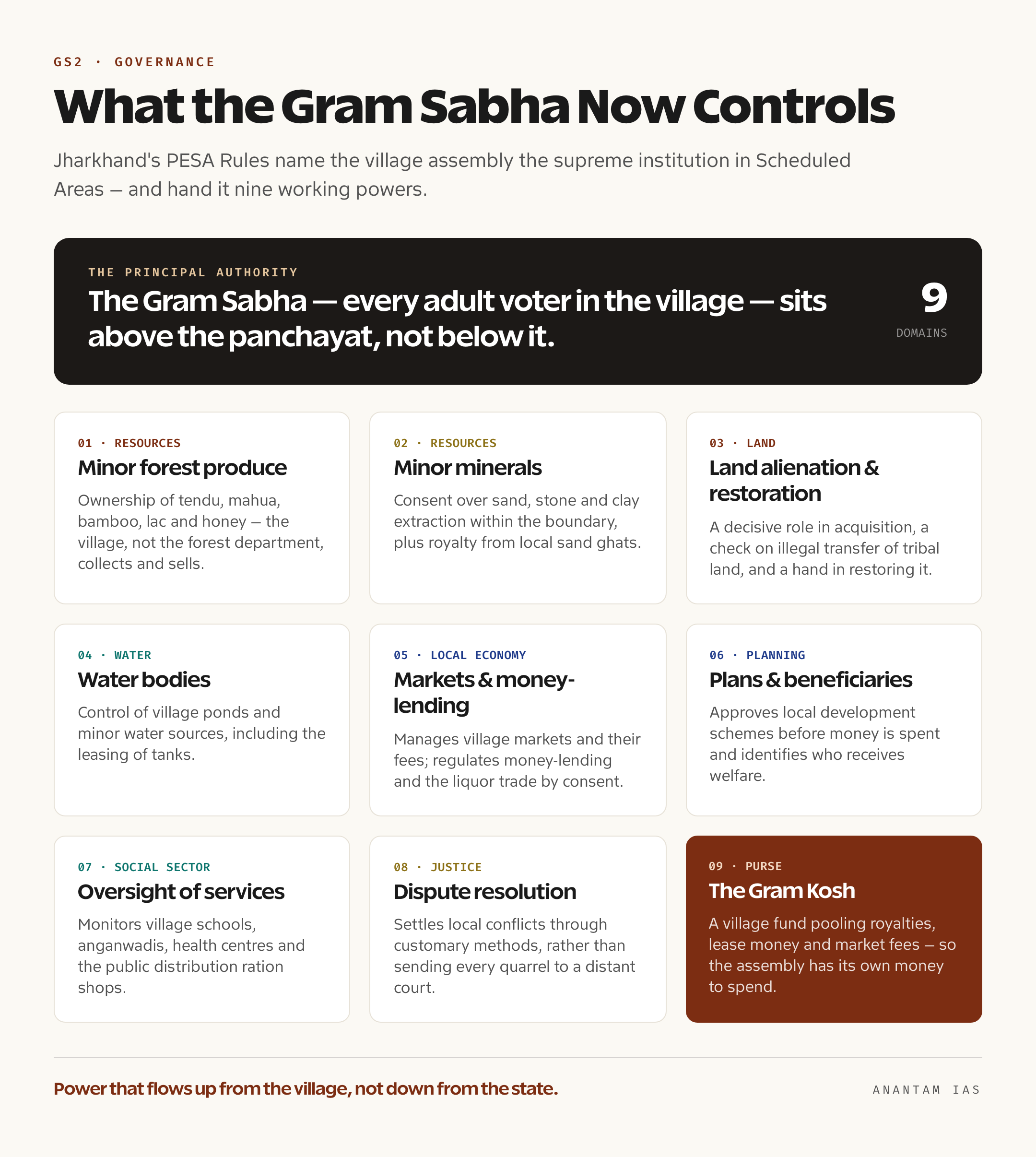
So what can a Jharkhand Gram Sabha now actually do? The rules name it the strongest and supreme institution in the Scheduled Areas, and they translate PESA’s broad mandate into concrete, examinable powers. Start with natural resources, because that’s where the stakes are highest. The Gram Sabha gets ownership and control over minor forest produce — the tendu leaves, mahua flowers, bamboo, lac, honey and wild fruit that tribal households gather and sell, which PESA explicitly vests in the village rather than the forest department. It gets a say over minor minerals — sand, stone, ordinary clay and the like — including the power to monitor and consent to mining and quarrying within its boundary, and to take royalty and fees from sand ghats and the local extraction it allows.
Then comes the heart of the matter for Adivasi India: land. The rules give the Gram Sabha a decisive role in land acquisition, requiring its involvement before tribal land is taken for any project, and a role in preventing land alienation — the illegal transfer of tribal land to non-tribals — and in restoring land that has been wrongly taken. They hand it control over village water bodies and minor water sources, including the leasing of ponds. And they devolve a cluster of everyday governance powers that decide how a village actually lives. The Gram Sabha now manages village markets and collects their fees. It regulates money-lending to Scheduled Tribes, the historic trap that has stripped Adivasis of land for generations. It controls the local liquor trade — no manufacture, storage or sale without the assembly’s consent, a recognition that excise has long preyed on tribal areas.
Beyond resources, the rules wire the Gram Sabha into the machinery of the state. It approves local plans and development schemes before money is spent, and it identifies the beneficiaries of poverty-reduction and welfare programmes — turning the assembly from a petitioner into a planner. It oversees the social sector running in the village: the power to monitor schools, anganwadis (the rural child-care and nutrition centres), health sub-centres and the ration shops of the public distribution system. It is empowered in dispute resolution, settling local conflicts through customary methods rather than sending every quarrel to a distant court. And to give all this teeth, each Gram Sabha can build a Gram Kosh — a village fund pooling royalties, lease money, market fees and other local income, so the assembly has its own purse to spend. Take those together — minor minerals, minor forest produce, land alienation and restoration, water bodies, village markets, money-lending, local plans and beneficiary lists, social-sector oversight and dispute resolution — and you have a Gram Sabha that, on paper at least, governs almost everything that touches a tribal villager’s daily life.
What Operationalising PESA Means for Tribal Self-Rule
Step back and the significance is constitutional, not just administrative. PESA is the only place in Indian law where the Gram Sabha is not a junior body under an elected panchayat but the principal authority above it. Everywhere else in India, real power flows downward from the state through elected councils. In Scheduled Areas under PESA, it is supposed to flow upward from the village assembly. That inversion is the whole point — it tries to make decentralisation genuine, pushing decisions to the people who live with their consequences. By framing its rules, Jharkhand has at last given that principle an operating manual within its borders, and it brings the state into line with the spirit of the Fifth Schedule, which exists precisely to let tribal areas be governed differently.
The deeper purpose is protective. For tribal communities, land and forest are not assets to be traded but the basis of identity, livelihood and culture, and the long history of Adivasi dispossession is a history of that base being eroded — by moneylenders, by acquisition, by quiet alienation. A Gram Sabha with real authority over land restoration, minor forest produce and consent for projects is a shield against that erosion, and a way to keep the fruits of local resources in local hands through the Gram Kosh. It also revives institutions of self-governance that predate the Indian state itself, giving legal weight to customary decision-making rather than overriding it.
And the timing carries its own message. Jharkhand acting in 2026, however late, adds momentum to a wider push for tribal rights and reads alongside the Forest Rights Act of 2006, which gives communities title to the forests they have long used, as part of a slow constitutional project to make Adivasi self-rule real rather than rhetorical. When it works, PESA can do what few laws manage — turn a marginalised community from the object of governance into its author. For a state that defines itself by its tribal identity, finally switching the law on is a statement about what kind of democracy Jharkhand wants to be.
Gaps, Challenges and the Way Forward
But a notification is not a transformation, and the criticism that greeted these rules is worth taking seriously. The sharpest objection from tribal groups is that Jharkhand has diluted PESA by folding it into the state’s ordinary Panchayati Raj Act of 2001, instead of treating PESA as the special, stand-alone law it is meant to be. Activists argue that key safeguards have been weakened — that the protection of customary law, religious practice and cultural identity, which PESA insists on, has been thinned, and that on land restoration the rules stop short of the full authority PESA envisages. When the body that recognises a Gram Sabha is a district official rather than the community itself, critics say, you have reintroduced the very bureaucratic control PESA was written to remove. That is the difference between empowering an assembly and merely permitting one.
The bigger, structural problem is one PESA has faced everywhere it operates. The law sits inside a thicket of older laws — on land, forests, mining, excise and revenue — that often contradict it, and line departments routinely treat the Gram Sabha’s consent as a box to tick rather than a decision to respect. A village can say no to a mine and still find the clearance granted, because a sectoral law lets the department proceed. There is also the consent-versus-consultation gap: where PESA demands the Gram Sabha’s agreement, officials too often settle for a token meeting. And unlike the Sixth Schedule areas of the Northeast, which have their own autonomous district councils, Fifth Schedule Gram Sabhas lack a higher tier of self-government to back them up, which can leave them strong on paper and weak in practice.
So the way forward is less about new laws than about honouring this one. The state needs to harmonise its land, mining and excise rules with PESA so the Gram Sabha’s word is not quietly overruled, treat consent as real consent, and invest in the unglamorous work of capacity-building — training Gram Sabha members, funding the Gram Kosh, and protecting assemblies from capture by local elites, contractors and political muscle. Genuine recognition of customary institutions, not their absorption into the standard panchayat, would answer the central complaint. And the test, ultimately, is on the ground: whether a village in Khunti or Simdega can actually stop an illegal transfer, collect its mahua royalty and plan its own school. If it can, Jharkhand’s 2026 rules will be remembered as the year self-rule arrived. If it can’t, they will be another well-drafted law waiting, like the Act itself, for someone to mean it.
For Your Mains Answer
This is a core topic for GS Paper 2, which covers devolution of powers, local self-government, the Panchayati Raj system, statutory and constitutional provisions for vulnerable sections, and the working of mechanisms for protecting the rights of the Scheduled Tribes. It links the 73rd Amendment, the Fifth Schedule and PESA into one chain, and it offers a sharp, current case study — Jharkhand’s January 2026 rules — for any question on decentralisation, tribal rights or the gap between legislation and implementation. It also feeds GS1 on the issues of the Scheduled Tribes and Essay themes of inclusion and grassroots democracy.
How to Build the Answer
Move in a clear chain: the 73rd Amendment (1992) brought Panchayati Raj but left out Scheduled Areas → PESA (1996), built on the Bhuria Committee, extended it on tribal terms and made the Gram Sabha supreme → states had to frame rules, and most delayed → Jharkhand finally notified its rules on 2 January 2026, 25 years after statehood → list the powers devolved (minor forest produce, minor minerals, land restoration, water, markets, money-lending, plans, beneficiaries, social-sector oversight, dispute resolution) → assess the significance and the gaps → close with the way forward. That arc — context, law, delay, powers, significance, critique, fix — fits almost any PESA or tribal-governance question.
Common Mistakes to Avoid
Don’t confuse PESA with the Forest Rights Act of 2006 — PESA is about self-governance and the Gram Sabha’s powers, the FRA about individual and community forest title; mention both, but keep them distinct. Don’t say PESA created Panchayati Raj; the 73rd Amendment did that, and PESA extended it to Scheduled Areas. Don’t forget that PESA needs state rules to work — the whole Jharkhand story is about the rules, not the Act. And don’t present the notification as an unqualified success; the marks come from noting the dilution debate and the consent-versus-consultation problem.
A Compact Answer Spine
73rd Amendment (1992) excludes Fifth Schedule areas → PESA Act (24 Dec 1996), from the Bhuria Committee, extends Part IX to Scheduled Areas with the Gram Sabha as supreme → covers 10 Fifth Schedule states → Jharkhand notifies rules 2 Jan 2026, 25 years late, across 16,022 villages and 2,074 panchayats in 13+3 districts → powers: minor forest produce, minor minerals, land alienation/restoration, water bodies, markets, money-lending, local plans, beneficiaries, social-sector oversight, dispute resolution, Gram Kosh → significance: makes the Gram Sabha principal authority, shields tribal land → gaps: dilution into 2001 panchayat law, sectoral-law conflicts, consent treated as formality → way forward: harmonise laws, real consent, capacity-building.
Diagram or Flowchart Idea
Draw a simple downward funnel: Constitution (Fifth Schedule, Art. 244) → PESA 1996 → State Rules (Jharkhand 2026) → Gram Sabha, with the Gram Sabha box ringed by its powers (land, minor forest produce, minor minerals, water, markets, money-lending, schemes, disputes). A parallel timeline strip — 1992 → 1996 → 2000 → 2026 — drives home the delay at a glance.
A Balanced-Conclusion Line
A line that lands the marks: “Jharkhand’s PESA Rules of 2026 are a belated but real step toward making the Gram Sabha the author of its own development — yet their promise will be measured not by the notification, but by whether a tribal village can finally say no and be heard.”
How to Use Data Without Cramming
You need only a handful of anchors: PESA enacted 24 December 1996; rules notified 2 January 2026; 25 years after Jharkhand’s formation in 2000; 16,022 villages and 2,074 panchayats; full coverage in 13 districts. Drop those into the right sentences and attribute them plainly — “as the state’s January 2026 notification showed” — rather than scattering figures loose.
FAQ
What are the Jharkhand PESA Rules 2026? They are the operating rules that Jharkhand notified on 2 January 2026 to implement the central Panchayats (Extension to Scheduled Areas) Act, 1996 — PESA — in the state’s Fifth Schedule tribal areas. The cabinet cleared them on 23 December 2025. The rules apply across 16,022 villages and 2,074 panchayats, fully in 13 districts and partly in three more, and they name the Gram Sabha, the assembly of all adult voters in a village, the supreme authority over local land, water, forest and governance.
What is the PESA Act and when was it passed? PESA, the Panchayats (Extension to Scheduled Areas) Act, was enacted on 24 December 1996. After the 73rd Constitutional Amendment of 1992 brought Panchayati Raj to the rest of India but left out the Fifth Schedule areas, PESA extended that system to those tribal tracts on special terms — making the Gram Sabha, rather than the bureaucracy, the principal authority over natural resources and development, in line with the Bhuria Committee’s recommendations.
What powers does the Gram Sabha get under PESA? A Gram Sabha in a PESA area controls minor forest produce (tendu, mahua, bamboo and the like), has a say over minor minerals and mining within its boundary, plays a decisive role in land acquisition and the prevention of land alienation and its restoration, manages village water bodies and markets, regulates money-lending and the liquor trade, approves local plans and identifies scheme beneficiaries, oversees village schools, anganwadis, health centres and ration shops, and resolves local disputes by custom. In Jharkhand it can also build a Gram Kosh, a village fund of local royalties and fees.
Why did Jharkhand take 25 years to frame the PESA Rules? Because PESA gives the Gram Sabha powers — a veto over mines, over land transfers, over local revenue — that successive governments and line departments were reluctant to surrender, since land, mining and excise are exactly where state power and PESA collide. Political churn, administrative inertia and confusion over fitting PESA into the state’s 2001 panchayat law added to the delay. Sustained Jharkhand High Court pressure and tribal mobilisation finally forced the notification in January 2026.
Practice Questions
Prelims MCQs
- With reference to the PESA Act, consider the following:
(a) it was enacted in 1996
(b) it extends Part IX of the Constitution to Fifth Schedule areas
(c) it makes the Gram Sabha the principal authority over local resources
(d) all of the above
Answer: (d) PESA, enacted on 24 December 1996, extends the Panchayati Raj provisions of Part IX to Scheduled Areas and makes the Gram Sabha the supreme local authority. - The 73rd Constitutional Amendment of 1992 did which of the following with respect to the Fifth Schedule areas?
(a) automatically applied Panchayati Raj to them
(b) excluded them, leaving extension to a separate law
(c) abolished the Fifth Schedule
(d) created autonomous district councils for them
Answer: (b) The amendment excluded Scheduled Areas, and PESA (1996) later extended Panchayati Raj to them on tribal-friendly terms. - Which committee’s recommendations formed the basis of the PESA Act?
(a) the Balwant Rai Mehta Committee
(b) the Ashok Mehta Committee
(c) the Bhuria Committee
(d) the Sarkaria Commission
Answer: (c) The Bhuria Committee of 1994-95, chaired by Dilip Singh Bhuria, recommended that the Gram Sabha control natural resources in tribal areas, shaping PESA. - Under PESA, the Gram Sabha is empowered with which of the following?
(a) ownership of minor forest produce
(b) prevention of land alienation and its restoration
(c) a role in approving local plans and identifying beneficiaries
(d) all of the above
Answer: (d) PESA vests the Gram Sabha with minor forest produce, land-alienation safeguards, planning approval, beneficiary identification and more. - The Fifth Schedule of the Constitution is associated with which Article?
(a) Article 244(1)
(b) Article 370
(c) Article 280
(d) Article 356
Answer: (a) The Fifth Schedule is provided for under Article 244(1) and deals with the administration of Scheduled Areas and Scheduled Tribes outside the Sixth Schedule states.
Mains Practice Questions
- The PESA Act, 1996 makes the Gram Sabha the principal authority in Scheduled Areas, yet its promise has remained largely unrealised. Examine the powers it devolves and the reasons for its weak implementation. (15 marks, 250 words)
- “A notification is not a transformation.” In light of Jharkhand’s framing of its PESA Rules after 25 years, critically analyse the gap between legislating tribal self-governance and delivering it. (15 marks, 250 words)
- Trace the constitutional journey from the 73rd Amendment to PESA and discuss why a separate law was needed for Panchayati Raj in the Fifth Schedule areas. (10 marks, 150 words)
- Discuss how conflicts between PESA and sectoral laws on land, forests, mining and excise dilute the authority of the Gram Sabha, and suggest measures to harmonise them. (15 marks, 250 words)
- PESA and the Forest Rights Act, 2006 are often described as twin pillars of tribal empowerment. Compare their objectives and assess their combined significance for tribal self-rule in India. (15 marks, 250 words)
Source: https://anantamias.com/current-affairs/jharkhand-pesa-rules-2026/
India-Germany Joint Statement 2026: Defence, Semiconductors and Green Hydrogen
Germany’s Chancellor Friedrich Merz visited India in January 2026, and the joint statement that followed was unusually dense. Defence industrial cooperation, semiconductors, critical minerals, telecom, green hydrogen, green ammonia, bioeconomy and skilled migration all appeared in one diplomatic package.
For UPSC, this is not a routine bilateral visit. It shows how India is building partnerships with middle powers and major industrial economies at a time when supply chains, climate technology and defence manufacturing are becoming strategic rather than purely commercial questions.
This article decodes the India-Germany 2026 outcomes through a GS-II international relations lens and a GS-III technology-security lens.
Quick Facts
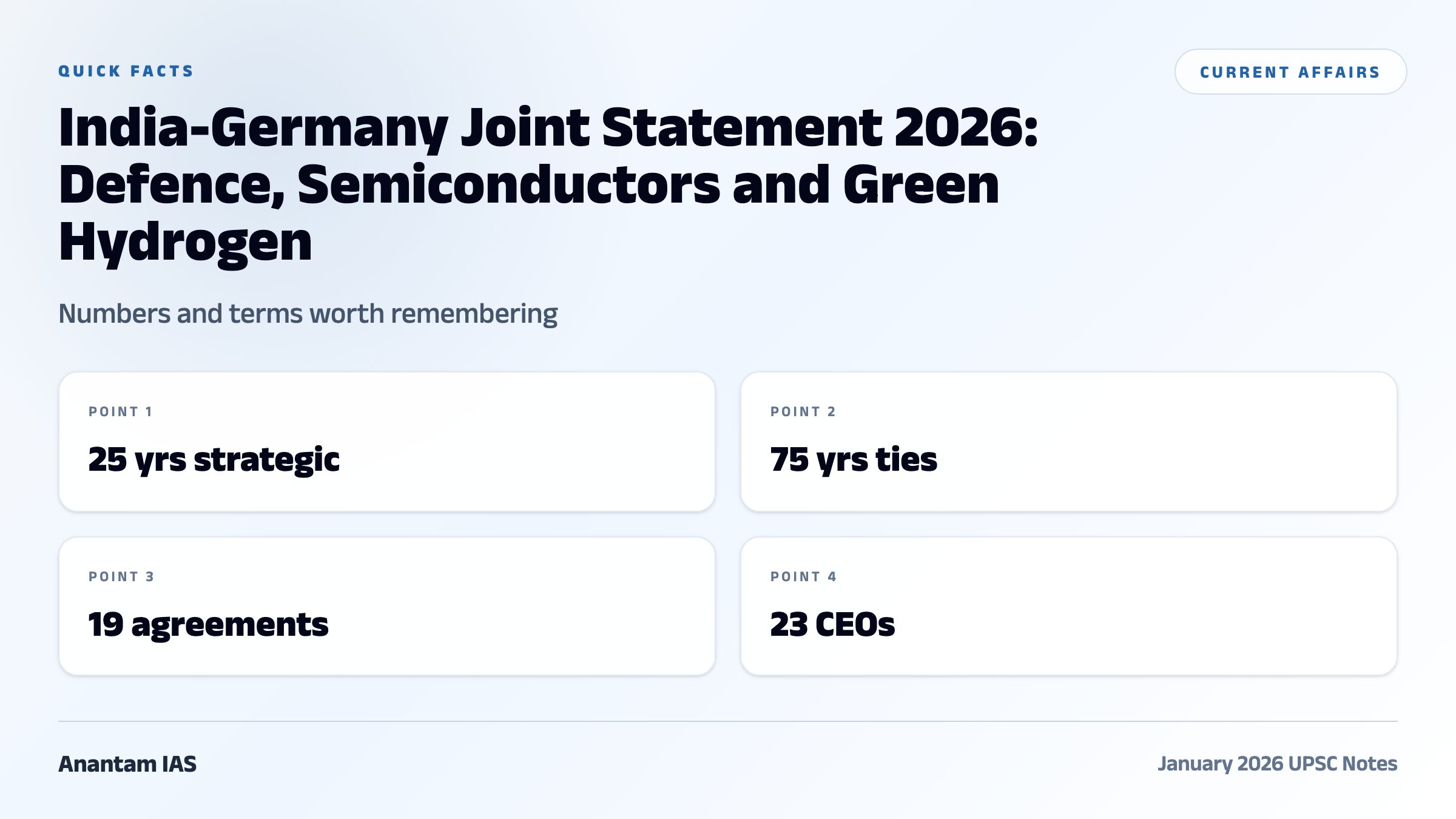
- The visit marked the 25th anniversary of the India-Germany Strategic Partnership and 75 years of diplomatic relations.
- A 23-member German CEO delegation accompanied the Chancellor.
- The joint statement listed 19 formal agreements and eight major announcements.
- Priority areas included defence, semiconductors, critical minerals, telecom, quantum, AI, green hydrogen and green ammonia.
- Germany announced visa-free transit facility for Indian nationals.
- Germany’s Global Shield against Climate Risks was linked with climate-resilience cooperation.
- Official source: PIB joint statement.
What Just Happened
The two sides adopted a wide-ranging joint statement after Chancellor Merz’s India visit. The outcomes covered security, industrial cooperation, climate action, migration, education, innovation and Indo-Pacific coordination.
The important shift is from values-only diplomacy to production-linked diplomacy. Defence platforms, semiconductor supply chains, critical minerals, AI and green hydrogen are now treated as strategic infrastructure.
India and Germany also used the visit to signal a shared interest in a rules-based Indo-Pacific, secure sea lanes and resilient technology supply chains. That gives the relationship relevance beyond trade.
Background and Historical Context
India and Germany established diplomatic relations in 1951. The Strategic Partnership was launched in 2000, and the Inter-Governmental Consultations mechanism later gave the relationship a Cabinet-level review format.
Germany is Europe’s largest economy and a major manufacturing, technology and climate-finance actor. India is a large market, a skilled-labour source, an Indo-Pacific power and a diversification option for European companies.
The relationship has often underperformed its potential because German industry moved slowly in India, and India did not always align regulatory systems with European manufacturing expectations. Supply-chain stress after COVID-19 and geopolitical uncertainty have changed the incentive structure.
Key Features of the 2026 Joint Statement

The core policy architecture can be read through these features.
- Defence industry: cooperation moved toward co-development, co-production and technology partnerships.
- Semiconductors: the statement placed chip design, manufacturing ecosystems and talent cooperation in the bilateral frame.
- Critical minerals: both sides linked green transition with secure mineral supply chains.
- Green hydrogen: hydrogen and green ammonia were treated as trade, climate and industrial-policy priorities.
- Mobility: skilled migration and visa facilitation supported labour-market complementarity.
- Indo-Pacific: maritime security and rules-based order appeared as strategic anchors.
Why It Matters
This is a high-yield UPSC topic because it joins current news with durable syllabus themes.
- It gives GS-II content on India’s relations with Europe beyond the India-EU framework.
- It connects IR with GS-III themes: semiconductors, defence manufacturing, energy transition and supply-chain security.
- It shows how diplomacy now includes CEOs, technology standards, migration and climate finance.
- It provides Essay material on a multipolar world and strategic autonomy.
Detailed Analysis: International Relations Lens
The relationship is moving from market access to strategic production. Germany wants supply-chain diversification. India wants technology, investment and manufacturing depth. The overlap is real, but it needs execution.
Green hydrogen is the bridge sector. Germany will need imported green molecules. India wants to become a low-cost producer. If standards, finance and offtake contracts align, this can become one of the most concrete India-Germany partnerships.
Defence cooperation remains promising but difficult. Germany has advanced platforms and engineering capacity, while India seeks indigenisation. Export controls, cost, intellectual property and long procurement cycles will test the ambition.
Comparative Perspective
A comparison helps prevent the answer from becoming a one-dimensional news summary.
- India-France: defence and space cooperation are deeper and more operationally mature.
- India-Germany: manufacturing, green technology, skills and industrial supply chains are the stronger pillars.
- India-UK: services, education, finance and diaspora dominate the relationship.
- India-EU: the wider framework covers trade, standards and climate, but Germany remains the industrial heavyweight inside Europe.
Challenges
The policy or institutional promise runs into recurring constraints.
- German companies often find India’s regulatory and compliance environment difficult.
- India needs deeper supplier ecosystems before it can absorb high-end manufacturing at scale.
- Technology transfer in defence and semiconductors will remain sensitive.
- Green hydrogen trade requires common standards, certification and long-term offtake certainty.
- Europe’s internal politics can slow external industrial and trade decisions.
Prelims Pointers
- India-Germany Strategic Partnership began in 2000.
- Inter-Governmental Consultations are a high-level bilateral review mechanism.
- Green hydrogen is produced using renewable electricity through electrolysis.
- Critical minerals are essential for batteries, clean energy, electronics and defence systems.
- Semiconductors are central to electronics, AI, defence, automobiles and telecom.
- Germany is a member of the G7, EU and NATO.
Mains Questions
- India-Germany relations are shifting from trade diplomacy to technology and supply-chain diplomacy. Discuss. (GS Paper II, 250 words)
- How can green hydrogen become a strategic pillar of India-Europe relations? (GS Paper III, 150 words)
- Evaluate the role of middle powers and industrial democracies in India’s strategic autonomy. (GS Paper II, 250 words)
- What constraints limit defence industrial cooperation between India and Germany? Suggest reforms. (GS Paper III, 250 words)
Way Forward
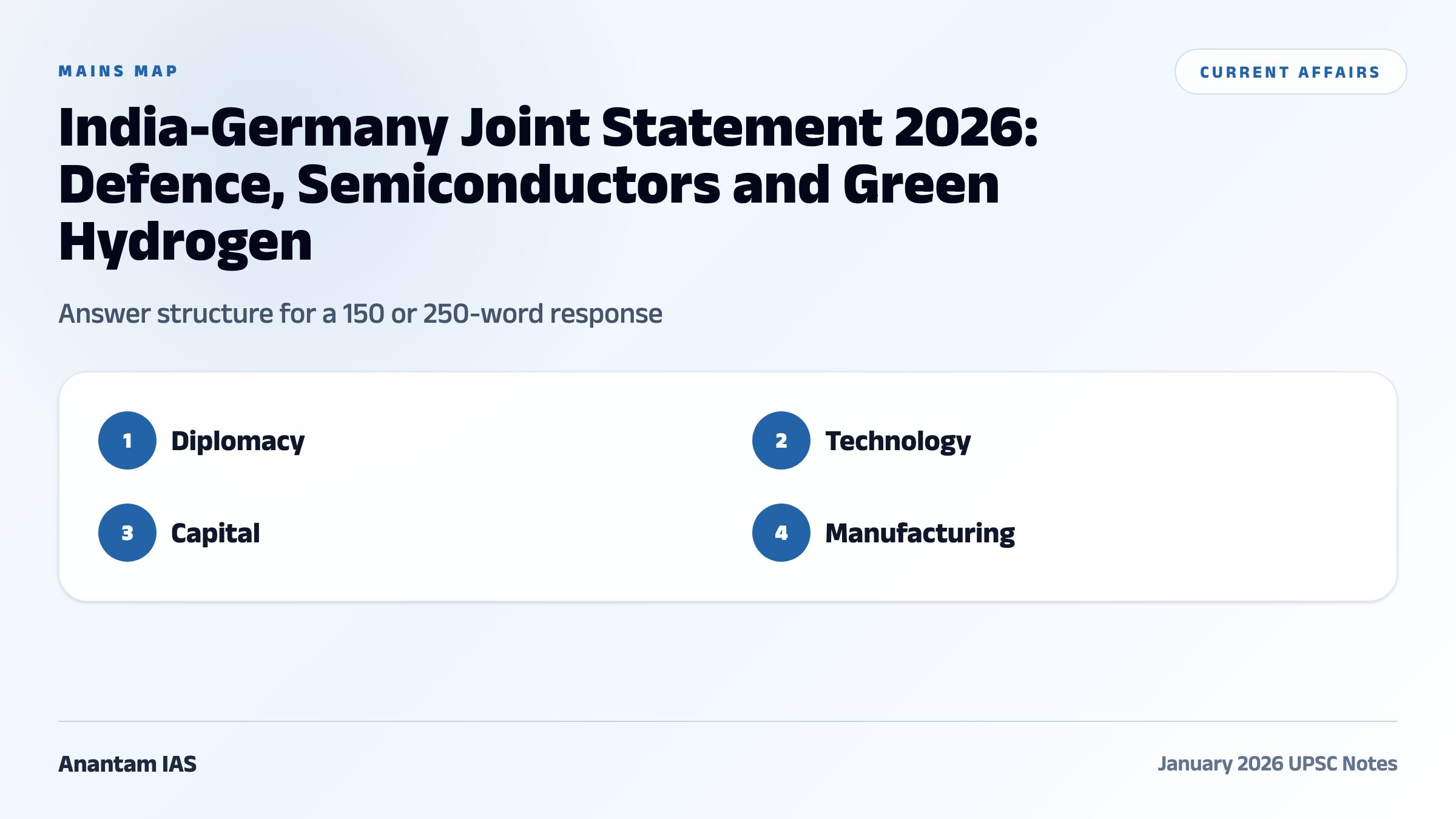
India should convert the joint statement into sector-specific roadmaps: one for defence platforms, one for green hydrogen offtake, one for semiconductor talent and one for critical minerals.
Regulatory predictability will matter more than diplomatic warmth. German firms will invest at scale only if land, taxation, customs, standards and dispute-resolution systems are dependable.
The best India-Germany partnership will not be measured by communiques. It will be measured by factories, research labs, skilling pipelines, co-developed technologies and clean-energy contracts.
The examiner is unlikely to reward a bare fact dump here. The better answer connects the January 2026 event to institutional design, implementation capacity and India’s long-term development priorities.
Frequently Asked Questions
Why was the 2026 India-Germany visit important?
It marked key anniversaries in the relationship and produced outcomes across defence, semiconductors, critical minerals, green hydrogen, AI, migration and the Indo-Pacific.
What is the India-Germany Strategic Partnership?
It is the bilateral framework launched in 2000 to deepen cooperation across political, economic, technological and security domains.
Why does Germany matter to India?
Germany is Europe’s largest economy, a manufacturing powerhouse and a major source of technology, skills cooperation and climate finance.
Why does India matter to Germany?
India offers market scale, skilled talent, Indo-Pacific relevance and supply-chain diversification opportunities.
What are the UPSC themes here?
GS-II international relations, GS-III technology, defence manufacturing, green hydrogen, critical minerals and supply-chain security.
What is the main challenge?
Implementation. The relationship has strong intent, but regulatory friction, technology transfer limits and slow procurement can weaken outcomes.
Source: https://anantamias.com/current-affairs/india-germany-joint-statement-2026/
Ganga Innovation Meet 2026: Technology, Biodiversity and River Rejuvenation
Ganga Innovation Meet 2026 brought together technology, research and river-rejuvenation ideas under the Namami Gange umbrella. The event signalled that river governance is increasingly looking to sensors, biodiversity science, citizen participation and applied innovation.
For UPSC, this topic helps students move beyond a static Namami Gange note. It asks what kind of innovation actually matters for a living river system.
This article explains the innovation agenda in river governance and connects it with biodiversity, pollution control and institutional coordination.
Quick Facts
- Ganga Innovation Meet was organised in January 2026.
- It was linked to Namami Gange and NMCG’s river-rejuvenation agenda.
- Themes included technology, biodiversity, pollution monitoring and stakeholder participation.
- River governance requires basin-level thinking, not city-wise projects alone.
- The topic is relevant for GS-III environment and science and technology.
- Official source: PIB Jal Shakti release dated 13 January 2026.
- Official source: PIB, Ministry of Jal Shakti.
What Just Happened
The Meet created a platform for innovation in river rejuvenation, including technological and ecological approaches.
The policy signal was that river cleaning cannot remain a civil-engineering exercise. It needs data, ecological restoration and community engagement.
For aspirants, the event is useful for writing answers on how environmental governance can use technology without losing sight of ecology.
Background and Historical Context
Ganga rejuvenation efforts have evolved from project-based sewage treatment to a broader basin approach involving pollution control, biodiversity, wetlands, afforestation and public participation.
NMCG has increasingly used research institutions, data systems and stakeholder platforms to strengthen implementation.
Innovation in river governance can include real-time water-quality monitoring, low-cost sensors, bio-remediation, biodiversity mapping and riverfront behaviour change.
Key Features of River Innovation
The core policy architecture can be read through these features.
- Technology focus: digital and scientific tools can improve monitoring.
- Biodiversity link: river health includes species, habitats and ecological flows.
- Stakeholder platform: innovators, researchers and administrators can interact.
- Basin thinking: tributaries and catchments must be part of solutions.
- Citizen role: behavioural change and local monitoring can support formal systems.
- Implementation test: pilots must move into procurement and field use.
Why It Matters
This is a high-yield UPSC topic because it joins current news with durable syllabus themes.
- It connects a January 2026 event with durable UPSC syllabus themes.
- It gives usable facts for Prelims and analytical hooks for Mains.
- It helps students move from news recall to policy reasoning.
- It can be linked with static concepts in polity, economy, governance, science, environment or society.
Detailed Analysis: River Innovation Lens
Innovation cannot be gadget-driven. A sensor is useful only when institutions respond to the data.
Ecological restoration is different from beautification. A clean-looking riverfront is not the same as a healthy river.
Public participation matters because rivers are social spaces. Ritual use, waste disposal, tourism and urban growth all shape river outcomes.
Comparative Perspective
A comparison helps prevent the answer from becoming a one-dimensional news summary.
- STP dashboards: track sewage-treatment performance.
- Biodiversity programs: focus on species and habitats.
- Wetland restoration: improves natural filtration and flood buffering.
- Innovation meets: create a bridge between ideas and mission implementation.
Challenges
The policy or institutional promise runs into recurring constraints.
- Pilot projects often fail to scale.
- Ecological indicators are harder to communicate than infrastructure milestones.
- Cities may lack capacity to adopt new tools.
- Data from sensors needs validation and maintenance.
- River rejuvenation requires coordination across multiple states.
Prelims Pointers
- NMCG is linked to Namami Gange implementation.
- BOD, dissolved oxygen and faecal coliform are important water-quality indicators.
- Environmental flows sustain river ecosystems.
- Wetlands can support natural water purification.
- Ganga river dolphin is an important indicator species.
- River basins cross administrative boundaries.
Mains Questions
- River rejuvenation requires ecological restoration, not only pollution-control infrastructure. Discuss. (GS Paper III, 250 words)
- How can technology improve river governance without becoming a substitute for enforcement? (GS Paper III, 150 words)
- Explain the importance of basin-level planning in river conservation. (GS Paper III, 250 words)
- Citizen participation is critical to environmental governance. Analyse with reference to river rejuvenation. (GS Paper III, 250 words)
Way Forward
Innovation platforms should connect pilots with procurement pathways, city-level capacity and public data disclosure.
River-health dashboards should include ecological indicators, not only sewage-infrastructure milestones.
For UPSC, frame Ganga Innovation Meet as a shift from project execution to adaptive river governance.
The examiner is unlikely to reward a bare fact dump here. The better answer connects the January 2026 event to institutional design, implementation capacity and India’s long-term development priorities.
Frequently Asked Questions
What is Ganga Innovation Meet?
It is a platform focused on innovative approaches for Ganga river rejuvenation.
How is it linked to Namami Gange?
It supports the mission’s broader goals of pollution control, biodiversity and river restoration.
Why is technology important?
It can improve monitoring, data quality and targeted action.
What is ecological flow?
It is the water flow needed to sustain river ecosystems.
Why is this UPSC-relevant?
It combines environment, science, governance and federal coordination.
What is the main caution?
Innovation must scale into accountable implementation, not remain a conference theme.
Source: https://anantamias.com/current-affairs/ganga-innovation-meet-2026/
Pariksha Pe Charcha 2026: Exam Stress, Student Wellbeing and Public Communication
Pariksha Pe Charcha 2026 crossed a record registration figure in January, keeping exam stress, student wellbeing and parent-teacher communication in the public-policy conversation.
For UPSC, the topic is useful because it connects education policy with mental health, adolescent wellbeing, competitive pressure and the state’s use of public communication to shape social behaviour.
This article reads Pariksha Pe Charcha as a governance communication tool and asks what deeper reforms are needed to reduce exam stress.
Quick Facts
- Pariksha Pe Charcha is an annual interaction around exams, stress and student motivation.
- The 2026 edition saw very large registrations through official platforms.
- The event is linked to students, teachers and parents.
- The broader theme is exam stress and student wellbeing.
- It connects with NEP 2020’s emphasis on holistic education.
- Official source: PIB Ministry of Education release dated 13 January 2026.
- Official source: PIB, Ministry of Education.
What Just Happened
The Ministry of Education announced strong registration numbers for Pariksha Pe Charcha 2026.
The event seeks to normalise conversations around exam anxiety, preparation, motivation and parental pressure.
For aspirants, the news hook is a chance to discuss mental health in education without reducing it to motivational messaging.
Background and Historical Context
India’s education system has long been exam-heavy. Board exams, entrance tests and coaching ecosystems create pressure that affects students and families.
NEP 2020 calls for more holistic, flexible and competency-based education. Assessment reform is central to that vision.
Student wellbeing is now part of education governance because stress, dropout, self-harm and learning anxiety affect human capital.
Key Features of Student Wellbeing
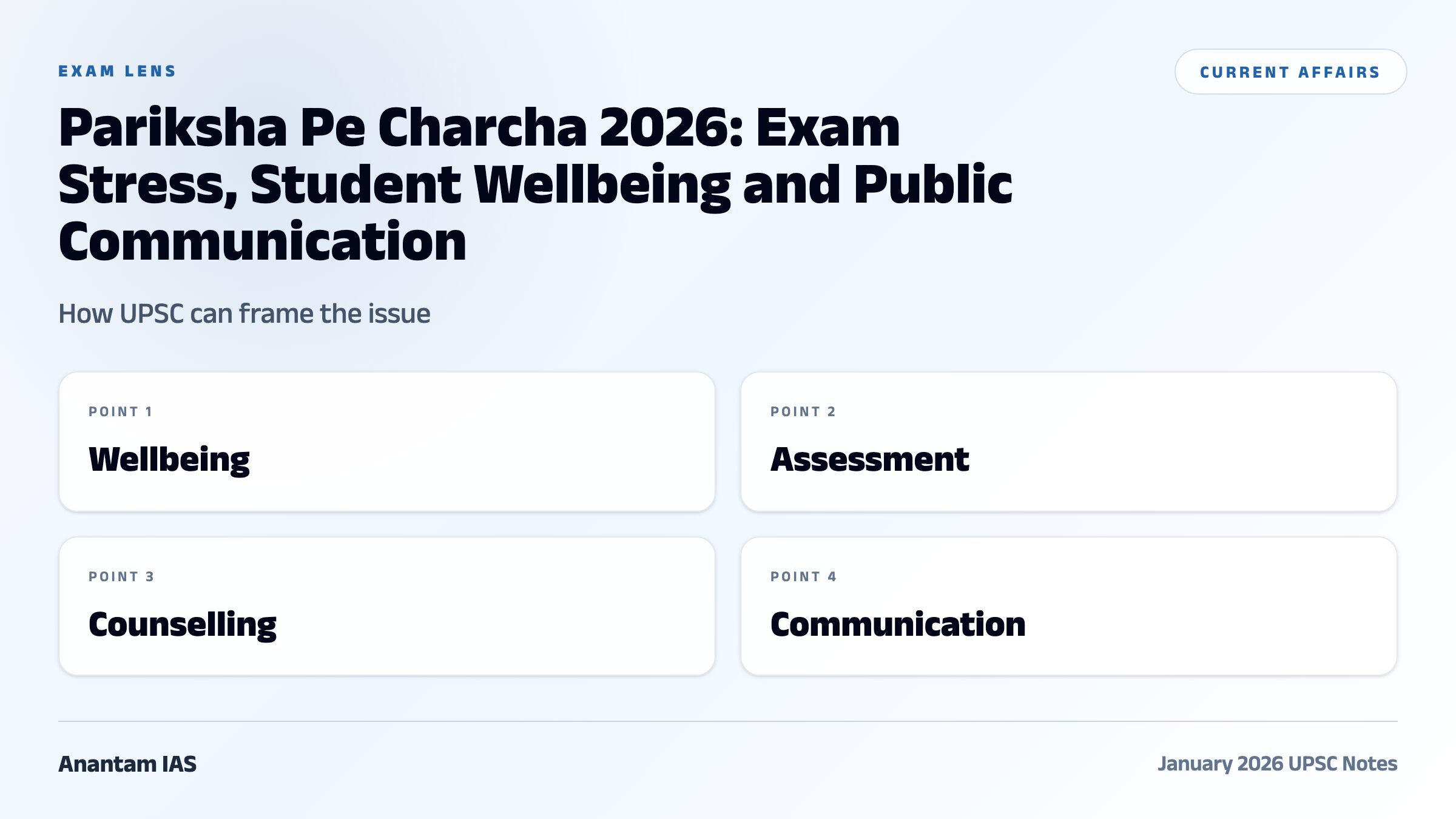
The core policy architecture can be read through these features.
- Public communication: the platform creates national conversation around exam stress.
- Stakeholder inclusion: students, teachers and parents participate.
- Behavioural signal: it tries to reduce fear and stigma around exams.
- NEP link: holistic education and assessment reform provide the policy background.
- Mental-health angle: stress management needs institutional support.
- Limitation: communication cannot replace counselling and assessment reform.
Why It Matters
This is a high-yield UPSC topic because it joins current news with durable syllabus themes.
- It connects a January 2026 event with durable UPSC syllabus themes.
- It gives usable facts for Prelims and analytical hooks for Mains.
- It helps students move from news recall to policy reasoning.
- It can be linked with static concepts in polity, economy, governance, science, environment or society.
Detailed Analysis: Student Wellbeing Lens
Motivation is useful, but structural pressure remains. Students still face high-stakes exams, coaching inequality and narrow definitions of success.
Parents are part of the policy ecosystem. Exam stress is shaped at home as much as in school.
Schools need counselling capacity. Public messaging should be backed by counsellors, teacher training and referral systems.
Comparative Perspective
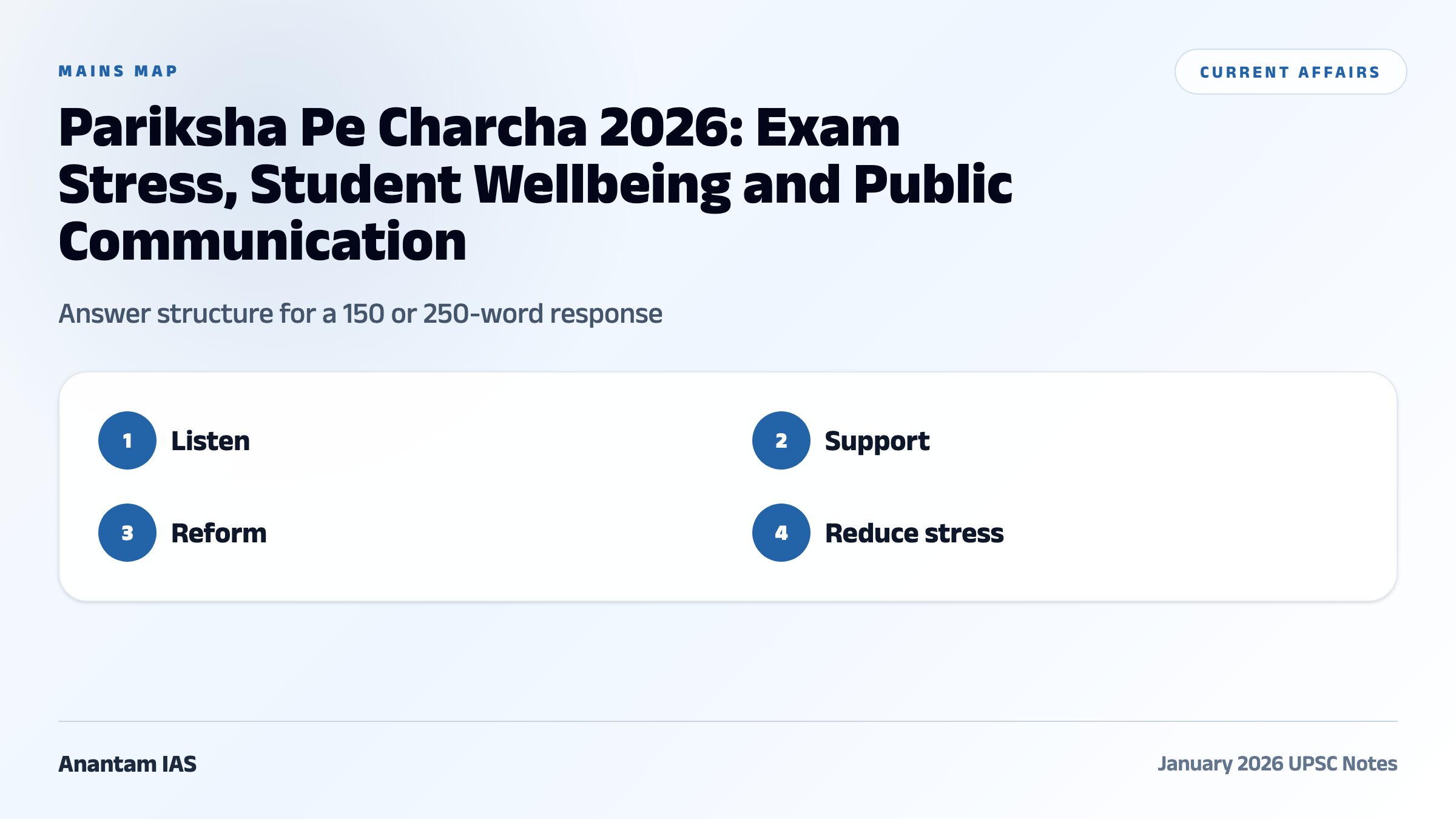
A comparison helps prevent the answer from becoming a one-dimensional news summary.
- Exam reform: changes assessment design and stakes.
- Counselling: provides direct mental-health support.
- Public campaigns: shift social norms and awareness.
- Pariksha Pe Charcha: works mainly as public communication and motivation.
Challenges
The policy or institutional promise runs into recurring constraints.
- One annual event cannot substitute for school-level counselling.
- Competitive exams continue to create high-stakes pressure.
- Rural and government schools need stronger wellbeing infrastructure.
- Parents and coaching centres may reinforce unhealthy pressure.
- Mental-health stigma prevents students from seeking help.
Prelims Pointers
- Pariksha Pe Charcha is linked to exam stress and student interaction.
- NEP 2020 emphasises holistic development and assessment reform.
- Adolescent mental health is a public-health and education concern.
- School counsellors and teacher training are important wellbeing measures.
- Competency-based assessment tests understanding rather than rote recall.
- Public communication can be a governance tool.
Mains Questions
- Student wellbeing must be treated as a core education-policy concern. Discuss. (GS Paper II, 250 words)
- Public communication can reduce stigma but cannot replace institutional reform. Analyse with reference to exam stress. (GS Paper II, 150 words)
- How can assessment reform reduce pressure in India’s school system? (GS Paper II, 250 words)
- Examine the role of parents and teachers in addressing adolescent mental health. (GS Paper II, 250 words)
Way Forward
Pariksha Pe Charcha should be backed by school counsellors, teacher mental-health training, helplines, peer-support systems and assessment reform.
Student wellbeing indicators should be tracked along with enrolment and learning outcomes.
In UPSC answers, use the event as a hook but move quickly to structural reforms.
The examiner is unlikely to reward a bare fact dump here. The better answer connects the January 2026 event to institutional design, implementation capacity and India’s long-term development priorities.
Frequently Asked Questions
What is Pariksha Pe Charcha?
It is an annual interaction focused on exams, stress, motivation and student wellbeing.
Why is it relevant for UPSC?
It links education policy with mental health, assessment reform and public communication.
Is it a scheme?
It is more of a public interaction and communication platform than a conventional welfare scheme.
What is the main limitation?
It cannot replace counselling, assessment reform and school-level wellbeing systems.
How does NEP 2020 connect?
NEP emphasises holistic education, flexibility and assessment reform.
Which GS paper is relevant?
GS-II social sector and governance.
Source: https://anantamias.com/current-affairs/pariksha-pe-charcha-2026-registrations/