Daily Digest
UPSC · Civil Services Examination
Current Affairs · Saturday, 13 September 2025
Current affairs curated and edited by Anantam IAS faculty — pulled from The Hindu, PIB, IDSA, Foreign Affairs and the ministries. Read, annotate, revise.
Old Rajinder Nagar · Delhi 110005 · anantamias.com
Right to Clean Air

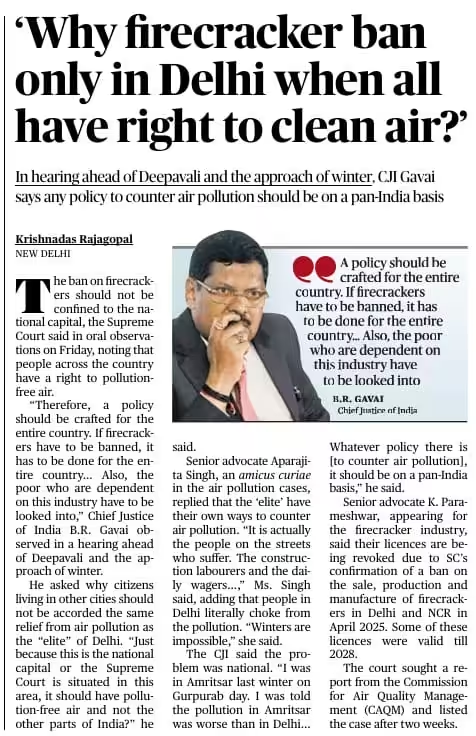
Why in news:
Chief Justice of India (CJI) D.Y. Chandrachud, while hearing a plea regarding firecracker bans ahead of Deepavali (Diwali) and the onset of winter pollution, questioned why such bans are enforced only in Delhi. He emphasized that “clean air is a fundamental right of every citizen”, not just those living in the national capital.
UPSC Relevance:
Conservation, environmental pollution and degradation.
UPSC PYQ 2015:
Does the right to clean environment entail legal regulations on burning crackers during Diwali?
Fire Cracker Ban:
The bench of Justice Abhay S. Oka and Justice Ujjal Bhuyan directed the states of Uttar Pradesh, Rajasthan and Haryana to issue directions under Section 5 of the Environment Protection Act, 1986, enforcing a complete ban on firecrackers in the National Capital Region (NCR).
History:
- The Court permitted the use of “green crackers”, which comply with the environmental norms set forth in its 2018 judgment. These crackers are designed to produce reduced emissions and lower noise levels, and must be certified by the Council of Scientific and Industrial Research (CSIR).
- In 2021, the Supreme Court of India issued a series of directions to ensure that firecrackers containing banned chemicals were not manufactured or sold ahead of Diwali. The Court clarified that there is no blanket ban on firecrackers, but only those containing barium salts are prohibited due to their hazardous impact on health and environment.
- In 2023, the Supreme Court reaffirmed that its restrictions on firecrackers are applicable across the entire country, not limited to Delhi-NCR. The Court directed all state governments to take effective steps to control air and noise pollution, particularly during the festive season. This directive came in response to petitions demanding a nationwide ban on the sale and use of polluting firecrackers.
Legal and Environmental Concerns:
- The SC highlighted regional discrimination and suggested uniform national policy rather than ad-hoc regional orders.
- Right to Clean Air is a part of Article 21 (Right to Life) of the Constitution.
- Firecracker bans have been mainly implemented in Delhi-NCR due to severe winter smog, but pollution affects many cities across India.
Socio-economic Angle:
- The court emphasized balancing environmental protection with economic justice. The CJI also raised concerns about the poor, especially those dependent on the firecracker industry. Blanket bans without rehabilitation plans could disrupt livelihoods.
Source: https://anantamias.com/current-affairs/right-to-clean-air/
Right to Information to Right to deny Information

Why in news:
This article is in news because of growing concern that amendments and reinterpretations of the Right to Information (RTI) Act are gradually weakening citizens’ access to information, particularly by expanding the definition of ‘personal information’ and prioritizing privacy over public interest and transparency.
UPSC CSE Relevance:
UPSC CSE in mains examination has focused on Important aspects of governance, transparency and accountability, e-governance- applications, models, successes, limitations, and potential in GSII.
UPSC mains PYQ 2023:
E-governance, as a critical tool of governance, has ushered in effectiveness, transparency and accountability in governments. What inadequacies hamper the enhancement of these features?
All About RTI:
https://anantamias.com/current-affairs/right-to-information/
New Emerging Issues:
Expanded Definition of “Personal Information” in (DPDP) Act, 2023
- Expand Personal information” very broadly — includes names, family, firms, companies, and even the state.
- If this wider definition is adopted in RTI interpretation, almost all government information could be denied.
Conflict Between RTI and DPDP Act
- DPDP Act imposes heavy fines (₹250 crore) for breaches of personal data.
- Due to this a shift from “Right to Information” to “Right to Deny Information”.
- Basic info such as service records of public officials, assets, or reasons for policy decisions are being denied under the guise of privacy.
Source: https://anantamias.com/current-affairs/right-to-information-to-right-to-deny-information/