Daily Digest
UPSC · Civil Services Examination
Current Affairs · Wednesday, 14 October 2026
Current affairs curated and edited by Anantam IAS faculty — pulled from The Hindu, PIB, IDSA, Foreign Affairs and the ministries. Read, annotate, revise.
Old Rajinder Nagar · Delhi 110005 · anantamias.com
Ayush Treatment Guidelines: Standardisation and Evidence Limits
Why in News?
On 13 October, the Ministry of Ayush reported issuing system-specific standard treatment guidelines for skin disorders, prepared by the Ayush Vertical of the Directorate General of Health Services.
- The four systems covered are Ayurveda, Siddha, Unani and Homoeopathy, with the inclusion of Yoga.
- The guidelines address prevention, diagnosis, treatment, follow-up and rehabilitation for common dermatological conditions.
- Medical Officers in Delhi provided feedback on operational usability in primary and secondary healthcare settings.
- The governance question is whether consistent procedures can improve accountability while making the limits of supporting evidence clear.
- The announcement describes standardisation; it does not establish equal effectiveness across systems or prove every recommended intervention.
UPSC Relevance
Prelims Relevance
- Standard Treatment Guidelines: recommendations intended to guide clinical practice.
- Ayush Vertical: located within DGHS, Ministry of Health & Family Welfare.
- Ministry of Ayush: ministry reporting the system-specific dermatology guidelines.
- Operational usability: whether a protocol can be understood and applied in practice.
- Clinical effectiveness: patient benefit requiring suitable outcome evidence.
Mains Relevance
GS Paper 2
- Quality assurance and accountability in healthcare delivery.
- Evidence appraisal and institutional coordination in health policy.
Essay
- Public trust depends on institutions distinguishing an intention from a demonstrated result.
Background and Context
What Standardisation Can Change
A common reference can organise clinical decisions, but its publication alone does not demonstrate better patient outcomes or settle disagreements about evidence.
- The institutional arrangement crosses administrative boundaries: the Ministry of Ayush reported guidelines prepared by the Ayush Vertical within DGHS, which belongs to the Ministry of Health & Family Welfare, rather than Ayush alone.
- The documents retain system-specific approaches while covering a common dermatology domain. This means a shared policy objective of consistency, rather than one identical treatment protocol applied across every system or clinical situation.
- Conditions named include psoriasis, dermatitis and vitiligo, alongside urticaria and dermatophytosis. Their inclusion describes the scope of the guidelines; listing a disorder is not evidence that a particular intervention cures it reliably.
- The stated scope follows a care pathway from prevention and diagnosis through treatment, follow-up and rehabilitation. For administration, this offers a reference around which practitioner training and service review can be organised.
- The ministry presents quality assurance and rational decision-making as expected benefits. A careful policy answer should retain that forward-looking status instead of describing reduced disease burden or improved recovery as already measured achievements.

How the Guidelines Were Developed
The reported process brought several professional perspectives together, then sought feedback from practitioners using the protocols in routine services.
- Research councils and academic specialists from the four systems participated alongside Yoga experts and specialists in modern medicine. This describes multidisciplinary participation; it does not establish that all participants endorsed every intervention as equally effective.
- The preparation combined classical-text review, contemporary scientific evidence and expert consultation, followed by consensus deliberations. These inputs serve different purposes; their presence should not be collapsed into a single claim of conclusive clinical proof.
- The Delhi Directorate of Ayush partnered in field-level validation involving Medical Officers working in primary and secondary care. The release identifies their feedback as addressing operational usability, helping refine the final documents for practice.
- Usability feedback asks whether a protocol works as a practical guide for its users. It can inform clearer instructions and feasible workflows without independently answering whether the intervention improves a patient’s condition.
- The release describes the documents as resources for practitioners, teachers, researchers and policymakers. Their research role matters: a guideline can organise questions that still need investigation, rather than close scientific inquiry after publication.
The Evidence Test for Health Policy
The key comparison is between making practice consistent and establishing that an intervention produces reliable clinical benefit.
- Standardisation reduces variation in how a process is described or followed; effectiveness concerns what happens to patients. A consistently followed protocol can still need stronger evidence on its benefits and harms.
- The WHO guideline-development framework emphasises systematic evidence search, synthesis and quality assessment. This provides an appraisal benchmark; it is not a WHO endorsement of these Ayush documents or their individual recommendations.
- WHO also highlights conflict-of-interest management and transparent decisions considering potential benefits, harms and user preferences. For governance, these safeguards help readers examine how recommendations were reached rather than relying only on institutional authority.
- The reported field validation should not be relabelled a randomised efficacy trial. The PIB account supplies no such trial results; it cannot establish treatment equivalence, a proven cure or superiority over established care.
- For a policy answer, treat evidence transparency as a continuing requirement: distinguish what a document recommends, what studies demonstrate and what remains uncertain. Administrative integration should not blur these separate claims for the public.
Way Forward
Make Recommendations Auditable
- Publish accessible evidence summaries and the basis for each recommendation, making uncertainty visible alongside intended benefits.
- Build practitioner training around appropriate use, documentation and referral responsibilities; assess service quality beyond the number of documents distributed.
- Track patient outcomes and adverse events, and specify when new evidence should trigger revision of a recommendation.
Conclusion
- The Ayush guidelines are a clinical-governance development, with standardisation as their stated purpose. Their policy value must be assessed through transparent recommendations, workable implementation and measured outcomes, rather than the act of publication alone.
- Keep operational usability separate from clinical proof. This distinction allows an answer to recognise institutional coordination while remaining precise about what the reported field exercise does, and does not, establish for patients.
UPSC Practice Questions
Prelims MCQ 1
With reference to the reported Ayush dermatology guidelines, consider the following statements:
- They cover Ayurveda, Siddha, Unani and Homoeopathy, with Yoga included.
- They were prepared by the Ayush Vertical of DGHS.
- The reported usability exercise establishes equal clinical effectiveness across all four systems.
How many of the above statements are correct?
(a) Only one (b) Only two (c) All three (d) None
Answer: (b) Only two
Explanation:
The first two statements match the official release. Feedback on operational usability cannot establish equal clinical effectiveness.
Prelims MCQ 2
Which question is most directly addressed by operational usability testing of a treatment guideline?
(a) Does every intervention cure the relevant disorder? (b) Are all systems clinically equivalent? (c) Can practitioners understand and apply the protocol in their service setting? (d) Is further clinical research unnecessary?
Answer: (c) Can practitioners understand and apply the protocol in their service setting?
Explanation:
Usability concerns practical application. Establishing clinical benefit needs appropriate outcome evidence, and usability feedback cannot replace it.
UPSC Mains Questions
- Distinguish standardisation of clinical practice from evidence of clinical effectiveness. Discuss this distinction using the recently reported Ayush dermatology guidelines.
- How can transparency in guideline development improve accountability in healthcare? Explain the roles of evidence appraisal, practitioner feedback and periodic revision.
Sources: PIB, Ministry of Ayush and WHO Guidelines Review Committee.
Frequently Asked Questions
What are the new Ayush dermatology guidelines?
They are system-specific standard treatment guidelines covering common skin disorders in Ayurveda, Siddha, Unani and Homoeopathy, with Yoga included. Their stated purpose is greater consistency and quality assurance in clinical practice.
Which institution prepared the guidelines?
The Ayush Vertical of the Directorate General of Health Services, within the Ministry of Health & Family Welfare, prepared them through a multidisciplinary process. The Ministry of Ayush reported their issuance.
What did field validation assess?
Medical Officers working in primary and secondary healthcare provided feedback on operational usability through a partnership with Delhi’s Directorate of Ayush. This concerns practical use of protocols and should not be described as proof of clinical efficacy.
Do these guidelines prove that all covered treatments work equally well?
No. Issuing guidelines or collecting usability feedback does not establish treatment equivalence or a proven cure. Such claims require appropriate clinical evidence; the official announcement does not provide that comparative proof.
Source: https://anantamias.com/current-affairs/ayush-skin-guidelines-standardisation-evidence-limits/
BIMSTEC Delhi Declaration: Cooperation Against Forced Criminality
Why in News?
The first BIMSTEC Home Ministers’ Meeting adopted the Delhi Declaration in New Delhi on 13 October 2026, calling for regional security cooperation against trafficking, terrorism and transnational crime.
- The declaration specifically recognises forced criminality: trafficked people compelled to conduct online fraud and scam operations.
- It calls for a victim-centred approach involving countries of origin, transit and destination, alongside countries hosting scam centres and defrauded individuals.
- It seeks implementation of existing cooperation instruments while urging early finalisation of unfinished conventions and victim-rescue procedures.
- A scam operation can connect human trafficking and financial fraud across borders; a purely domestic investigation may capture only one part of that chain.
- Regional cooperation must connect victim protection with evidence gathering without treating an international declaration as permission to bypass national law.
UPSC Relevance
Prelims Relevance
- BIMSTEC: Bay of Bengal Initiative for Multi-Sectoral Technical and Economic Cooperation.
- Members: Bangladesh, Bhutan, India, Myanmar, Nepal, Sri Lanka and Thailand.
- Forced criminality: exploiting trafficked victims by compelling criminal activity.
- Distinction between mutual legal assistance and extradition.
- Delhi Declaration: victim-centred cooperation within domestic laws and applicable international obligations.
Mains Relevance
GS Paper 2
- Regional institutions and sovereign equality in cross-border cooperation.
- Rights-based responses to trafficking and victim rehabilitation.
GS Paper 3
- Cyber-enabled organised crime, human trafficking and financial investigation.
Essay
- Security cooperation is strongest when protection of people accompanies prosecution of crime.
Background and Context
What Forced Criminality Changes
The declaration connects online fraud with exploitation of the people made to carry it out.
- Forced criminality describes the exploitation identified here: organised groups compel trafficked victims to perpetrate online scams. The person communicating with a fraud victim may also be under coercion, debt bondage or other abuse.
- Two forms of harm can coexist in the same operation: exploitation of trafficked workers and financial loss suffered by those deceived. Investigations should examine both without assuming everyone performing a scam has the same role.
- Victim identification matters before assigning responsibility. A victim-centred response examines coercion and exploitation, rather than reading a person’s presence in a scam centre as sufficient evidence of freely chosen participation in an organised criminal enterprise.
- Technology helps criminal groups facilitate trafficking and exploit victims in online fraud, according to the declaration. This joins human-security and cybercrime concerns; treating them as unrelated problems can leave the underlying exploitation insufficiently examined.
- Rescue alone is an incomplete policy response. The declaration also seeks procedures for repatriation and reintegration, recognising that returning a person across a border does not itself settle their protection and recovery needs.
Why Several Countries Must Cooperate
The relevant jurisdictions are defined by the trafficking and fraud chain, rather than by the location of one arrested suspect.
- Origin, transit and destination countries have different connections to the movement and exploitation of victims. The declaration explicitly asks them to cooperate rather than leaving responsibility solely to the country where a victim is found.
- Scam-centre locations and countries where individuals are defrauded also belong in this response. That distinction matters because the place of exploitation and the place of financial harm need not be the same jurisdiction.
- Domestic law remains the operating framework: cooperation is required within respective jurisdictions and across borders, subject to applicable international obligations. The declaration does not grant a member’s police unrestricted authority inside another member’s territory.
- Sovereign equality, territorial integrity and non-interference frame BIMSTEC security cooperation. Its work complements bilateral and other regional arrangements; it does not replace those channels or create a single regional criminal-justice jurisdiction.
- Implementation depends on institutions after the meeting. The declaration directs the Joint Working Group on Counter-Terrorism and Transnational Crime and its subgroups to follow up, while encouraging specialised training across member states.
Separate Commitments From Completed Legal Instruments
The official declaration distinguishes existing instruments from texts still needing agreement.
- The Delhi Declaration records agreed political directions. Adoption should not be described as enactment of a common criminal law, creation of a regional police force or an automatic right to extradite suspects.
- The counter-terrorism convention, covering international terrorism, transnational organised crime and illicit drug trafficking, entered into force in March 2021. The declaration calls for full implementation of this existing instrument rather than announcing its first adoption.
- Mutual legal assistance concerns cooperation in criminal matters; extradition concerns surrender of a person. The declaration refers to a signed assistance convention while separately asking members to finish the extradition convention’s text.
- Trafficking and prisoner-transfer conventions also require early finalisation, alongside rescue, repatriation and reintegration procedures. These requests identify unfinished work; they are not evidence that all the proposed instruments are already operational across member states.
- Information sharing is another pending step: members are asked to consult further on a proposed mechanism covering trafficking and migrant smuggling. Its future operation must follow national legal frameworks, rather than unrestricted cross-border data exchange.
Way Forward
Make Cooperation Usable in Individual Cases
- Develop victim-referral procedures linking rescue, interpreters, safe return and reintegration, with clear responsibilities for the countries involved.
- Use lawful evidence requests and financial investigation alongside rescue, so action reaches organisers and proceeds rather than stopping at people found inside scam centres.
- Assess progress through implemented procedures, case cooperation and victim protection; do not equate another declaration with completed enforcement arrangements.
Conclusion
- The Delhi Declaration’s useful contribution is to connect forced criminality with victim-centred regional cooperation. It recognises that online fraud can involve both exploitation of workers and harm to people deceived across borders.
- For analysis, separate political commitment, existing legal instruments and unfinished negotiations. Effective cooperation requires protection of victims and coordination between jurisdictions, with domestic law remaining central to how individual cases are handled.
UPSC Practice Questions
Prelims MCQ 1
With reference to the BIMSTEC Delhi Declaration adopted in October 2026, consider the following statements:
- It recognises that trafficking victims may be forced to carry out online scams.
- It makes regional security cooperation a substitute for bilateral cooperation.
- It calls for early finalisation of the convention on extradition.
How many of the above statements are correct?
(a) Only one (b) Only two (c) All three (d) None
Answer: (b) Only two
Explanation:
Statements 1 and 3 are correct. The declaration expressly makes BIMSTEC cooperation complementary to, rather than a substitute for, bilateral and other cooperation.
Prelims MCQ 2
Which approach best reflects the declaration’s response to scam-centre trafficking?
(a) Treat every person conducting an online scam as acting voluntarily (b) Limit cooperation to the country where the scam centre operates (c) Coordinate relevant jurisdictions while respecting victims’ rights and domestic laws (d) Allow foreign police to operate anywhere in the region without legal procedures
Answer: (c) Coordinate relevant jurisdictions while respecting victims’ rights and domestic laws
Explanation:
The declaration includes origin, transit and destination countries as well as locations of scam centres and defrauded individuals, with a victim-centred approach and legal safeguards.
UPSC Mains Questions
- How does trafficking for forced criminality complicate the distinction between offenders and victims? Discuss the requirements of a victim-centred regional response.
- Evaluate the potential and limitations of BIMSTEC cooperation against transnational organised crime, with reference to the Delhi Declaration.
Source: PIB, Ministry of Home Affairs.
Frequently Asked Questions
What is the BIMSTEC Delhi Declaration?
It is the declaration adopted at the first BIMSTEC Home Ministers’ Meeting on 13 October 2026. It sets directions for regional security cooperation, including action against trafficking, terrorism and transnational organised crime.
What does forced criminality mean here?
It refers to trafficked people being compelled to carry out criminal activity, particularly online fraud and scam operations. The declaration links this exploitation with debt bondage and other abusive practices.
Does the declaration create automatic extradition?
No. It calls for early finalisation of the extradition convention’s text. A political declaration should not be read as automatically authorising surrender of suspects or overriding applicable domestic legal procedures.
Why are countries where people are defrauded included?
Fraud victims may be in a different country from the scam centre or trafficked workers. Including their jurisdictions connects the financial harm with the wider trafficking and exploitation investigation.
Source: https://anantamias.com/current-affairs/bimstec-delhi-declaration-trafficking-security-cooperation/
Keralam Elder-Care Bill: Registration and Rights-Based Oversight
Why in News?
The Keralam government introduced the Senior Citizens’ (Care and Protection of Rights) Bill, 2026, on October 13, proposing registration and rights-based oversight of elder-care services, The Indian Express reported.
- The Bill remains a legislative proposal; its proposed registration duties and enforcement powers must not be described as already operational law.
- Its coverage extends beyond residential homes to day care, home-care agencies and caregiver-training centres, subject to exclusions in the draft.
- A proposed Registrar and district institutions would connect registration decisions, inspection reports and complaint handling.
- The draft pairs service regulation with dignity, supported decision-making and ageing in place, rather than treating shelter alone as adequate care.
- An older person may depend on a provider for everyday assistance while finding it difficult to complain; independent oversight addresses this unequal relationship.
- The governance test is whether registration leads to continuing accountability, while protecting autonomy and keeping essential services accessible.
UPSC Relevance
Prelims Relevance
- Ageing in place: living safely and independently at home or in a chosen community.
- Registrar: the proposed designation of the Director, Department of Senior Citizens.
- District Protection Unit: the proposed executing and inquiry institution.
- District Protection Forum: the proposed supervisory and complaint-direction institution.
- Supported decision-making: assistance that prioritises the older person’s own choices.
Mains Relevance
GS Paper 2
- Regulation of welfare-service providers and accountability for vulnerable groups.
- Balancing protection from abuse with autonomy, accessibility and procedural fairness.
Essay
- Care preserves dignity when assistance strengthens choice rather than replacing it.
Background and Context
What Services Would the Bill Regulate?
The proposal treats elder care as a range of services, with registration intended to make providers identifiable and accountable.
- The definition of a senior citizen care centre covers paid and unpaid facilities, including residential homes, day-care centres, respite care, hospices, home-care agencies and caregiver-training establishments serving older people.
- Coverage is not unlimited: the definition excludes government old-age homes established under the central maintenance law and long-term care homes or units within the Mental Healthcare Act’s purview.
- The proposed Registrar would maintain separate registers for different categories of care centres and develop a searchable public registry, while preventing disclosure of personal data held within the registration system.
- Minimum standards would cover facilities, care coordination, referral and continuity arrangements; separate category-specific guidelines recognise that a residential home and a home-care agency do not deliver identical forms of care.
- The definition of a home-care service agency includes paid digital intermediaries connecting caregivers with families; the draft would require accessible pricing, grievance arrangements and safeguards for sensitive personal information.

How Would Registration and Complaints Work?
The proposed structure separates field inquiry, supervisory directions and registration decisions, giving each institution a different responsibility in provider oversight.
- A provider would apply to the Registrar through the district Protection Unit; the Unit would inquire into the application and forward its findings and recommendation, rather than grant registration itself.
- The Registrar would decide whether to register the centre or reject its application with recorded reasons; an aggrieved applicant could appeal through the route specified in the Bill.
- The district Protection Unit would inspect suspected unregistered facilities, check infrastructure and investigate complaints; its reports would supply evidence for further action, rather than make every allegation an automatic closure order.
- The district Protection Forum, chaired by the District Collector, would supervise the Unit and issue complaint-redress directions; continued non-compliance could trigger closure action coupled with arrangements to rehabilitate residents.
- Procedural safeguards include an opportunity to respond before registration revocation; timely renewal applications would keep certificates effective pending disposal, distinguishing accountable regulation from abrupt disruption of ongoing care.
Why Do Resident Rights Matter Alongside Registration?
A registered building can still deliver coercive or inaccessible care; the proposal also addresses how older people experience services and exercise choices.
- Ageing in place favours remaining safely at home or in a chosen community, with institutional care as a last resort; it does not mean that families need no service support.
- The draft prioritises supported decision-making and permits substitute decisions only when support is not possible; its independence principle also recognises privacy, beliefs and choices about care and quality of life.
- Accessibility includes senior-friendly public spaces and usable digital services, alongside non-digital alternatives; this combination matters because an online-only complaint or application route can exclude the people regulation is intended to protect.
- Abuse extends beyond physical harm to economic exploitation, coercive control and neglect; registered medical practitioners and care centres would have reporting duties when they reasonably suspect abuse, neglect or exploitation.
- The contrast is between provider compliance and resident protection: registration identifies who supplies care, while complaints, independent inquiry and respect for individual choices address how that care is actually delivered.
Way Forward
Make Oversight Usable for Residents
- Define inspection standards around actual care, privacy and safe access, rather than treating paperwork as sufficient evidence of quality.
- Provide assisted and offline complaint channels, with clear responsibility for follow-up and protection against retaliation by providers.
- Link any closure action to continuity of care, so residents retain shelter, support and access to their records.
- Scrutinise delegated rules and implementation capacity before assuming the proposed institutional structure will produce effective protection.
Conclusion
- The Bill’s central contribution is a proposed chain of provider registration, district scrutiny and rights-based care; its value depends on whether residents can use that chain when services fail.
- For governance answers, distinguish a proposed legal framework from implemented protection: institutional design creates responsibilities, but accessible complaints, reasoned decisions and continuity of care determine whether those responsibilities help older people.
UPSC Practice Questions
Prelims MCQ 1
With reference to the proposed Keralam Senior Citizens’ Bill, consider the following statements:
- Home-care agencies operating through paid digital platforms fall within its regulatory scope.
- The district Protection Unit would itself grant every registration certificate.
- Ageing in place gives preference to care at home or in the chosen community.
How many of the above statements are correct?
(a) Only one (b) Only two (c) All three (d) None
Answer: (b) Only two
Explanation:
Statements 1 and 3 are correct. The district Unit would inquire and recommend; the Registrar would decide registration applications.
Prelims MCQ 2
Which arrangement best reflects supported decision-making in elder care?
(a) Replacing every older person’s choice with the provider’s choice (b) Treating admission to a care home as loss of privacy (c) Helping an older person understand options and express a choice (d) Restricting complaints to relatives alone
Answer: (c) Helping an older person understand options and express a choice
Explanation:
The Bill prioritises supported decision-making. Substitute decisions are envisaged only when supported decision-making is not possible.
UPSC Mains Questions
- Registration of elder-care providers is necessary but insufficient to protect residents. Discuss with reference to complaint handling, autonomy and continuity of care.
- How can a rights-based elder-care framework reconcile ageing in place with the regulation of institutional and home-based services?
Sources: Keralam Legislature, Bill No. 15 and The Indian Express.
Frequently Asked Questions
Is the Keralam elder-care Bill already an operational law?
The verified development is its introduction in the Legislative Assembly. The registration duties, institutions and enforcement arrangements discussed here are proposals in the Bill, not confirmed operational provisions.
Would the proposal cover only residential care homes?
No. Its definition includes day-care centres, respite care, hospices, home-care service agencies and caregiver-training centres. It also specifies exclusions, so coverage should not be described as universal across every existing institution.
Who would decide registration applications?
The proposed Registrar would decide applications after examining the district Protection Unit’s inquiry report and relevant records. The Unit would undertake field scrutiny and make recommendations rather than independently grant registration.
What does ageing in place mean?
It means living safely and independently in one’s home or chosen community. The Bill treats institutional care as a last resort while recognising the importance of family, community and service support.
Why are non-digital alternatives relevant to elder care?
Older people with limited digital literacy may struggle to use online services. The Bill recognises accessible digital services alongside non-digital alternatives, helping prevent technology requirements from becoming barriers to rights and support.
Source: https://anantamias.com/current-affairs/keralam-elder-care-bill-registration-rights-safeguards/
MSDC Port Rules: Coordinating Coastal States and Common Processes
Why in News?
On 13 October 2026, the Maritime State Development Council concluded its first meeting since receiving statutory recognition, approving draft instruments and a shared programme for port coordination.
- The Council approved draft regulations and guidelines covering its functioning, port data and tariff transparency.
- It resolved to implement One Nation One Port Process reforms and single-window integration across ports by March 2027.
- Electronic publication of port tariffs was mandated to improve transparency for port users.
- States were urged to align port master plans and connectivity projects with a national perspective.
- A port expansion can underperform when land transport links, cargo-handling capacity and regulatory processes develop separately.
- Cooperative federalism matters because coordinated infrastructure planning requires central institutions, coastal governments and port bodies to work together.
UPSC Relevance
Prelims Relevance
- MSDC: a statutory consultative body under the Indian Ports Act, 2025.
- Other Than Major Ports: included in the coordinated planning agenda alongside Major Ports.
- ONOP: common documentation, port-process redesign and inter-ministerial reforms.
- Tariff transparency: publication of charges, distinct from uniform charges.
- Multimodal connectivity: integrating ports with different freight transport modes.
Mains Relevance
GS Paper 2
- Centre–State coordination through a statutory consultative institution.
- Distinguishing policy resolutions from enforceable rules and completed implementation.
GS Paper 3
- Port-led development, logistics bottlenecks and transparent user charges.
Essay
- Institutions create economic value when they coordinate interdependent public decisions.
Background and Context
What Statutory Port Coordination Changes
The Council provides a formal meeting point for institutions whose decisions shape the same maritime economy, even when their administrative responsibilities differ.
- The Indian Ports Act, 2025 gives MSDC a statutory consultative basis. According to the ministry, its mandate covers coordinated policy formulation, integrated maritime growth and planned infrastructure development across the sector.
- Consultation brings coastal governments, State Maritime Boards, Major Ports and central ministries into a shared planning forum. This helps reveal dependencies that an individual port authority may not be able to resolve alone.
- A statutory foundation establishes the institutional basis for coordination. It does not mean every Council announcement automatically becomes an operational rule, or that all agreed measures already apply uniformly to port users.
- The meeting approved draft regulations and guidelines and called for subordinate rule-making by States and Union Territories. Draft approval, formal notification and practical enforcement are separate stages when assessing a reform’s legal effect.
- The announcement describes joint Centre–State action, including State-led port planning. It does not announce a takeover of all state ports by the Centre; cooperation should not be confused with a transfer of ownership.
Common Processes and Visible Tariffs
Process harmonisation aims to make port procedures more consistent, while tariff transparency makes the charges associated with those services easier to examine.
- One Nation One Port Process includes common documentation, port-process re-engineering and inter-ministerial changes. The practical issue is whether traders encounter repeated information requests and inconsistent procedures when cargo moves through different ports.
- The Council set March 2027 for nationwide implementation and single-window integration. This is a future implementation commitment; the release does not establish that every port already operates under a fully harmonised system.
- A single-window arrangement can provide a common digital interface for port-related processes. Its value depends on participating agencies coordinating requirements behind that interface, rather than merely moving existing forms onto a screen.
- Electronic tariff publication lets users inspect the charges a port advertises before choosing services. Better visibility can help firms compare costs and question discrepancies, but publication by itself does not guarantee lower charges.
- Transparent tariffs and identical tariffs are different concepts. The Council’s publication decision concerns access to pricing information; it should not be read as imposing one nationally uniform price for every port service.
Why Connectivity Must Accompany Port Expansion
The planning agenda connects harbour capacity with the transport links and industrial locations that generate cargo and carry it inland.
- States were urged to prepare Port Master Plans for Other Than Major Ports using a standardised template. A common planning framework can make proposals easier to compare while retaining their local infrastructure context.
- Multimodal connectivity links ports with road, rail, inland waterways, pipelines and conveyors. Each mode serves different cargo needs; choosing connections requires matching the transport system to cargo characteristics and the surrounding industrial geography.
- The Council sought port-linked industrial clusters with land, ready infrastructure and coordinated approvals. Linking industrial locations to port expansion can help align expected cargo demand with the capacity being planned to handle it.
- A larger berth cannot by itself resolve an inland freight bottleneck. If road or rail access remains constrained, cargo can accumulate beyond the waterfront; assessing the complete journey is essential to diagnosing delays.
- Implementation quality should be judged through actual process changes, accessible tariff information and completed connectivity links. A shared plan is a starting point for coordination, rather than evidence that congestion or compliance burdens have disappeared.

Way Forward
Measure Implementation Across the Cargo Journey
- Publish clear implementation responsibilities for each agreed measure, distinguishing draft instruments from notified rules and operational processes.
- Check whether port users can find current tariffs, identify applicable charges and resolve discrepancies through a usable grievance route.
- Sequence connectivity investments alongside port capacity so that unfinished inland links do not become the next bottleneck.
- Track duplicate documentation and processing delays before and after reforms to assess benefits beyond the availability of a digital interface.
Conclusion
- The MSDC decisions illustrate cooperative federalism applied to interdependent infrastructure: common processes and information standards require coordinated action across institutions, while port development must remain connected to inland freight needs.
- For analysis, separate the statutory institution, the Council’s decisions and completed implementation. Transparent charges, coordinated planning and a future deadline are meaningful developments, but do not prove nationwide operational uniformity.
UPSC Practice Questions
Prelims MCQ 1
With reference to the October 2026 MSDC decisions, consider the following statements:
- MSDC functions as a statutory consultative body under the Indian Ports Act, 2025.
- Electronic publication of port tariffs necessarily establishes identical tariffs at every port.
- The Council set a future deadline for nationwide ONOP implementation.
How many of the above statements are correct?
(a) Only one (b) Only two (c) All three (d) None
Answer: (b) Only two
Explanation:
Statements 1 and 3 are correct. Publication makes tariffs visible; the release does not prescribe identical charges across ports.
Prelims MCQ 2
Which situation best illustrates the need for integrated port connectivity planning?
(a) A new berth opens while its inland rail connection remains a cargo bottleneck. (b) A port publishes a clear list of service charges. (c) A trader compares the published charges of two ports. (d) A port replaces one redundant form with a common document.
Answer: (a) A new berth opens while its inland rail connection remains a cargo bottleneck.
Explanation:
Port capacity and inland evacuation capacity are interdependent. Expanding the waterfront alone cannot remove a bottleneck elsewhere in the freight journey.
UPSC Mains Questions
- Explain how a statutory consultative institution can strengthen cooperative federalism in port development without centralising every operational responsibility.
- Common digital processes cannot substitute for physical connectivity in port-led development. Discuss with reference to the MSDC reform agenda.
Source: PIB, Ministry of Ports, Shipping and Waterways.
Frequently Asked Questions
What is the Maritime State Development Council?
MSDC is a statutory consultative body under the Indian Ports Act, 2025. It brings central and coastal-state institutions together for coordinated maritime policy and planned infrastructure development.
Have common port processes already been implemented nationwide?
The October meeting resolved to implement ONOP reforms and single-window integration across ports by March 2027. That is an implementation commitment, not confirmation that harmonisation is already complete at every port.
Does electronic tariff publication mean identical port charges?
No. Publication improves access to information about charges. Uniform tariffs would require a separate pricing decision; the Council’s transparency announcement should not be interpreted as establishing identical charges for every port service.
Did the Council announce a takeover of state ports?
No such takeover is announced in the release. Its focus is coordinated planning involving States, State Maritime Boards, Major Ports and central ministries, including State preparation of port master plans.
Why does port reform require inland connectivity?
Cargo must move between the waterfront and inland producers or users. Berth expansion can deliver limited benefits if road, rail or other freight connections remain constrained, making coordinated investment essential.
Source: https://anantamias.com/current-affairs/msdc-statutory-port-coordination-tariff-transparency/
Samarthak: A Multipurpose Platform for Naval Trials
Why in News?
The Ministry of Defence announced on 13 October that the Indian Navy is scheduled to commission Samarthak, a multipurpose vessel, at Karwar on 16 October 2026.
- Larsen and Toubro built the vessel; the announcement describes maritime surveillance and patrol as its primary design roles.
- Announced additional roles include a target deployment and trials platform and an unmanned or autonomous system mothership.
- The release also lists humanitarian assistance and disaster relief and possible conversion to a limited hospital ship; it does not establish that such a conversion has occurred.
- The trials focus differs from fleet replenishment and shallow-water anti-submarine craft: supporting equipment evaluation is a distinct contribution to naval capability.
- The useful distinction is between an announced role, successful trials and a demonstrated operational capability; they are not interchangeable stages.
UPSC Relevance
Prelims Relevance
- Samarthak: multipurpose vessel built by Larsen and Toubro.
- Commissioning announced for 16 October 2026 at Naval Base, Karwar.
- Target deployment and trials platform: one of its stated roles.
- Unmanned does not necessarily mean autonomous.
- Hospital conversion is a stated possibility, not confirmed completed conversion.
Mains Relevance
GS Paper 3
- Role of support and trials infrastructure in indigenous defence technology.
- Human oversight, verification and operational limits of unmanned maritime systems.
Essay
- Technological self-reliance depends on testing capacity as well as manufacturing.
Background and Context
What Has Been Announced About Samarthak?
The announcement identifies a versatile naval vessel, but a list of intended roles is not evidence of every role being operationally demonstrated.
- The Ministry of Defence release describes surveillance and patrol as primary design purposes. These concern maintaining awareness and presence at sea, rather than proving that the ship possesses every specialised combat capability.
- The trials-platform role is particularly relevant to defence innovation. A vessel used for evaluating equipment provides a maritime setting for testing; the announcement alone does not disclose test protocols, results or acceptance standards.
- The stated mothership role concerns supporting unmanned or autonomous systems. Read this as an assigned utility function, not confirmation of particular onboard vehicles, their operating range, endurance, payloads or an already deployed autonomous fleet.
- The release mentions an integrated combat suite combining indigenous sensors, weapons and electronic systems. It does not name those systems, so specific radar models, weapon types or performance figures cannot be inferred from this description.
- Commissioning is scheduled for 16 October at Karwar. The announcement sets out the intended induction and utility roles; it does not report completed commissioning or provide results from operational deployments.
How Does a Mothership Support Unmanned Systems?
Mothership, unmanned and autonomous describe different concepts: the supporting platform, the absence of onboard crew and the degree of independent operation.
- A mothership, in general maritime usage, supports smaller craft or systems away from shore. Possible support functions depend on its design; the label by itself does not verify which facilities Samarthak actually carries.
- An unmanned system operates without a person aboard the vehicle itself. Human operators may still direct it remotely, making the absence of onboard personnel different from the absence of human involvement in a mission.
- An autonomous system can perform specified functions with some independence from continuous commands. Autonomy is task-dependent; describing a platform this way does not establish independent decision-making across all navigation, sensing or other operational functions.
- A trials platform can help examine how equipment behaves in realistic maritime conditions. Conceptually, testing links a design claim to observations, enabling engineers to identify limitations before treating a prototype as dependable operational equipment.
- Target deployment and system testing are connected but distinct functions. Deploying a target creates a test condition; evaluating the resulting observations determines what was demonstrated, under which conditions, and what still requires further examination.

Why Utility Platforms Need Careful Capability Claims
A multipurpose vessel offers flexibility, but flexibility is not unlimited capability: each additional mission requires suitable equipment, personnel and validated procedures.
- Multipurpose describes the breadth of possible assignments. It should not be interpreted as the ability to perform every listed mission simultaneously, because equipment arrangements, trained personnel and operating conditions can constrain practical mission choices.
- The announcement lists humanitarian assistance and disaster relief among the vessel’s roles. That supports discussing utility beyond combat, but does not justify inventing relief cargo capacities, evacuation numbers or particular onboard medical facilities.
- Possible conversion to a limited hospital ship is conditional language. It signals an adaptation envisaged in the announcement, not evidence that hospital facilities have been installed, staffed, certified or used in an actual response.
- Manufacturing and verification address different questions. Domestic construction identifies where a platform is built; trials examine whether equipment performs as intended. Neither fact alone establishes complete technological independence or readiness for every assigned operational task.
- For unmanned maritime technology, human oversight remains an important analytical question. An assessment should ask who authorises tasks, monitors performance and intervenes during failure, rather than assuming “autonomous” means that responsibility disappears from naval operations.
Way Forward
Assess Roles Against Demonstrated Performance
- Publish appropriate non-sensitive trial outcomes so announced functions can be distinguished from tested and accepted capabilities.
- Evaluate mission-specific readiness, including trained crews and support arrangements, before treating a flexible platform as ready for every listed role.
- Build human oversight and failure procedures into evaluation of unmanned systems, alongside their technical performance.
Conclusion
- Samarthak’s significance lies in the announced combination of patrol, trials and unmanned-system support functions; the important current development is its planned commissioning, not proof that every listed role has already been demonstrated.
- Use the example to explain that defence self-reliance involves platforms for testing and supporting technology as well as building it, while keeping design intentions, verified performance and operational employment clearly separated.
UPSC Practice Questions
Prelims MCQ 1
With reference to Samarthak and unmanned maritime systems, consider the following statements:
- The Ministry of Defence lists a target deployment and trials platform among Samarthak’s roles.
- An unmanned vehicle must necessarily operate without any remote human control.
- As of 14 October 2026, Samarthak’s commissioning was scheduled for 16 October.
How many of the above statements are correct?
(a) Only one (b) Only two (c) All three (d) None
Answer: (b) Only two
Explanation:
Statements 1 and 3 match the announcement. Unmanned means no person aboard the vehicle; it does not exclude remote human control.
Prelims MCQ 2
Which interpretation of an announced multipurpose naval vessel is most accurate?
(a) Every listed role has already been demonstrated in operations. (b) The vessel can necessarily perform every role simultaneously. (c) Each listed role requires assessment of suitable equipment, personnel and procedures. (d) A mothership is necessarily itself an unmanned vessel.
Answer: (c) Each listed role requires assessment of suitable equipment, personnel and procedures.
Explanation:
A broad list of roles describes utility; it does not demonstrate simultaneous readiness or remove mission-specific requirements.
UPSC Mains Questions
- Explain how naval trials and support platforms contribute to indigenous defence technology development. Distinguish manufacturing capability from demonstrated operational performance.
- Differentiate unmanned and autonomous maritime systems. Discuss why human oversight and mission-specific evaluation matter in their naval use.
Source: PIB, Ministry of Defence.
Frequently Asked Questions
Has Samarthak already been commissioned?
As of 14 October 2026, no completed commissioning is established by the cited announcement. The Ministry of Defence said on 13 October that commissioning was scheduled at Karwar for 16 October.
What are Samarthak’s announced roles?
The release identifies surveillance and patrol as primary design roles, alongside functions including target deployment, trials, unmanned-system support and disaster relief. These statements should be distinguished from verified operational results.
Is an unmanned system always autonomous?
No. Unmanned means there is no person aboard the vehicle itself. It may still be remotely controlled. Autonomy concerns the degree to which specified functions can proceed without continuous commands.
Does the announcement confirm an operational hospital ship?
No. The release lists conversion to a limited hospital ship as a possibility. It does not establish that medical facilities have been installed or that a hospital conversion has already occurred.
Source: https://anantamias.com/current-affairs/samarthak-multipurpose-vessel-unmanned-trials-platform/
Soybean Trials: From Harvest Results to Reliable Yield Evidence
Why in News?
On 13 October, PIB reported promising preliminary soybean yields from NRC 268 and NRC 270, assessed during the ICAR–National Soybean Research Institute’s Harvest Day on 9 October.
- Preliminary yields were approximately 20 quintals per hectare; the release placed national average productivity at approximately 10–11 quintals per hectare.
- The Indore institute reported encouraging performance despite adverse weather, while stating that the harvested data would undergo further scientific analysis.
- The report emphasised multi-year data across regions, varieties and production conditions to assess productivity gains and guide agricultural extension.
- Varietal improvement can raise production from existing cultivated land, but the observed outcome also depends on management and environmental conditions.
- Extension advice needs locally relevant evidence: a promising research observation should become a testable recommendation, rather than a guaranteed yield claim.
UPSC Relevance
Prelims Relevance
- NRC 268 and NRC 270: soybean varieties assessed by ICAR–National Soybean Research Institute, Indore.
- Yield per hectare measures productivity; total production also depends on cultivated area.
- Genotype, management and environment jointly influence realised crop yield.
- A national average is not a matched experimental control.
Mains Relevance
GS Paper 3
- Agricultural research, extension and the gap between experimental results and farm outcomes.
- Evidence requirements for assessing crop performance under variable weather.
Essay
- Scientific progress depends on testing whether promising results remain reliable outside their original setting.
Background and Context
What the Soybean Harvest Actually Shows
The harvest provides a promising observation about particular varieties under particular conditions; it does not yet establish an outcome for every soybean farmer.
- NRC 268 and NRC 270 were developed by the ICAR institute at Indore. The release describes their harvest results as preliminary, making further analysis part of the finding rather than an optional qualification.
- The reported 20 quintals per hectare is an area-normalised yield measure. It describes harvested output relative to land area, not the quantity that every participating field necessarily produced in total.
- The national average offers a useful productivity benchmark, but combines farms with different soils, weather and management. Comparing the harvest with that average cannot isolate the contribution made by the new varieties alone.
- Adverse-weather performance is relevant because farmers face variable conditions. The release does not establish which specific stress each variety tolerates, or quantify how much yield loss it avoided against a comparable alternative.
- Promising and proven across farming conditions describe different evidence levels. The announcement supports further investigation; it does not establish guaranteed doubling of farm yields, specific genetic traits or an assured commercial return.

Why Varieties Perform Differently Across Fields
Realised yield emerges from the interaction between the plant, its growing conditions and the practices used to manage it throughout the season.
- Genotype refers to the plant’s genetic constitution. A variety’s productive potential is expressed within an environment, so good performance at one location does not automatically establish equally good performance in another region.
- Management includes practical decisions about sowing and crop care. When management differs between fields, an observed yield difference cannot safely be attributed only to the variety; the production package must also be considered.
- Weather and soil conditions influence the growing environment. A useful assessment records these conditions alongside yields, allowing researchers to distinguish a broadly repeatable advantage from a result tied to one favourable combination.
- Multi-environment trials examine performance across locations and seasons. They help identify whether a variety performs consistently or mainly suits particular conditions, making recommendations more informative than a single highest-yield observation.
- Fair comparison requires suitable alternatives grown under comparable conditions. Without that comparison, a successful harvest shows what happened, but provides weaker evidence about why it happened or which change caused the improvement.
From Research Results to Farm Recommendations
The policy challenge is to turn an encouraging result into advice farmers can trust, with its benefits, costs and limits clearly stated.
- Repeated measurement can show whether an apparent advantage persists. The institute explicitly highlighted systematic data collection over several years as a basis for assessing productivity changes and the effectiveness of research dissemination.
- Farm-level validation should examine performance under practical production conditions. A result achieved with close supervision may not transfer unchanged where farmers face different access to inputs, timely operations, information or labour.
- Yield stability and peak yield answer different questions. Farmers need to know whether performance is dependable, while researchers also need to understand the conditions associated with both stronger results and disappointing harvests.
- Economic assessment should accompany productivity evidence. Additional output is useful, but its value depends on the costs and constraints of achieving it; yield alone is insufficient to establish a farmer’s net benefit.
- Transparent extension should separate the observed result from the recommendation. Reports should explain the comparison used, applicable conditions and remaining uncertainty, enabling farmers and public agencies to assess the evidence behind adoption advice.
Way Forward
Build Recommendations Around Comparable Evidence
- Publish analysed trial findings with suitable comparisons and production conditions, preserving the distinction between an initial harvest observation and a validated recommendation.
- Connect research with local extension feedback so evidence reflects practical constraints; the broader farmer-policy debate also requires attention to viability.
- Keep performance evidence separate from other seed-policy questions, including benefit-sharing in the seed sector; neither substitutes for reliable agronomic testing.
Conclusion
- The soybean harvest is an evidence-building opportunity: encouraging preliminary yields justify deeper assessment, while the national average provides context rather than proof that the varieties alone caused the difference.
- Use the example to connect research with extension: reliable agricultural innovation requires repeatable performance, suitable local comparisons and clear communication of uncertainty before promising farmers a particular outcome.
UPSC Practice Questions
Prelims MCQ 1
With reference to evaluating a new crop variety, consider the following statements:
- A national average yield is necessarily a matched control for a research harvest.
- Performance across different seasons and locations helps assess the reliability of a variety’s yield.
- An encouraging harvest in adverse weather alone proves tolerance to every climatic stress.
How many of the above statements are correct?
(a) Only one (b) Only two (c) All three (d) None
Answer: (a) Only one
Explanation:
Only statement 2 is correct. National averages combine different conditions; a preliminary adverse-weather observation cannot establish tolerance to every stress.
Prelims MCQ 2
Which approach best helps isolate a new variety’s contribution to yield?
(a) Comparing its highest harvest only with a national average (b) Comparing suitable varieties under comparable production conditions (c) Inferring performance from the variety’s name (d) Treating one successful harvest as a nationwide guarantee
Answer: (b) Comparing suitable varieties under comparable production conditions
Explanation:
Comparable conditions and suitable alternatives reduce the risk of attributing management or environmental effects solely to the variety.
UPSC Mains Questions
- Why should promising research-station yields be distinguished from reliable farm-level outcomes? Discuss using recent soybean harvest observations.
- Explain how multi-environment testing and agricultural extension can strengthen evidence-based recommendations for improved crop varieties.
Source: PIB, Ministry of Agriculture & Farmers Welfare.
Frequently Asked Questions
What did the recent soybean harvest report find?
PIB reported preliminary yields of approximately 20 quintals per hectare for NRC 268 and NRC 270. The institute described the observations as encouraging and said the data would undergo further scientific analysis.
Do these results prove that farmer yields will double?
No. The national average combines farms with different growing conditions. Comparing it with a preliminary harvest cannot establish a guaranteed farm outcome or isolate the effect of the varieties from management and weather.
Why are several seasons of crop data useful?
Observations across seasons help assess whether performance persists when growing conditions change. They provide a stronger basis for identifying suitable production conditions and communicating a variety’s limits than a single successful harvest.
Does performance in adverse weather establish climate resilience?
It is a useful observation, but not sufficient proof of broad climate resilience. Researchers need clearer evidence about the stress involved, comparable alternatives and repeated performance under relevant conditions before making that claim.
Source: https://anantamias.com/current-affairs/soybean-variety-trials-yield-weather-evidence/
Wastewater Nanofibres: Combining Light and Vibration
Why in News?
On 13 October 2026, the science ministry reported an INST Mohali membrane that combines light and mechanical vibration to treat dye-contaminated wastewater.
- The PLA–ZnO membrane embeds zinc oxide nanoparticles in porous polylactic acid nanofibres, keeping the catalyst within a recoverable structure.
- Laboratory tests reported 98.6% MB and 96.7% CR decolorisation within 120 minutes under combined light and ultrasonic excitation.
- Machine learning predicted dye-decolorisation behaviour from experimental conditions; it did not replace the physical treatment mechanism.
- Persistent industrial dyes can resist natural degradation, making pollutant destruction different from simply separating coloured material from water.
- This is research-stage evidence, not proof of safe drinking water, complete pollutant mineralisation or commercial-scale performance.
UPSC Relevance
Prelims Relevance
- Photocatalysis: light activates a catalyst and generates charge carriers.
- Piezoelectric polarisation: mechanical stress produces electrical polarisation in a suitable material.
- Immobilisation: fixing catalyst particles within a supporting structure.
- Electrospinning: fabrication route used for the porous PLA–ZnO nanofibres.
- Decolorisation: loss of colour, distinct from proof of complete mineralisation.
Mains Relevance
GS Paper 3
- Nanomaterials and combined-energy approaches to industrial wastewater treatment.
- Evidence requirements for translating laboratory results into environmentally safe treatment systems.
Essay
- An environmental innovation must be judged by its entire treatment outcome, not its most impressive laboratory metric.
Background and Context
Why Embed Zinc Oxide in a Fibrous Membrane?
The new design changes how the catalyst contacts polluted water and how it can be handled after treatment, rather than merely adding another filter layer.
- Zinc oxide supplies the catalytic component, while polylactic acid forms the fibrous support. Their combination creates a treatment membrane whose role extends beyond physically trapping suspended matter at a barrier.
- Immobilisation addresses a practical weakness of freely dispersed nanoparticle powders: separating the catalyst from treated water. Holding particles in a membrane supports recovery, although actual particle release still requires measurement during repeated operation.
- Electrospinning produced porous nanofibres with high surface area and mechanical stability, according to the release. The open structure provides contact between pollutants and catalytic surfaces, a requirement for reactions to occur efficiently.
- Turmeric extract supplied compounds used during nanoparticle synthesis as reducing and stabilising agents. This describes the preparation route; it does not, by itself, establish that the finished composite is harmless in every environment.
- The relevant distinction is separation versus degradation: adsorption transfers a pollutant onto a surface, whereas catalytic treatment seeks chemical breakdown. A treatment train may still need both functions rather than treating them as interchangeable.

How Light and Vibration Work Together
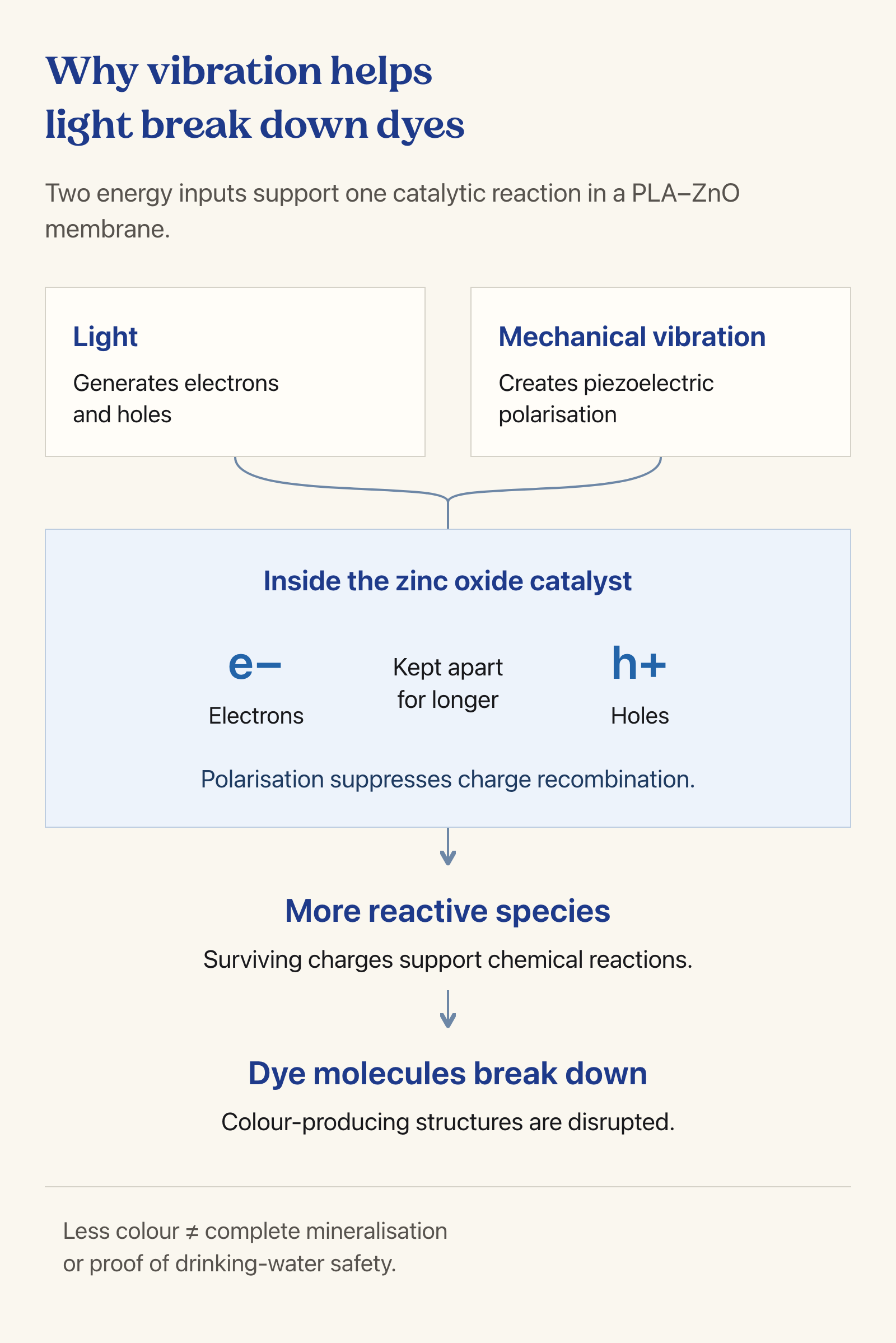
The reported advantage comes from preserving useful electrical charges long enough to drive chemical reactions, with two energy inputs supporting the same catalytic process.
- Under light excitation, the catalyst generates electrons and holes. These charge carriers can participate in reactions that form reactive species, but their usefulness falls when they recombine before contributing to pollutant breakdown.
- Mechanical vibration produces piezoelectric polarisation in the material. The reported experiments used ultrasonic excitation alongside light; ordinary water flow should not be assumed to reproduce the same controlled laboratory energy input.
- The resulting polarisation suppresses electron–hole recombination, according to the researchers. More surviving charges support reactive-species formation, explaining why combining the inputs can improve the catalytic response rather than merely shaking the water.
- Reactive species attack dye molecules and can disrupt the structures responsible for their colour. The mechanism explains the decolorisation result, but identifying every reaction product requires separate chemical analysis of the treated liquid.
- Machine learning connected conditions such as illumination, treatment time, catalyst amount and dye concentration with experimental decolorisation behaviour. Its role was prediction within the study, not an autonomous system that physically removes pollutants.
What the Results Establish and What They Leave Open
The strongest reading is a promising laboratory mechanism with clear next tests, not a claim that visibly clearer water has become safe for unrestricted use.
- Decolorisation measures the disappearance of colour. Mineralisation means much more extensive conversion of organic pollutants into simple inorganic end products; high colour removal alone cannot demonstrate that this endpoint has been reached.
- Toxicity can depend on transformation products as well as the original dye. Assessing treated effluent requires examining residual compounds and biological effects, rather than using transparency or a colour-removal percentage as a safety certificate.
- Real industrial effluent contains mixtures that differ from controlled dye solutions. Competing substances, changing concentrations and operating conditions can alter performance, so laboratory results should not be presented as guaranteed outcomes at textile facilities.
- Energy demand matters because the experiment combines light with ultrasound. Practical assessment must compare treatment benefits with the electricity required, while testing catalyst durability, membrane fouling and performance across repeated treatment cycles.
- PLA biodegradability is not a licence to discharge the composite into waterways. End-of-life assessment must consider disposal conditions and the embedded zinc oxide separately, including potential release during use and after the membrane is discarded.
Way Forward
Test the Whole Treatment Outcome
- Measure transformation products and residual toxicity alongside colour removal before making water-quality claims.
- Run real-effluent trials with repeated cycles, particle-release measurements and membrane-fouling checks.
- Compare energy use and treatment cost against established processes at equivalent effluent-quality endpoints.
Conclusion
- The study illustrates how material design and complementary energy inputs can address charge recombination and catalyst recovery together. Its educational value lies in the mechanism, not in treating one laboratory metric as universal success.
- In an answer on environmental nanotechnology, connect the innovation to its verification burden: dye decolorisation, pollutant destruction, toxicity reduction and practical deployment are related but separate claims requiring their own evidence.
UPSC Practice Questions
Prelims MCQ 1
With reference to the PLA–ZnO membrane research, consider the following statements:
- Mechanical excitation can generate piezoelectric polarisation.
- Immobilising a catalyst can assist its recovery from treated water.
- High dye decolorisation necessarily proves complete mineralisation.
How many of the above statements are correct?
(a) Only one (b) Only two (c) All three (d) None
Answer: (b) Only two
Explanation:
The first two statements describe the reported mechanism and design. Colour removal alone does not prove complete mineralisation.
Prelims MCQ 2
What was the role of machine learning in the reported study?
(a) Replacing the zinc oxide catalyst (b) Certifying drinking-water safety (c) Predicting dye-decolorisation behaviour from experimental parameters (d) Generating ultrasonic energy without electricity
Answer: (c) Predicting dye-decolorisation behaviour from experimental parameters
Explanation:
Machine learning predicted experimental behaviour; the physical treatment relied on the membrane, light and mechanical excitation.
UPSC Mains Questions
- Explain how combining photocatalysis and piezoelectric effects can improve pollutant treatment. What separates a laboratory result from a viable wastewater-treatment technology?
- Why is decolorisation insufficient to establish the environmental safety of treated industrial effluent? Discuss appropriate evidence for evaluating catalytic membranes.
Source: PIB, Ministry of Science & Technology.
Frequently Asked Questions
What is the PLA–ZnO membrane?
It is a porous nanofibre membrane combining polylactic acid with zinc oxide nanoparticles. INST Mohali researchers used it to study dye treatment under combined light and mechanical excitation.
Why add mechanical vibration to light?
Mechanical excitation generates piezoelectric polarisation that suppresses electron–hole recombination. This supports reactive-species formation, allowing more of the light-generated charges to contribute to the catalytic reaction in the reported study.
Does removing dye colour make water safe to drink?
No. Decolorisation is a specific experimental result, not a drinking-water safety test. Residual pollutants, transformation products, toxicity and other water-quality requirements need separate assessment before any such claim is justified.
Did artificial intelligence treat the water?
No. Machine learning predicted decolorisation behaviour from experimental parameters. The treatment mechanism remained physical and chemical, involving the composite membrane, illumination, mechanical excitation and the resulting reactive species.
Source: https://anantamias.com/current-affairs/zno-pla-membrane-light-vibration-dye-treatment/