Daily Digest
UPSC · Civil Services Examination
Current Affairs · Monday, 18 August 2025
Current affairs curated and edited by Anantam IAS faculty — pulled from The Hindu, PIB, IDSA, Foreign Affairs and the ministries. Read, annotate, revise.
Old Rajinder Nagar · Delhi 110005 · anantamias.com
Vice-President Election(Part v- The Union)
Article 63: The Vice-President of India.—There shall be a Vice-President of India.

Why in news:
Maharashtra Governor C.P. Radhakrishnan was chosen as the National Democratic Alliance’s Vice Presidential candidate, after a meeting of the BJP Parliamentary Board.
UPSC Relevance:
Parliament and State legislatures—structure, functioning, conduct of business, powers & privileges and issues arising out of these.
UPSC PYQ:
Consider the following statements
- The Chairmen and the Deputy Chairman of the Rajya Sabha are not the members of that House.
- While the nominated members of the two Houses of the Parliament have no voting right in the presidential election, they have the right to vote in the election of the Vice President.
Which of the statements given above is/are correct?
A) 1 only
B) 2 only
C) Both 1 and 2
D) Neither 1 nor 2
Vice President election process:
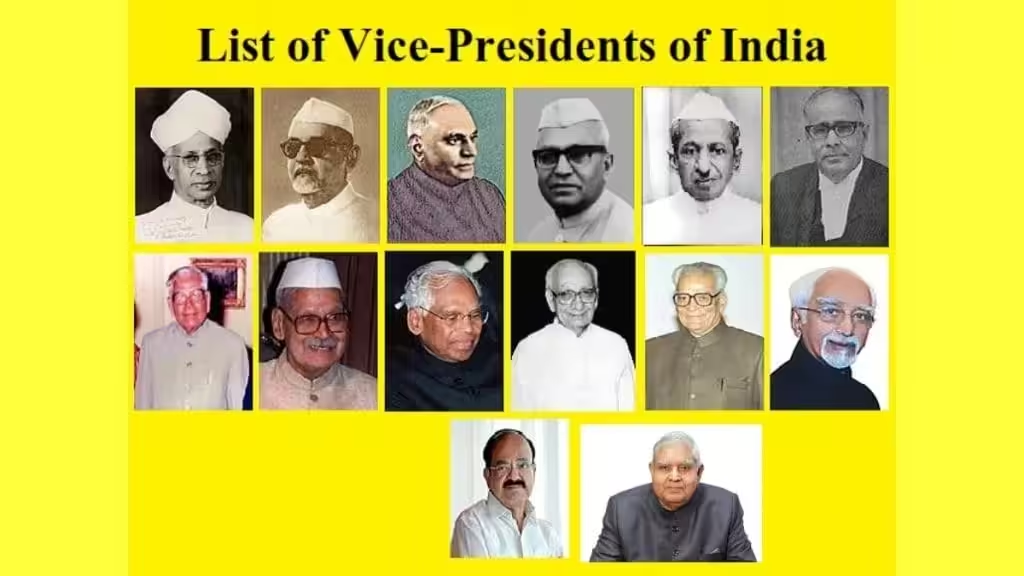
Article 66: Election of Vice-President.
- The Vice-President shall be elected by the members of an electoral college consisting of the members of both Houses of Parliament in accordance with the system of proportional representation by means of the single transferable vote and the voting at such election shall be by secret ballot.
- The Vice-President shall not be a member of either House of Parliament or of a House of the Legislature of any State, and if a member of either House of Parliament or of a House of the Legislature of any State be elected Vice-President, he shall be deemed to have vacated his seat in that house on the date on which he enters upon his office as Vice-President.
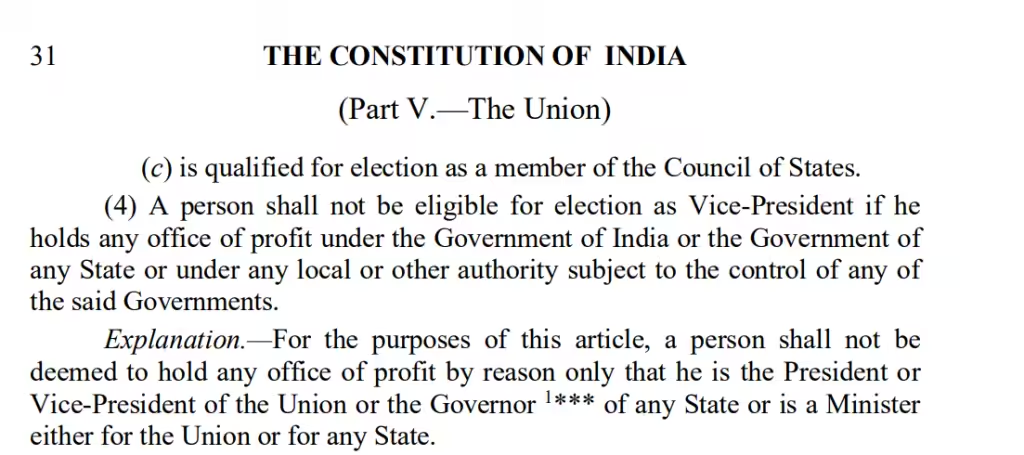
- A person shall not be eligible for election as Vice-President if he holds any office of profit under the Government of India or the Government of any State or under any local or other authority subject to the control of any of the said Governments.
Eligibility:
- is a citizen of India
- has completed the age of thirty-five years
- is qualified for election as a member of the Council of States
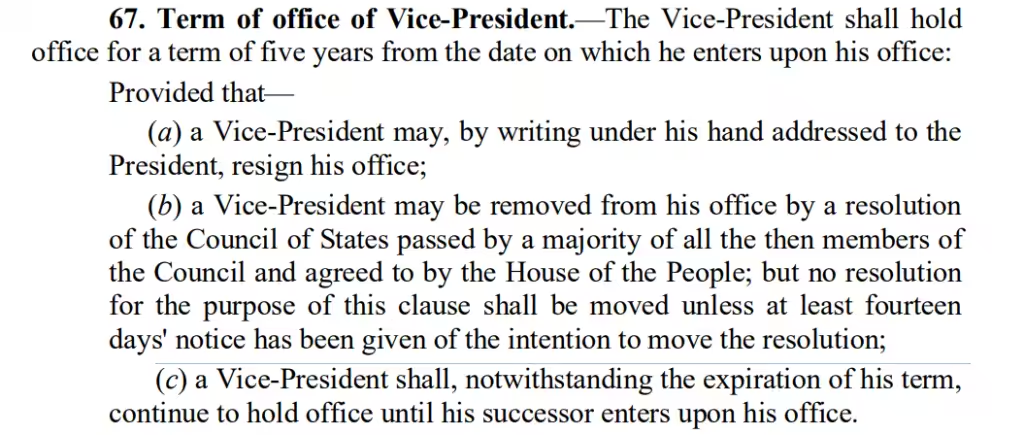
Term of office of Vice-President: Article 67
The Vice-President shall hold office for a term of five years from the date on which he enters upon his office: Provided that—
(a) a Vice-President may, by writing under his hand addressed to the President, resign his office
(b) a Vice-President may be removed from his office by a resolution of the Council of States passed by a majority of all the then members of the Council and agreed to by the House of the People; but no resolution for the purpose of this clause shall be moved unless at least fourteen days’ notice has been given of the intention to move the resolution;
(c) a Vice-President shall, notwithstanding the expiration of his term, continue to hold office until his successor enters upon his office.
Oath or affirmation by the Vice-President: Article 69
Every Vice President shall, before entering upon his office, make and subscribe before the President, or some person appointed in that behalf by him, an oath or affirmation in the following form, that is to say—

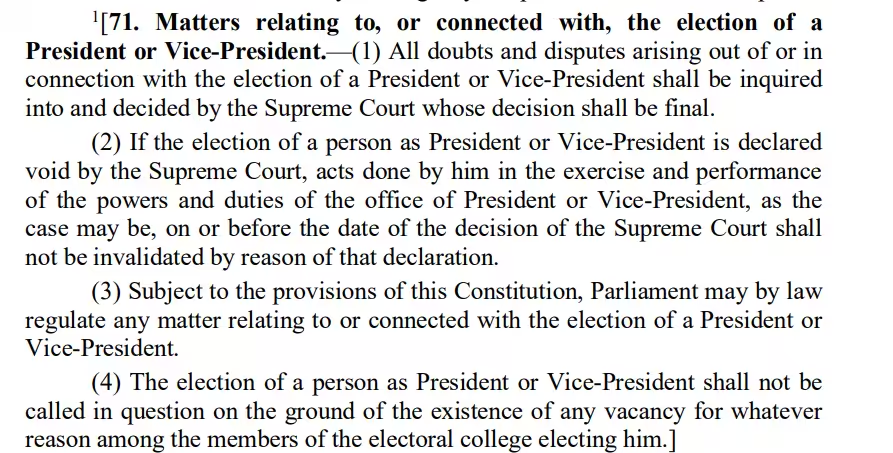
Article 71:
Vice-President’s role as Chairman of the Rajya Sabha:
- As Chairman of Rajya Sabha, the Vice President is the final authority on the interpretation of the Constitution and the Rules of Procedure for all house-related matters. His rulings constitute binding precedent. He also determines whether a Rajya Sabha member stands to be disqualified on grounds of defection. Such powers make him an important stakeholder in the functioning of our parliamentary democracy.
- The Vice President is also vested with powers to improve the functioning of the Upper House. There have been several instances where the current Vice President has used his powers to address issues ranging from improving the productivity of question hour, reducing prolonged disruptions, maintaining decorum in the House, to facilitating discussion on issues of national importance.
Role in Parliamentary Committees and other institutions
Parliamentary committees review proposed laws, oversee activities of the executive, and scrutinise government’s expenditure. The Vice President nominates members to various Parliamentary Committees, appoints their Chairmen and issues directions to them. The Vice President also nominates members of the Rajya Sabha on various bodies such as the Haj Committee, the Institute of Constitutional and Parliamentary Studies, Courts of several universities such as JNU, etc. He is also on the three-member Committee which nominates the Chairman of the Press Council of India.
Source: https://anantamias.com/current-affairs/vice-president-electionpart-v-the-union/
Honour Killings

Why in news:
Multiple cases of Honour Killing recently have been attributed to rigid social hierarchies and patriarchy by experts.
UPSC Relevance:
GS 1, Salient features of Indian Society – Caste Hierarchies and Patriarchy, Role of Women and Women’s Organization – Empowerment of Women, Freedom to choose partner. UPSC has shown interest in societal evils and structures, their causes and evolution in recent times.
PYQ:
2024 – Intercaste marriages between castes which have socio-economic parity have increased, to some extent, but this is less true of interreligious marriages. Discuss.
2023 – Do you think marriage as a sacrament is losing its value in Modern India?
What is so honorable in Honour Killing?
- Honour crimes are acts of violence, usually murder, mostly committed by family members predominantly against female relatives, who are perceived to have brought dishonour upon the family.
- Honour killings are rooted in outdated traditions and social values where women are considered to be the embodiment of family’s, caste’s, religion’s, honour and dignity or Ghar ki Ijjat as it is usually called.
- Any detour from the set path, conduct, hierarchies and boundaries that violates this honour comes with consequences often costing lives.
- The purpose is to set an example for others to not dare to violate the laid boundaries and hierarchies.
Multiple Cases in Past Month:
- Kavin Selvaganesh Case (Tamil Nadu) – This case, which sparked outrage and demands for a specific law on honor killings, involves a 27-year-old Dalit engineer named Kavin who was allegedly murdered by his girlfriend’s family. His crime was falling in love with a woman from a dominant caste.
- Gujarat NEET Aspirant Case (Gujarat) – An 18-year-old woman, who had cleared the NEET exam and was on her way to pursuing a medical career, was allegedly killed by her father and uncle. The motive was their disapproval of her being in a live-in relationship with her boyfriend. This case underscores how family “honor” is prioritized over a woman’s right to life, education, and personal freedom.
- Bihar Nursing Student Case (Bihar) – A 25-year-old nursing student was shot dead in a hospital in front of his wife, allegedly by her father. The couple was in an inter-caste marriage, which the girl’s family had opposed. The victim’s wife reported that her father had previously threatened them and that they had even filed a formal complaint with the court to preempt a potential attack. This case demonstrates how even in the face of legal protection and warnings, family violence can be carried out with impunity.
Why Does Honour Killing Continue?
Non acceptance of Inter-caste and Inter-religious Marriages – This is the most common cause. Families and communities, particularly in rural areas, believe that marrying outside of one’s caste or religion “pollutes” their bloodline and dishonours their family’s social standing.
- Caste as a deeply entrenched Social Phenomenon makes it difficult to accept Inter caste Marriages – highlighted by author
- Caste in India is a deeply ingrained social structure, not just an individual issue.
- It is perpetuated and legitimized by families, communities, and social systems through everyday customs and traditions.
- Children are made to internalize caste boundaries early on, which makes the system highly resilient.
- The family is the primary vehicle for transmitting caste across generations, not just political parties or organizations.
Non acceptance of Intra-caste and Gotra Marriages: In some communities, particularly in northern states like Haryana, marriages within the same clan (gotra) are forbidden, as it’s considered incestuous. People who violate this custom, even if they’re of the same caste, can face violence from so-called “Khap Panchayats” (caste councils) and family members.
Exercise of Sexual Autonomy by Females : A woman’s sexual behaviour is often seen as a reflection of her family’s honour. This leads to killings for a variety of reasons, including:
- Having a pre-marital or extra-marital relationship.
- Refusing an arranged marriage.
- Seeking a divorce or separation.
- Being a victim of rape or sexual assault.
Public morality prevailing over Constitutional Morality – violating Article 14, 19 and 21 of Constitution of India and violation of Special Marriage Act, 1954. Social vigilantism prevails over law and order.
Perception of impunity due to Social Collusion- the whole society works together to cover such acts in the name of maintaining social morality and it becomes difficult to punish the perpetrators.
Lack of Political Will – Politicians rarely talk about and address such issues due to sensitivity of caste and religion matters and possible effects on their vote bank.
Honour Killing despite Social mobility and Empowerment as it is seen as a challenge to the existing hierarchies and hidden pride – highlighted by author
- Access to education and meaningful employment for marginalized communities, particularly Dalits, challenges the rigid caste system. This empowerment leads to increased interaction and relationships across caste lines, especially inter-caste marriages.
- Inter-caste unions, particularly between Dalit men and dominant-caste women, are a direct challenge to centuries-old hierarchies and are often met with extreme violence.
- States with higher rates of Dalit empowerment and inter-caste marriages, such as Tamil Nadu, Telangana, and Kerala, also ironically have higher rates of “honour” killings.
- The online glorification of caste stems from a fear of losing inherited power and a deep anxiety about cultural change.
- Everyday customs, marriage arrangements, and inherited prejudices within the family ensure caste’s survival despite rising education and urbanization.
- The Paradox of Tamil Nadu
- Tamil Nadu presents a paradox where a strong public consciousness against casteism coexists with hidden, private caste pride.
- The state has a vibrant civil society opposing caste killings in strong voices, but social media platforms are also used to anonymously defend them.
- This reflects a society that is collectively progressive but individually conflicted, living in a space between tradition and transformation.
Underreporting Challenge:
- Since “honour killing” is not a crime classified separately under the Indian laws, no data is collected separately regarding this crime by the National Crime Records Bureau, and the same is covered under ‘murder’.
- Moreover, it is difficult to identify or classify an honour killing as such in any given community, since the reasons for such killings often remain a closely guarded private family matter. These crimes are often disguised as suicides or accidents.
- According to a 2021 NCRB report, 33 honour killings were recorded in that year.
- In contrast, NGOs and human rights groups often report much higher numbers. For example, the NGO Evidence reported 195 honour killings in the state of Tamil Nadu alone between 2014 and 2019, while official NCRB data for the same period was significantly lower. This discrepancy highlights the scale of the problem and the challenges in accurately documenting it.
Judicial Interventions:
| Case Law | Key Ruling & Significance |
| Bhagwan Dass v. State (NCT of Delhi) (2011) | In this case, the Supreme Court sentenced a father to death for the honor killing of his daughter. The court ruled that honor killings fall into the category of “rarest of rare” cases, deserving the death penalty. It highlighted that such killings are premeditated murders rooted in a feudal mindset and are a “blot on our nation.” The court firmly rejected any defense of “grave and sudden provocation” in such cases. |
| Arumugam Servai v. State of Tamil Nadu (2011) | The Supreme Court not only affirmed convictions for a caste-related assault but also took the opportunity to strongly condemn honor killings and the actions of khap panchayats. The court reiterated that such bodies have no legal or moral authority and that any violence or harassment in the name of honor is illegal. The judgment further directed all state governments to ensure that officials take swift action against those who promote or engage in such practices. |
| Shafin Jahan v Ashokan K.M.(2018)Known as Hadiya Case | In the Hadiya case, the Supreme Court upheld the validity of Hadiya’s marriage to Shafin Jahan, asserting her right to choose her life partner and religion. The Court recognized the right to marry a person of one’s choice as a fundamental right under Article 21, Right to Life. |
| Shakti Vahini v. Union of India (2018) | The Supreme Court issued a comprehensive set of preventive, remedial, and punitive guidelines to combat honor killings. The court declared that khap panchayats or any other extra-constitutional body have no right to interfere in the marriage of two consenting adults. This case is pivotal for providing a concrete legal framework to address honor crimes. SC recognised freedom to choose life partner under Article 21, Right to Life. |
Supreme Court’s Guidelines to combat Honour KillingIn the Shakti Vahini v. Union of India (2018) case, the Supreme Court of India issued detailed guidelines to combat honor killings, which are seen as a violation of the fundamental rights to life, liberty, and personal dignity.
Preventive Measures:
- Identify Vulnerable Areas – State governments must identify districts, sub-divisions, or villages with a history of honor killings or khap panchayat gatherings.
- Increased Police Vigilance – Officers-in-charge of police stations in these identified areas must be extra cautious and vigilant, especially regarding inter-caste or inter-religious marriages.
- Immediate Action on Information – If a police officer or district official receives information about a proposed khap panchayat meeting, they must immediately inform their superiors.
- Prohibitory Orders – The Deputy Superintendent of Police (DSP) or a senior officer must personally interact with khap panchayat members to impress upon them that such meetings are illegal. If the gathering cannot be prevented and poses a threat, the DSP can propose invoking prohibitory orders under Section 144 of the Code of Criminal Procedure (CrPC).
- Video Recording – If a meeting proceeds despite warnings, the police must remain present and video-record the proceedings to document any unlawful decisions or threats.
Remedial Measures:
- 24/7 Helpline and Special Cells – State governments must create Special Cells in every district, comprising the Superintendent of Police, District Social Welfare Officer, and District Adi-Dravidar Welfare Officer, to receive and register complaints. These cells should operate a 24-hour helpline to provide necessary assistance and protection.
- Immediate FIR Registration – If a khap panchayat issues a diktat against a couple, the jurisdictional police must immediately lodge an FIR under the relevant provisions of the Indian Penal Code.
- Protection and Safe Houses – Police must provide security to the threatened couple or their family. If necessary, they should be moved to a safe house within the district or elsewhere. The government may consider establishing safe houses at district headquarters for this purpose, where couples can stay for a nominal charge.
- Prompt Investigation – The investigation of the crime must be conducted with promptness and supervised by a senior officer to ensure it reaches a logical conclusion.
Punitive Measures:
- Fast-Track Courts – Criminal cases related to honor killings or violence must be tried before designated Fast-Track Courts. The trial should proceed on a day-to-day basis and be concluded within six months from the date of taking cognizance of the offense.
- Liability for Conspiracy – Anyone, including members of khap panchayats, found to be involved in the conspiracy or abetment of honor crimes shall be held criminally liable.
- Action Against Negligent Officials – Any police or administrative official who fails to comply with the court’s directions will be deemed to have committed an act of deliberate negligence and misconduct. Departmental action must be initiated against them, to be completed within six months.
Other Steps to Combat Honour Killing:
- Social sensitization and awareness is very important to address the true roots of the problem which is the tendency to control women and men and their sexual agency to maintain rigid social hierarchies based on caste and religion as highlighted by the author.
- Legal Reform – Making honour killing a separate crime under Bhartiya Nyaya Sanhita. Law Commission in its 242nd report has recommended barring Khap Panchayat Members from contesting any election if they are found involved in any such crimes of social vigilantism.
- Reporting and Collecting Data – NCRB should maintain data regarding honour killing. Police officers must be sensitized to ensure that such cases are reported and not disguised.
- Honour Killings in 21st Century India not only violates the rights enshrined in the constitution but goes against the very dignity of human beings in any free and open society. Timely actions are needed to curb this heinous crime at the earliest. It will help us realise the Sustainable Development Goal 5 that aims to achieve Gender Equality by 2030.
Source: https://anantamias.com/current-affairs/honour-killings/
Grassland invaders stifle Assam’s island-like national park

UPSC Relevance:
UPSC has been asking questions on vegetation and plant species and their peculiar features.
PYQ: 2021
Which one of the following is used in preparing a natural mosquito repellent?
(a) Congress grass
(b) Elephant grass
(c) Lemongrass
(d) Nut grass
Study on Ecosystem Changes in Dibru-Saikhowa National Park:
A study titled “Grasslands in Flux” analyzed land use and land cover (LULC) changes in Dibru-Saikhowa National Park (DSNP) from 1999 to 2024. The findings were published in the peer-reviewed journal Earth.
Key Discovery – The study identified that two native flowering tree species, Bombax ceiba (Simalu – in Assamese) and Lagerstroemia speciosa (Ajar – in Assamese ), are acting as “invaders” alongside few well-known invasive alien species like shrub Chromolaena odorata , herb Parthenium hysterophorus and climber Mikania Micrantha.
- An invasive alien species refers to an alien species whose introduction and/or spread threatens the biological diversity of the region/habitat .
Contributing Factors to Ecosystem Changes- The primary reasons for the changes in DSNP’s ecosystem are:
- The spread of native and invasive plant species via humans and water.
- Recurring floods from the Brahmaputra River.
- Increasing human pressure from forest villages within the park’s boundaries.
Impact of Plant Invaders – They are altering the landscape, causing a decline in the park’s dominant grasslands.
Observed Land Cover Changes (1999-2024)
- In 2000, grasslands made up 28.78% of the park.
- By 2013, shrubland became the most prominent class, and degraded forest areas expanded.
- In 2024, degraded forest further increased to 23.47%, indicating a consistent decline in grassland and semi-evergreen forest areas.
- This indicates human induced ecological succession.
- Ecological succession is the gradual process of change in the species structure of an ecological community over time. It is a predictable and continuous process where one community of species is gradually replaced by another, until a stable ecosystem, known as a climax community, is established. However, anthropogenic factors may either pace up or slow down these natural processes.

Threat to Biodiversity – The shift in the landscape’s structure poses a significant threat to grassland-dependent fauna, many of which are already globally threatened. Species at risk include the Bengal florican [Houbaropsis benga-lensis], Hog deer [Axis porcinus], and swamp grass babbler [Prinia cine-rascens]. The park is also home to about 200 feral horses.
- A feral horse is a free-roaming horse of domesticated stock. Unlike a wild animal that has never been domesticated (like a tiger or a zebra), a feral horse’s ancestors were at one point domesticated by humans. The only truly wild horse species remaining in the world is the Przewalski’s horse (also known as the takhi) of Mongolia.
- In India, feral horses are primarily found in the Dibru-Saikhowa National Park in Assam. There is also a small population in the Point Calimere Wildlife and Bird Sanctuary in Tamil Nadu.
- The exact origin of the feral horses in Dibru-Saikhowa is debated, but the most widely accepted theory is that they are descendants of military horses abandoned by British and American troops after World War II.
Study Recommendations for Recovery – The study suggests a comprehensive grassland recovery project that includes:
Implementing LULC-based management to protect habitats and enhance the survival of native plants and animals.
- Controlling invasive species
- Improving surveillance
- Increasing staffing
- Relocating forest villages to reduce human impact
Dibru-Saikhowa National Park:

- Location and Status – Located in the Dibrugarh and Tinsukia districts, it’s a national park as well as a UNESCO Biosphere Reserve. It was declared a national park in 1999, two years after it received its biosphere reserve status. It’s also an Important Bird Area (IBA).
- Unique Habitat – It’s an island-like formation between the Brahmaputra and Lohit rivers to the north and the Dibru River to the south. This location makes it a riverine ecosystem prone to recurring floods, which have a significant impact on its landscape.
- It’s a mix of moist mixed semi-evergreen forests, tropical moist deciduous forests, and grasslands. It is considered the largest Salix swamp forest in northeastern India.
- Feral Horses – Dibru-Saikhowa is the only habitat for feral horses in India.
- Key Fauna – The park is a haven for many rare and endangered species. It was originally established to protect the white-winged wood duck. It is also home to the Gangetic river dolphin, hoolock gibbon, Bengal tiger, and numerous other mammals, reptiles, and fish.
Read more about invasive species : Water Hyacinth – The terror of Bengal
Source: https://anantamias.com/current-affairs/grassland-invaders-stifle-assams-island-like-national-park/