Daily Digest
UPSC · Civil Services Examination
Current Affairs · Saturday, 25 April 2026
Current affairs curated and edited by Anantam IAS faculty — pulled from The Hindu, PIB, IDSA, Foreign Affairs and the ministries. Read, annotate, revise.
Old Rajinder Nagar · Delhi 110005 · anantamias.com
RBI cancels the Banking Licence of Paytm Payments Bank
Why in News?
The Reserve Bank of India (RBI) has cancelled the banking licence issued to Paytm Payments Bank Limited under Section 22(4) of the Banking Regulation Act, 1949.
The RBI will make an application to the High Court for the winding up of the bank.
| UPSC Relevance: GS-3 Economy: Banking and Monetary Policy Prelims: Key facts related to Payments Banks |
Paytm Payments Bank Limited is prohibited from conducting the business of ‘banking’ as defined in Section 5(b) or any additional business specified under Section 6 of the Banking Regulation Act, 1949, with immediate effect.
Why was the license cancelled?
Paytm Payments Bank was not complying with certain norms of the Banking Regulation Act, 1949.
- The bank’s affairs were conducted in a manner detrimental to the interests of the bank and its depositors.
- The general character of the management of the bank is prejudicial to the interest of depositors as well as the public interest.
- The bank failed to comply with the conditions stipulated in the Payments Bank license issued to it.
Paytm app, Paytm UPI, Paytm QR, Soundbox, card machines and Payment Gateway, will continue to operate uninterrupted despite regulatory action against Paytm Payments Bank Limited.
What are Payments Banks?
- Payments Banks are a specialised, differentiated category of banks licensed by the Reserve Bank of India (RBI) under Section 22 of the Banking Regulation Act, 1949.
- Conceptualised on the recommendation of the Nachiket Mor Committee on Comprehensive Financial Services (2014).
- Rationale: To provide basic banking services (primarily payments and remittances) to underserved populations.
- The banks accept deposits and facilitate payments, but cannot undertake lending activities.
Key facts related to Payments Banks:
| Criteria | Payments Bank |
| Registration | registered as a public limited company under the Companies Act, 2013. |
| Licensing | granted a banking license by the RBI under Section 22 of the Banking Regulation Act, 1949. |
| Minimum Paid-up Capital | ₹100 crore |
| Deposit Limit per Customer | ₹2 lakh |
| Activities Permitted | • Accept demand deposits up to ₹2 lakh per customer. • Issue debit cards and prepaid payment instruments. • Provide internet banking and mobile banking services. • Offer remittance and money transfer services. • Distribute mutual funds, insurance & pension products. • Act as Business Correspondents (BCs) of other banks. • Sell government securities & treasury bills |
| Activities Prohibited | • Cannot issue credit cards or extend loans. • Cannot accept time deposits (FDs/RDs). • Cannot set up subsidiaries to undertake NBFC activities. • Cannot lend to individuals or businesses directly. • Cannot hold Non-Resident Indian (NRI) deposits |
| Eligible Promoters (entities or individuals permitted by RBI to establish and own Payments Banks) | Telecom companies, NBFCs, corporate entities, public sector entities, and individuals |
| FDI Limit | Up to 74% (as per private sector bank norms) |
| Deposit Insurance | Applicable (covered under DICGC) |
| SLR Requirement | maintain at least 75% of their deposits in government securities or treasury bills with a residual maturity of up to one year. |
| Priority Sector Lending (PSL) Norms | Not applicable |
| Basel III norms | Not applicable |
| Examples | Airtel Payments Bank; India Post Payments Bank; Jio Payments Bank |
Role in Financial Inclusion:
- Last-Mile Outreach: Financial inclusion in remote villages, serving farmers, MNREGA workers, and pensioners. E.g., India Post Payments Bank backed by the postal network.
- Distribution channels for financial products: Selling insurance, micro-pension schemes like APY (Atal Pension Yojana), and mutual fund units to first-time investors who lack access to full-service branches.
- Digital Payments Infrastructure: Payments Banks have been central to expanding UPI adoption, mobile wallets, and digital payment literacy among low-income households and migrant workers.
- Remittance gateways: Payments Banks have created efficient, low-cost domestic remittance corridors, enabling migrants to send money home affordably and safely.
Challenges facing Payments Banks:
- Unviable Business Model:
- Payments Banks are prohibited from lending, which eliminates their primary source of revenue (interest income).
- With 75% of deposits mandatorily parked in low-yield government securities, net interest margins are thin.
- Revenue depends almost entirely on transaction fees, remittance charges and cross-selling commissions (insurance, mutual funds), which are insufficient to sustain the high costs of customer acquisition and technology infrastructure.
- Low Deposit Cap& Low Engagement:
- With the deposit limit capped at ₹2 lakh per customer, Payments Banks struggle to retain customers as their financial needs grow.
- Low engagement from the “last-mile” customer (primary target). This often traps banks in a high-compliance, low-return equilibrium.
- Competition from UPI & Fintechs has eroded the core payments differentiation and the unique value proposition that Payments Banks once held.
- Regulatory & Compliance Burden: The regulatory compliance cost on payments banks is exceptionally high relative to their restricted revenue streams. Often, banks resort to cutting corners on compliance to remain profitable, which creates a governance-viability issue.
Practice MCQ:
Q. Consider the following statements regarding Payments Banks:
1. At least 75% of their demand deposit balances must be invested in government securities.
2. They can accept deposits from Non-Resident Indians (NRIs).
3. They are required to maintain the Cash Reserve Ratio (CRR) with the Reserve Bank of India.
Which of the statements given above is/are correct?
(a) 1 and 3 only
(b) 1 only
(c) 2 and 3 only
(d) 1, 2 and 3
Answer: (a)
UPSC PYQ 2016
Q. The establishment of ‘Payment Banks’ is being allowed in India to promote financial inclusion. Which of the following statements is/are correct in this context?
1. Mobile telephone companies and supermarket chains that are owned and controlled by residents are eligible to be promoters of Payment Banks.
2. Payment Banks can issue both credit cards and debit cards.
3. Payment Banks cannot undertake lending activities.
Select the correct answer using the code given below.
(a) 1 and 2 only
(b) 1 and 3 only
(c) 2 only
(d) 1, 2 and 3
Answer: (b)
Source: https://anantamias.com/current-affairs/rbi-cancels-the-banking-licence-of-paytm-payments-bank/
Kuki-Naga conflict rages in Manipur
Why in News?
The ongoing conflict between the Kuki and Naga communities in Manipur has escalated, resulting in multiple deaths and retaliatory attacks. The Naga community (neutral since 2023) has now been drawn into the conflict, transforming Manipur’s bilateral Meitei-Kuki crisis into a three-way ethnic flashpoint.
The 2023 High Court order on Scheduled Tribe status for Meiteis was the proximate trigger of violence in Manipur, as tribal groups feared loss of their protected reservations in jobs, education, and land.
| UPSC Relevance: GS-3 Internal Security: Insurgency and linkages with organised crime. Prelims: Key Constitutional & Statutory Provisions. Mains: Internal Security issue in Manipur. |
Ethnic Communities in Manipur:
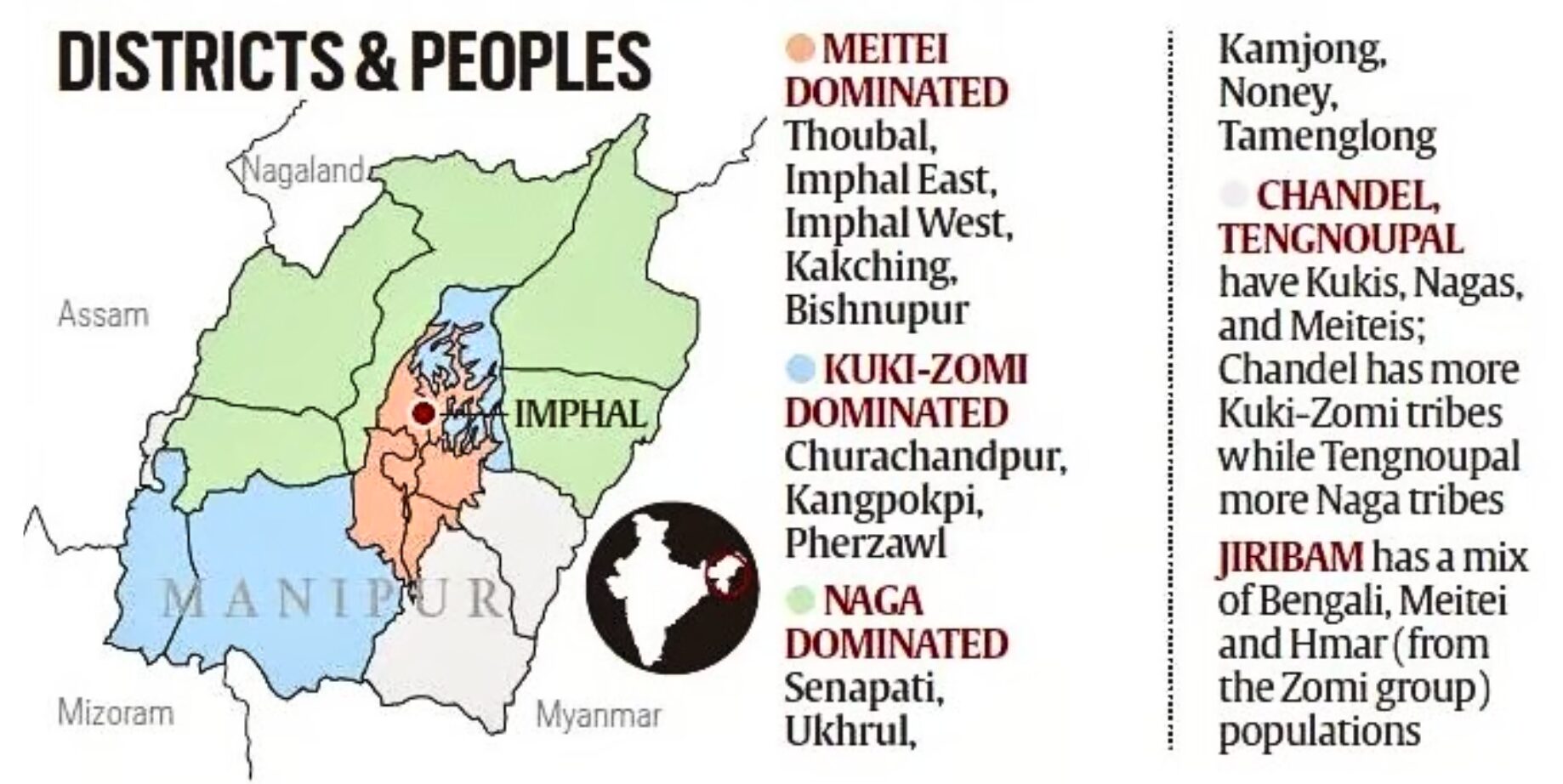
Manipur is home to three broad ethno-cultural groups with distinct geographies, languages, and political aspirations:
- Meiteis: Constitute ~53% of the state’s population, largely Hindu and non-tribal. They inhabit the Imphal Valley and dominate the legislature and bureaucracy. They have long sought Scheduled Tribe (ST) status to access forest land and government benefits in hill areas.
- Kuki-Zo Tribals: A cluster of tribes (Kuki, Zo, Hmar, Mizo-related groups) with roots in the Chin-Kuki-Mizo ethno-linguistic family. They inhabit the southern and western hill districts. Their demand for a separate Kukiland / Zomi homeland carved out of Manipur has intensified after the 2023 violence. Many allege they face existential threats from Meitei ST demands and state-backed evictions from “reserved forests.”
- Nagas: Comprising multiple tribes (Tangkhul, Mao, Maram, Zeme, etc.), Nagas dominate the northern and eastern hill districts. They have historically pursued Naga political sovereignty through bodies like NSCN (IM) and share contested border territory with both Meiteis and Kukis.
Factors Behind the Conflict in Manipur:
- ST Status demand of Meiteis: The April 2023 Manipur HC order on Meitei ST status shattered the post-independence compact that gave tribal communities exclusive land and job protections in the hills, while keeping Meiteis confined to the valley.
- Forest Land & Evictions: State-ordered evictions of Kuki-Zo settlers from “protected forests” created deep resentment and a narrative of land dispossession that has fuelled armed mobilisation.
- Hill-Valley Constitutional Asymmetry: Manipur’s hills are not under the 6th Schedule (unlike Assam, Meghalaya, and Mizoram), denying tribal communities an Autonomous District Council. Article 371(C) is widely viewed as insufficient protection. This structural gap means hill communities have no institutional safety valve, forcing grievances into armed channels.
- Ungoverned Armed Groups: Dozens of armed outfits (NSCN-IM, KNF, Arambai Tenggol, Meitei Leepun) operate across ethnic lines. The proliferation of looted state weapons (700+ from police armouries) since 2023 has militarised the conflict.
- Kuki-Naga Territorial Disputes: Kuki and Naga villages in border districts contest village boundaries, forest rights, and administrative jurisdiction — a legacy grievance now exploding into direct violence.
- Political Neglect and Misgovernance: The state government’s alleged partisan handling of violence, absence of dialogue, failure to restore normalcy, and the Centre’s delayed invocation of Article 355 mechanisms have widened the fault lines.
- Cross-Border Ethnic Linkages: Kuki-Zo communities have ethnic kin in Myanmar’s Chin State, and Nagas around the India-Myanmar border. The Myanmar civil war since 2021 has increased the influx of arms, refugees, and sympathetic foreign fighters into Manipur’s hills.
- Economic Marginalisation: Poppy cultivation, drug trafficking via the “Golden Triangle” route, and blockade-led economic disruptions have created an illicit economy in which armed groups are the primary employers for hill youth.
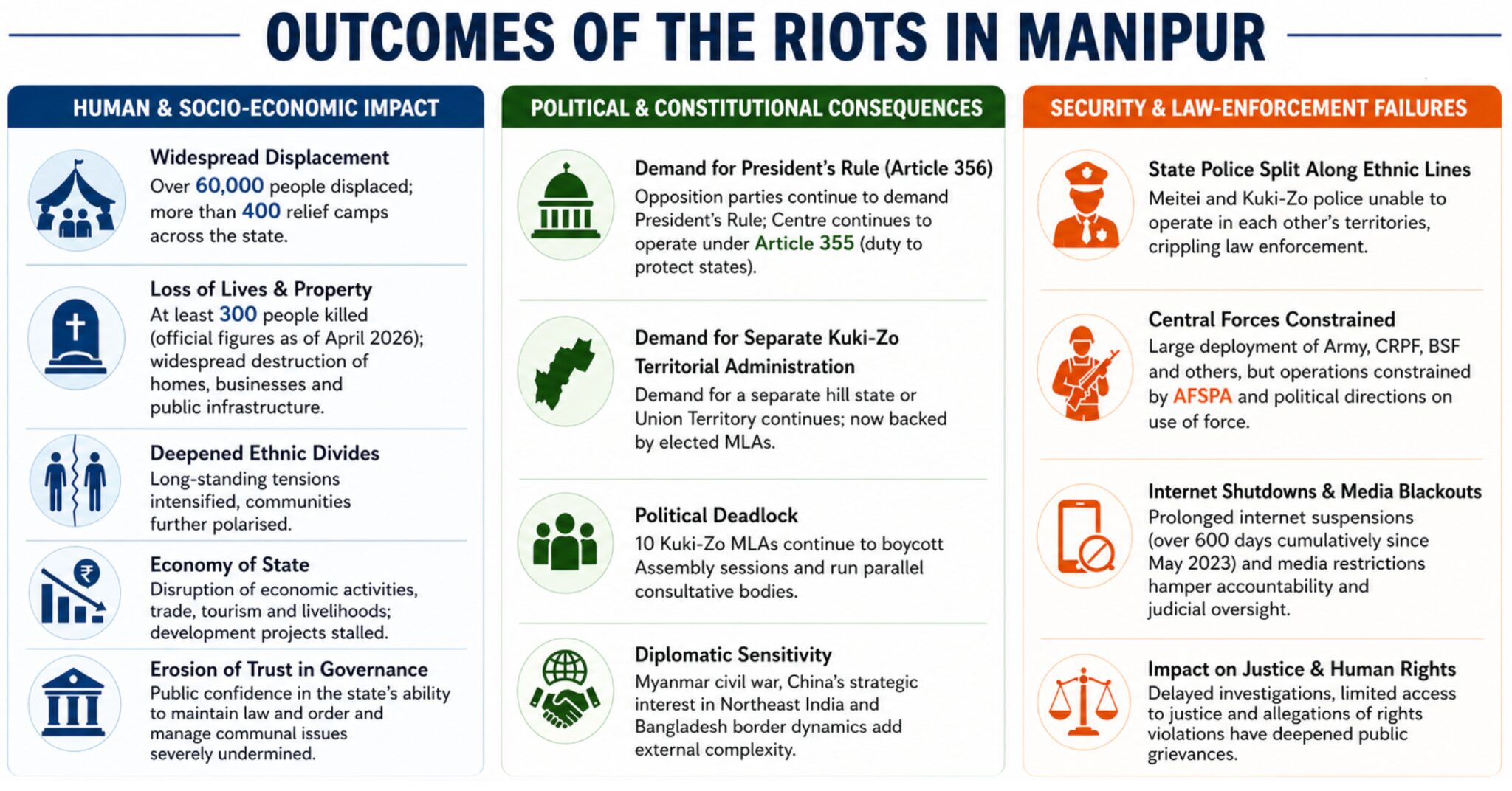
Outcomes of the Riots in Manipur:
Way Forward:
- Structured Political Dialogue: Convene a tripartite dialogue between Meitei, Kuki-Zo, and Naga leadership under Central mediation (similar to Assam’s Bodo peace process). Include elected representatives, civil society, and women’s groups.
- Revisit Governance: Examine the extension of the 6th Schedule to Manipur’s hill districts to provide Autonomous District Councils with legislative and judicial powers. The long-pending demand could address constitutional asymmetry at the root of tribal insecurity.
- Transparent Land & Forest Rights: Conduct a credible, tri-community survey of forest and village boundaries. Operationalise the Forest Rights Act impartially to resolve the Kuki-Naga village boundary disputes and the eviction grievances.
- Rehabilitation: The Central-funded State Rehabilitation Authority should oversee the safe return of over 60,000 Internally Displaced Persons, the construction of houses, and community reconciliation.
- Address Myanmar Linkage: Strengthen border management; create a regulated humanitarian corridor for genuine Chin refugees while preventing arms flow. Engage Myanmar’s shadow government on cross-border ethnic issues.
- Economic Integration: Fast-track the Act East Policy infrastructure projects (NH-2, Moreh trade corridor) to create economic stakes for peace. Special employment schemes targeting hill youth to reduce dependency on armed groups.
- Judicial Oversight: Lift internet shutdowns, allow independent media access, and facilitate the Supreme Court-monitored probe into human rights violations by all sides to restore faith in the rule of law.
The government should explore utilising Consociationalism in Manipur. Consociationalism is a power-sharing model with guaranteed representation for each ethnic community in the executive, legislature, and security forces. This addresses the zero-sum nature of majoritarian politics.
Key Constitutional & Statutory Provisions:
| Article 355 mandates the Union to protect states from external aggression and internal disturbances. It serves as a directive obligation and forms a basis for Central intervention (such as sending paramilitary forces) without immediately imposing President’s Rule under Article 356. |
| Article 356 authorises the President to impose President’s Rule on a state if its government cannot function according to constitutional provisions. |
| 5th vs 6th Schedule: Tribal areas of Manipur’s hills are NOT under the 6th Schedule (unlike Assam, Meghalaya, Mizoram). This is a key grievance as Kuki-Zo tribals demand 6th Schedule or equivalent autonomous council protection. |
| Article 371(C): Provides special provisions to preserve the cultural, social, and administrative identity of the tribal communities in the hilly parts of Manipur. • The President is empowered to form the Hill Areas Committee (HAC) of MLAs from designated hill areas in Manipur to oversee policy and development, protecting tribal interests. • The Governor is given special responsibility to ensure the proper functioning of this committee. The Governor is required to report annually (or as requested) to the President regarding the administration of the hill areas. |
| The Inner Line Permit (ILP) regime was officially extended to Manipur in 2019, primarily to regulate the entry of outsiders and protect the indigenous population. ILP does not resolve and is not designed to address the underlying conflicts between the indigenous communities. |
| AFSPA, 1958: The Armed Forces (Special Powers) Act remains in force in parts of Manipur to maintain security. It grants armed forces special powers but is seen by tribal groups as enabling impunity. |
UPSC Mains PYQ 2025
Q. What are the major challenges to internal security and the peace process in the North-Eastern States? Map the various peace accords and agreements initiated by the government in the past decade. (15 M)
Source: https://anantamias.com/current-affairs/kuki-naga-conflict-rages-in-manipur/